The Hyundai Ioniq 9 enters the 2026 model year as the automaker's flagship three-row electric SUV, built on the E-GMP platform with a massive 110.3 kWh battery and 800V architecture. The mid-tier SEL trim occupies the sweet spot for most buyers, adding luxury and tech over the base SE without the six-figure aspirations of the Calligraphy. After spending time with the specs and cross-referencing EPA data, here's what the Ioniq 9 SEL actually delivers to your driveway.
2026 Hyundai Ioniq 9 SEL at a Glance
| Spec | Value |
|---|---|
| EPA Range (RWD) | 311 miles |
| EPA Range (AWD) | 290 miles (est.) |
| Battery Capacity | 110.3 kWh usable (NMC) |
| Peak DC Fast Charge | ~240 kW (800V architecture) |
| 10–80% DC Charge Time | ~24 minutes |
| Level 2 Home Charge Rate | 10.9 kW (~35 mi/hr) |
| 0–60 mph (RWD) | ~7.0 seconds |
| 0–60 mph (AWD Dual-Motor) | ~5.5 seconds |
| Horsepower (RWD / AWD) | 215 hp / 338 hp |
| Drivetrain | RWD standard, AWD optional |
| Efficiency (RWD) | 89 MPGe combined / 38 kWh/100 mi |
| Base MSRP (SEL RWD) | $59,895 |
| As-Tested (SEL AWD w/ options) | ~$65,500 |
| Battery/Powertrain Warranty | 10 years / 100,000 miles |
| Seating | 6-passenger (2nd-row captain's chairs) or 7-passenger |
Range and Efficiency: EPA Numbers vs. the Real World
The Ioniq 9 SEL with rear-wheel drive carries an EPA-estimated 311 miles of range, making it one of the longest-range three-row electric SUVs on the market. The dual-motor AWD variant drops to approximately 290 miles, still competitive against the Kia EV9 and well ahead of the Rivian R1S in comparable trim.
EPA 311 mi (RWD) / ~290 mi (AWD). Expect 250–275 miles on sustained highway driving at 70+ mph, and 220–250 miles in sub-30°F winter conditions without preconditioning. The 110.3 kWh battery provides a large buffer, but this is a 5,000+ lb SUV — efficiency drops noticeably at speed and in cold weather. City/regenerative driving can push closer to or slightly above the EPA sticker.
The RWD model achieves an estimated 89 MPGe combined (roughly 38 kWh per 100 miles), which is respectable for a vehicle of this size. AWD drops efficiency to roughly 82 MPGe. For context, that's about $0.11–$0.14 per mile on the national average electricity rate of $0.17/kWh — roughly half the per-mile fuel cost of a comparable gas-powered three-row SUV getting 22 MPG combined.
Charging Speed: 800V Architecture Pays Off
Hyundai's 800V E-GMP platform remains one of the best in the business for DC fast charging. The Ioniq 9 supports a peak charge rate of approximately 240 kW at a compatible 350 kW DC fast charger (Electrify America, EVgo, or Tesla Supercharger via the included NACS adapter for 2026 models).
| Charging Level | Power / Rate | Speed / Time |
|---|---|---|
| Level 1 (120V household) | ~1.4 kW | ~4 miles per hour |
| Level 2 (240V home, 48A) | 10.9 kW | ~35 miles per hour (full charge ~11 hrs) |
| DC Fast Charge (350 kW station) | Peak ~240 kW | 10–80% in ~24 minutes |
| DC Fast Charge (150 kW station) | ~130 kW sustained | 10–80% in ~40 minutes |
The 10–80% time of roughly 24 minutes on a 350 kW charger is a standout figure. However, the charge curve tapers significantly above 80% state of charge (SoC) — a full 80–100% top-off can add another 25–30 minutes. For road trips, the practical strategy is to charge to 80% and go, which still adds roughly 230 miles of real-world highway range in under a half-hour.
At home on a Level 2 charger (240V, 48-amp hardwired), the onboard 10.9 kW charger replenishes the full 110.3 kWh battery in about 11 hours. Most owners who plug in nightly will never need a full 0–100% charge, making daily replenishment fast and effortless. Note that a 48-amp Level 2 charger requires a 60-amp dedicated circuit — factor in home electrical panel capacity when planning your install.
Performance and Driving Dynamics
The Ioniq 9 SEL in RWD form produces 215 horsepower from a single rear motor, delivering a 0–60 mph time of approximately 7.0 seconds. That's adequate for a family hauler but not thrilling. The optional dual-motor AWD bumps output to 338 hp and drops the 0–60 to roughly 5.5 seconds, which is genuinely quick for a three-row SUV carrying north of 5,000 pounds.
Ride quality is the Ioniq 9's dynamic strength. The multi-link rear suspension and well-tuned damping absorb highway expansion joints and potholes with composure. Steering is light and precise if not particularly communicative. Hyundai's e-SSCC (electronically controlled suspension) is available on higher trims but not the SEL, though the standard passive setup handles most situations well.
Regenerative braking offers four levels adjustable via steering-wheel paddles, including a strong i-Pedal mode for near one-pedal driving. The transition between regen and friction braking is smooth — a common pain point in competitors that Hyundai has largely solved.
Interior, Cargo, and Technology
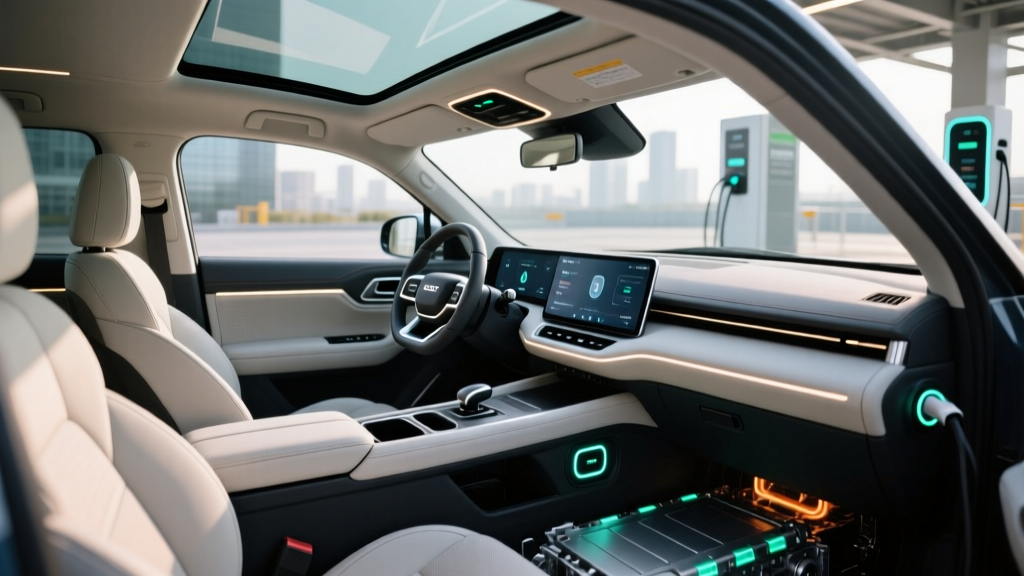
The Ioniq 9's cabin is where the SEL trim justifies its price. Standard features include a dual 12.3-inch curved display cluster (instrument + infotainment), Hyundai's latest ccNC infotainment system with wireless Apple CarPlay and Android Auto, heated and ventilated front seats, a heated steering wheel, and a panoramic sunroof.
The second row features captain's chairs in the SEL (six-passenger configuration) or an available bench for seven-passenger seating. Second-row legroom measures approximately 37.8 inches, and the third row offers 30.1 inches — sufficient for children or occasional adult use on shorter trips, but not class-leading against the larger Rivian R1S or the Kia EV9's third row.
Cargo volume breaks down as follows:
- Behind third row: ~15.9 cu ft (groceries, a couple of carry-ons)
- Third row folded: ~42.8 cu ft
- Both rear rows folded: ~81.7 cu ft
- Front trunk (frunk): ~1.8 cu ft (small — enough for a charging cable bag)
On the tech front, the Ioniq 9 SEL includes Hyundai's Highway Driving Assist 2 (HDA2), a Level 2 SAE driver-assistance system combining adaptive cruise control with lane-centering and automatic lane-change assist. This is not autonomous driving — the driver must keep hands on the wheel and eyes on the road at all times. The system performs well on divided highways but requires active supervision.
Other notable tech: vehicle-to-load (V2L) capability via an interior outlet and exterior adapter (powers devices up to 3.6 kW — enough for a campsite, power tools, or emergency backup), digital key 2 via NFC/UWB, over-the-air software updates, and a head-up display with augmented-reality navigation on equipped models.
Hyundai HDA2 is an SAE Level 2 driver-assist system. It does not drive the vehicle autonomously. The driver is legally and practically responsible for all vehicle operation at all times. Never treat any Level 2 system as a substitute for attentive driving.
Pricing, Trims, and Federal Tax Credit Eligibility
The 2026 Hyundai Ioniq 9 SEL carries a base MSRP of $59,895 (including destination charge) for the RWD model. Adding AWD increases the price to approximately $63,895. A fully loaded SEL AWD with premium packages lands around $65,500.
| Trim / Config | MSRP | Est. After §30D Credit* |
|---|---|---|
| SEL RWD | $59,895 | ~$52,395 |
| SEL AWD | $63,895 | ~$56,395 |
| SEL AWD w/ Premium Pkg | ~$65,500 | ~$58,000 |
*Federal tax credit estimates assume full §30D eligibility. Actual credit depends on individual tax liability, income caps, battery sourcing compliance, and point-of-sale transfer rules. Consult a tax professional.
The Ioniq 9 qualifies for the IRS §30D federal clean vehicle credit — up to $7,500 — but eligibility is conditional. Here's what buyers must verify:
- MSRP Cap: SUVs must have an MSRP at or below $80,000 — the Ioniq 9 SEL clears this comfortably.
- Buyer Income Cap: Modified adjusted gross income must not exceed $150,000 (single), $225,000 (head of household), or $300,000 (joint filing).
- Battery Sourcing: The $7,500 credit requires meeting both critical-minerals and battery-component sourcing thresholds. Hyundai has been working to localize battery production at its Georgia plant; verify current-year sourcing compliance on the fueleconomy.gov tax credit lookup before purchasing.
- Point-of-Sale Transfer: As of 2024, buyers can transfer the credit to the dealer at purchase for an immediate price reduction rather than waiting to claim it on their tax return. The dealer must be IRS-registered.
Pros and Cons
- 311-mile EPA range (RWD) is class-leading for a 3-row EV
- 800V architecture enables ~24-minute 10–80% DC charging
- 10-year/100,000-mile battery & powertrain warranty
- Comfortable, quiet ride quality
- V2L capability (3.6 kW) for camping and emergencies
- Strong standard safety and driver-assist suite (HDA2)
- Qualifies for up to $7,500 federal tax credit (verify eligibility)
- RWD model's 215 hp feels sluggish for the vehicle's weight
- Third-row legroom (30.1 in.) is tight for adults
- Frunk is tiny (1.8 cu ft) — barely fits a charge cable bag
- SEL trim lacks the e-SSCC adaptive suspension of higher trims
- Real-world highway and cold-weather range drops are significant
- AWD adds ~$4,000 and reduces range to ~290 mi
How It Compares: Ioniq 9 SEL vs. Key Rivals
The Ioniq 9 SEL's most direct competitors are the Kia EV9 (corporate cousin with shared E-GMP architecture), the Rivian R1S (more off-road capable but pricier), and the Tesla Model X (faster but aging interior). Against the EV9 Land (AWD, ~$65,095), the Ioniq 9 SEL offers a similar platform but with slightly more premium interior materials and a more conservative exterior design. The Rivian R1S Dual-Motor starts around $75,900 and offers superior third-row space and genuine off-road chops, but at a significant price premium. The Model X Long Range starts near $81,630 and offers more range and performance but falls well outside the Ioniq 9's value proposition.
Look elsewhere if: You need a usable adult-sized third row (consider the Rivian R1S), want a sportier driving experience (Tesla Model X or BMW iX), or need a large frunk for gear (Rivian R1S offers 11+ cu ft up front).
Who the Ioniq 9 SEL Is For
This SUV is built for families who want a practical, long-range EV for daily commuting and road trips without stepping into luxury-SUV pricing. The 311-mile range and 24-minute fast-charge capability make it viable for 300-mile highway stretches with a single quick stop. The V2L feature adds genuine utility for camping or power-outage backup. The SEL trim hits the right balance: you get the premium comfort features most buyers want without paying for the Calligraphy's cosmetic upgrades.
It's less suited for buyers who regularly carry adults in the third row, who need serious towing capacity (rated at approximately 2,000 lbs — light duty only), or who want a performance-oriented driving experience.
Frequently Asked Questions
What is the real-world range of the 2026 Hyundai Ioniq 9 SEL?
The EPA estimates 311 miles for the RWD and approximately 290 miles for the AWD. In real-world highway driving at 70+ mph, expect 250–275 miles. In cold weather (below 30°F), plan for 220–250 miles unless you precondition the battery while plugged in.
How fast does the Ioniq 9 charge at home and on the road?
On a Level 2 home charger (240V, 48A), the Ioniq 9 charges at 10.9 kW — about 35 miles of range per hour, or a full charge in roughly 11 hours. On a 350 kW DC fast charger, it peaks at ~240 kW and charges from 10–80% in about 24 minutes.
Does the 2026 Ioniq 9 SEL qualify for the $7,500 federal EV tax credit?
It can, but eligibility depends on your income (must be under $150K single / $300K joint), the vehicle's MSRP (under $80K — the SEL qualifies), and battery-sourcing compliance. Check fueleconomy.gov for the latest sourcing status and consult a tax professional. The credit can be transferred to the dealer at point of sale for an immediate price reduction.
Is the Ioniq 9 worth buying over the Kia EV9?
Both share the E-GMP platform and offer similar range and charging. The Ioniq 9 leans more premium in interior materials and ride tuning, while the EV9 offers bolder styling and a slightly more practical boxy interior. If you value a quieter, more refined cabin, the Ioniq 9 edges ahead. If you want maximum cargo versatility and head-turning design, the EV9 is compelling. Pricing is close enough that a back-to-back test drive is the best decision tool.
What is the battery warranty on the Ioniq 9?
Hyundai covers the battery and powertrain for 10 years or 100,000 miles, whichever comes first. The warranty guarantees the battery will retain at least 70% of its original capacity during that period. This is one of the strongest EV battery warranties in the industry.
Does the Ioniq 9 have a NACS (Tesla) charging port?
For the 2026 model year, Hyundai has adopted the NACS connector on new Ioniq 9 models, enabling native access to Tesla Supercharger stations (V3 and V4) without an adapter. This significantly expands the fast-charging network available to Ioniq 9 owners on road trips.
Can the Ioniq 9 power my home during an outage?
The Ioniq 9 supports vehicle-to-load (V2L) at up to 3.6 kW, which can power appliances, tools, or devices directly via an interior outlet or exterior adapter. Full vehicle-to-home (V2H) bidirectional capability requires additional home hardware and is expected to be supported via future updates, but confirm availability with your dealer for the 2026 model year.
Sources: fueleconomy.gov (EPA range and efficiency data), IRS §30D clean vehicle credit guidelines, Hyundai Motor America official specifications.