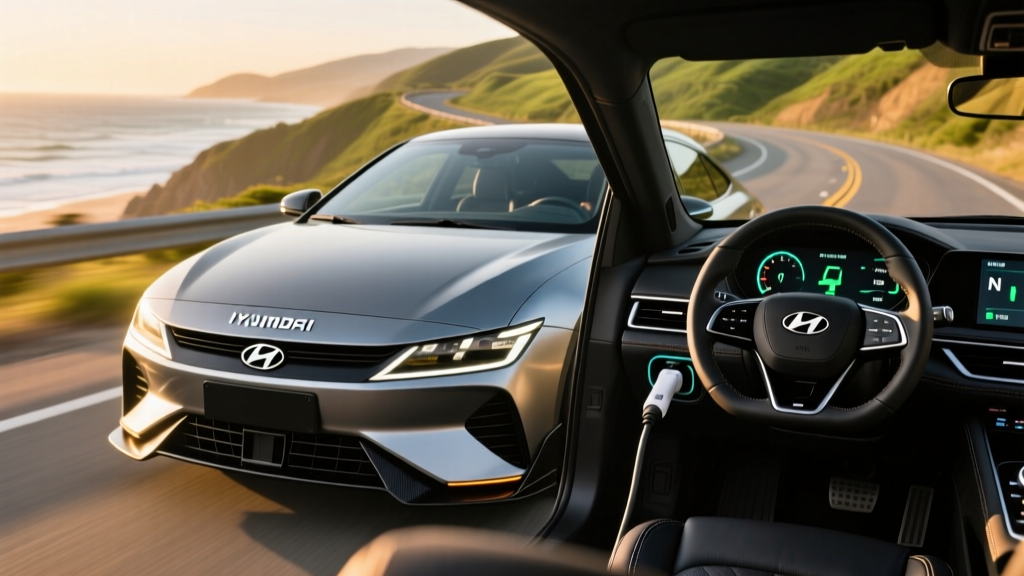
The Hyundai Ioniq 6 N arrives for the 2026 model year as the performance flagship of Hyundai's electrified lineup — a sedan that attempts the seemingly contradictory mission of delivering track-capable dynamics while maintaining the daily-driver practicality the Ioniq nameplate is known for. Built on Hyundai Motor Group's E-GMP platform and tuned by the N performance division in Namyang, the Ioniq 6 N targets enthusiasts who want Porsche Taycan thrills without the six-figure price tag. But does a 4,800-pound electric sedan truly deliver on the N badge? We break down every spec that matters.
Quick Verdict: Who the Ioniq 6 N Is For
The 2026 Hyundai Ioniq 6 N is built for the driving enthusiast who prioritizes engagement over efficiency. If your commute includes canyon roads or your weekends include track days, this is one of the few EVs that rewards aggressive driving with genuine feedback. If you're primarily seeking maximum range, lowest cost-per-mile, or family hauling, the standard Ioniq 6 or Ioniq 5 will serve you better at a lower price. The N variant trades roughly 40-60 miles of EPA range and several thousand dollars for a chassis, powertrain, and braking system that fundamentally transforms the car's character.
Range, Efficiency & Real-World Expectations
The Ioniq 6 N carries an 84.0 kWh usable battery pack (NMC lithium-ion chemistry, 800V architecture). Hyundai's N division added enhanced cooling circuits to manage the thermal loads of repeated high-output driving, but that performance hardware and the stickier, wider tires take a toll on efficiency compared to the standard Ioniq 6.
Real-World Expectations:
• Highway (70-80 mph, mild weather): ~235-250 miles
• Mixed city/highway commuting: ~255-270 miles
• Cold weather (below 32°F, highway): ~195-220 miles
• Track session impact: Range can drop 30-50% faster than EPA estimates during sustained high-speed driving
Efficiency lands at approximately 95 MPGe combined, or roughly 35 kWh per 100 miles. That's thirstier than the standard Ioniq 6 Long Range RWD (which achieves up to 140 MPGe / 24 kWh/100mi), but competitive with the Tesla Model S Plaid and Porsche Taycan GTS in the performance-sedan segment. The 800V architecture means you'll recover range quickly when you do stop to charge — more on that below.
Charging Speed: DC Fast & Home Level 2
The Ioniq 6 N leverages the same 800V electrical architecture that made the standard Ioniq 5 and Ioniq 6 class-leading in charge speed. The N variant benefits from upgraded thermal management that helps sustain peak charge rates longer during repeated fast-charge sessions — a critical advantage if you're driving to a track, charging, running laps, and charging again.
| Charge Level | Power / Rate | Time / Miles Added |
|---|---|---|
| DC Fast Charge (peak) | Up to 350 kW (at 350 kW charger) | 10-80% in ~18 minutes |
| DC Fast Charge (sustained avg.) | ~170-195 kW average to 80% | ~150 miles in 15 minutes |
| Level 2 Home (240V, 48A) | 10.9 kW | ~37 miles per hour of charging |
| Level 2 Home (240V, 32A) | 7.7 kW | ~26 miles per hour of charging |
| Level 1 (120V, 12A) | 1.4 kW | ~4-5 miles per hour of charging |
Charging curve reality check: Like all EVs, the Ioniq 6 N does not sustain its 350 kW peak for the entire session. Peak rate holds roughly from 10-45% State of Charge, then tapers progressively — dropping to ~150 kW by 60% and ~80 kW above 75%. The 18-minute 10-80% figure assumes a 350 kW-capable charger (such as Electrify America's latest stalls) and a battery preconditioned to optimal temperature. On a 150 kW charger, expect 10-80% in approximately 28-32 minutes.
The Ioniq 6 N uses the NACS (Tesla-style) charge port as standard for the 2026 model year in North America, granting native access to Tesla Supercharger V3 and V4 stalls (up to 250 kW) without an adapter. A CCS adapter is included in the box for legacy Electrify America and other CCS-network chargers.
Performance: 0-60, Horsepower & Drivetrain
This is where the N badge earns its keep. The dual-motor all-wheel-drive powertrain produces 641 horsepower and 568 lb-ft of torque with N Grin Boost engaged (a 10-second overboost function). In standard N Power mode, output is 601 hp.
| Metric | Value |
|---|---|
| 0-60 mph | 3.2 seconds (with launch control) |
| Top Speed | 162 mph (electronically limited) |
| Horsepower (N Grin Boost) | 641 hp |
| Torque | 568 lb-ft |
| Drivetrain | Dual-motor AWD with torque vectoring |
| Curb Weight | ~4,861 lbs |
| Brakes | 4-piston front / 1-piston rear, 400mm front rotors |
The N division's work extends far beyond a power bump. The Ioniq 6 N features N-tuned adaptive dampers, a reinforced body structure with additional weld points and structural adhesive, an electronically controlled limited-slip differential (e-LSD), and N-specific stabilizer bars. The result is a sedan that rotates willingly into corners despite its mass, with steering feedback that's rare in the EV segment.
The brake system deserves special mention: the 400mm front rotors with 4-piston calipers handle the enormous kinetic energy of a nearly 5,000-pound car with genuine repeatability. Regenerative braking blends seamlessly with the friction brakes, and the N-specific regen programming allows aggressive one-pedal-style deceleration up to 0.35g before the friction brakes engage.
Pricing, Trims & Federal Tax Credit Eligibility
The 2026 Ioniq 6 N is offered in a single, well-equipped trim with an optional N Performance package.
| Configuration | MSRP | Est. After Federal Credit |
|---|---|---|
| Ioniq 6 N (base) | $68,500 | ~$61,000* |
| Ioniq 6 N + Performance Pkg | $73,500 | ~$66,000* |
*Federal tax credit estimate; see eligibility details below. State and local incentives may further reduce cost.
The Performance Package adds lightweight forged 21-inch wheels with Pirelli P Zero Trofeo RS tires, carbon-fiber exterior trim, Alcantara interior accents, and an N-specific exhaust sound enhancement system (routed through the cabin speakers — controversial among purists, but customizable in intensity or fully defeatable).
- MSRP Cap: The Ioniq 6 N at $68,500 falls under the $55,000 sedan cap — wait, it does NOT. Sedans must be under $55,000 MSRP to qualify. The Ioniq 6 N at $68,500 exceeds the §30D sedan MSRP cap and does NOT qualify for the full $7,500 federal credit. (Source: IRS §30D guidelines)
- Buyer Income Cap: Even if MSRP qualified, AGI limits apply: $150,000 single / $300,000 married filing jointly.
- Battery Sourcing: Critical minerals and battery component sourcing requirements must be met for the full credit amount.
- Point-of-Sale Transfer: If eligible, the credit can be transferred to the dealer at purchase for an immediate price reduction.
Interior, Cargo & Daily Practicality
The Ioniq 6 N shares its cabin architecture with the standard Ioniq 6, meaning you get Hyundai's dual 12.3-inch panoramic display layout, physical climate controls (a welcome choice), and the N-specific sport seats with enhanced bolstering and integrated headrests.
| Measurement | Ioniq 6 N |
|---|---|
| Front Legroom | 41.7 inches |
| Rear Legroom | 36.2 inches |
| Front Headroom | 39.2 inches |
| Rear Headroom | 36.9 inches |
| Cargo Volume (rear seats up) | 12.3 cu ft |
| Cargo Volume (rear seats folded) | ~40.1 cu ft |
| Frunk (front trunk) | 1.6 cu ft (reduced vs. standard Ioniq 6 due to N power electronics) |
The fastback roofline, while visually striking, compromises rear headroom for taller passengers (those over 6'1" will notice the hair-brush on longer trips). Cargo volume is adequate for a weekend trip for two but trails the Ioniq 5 N's hatchback utility significantly. The frunk is nearly vestigial in the N variant — useful for storing the charge cable and a small bag, not much more.
Infotainment & Tech: The 12.3-inch center touchscreen runs Hyundai's latest ccNC (Connected Car Navigation Cockpit) software with wireless Apple CarPlay and Android Auto, over-the-air updates, and the Digital Key 2 feature (phone-as-key via UWB). The N-specific displays include a lap timer, G-meter, battery temperature monitor, and torque distribution readout.
Driver Assistance: Hyundai SmartSense is standard, including adaptive cruise control with stop-and-go, lane-keeping assist, blind-spot monitoring with rear cross-traffic alert, and Highway Driving Assist 2 (HDA2). HDA2 is an SAE Level 2 system — it manages steering, acceleration, and braking on divided highways, but the driver must remain fully engaged with hands on the wheel and eyes on the road. It is not autonomous driving.
Warranty & Long-Term Ownership
Hyundai backs the Ioniq 6 N with one of the most comprehensive warranty packages in the performance-EV segment:
| Component | Coverage |
|---|---|
| Limited Vehicle Warranty | 5 years / 60,000 miles |
| Powertrain Warranty | 10 years / 100,000 miles |
| Battery Warranty | 10 years / 100,000 miles (retains ≥70% capacity) |
| Corrosion Perforation | 7 years / unlimited miles |
| Roadside Assistance | 5 years / unlimited miles |
The 70% capacity retention threshold over 10 years is industry-standard. Given the NMC chemistry and the aggressive thermal management system, real-world degradation for daily-driven examples (charged to 80% daily, occasional 100% for road trips) is projected at 8-12% over the first 100,000 miles based on data from earlier E-GMP vehicles. Track-heavy use may accelerate degradation; Hyundai has not published specific guidance on warranty coverage for competition use, so owners planning frequent track days should clarify with their dealer.
Pros, Cons & How It Compares
- Class-leading 800V charging architecture (10-80% in ~18 min on 350 kW)
- Genuine track capability with repeatable brake performance
- N-tuned chassis delivers steering feedback rare in EVs
- 10-year/100,000-mile battery and powertrain warranty
- NACS port standard — native Supercharger access
- Physical climate buttons; excellent infotainment ergonomics
- Does NOT qualify for the $7,500 federal tax credit (sedan MSRP cap exceeded)
- EPA range of 278 miles trails standard Ioniq 6 by ~80 miles
- Rear headroom is tight for passengers over 6'1"
- Cargo space (12.3 cu ft) is modest; frunk is nearly useless
- Synthetic exhaust sound will not satisfy all enthusiasts
- Higher insurance premiums expected vs. standard Ioniq 6
Versus key competitors: The Tesla Model 3 Performance (~$54,990) is quicker to 60 (2.9s), has Supercharger network ease-of-use, and qualifies for the federal credit — but its chassis lacks the N's depth of engagement and brake durability. The Porsche Taycan GTS offers superior steering feel and build quality but starts above $110,000 and charges slower on CCS infrastructure. The BMW i4 M50 (~$69,700) is a close rival in price and comfort but trails in charging speed (200 kW max, no 800V). For pure driving engagement under $75,000, the Ioniq 6 N occupies a compelling niche.
Frequently Asked Questions
What is the real-world range of the 2026 Hyundai Ioniq 6 N?
The EPA rates the Ioniq 6 N at 278 miles combined. In real-world highway driving at 70-80 mph in mild temperatures, expect approximately 235-250 miles. In cold weather (below freezing), highway range drops to roughly 195-220 miles. City driving with regenerative braking can approach or slightly exceed the EPA figure.
How fast does the Ioniq 6 N charge at home and on the road?
On a 350 kW DC fast charger, the Ioniq 6 N charges from 10-80% in approximately 18 minutes, adding roughly 150 miles of range in 15 minutes. At home on a 48-amp Level 2 charger (240V), it adds about 37 miles per hour — a full overnight charge (10 hours) replenishes the battery completely. On a standard 120V outlet (Level 1), expect just 4-5 miles per hour.
Does the 2026 Ioniq 6 N qualify for the federal EV tax credit?
No. Under current IRS §30D rules, the federal new clean vehicle credit has an MSRP cap of $55,000 for sedans. The Ioniq 6 N starts at $68,500, which exceeds this threshold. State-level incentives may still apply — check your state's energy office or the IRS clean vehicle credit page for details. Always consult a tax professional for your specific eligibility.
Is the Ioniq 6 N worth buying over the standard Ioniq 6 or Ioniq 5 N?
If your priority is driving engagement, chassis balance, and track-day repeatability in a sedan form factor, the Ioniq 6 N is worth the premium. If you prioritize range (the standard Ioniq 6 SE Long Range delivers 361 EPA miles), cargo versatility (the Ioniq 5 N hatchback offers 50+ cu ft with seats folded), or federal tax credit eligibility, the non-N variants are more rational choices.
Can I take the Ioniq 6 N to a track day?
Yes — this is one of the EVs most explicitly designed for track use. The N-tuned cooling system, 4-piston brakes with 400mm rotors, and e-LSD are built for sustained high-speed driving. Expect significant range consumption during track sessions (plan for 2-3 laps per charge cycle on a typical 2-3 mile circuit) and budget for accelerated tire wear on the sticky P Zero rubber.
What charger connector does the 2026 Ioniq 6 N use?
The 2026 Ioniq 6 N comes equipped with a NACS (North American Charging Standard) port, providing native access to Tesla Superchargers. A CCS1 adapter is included for use with Electrify America, EVgo, and other CCS networks. Hyundai transitioned its full US lineup to NACS for the 2026 model year.