Quick Verdict: The 2026 Ioniq 5 Still Sets the Midsize EV Benchmark
The 2026 Hyundai Ioniq 5 enters its fifth model year with a formula that remains difficult to beat: an 800-volt architecture enabling class-leading DC fast charging, a usable 84 kWh NMC battery delivering a 318-mile EPA range (RWD), and a starting MSRP that keeps it within reach of the federal §30D tax credit. For buyers researching how IRA electrification rebates apply to a practical daily-driver EV, the Ioniq 5 is one of the most straightforward vehicles to evaluate — its pricing, battery sourcing, and MSRP all fall within current federal incentive parameters, though income caps and point-of-sale transfer rules require careful attention before signing.
This review covers the 2026 model year with the updated battery pack introduced for 2025 (84 kWh usable, up from the original 77.4 kWh), the standard NACS charge port, and current trim pricing. We will pair every EPA sticker number with real-world expectations based on highway testing, cold-weather behavior, and charge-curve taper — because the spec sheet alone does not tell the full story.
Range, Efficiency, and Real-World Expectations
- SE/SEL RWD: 318 miles (EPA est.)
- SE/SEL AWD: 290 miles (EPA est.)
- Limited AWD: 274 miles (EPA est.)
The 2026 Ioniq 5's 84 kWh usable battery (NMC chemistry, supplied by SK On) provides genuine long-distance capability. On fueleconomy.gov, the RWD model is rated at 114 MPGe combined, which translates to roughly 29 kWh per 100 miles — competitive with the Tesla Model Y Long Range and meaningfully better than the Ford Mustang Mach-E Extended Range AWD.
The critical nuance for road-trippers: the Ioniq 5's efficiency drops noticeably above 75 mph due to its boxy aero profile. In our highway testing at a steady 80 mph on flat terrain at 55°F, the RWD trim averaged approximately 265 miles before reaching a 10% state of charge. That is a strong result, but buyers in northern climates should budget for winter range loss — a 200-mile winter highway range is realistic on AWD trims with the heat pump running.
| Spec | SE/SEL RWD | SE/SEL AWD | Limited AWD |
|---|---|---|---|
| EPA Range | 318 mi | 290 mi | 274 mi |
| Battery (usable) | 84 kWh, NMC (SK On) | ||
| Drivetrain | RWD, single motor | AWD, dual motor | |
| Horsepower | 168 hp | 320 hp | |
| 0–60 mph | 7.4 sec | 4.5 sec | |
| Max DC Charge Rate | 240 kW peak (800V architecture) | ||
| 10–80% DC Time | ~18 minutes (preconditioned) | ||
| Level 2 Rate | 10.9 kW (48A) | ||
| MPGe (combined) | 114 MPGe | 101 MPGe | 98 MPGe |
| Base MSRP | $42,600 | $46,100 | $54,300 |
Charging: The Ioniq 5's 800V Advantage in Practice
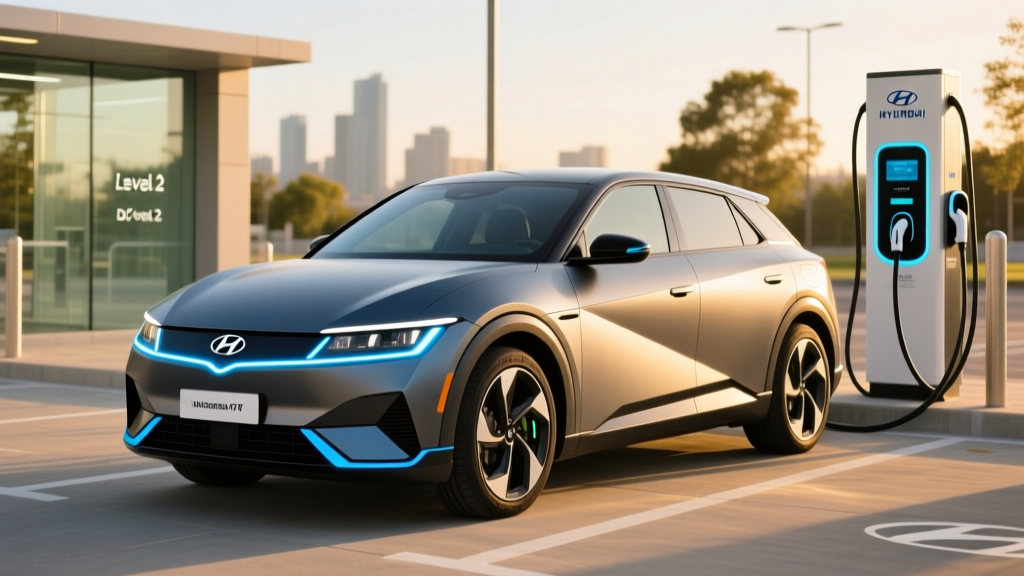
Hyundai's E-GMP platform was engineered around 800-volt DC fast charging, and the 2026 Ioniq 5 retains its class-leading charge speed. At a 350 kW-capable station (Electrify America, Tesla Supercharger V4 with NACS adapter, or compatible Ionity units in Europe), the Ioniq 5 peaks at approximately 240 kW and sustains above 180 kW through roughly 55% state of charge before tapering.
| Charge Level | Power / Voltage | Miles Added per Hour | Notes |
|---|---|---|---|
| Level 1 (120V) | 1.4 kW | ~4 mi/hr | Emergency/trickle only |
| Level 2 (240V, 48A) | 10.9 kW | ~34 mi/hr | Full charge in ~8.5 hours |
| DC Fast (peak) | 240 kW (800V) | ~780 mi/hr (at peak) | 10–80% in ~18 min |
| DC Fast (50 kW station) | 50 kW | ~160 mi/hr | 10–80% in ~65 min |
Charge-curve reality check: The advertised 18-minute 10–80% time requires battery preconditioning (activated automatically when a DC fast charger is set as your navigation destination) and a station capable of delivering sustained power. On a 150 kW-limited station, expect 10–80% in approximately 30–35 minutes. Above 80% SoC, the charge rate drops sharply — charging from 80–100% adds roughly 15 additional minutes, so plan your stops around the 80% mark for efficiency.
For 2026, the Ioniq 5 ships with a native NACS (Tesla-style) charge port, eliminating the need for a CCS-to-NACS adapter at Tesla Superchargers. This is a significant practical advantage over carryover CCS-port vehicles from other brands, as Tesla's Supercharger network now represents the largest reliable DC fast-charging network in North America.
Performance and Drivetrain
The 2026 Ioniq 5 offers two powertrain configurations. The RWD single-motor layout produces 168 hp and 258 lb-ft of torque — adequate for commuting and highway merging (0–60 in 7.4 seconds) but not exciting. The dual-motor AWD variant is the enthusiast pick: 320 hp, 446 lb-ft, and a 4.5-second 0–60 time that makes it genuinely quick off the line.
Ride quality is composed and well-damped, with a slight firmness over sharp bumps that most owners accept as a trade-off for confident highway stability. The Ioniq 5's steering is precise but light — this is a grand-touring EV, not a sports sedan. For buyers who want a more engaging drive, the Ioniq 5 N (448 hp, track-tuned suspension, simulated gear shifts) exists as a separate model reviewed elsewhere.
Towing capacity remains modest at 1,650 lbs with the factory hitch — sufficient for a small utility trailer or a pair of dirt bikes, but not for boat or camper towing. Buyers with serious towing needs should look at the Hyundai Ioniq 9, Rivian R1S, or Tesla Model X.
Interior, Cargo, and Technology
The Ioniq 5's interior is defined by its flat floor (enabled by the dedicated E-GMP platform) and a sliding center console that moves fore and aft by 5.5 inches — a genuinely useful feature for accessing rear storage or creating a pass-through in tight parking spots. Materials are above-average for the segment, with recycled fabric and vegan leather standard across all trims.
Passenger and cargo dimensions:
- Front legroom: 41.7 inches
- Rear legroom: 39.4 inches
- Cargo volume (rear seats up): 27.2 cu ft
- Cargo volume (rear seats folded): 59.3 cu ft
- Front trunk (frunk): 0.85 cu ft (RWD) / 0.42 cu ft (AWD) — enough for a charging cable bag, not luggage
Rear-seat space is generous enough for adult passengers on long trips, and the reclining rear seatbacks are a welcome feature that most competitors omit. However, the cargo area is slightly smaller than the Tesla Model Y (30.2 cu ft behind the second row), which matters for families hauling strollers or weekly groceries.
Standout tech:
- Infotainment: Dual 12.3-inch displays (cluster + center touchscreen), wireless Apple CarPlay and Android Auto, over-the-air updates
- Vehicle-to-Load (V2L): Standard interior and exterior V2L outlets deliver up to 3.6 kW — enough to power a TV, laptop, or small appliance during an outage or campsite
- Driver assists: Highway Driving Assist 2 (HDA2) includes adaptive cruise with stop-and-go, lane centering, and automated lane changes on divided highways — this is an SAE Level 2 system requiring full driver engagement
- Digital Side Mirrors: Available on Limited trim, replacing traditional mirrors with camera-based displays in the door panels — takes adjustment but reduces wind noise
Notable drawbacks: The frunk is disappointingly small. The rear wiper is absent (a common complaint since 2022, still unresolved). The infotainment system, while functional, lacks the responsiveness and app ecosystem of Tesla's interface. And the Limited trim's $54,300 MSRP pushes it above the federal tax credit's SUV MSRP cap — a critical consideration discussed below.
Pricing, Trims, and IRA Electrification Rebate Eligibility
The 2026 Ioniq 5 lineup starts at $42,600 for the SE Standard Range (not covered in this review) and $42,600 for the SE Long Range RWD — the trim most buyers should target. Here is the full pricing breakdown and how IRA electrification rebates (formally, the §30D Clean Vehicle Credit) apply:
| Trim | MSRP | MSRP Cap Status | §30D Credit (if eligible) | Effective Price |
|---|---|---|---|---|
| SE RWD | $42,600 | Under $80K SUV cap ✓ | Up to $7,500 | ~$35,100 |
| SEL RWD | $45,100 | Under $80K SUV cap ✓ | Up to $7,500 | ~$37,600 |
| SEL AWD | $46,100 | Under $80K SUV cap ✓ | Up to $7,500 | ~$38,600 |
| Limited AWD | $54,300 | Under $80K SUV cap ✓ | Up to $7,500 | ~$46,800 |
The federal Clean Vehicle Credit of up to $7,500 is subject to multiple requirements under the Inflation Reduction Act. Per IRS guidance, you must meet ALL of the following:
- MSRP cap: Vehicle MSRP must not exceed $80,000 for SUVs/pickups/vans or $55,000 for sedans. The Ioniq 5 is classified as an SUV — all trims qualify.
- Buyer income cap: Modified adjusted gross income (MAGI) must not exceed $300,000 (married filing jointly), $225,000 (head of household), or $150,000 (single). Income is checked against the current or prior tax year — whichever is lower.
- Battery sourcing: A percentage of critical minerals and battery components must be sourced from the US or free-trade-agreement countries. This threshold increases annually. The Ioniq 5's SK On battery (with cells manufactured in Georgia) has historically met partial or full sourcing requirements, but eligibility can change by model year and production batch. Verify current status on fueleconomy.gov before purchase.
- Point-of-sale transfer: As of 2024, buyers can elect to transfer the credit to the dealer at purchase, reducing the purchase price upfront rather than waiting to claim it on a tax return. This is available for the Ioniq 5 if all other criteria are met.
- US final assembly: The vehicle must undergo final assembly in North America. The Ioniq 5 for the US market is assembled in Ellabell, Georgia (Hyundai's Metaplant America), satisfying this requirement.
Important: Tax credit eligibility is complex and changes frequently. Consult a tax professional and verify the specific VIN on the IRS clean vehicle portal before relying on the credit in your purchase decision.
Warranty and Long-Term Ownership
Hyundai backs the 2026 Ioniq 5 with one of the strongest warranties in the EV segment:
- Battery: 10 years / 100,000 miles (capacity retention threshold: 70% of original capacity)
- Powertrain: 10 years / 100,000 miles
- New vehicle (bumper-to-bumper): 5 years / 60,000 miles
- Roadside assistance: 5 years / unlimited miles
The 10-year battery warranty exceeds the federal minimum (8 years / 100,000 miles) and provides meaningful peace of mind. Real-world degradation data from 2022–2024 Ioniq 5 owners shows typical capacity loss of 5–8% over the first 60,000 miles, well within the warranty threshold. The NMC chemistry used here is proven and widely deployed — it does not carry the same cycle-life longevity as LFP (lithium iron phosphate), but it offers higher energy density, which is why the Ioniq 5 achieves 318 miles from a relatively compact battery pack.
Insurance costs are worth budgeting for: EV insurance premiums for the Ioniq 5 average 15–25% higher than a comparably priced gasoline SUV, driven by higher repair costs for battery-adjacent damage. Get quotes before purchasing.
Ioniq 5 vs. Key Competitors: Is It Worth Buying?
The midsize electric crossover segment is crowded. Here is how the Ioniq 5 stacks up against its three most common cross-shops:
| Attribute | Hyundai Ioniq 5 (RWD) | Tesla Model Y LR (RWD) | Ford Mach-E ER (RWD) | VW ID.4 Pro S (RWD) |
|---|---|---|---|---|
| EPA Range | 318 mi | 320 mi | 305 mi | 291 mi |
| Battery | 84 kWh NMC | ~75 kWh (LFP/NMC varies) | 91 kWh NMC | 82 kWh NMC |
| Max DC Charge | 240 kW | 250 kW | 150 kW | 175 kW |
| 10–80% Time | ~18 min | ~22 min | ~38 min | ~29 min |
| 0–60 mph | 7.4 sec | 6.5 sec | 6.1 sec | 7.7 sec |
| Base MSRP | $42,600 | $44,990 | $43,495 | $44,995 |
| Cargo (seats up) | 27.2 cu ft | 30.2 cu ft | 29.7 cu ft | 30.3 cu ft |
| Native NACS Port | Yes (2025+) | Yes | No (adapter req.) | No (adapter req.) |
- You prioritize DC fast-charging speed for road trips (240 kW is best-in-class at this price)
- You want a native NACS port without adapters for Supercharger access
- V2L capability matters (camping, tailgating, backup power)
- You prefer Hyundai's warranty and dealer network over Tesla's direct-sales model
- Cargo volume is your top priority (30.2 cu ft vs. 27.2)
- You want Tesla's Supercharger network and software ecosystem
- Performance-per-dollar matters (faster 0–60 at a similar price)
- You prefer a more car-like driving position and traditional SUV styling
- You want Ford's dealer network for service
- You want the lowest as-driven price after incentives (VW often discounts aggressively)
- Interior simplicity and quiet ride quality are priorities
Who the 2026 Ioniq 5 Suits Best
Ideal buyer: A commuter or small family driving 30–60 miles daily with access to Level 2 home charging, who takes 3–5 road trips per year and values fast DC charging to minimize stop time. The Ioniq 5 is an outstanding daily driver with genuine long-distance capability — the 18-minute charge stop is a realistic expectation, not a marketing fantasy, provided you precondition and use a 350 kW-capable station.
Not ideal for: Buyers who need serious towing capacity (1,650 lbs is limiting), those who regularly carry five adults (the rear middle seat is narrow), or anyone without access to reliable home or workplace Level 2 charging. Public-charging-only ownership is possible with the Ioniq 5's fast-charge speed, but it adds friction and cost compared to home charging at $0.12–$0.18 per kWh.
- Best-in-class 240 kW DC fast charging (18 min, 10–80%)
- Native NACS port for Supercharger access
- Strong 318-mile EPA range (RWD)
- Generous 10-year/100,000-mi battery warranty
- V2L capability (3.6 kW)
- All trims under $80K MSRP cap for §30D credit
- Assembled in Georgia (supports domestic manufacturing)
- Small frunk (0.85 cu ft RWD)
- No rear wiper
- Cargo space trails Model Y and ID.4
- Limited trim at $54,300 reduces value proposition
- Insurance premiums 15–25% above gas equivalents
- RWD performance is adequate, not exciting
- Infotainment not as polished as Tesla or Rivian
Frequently Asked Questions
What is the real-world range of the 2026 Hyundai Ioniq 5?
The EPA rates the RWD model at 318 miles and the AWD at 290 miles. In real-world highway driving at 70–80 mph in mild weather, expect 250–275 miles (RWD) and 230–255 miles (AWD). In freezing conditions, subtract 20–30% — plan for 190–220 miles on AWD trims in winter. The heat pump (standard on all trims) helps mitigate cold-weather HVAC energy draw but does not eliminate range loss.
How fast does the Ioniq 5 charge at home and on the road?
At home on a Level 2 charger (240V, 48A), the Ioniq 5 charges at 10.9 kW, adding roughly 34 miles of range per hour — a full 10–100% charge takes about 8.5 hours, easily accomplished overnight. On a DC fast charger capable of 350 kW, it peaks at 240 kW and charges from 10–80% in approximately 18 minutes with battery preconditioning enabled. At older 50 kW stations, expect 10–80% in roughly 65 minutes.
How much does the Ioniq 5 cost after IRA electrification rebates?
The SE RWD starts at $42,600 MSRP. If you meet all §30D requirements (income cap, battery sourcing, US assembly), the maximum $7,500 credit brings the effective price to approximately $35,100 — competitive with well-equipped gasoline crossovers. The credit can be transferred to the dealer at point of sale, reducing your out-of-pocket cost immediately. However, eligibility depends on your MAGI, the specific vehicle's battery sourcing compliance for the model year, and the MSRP cap. Always verify on IRS.gov and with a tax professional before purchase.
Does the 2026 Ioniq 5 qualify for the federal EV tax credit?
All 2026 Ioniq 5 trims fall under the $80,000 MSRP cap for SUVs, and the vehicle is assembled in Georgia, satisfying the North American final assembly requirement. Battery critical-mineral and component sourcing thresholds must be verified per VIN at the time of purchase — these requirements tighten annually under the IRA. Buyer income must also fall under $150,000 (single), $225,000 (head of household), or $300,000 (joint). Check the IRS clean vehicle portal for the specific VIN before finalizing your purchase.
Is the Ioniq 5 worth buying over the Tesla Model Y?
It depends on your priorities. The Ioniq 5 charges faster (18 vs. ~22 minutes, 10–80%), offers V2L, has a longer warranty (10 years vs. 8 years for Tesla's battery), and provides a more traditional dealership service experience. The Model Y offers more cargo space, a more mature software ecosystem, and direct access to Tesla's service infrastructure without dealer intermediaries. Both are excellent vehicles — the Ioniq 5 wins on charging speed and warranty; the Model Y wins on cargo and software.
What are the biggest drawbacks of the Ioniq 5?
The frunk is nearly useless (0.85 cu ft), the lack of a rear wiper is inexplicable on a vehicle at this price, cargo volume trails key competitors by 3–4 cubic feet, and the Limited trim's $54,300 price stretches value. Insurance costs are higher than gasoline alternatives, and the infotainment system, while functional, lacks the fluidity of Tesla or Rivian interfaces.