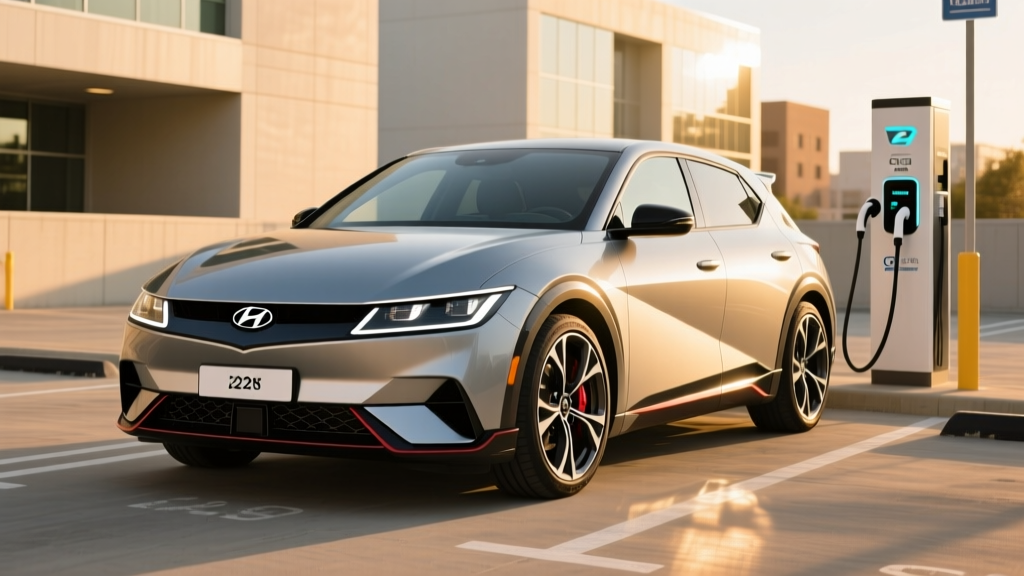
The 2026 Hyundai Ioniq 5 N isn't trying to be a rational commuter appliance. It's a 5,000-pound electric hot hatch that simulates gear shifts, fakes exhaust notes through interior speakers, and hits 60 mph in 3.2 seconds — all while offering 221 miles of EPA-estimated range and practical hatchback cargo space. For buyers who want track-day thrills without sacrificing daily-driver usability, the Ioniq 5 N occupies a category of one in the U.S. market.
But performance EVs carry trade-offs. The larger 84 kWh battery and dual-motor all-wheel-drive system add weight. The aggressive tire compound and sport-tuned suspension affect ride comfort and efficiency. And at a base MSRP of $67,500, the Ioniq 5 N sits above the IRS §30D federal tax credit MSRP cap for SUVs — a critical detail for cost-conscious buyers. This review breaks down every spec that matters, from real-world highway range to DC fast-charging curves, so you can decide whether Hyundai's electric N division delivers on its promises.
2026 Hyundai Ioniq 5 N: Complete Spec Sheet
| Spec | Value |
|---|---|
| EPA Range | 221 miles |
| Battery (usable) | 84.0 kWh, NMC (nickel-manganese-cobalt) |
| Drivetrain | Dual-motor AWD |
| Horsepower (N Grin Boost) | 641 hp / 568 lb-ft torque |
| 0–60 mph | 3.2 seconds |
| Top Speed | 161 mph (electronically limited) |
| Max DC Fast Charge | 240 kW (peak) |
| 10–80% DC Charge Time | ~18 minutes (preconditioned) |
| Level 2 Home Charge Rate | 10.9 kW (~30 mi/hr) |
| EPA Efficiency | 90 MPGe combined (37 kWh/100 mi) |
| Cargo Volume (rear seats up) | 27.2 cu ft |
| Cargo Volume (rear seats folded) | 59.3 cu ft |
| Base MSRP | $67,500 (incl. $1,495 destination) |
| Battery Warranty | 10 years / 100,000 miles |
| Powertrain Warranty | 10 years / 100,000 miles |
Real-World Range: What the EPA Sticker Doesn't Tell You
The EPA rates the 2026 Ioniq 5 N at 221 miles of combined range. That figure comes from the U.S. Department of Energy's fueleconomy.gov database and reflects a weighted mix of city and highway driving cycles under moderate temperatures.
- City / suburban mixed driving (65°F): ~215–230 miles — regenerative braking recovers energy in stop-and-go traffic, often exceeding the EPA estimate.
- Highway cruising at 70–75 mph (65°F): ~180–200 miles — aerodynamic drag dominates at sustained speed, reducing efficiency by roughly 10–15%.
- Cold weather highway (30°F or below): ~150–175 miles — battery internal resistance increases, cabin heating draws significant energy, and the N-specific Pirelli P Zero tires offer less rolling resistance optimization than all-season rubber. Expect a 20–30% range reduction versus the EPA sticker.
- Track use: Range drops precipitously. Sustained high-speed laps with N Grin Boost engaged can deplete the battery in under 50 miles. This EV is not designed for endurance racing — it's built for sprint sessions.
Hyundai equips the Ioniq 5 N with a battery preconditioning system that warms the pack to optimal temperature before DC fast charging. When you navigate to a charging station in the infotainment system, the car automatically begins heating the battery approximately 10–15 minutes before arrival. This is essential for achieving the advertised 240 kW peak charge rate — without preconditioning, especially in cold weather, peak rates may not exceed 120–150 kW.
Charging Speed: DC Fast, Level 2, and the Charge Curve Reality
The Ioniq 5 N uses Hyundai's E-GMP 800-volt architecture, which enables significantly faster DC fast charging than the 400-volt systems found in most competitors. Here's what you can expect at each charging level:
| Charging Level | Power (kW) | Speed (miles added/hr) | Typical Use Case |
|---|---|---|---|
| Level 1 (120V standard outlet) | ~1.4 kW | ~4 mi/hr | Emergency/trickle only |
| Level 2 (240V, 48A home charger) | 10.9 kW | ~30 mi/hr | Daily overnight charging (~8 hrs for full charge) |
| DC Fast Charge (350 kW station) | 240 kW (peak) | ~650 mi/hr (peak) | Road trips: 10–80% in ~18 min |
| DC Fast Charge (150 kW station) | ~140 kW (sustained) | ~380 mi/hr | 10–80% in ~28 min |
Understanding the charge curve: The 240 kW peak rate only applies between roughly 10% and 45% state of charge. Above 50%, the rate tapers to approximately 150 kW. Above 80%, it drops further to 60–80 kW to protect battery longevity. This is why manufacturers quote 10–80% times rather than 0–100% — the final 20% can take as long as the first 70%. On a road trip, plan to charge from 10% to 80% in one stop (~18 minutes), then drive on.
The Ioniq 5 N uses the CCS1 (Combined Charging System) connector standard. Hyundai has confirmed that NACS (Tesla Supercharger) adapter compatibility is available through a Hyundai-approved adapter, though native NACS ports are reserved for future model-year updates. If you rely heavily on Tesla Superchargers, verify adapter availability and any speed limitations before purchase.
Performance: 641 HP, Simulated Gear Shifts, and Track Engineering
The dual-motor AWD powertrain produces 601 hp in standard mode and 641 hp with N Grin Boost activated (a 10-second burst). Torque peaks at 568 lb-ft, delivered instantly as is characteristic of electric motors. The 3.2-second 0–60 mph time places the Ioniq 5 N in supercar territory, rivaling the Porsche Taycan 4S and Tesla Model 3 Performance.
But raw acceleration is only part of the N division's engineering story. The Ioniq 5 N introduces several features unusual for an EV:
- N e-Shift: Simulates an 8-speed dual-clutch transmission with simulated shift shocks and rev-matching. You feel and hear "gear changes" even though the car has a single-speed reduction gear. This is purely for driver engagement — it can be turned off.
- N Active Sound+: Projects synthesized engine and exhaust sounds through interior and exterior speakers. Three sound profiles are available, including one modeled after Hyundai's TCR race cars. Enthusiasts are divided on whether this is immersive or gimmicky; most owners report turning it on for canyon roads and off for commuting.
- N Torque Distribution: Allows the driver to adjust front/rear torque bias from 100% front to 100% rear, enabling controlled drift modes on closed courses.
- Track-tuned suspension: Electronically controlled dampers with N-specific spring rates. Ride comfort is firm — noticeably stiffer than the standard Ioniq 5 — but body control on twisty roads is exceptional for a vehicle this heavy.
- Braking: Regenerative braking combined with large mechanical disc brakes. The N-specific regen paddle allows one-pedal driving or adjustable regen levels. Track use reveals good fade resistance for a production EV, though dedicated track pads would be recommended for repeated hot laps.
Interior, Tech, and Daily Practicality
The cabin uses Hyundai's dual 12.3-inch panoramic display layout — a digital instrument cluster on the left and a touchscreen infotainment system on the right. The infotainment system supports wireless Apple CarPlay and Android Auto, over-the-air updates, and Hyundai's Bluelink connected services.
N-specific interior touches include:
- N-branded sport bucket seats with heavy bolstering and integrated headrests (comfortable for most body types but potentially confining for broader passengers)
- Alcantara and leather-trimmed steering wheel with N Mode buttons
- Physical buttons for climate control (a welcome contrast to the touchscreen-only trend)
- N Performance Blue ambient lighting and stitching
Space and cargo: Rear legroom measures 39.4 inches — generous for adults on longer trips. Cargo volume behind the rear seats is 27.2 cubic feet, expanding to 59.3 cubic feet with the 60/40-split rear seats folded. The front trunk (frunk) adds 0.85 cubic feet — enough for a charging cable bag but not much else. Compared to the standard Ioniq 5, the N variant loses a small amount of cargo space due to the reinforced rear subframe and battery cooling hardware.
Driver assistance: The Ioniq 5 N comes equipped with Hyundai SmartSense, which includes adaptive cruise control with stop-and-go, lane-keeping assist, blind-spot monitoring, rear cross-traffic alert, and highway driving assist. This is an SAE Level 2 driver-assistance system — the driver must remain engaged with hands on the wheel and eyes on the road at all times. It is not a self-driving system and does not approach the capabilities of Level 4 robotaxi services like Waymo.
Pricing, Tax Credits, and Ownership Economics
The 2026 Hyundai Ioniq 5 N is offered in a single, well-equipped trim at a base MSRP of $67,500 (including $1,495 destination charge). There are no additional trim levels — Hyundai positions this as a fully loaded performance model. Optional equipment is limited to exterior color choices (Performance Blue Matte adds $1,000) and accessory packages.
The Ioniq 5 N faces a significant hurdle for the federal EV tax credit. Under current IRS §30D rules, the vehicle MSRP cap is $80,000 for SUVs and $55,000 for sedans. The Ioniq 5 N is classified as an SUV by the EPA, so its $67,500 MSRP falls under the $80,000 cap. However, the credit amount depends on battery component sourcing and critical mineral requirements that shift annually. Buyers must also meet income caps: $300,000 for joint filers, $225,000 for heads of household, $150,000 for single filers.
As of early 2026, the Ioniq 5 N's battery sourcing has not been confirmed to meet the full $7,500 credit threshold. Hyundai has indicated partial credit eligibility ($3,750) for vehicles with qualifying critical-mineral sourcing but non-compliant battery component assembly. Consult the IRS qualified vehicles list before purchase, and discuss eligibility with a tax professional. Point-of-sale transfer is available through participating dealers if you qualify.
| Scenario | MSRP | Federal Credit | Net Price (before state incentives) |
|---|---|---|---|
| Full $7,500 credit (if sourcing qualifies) | $67,500 | –$7,500 | $60,000 |
| Partial $3,750 credit | $67,500 | –$3,750 | $63,750 |
| No federal credit | $67,500 | $0 | $67,500 |
Operating costs: At the U.S. average electricity rate of $0.17/kWh (EIA data), charging the Ioniq 5 N's 84 kWh battery from empty to full costs approximately $14.28, yielding a per-mile energy cost of roughly $0.065. Compare this to a gasoline performance car averaging 18 mpg at $3.50/gallon — $0.194 per mile. Over 15,000 miles annually, the Ioniq 5 N saves approximately $1,935 in fuel costs. Insurance premiums, however, run 15–25% higher than the standard Ioniq 5 due to the N variant's performance classification and repair costs.
Warranty Coverage and Battery Longevity
Hyundai backs the Ioniq 5 N with one of the strongest warranty packages in the industry:
- Battery: 10 years / 100,000 miles (capacity retention guaranteed above 70% of original capacity)
- Powertrain (motors, reduction gear): 10 years / 100,000 miles
- New vehicle limited: 5 years / 60,000 miles
- Complimentary maintenance: 3 years / 36,000 miles (oil changes aren't relevant, but this covers cabin air filter, tire rotation, and multi-point inspections)
The 84 kWh NMC (nickel-manganese-cobalt) battery pack uses an advanced thermal management system with active liquid cooling and heating. NMC chemistry offers higher energy density than LFP (lithium iron phosphate), which is why Hyundai chose it for a performance model where weight and packaging matter. However, NMC cells are more sensitive to sustained high-state-of-charge storage and extreme heat. For maximum longevity, Hyundai recommends keeping the state of charge between 20% and 80% for daily use and only charging to 100% before long road trips. Track-day use with repeated high-discharge cycles will accelerate degradation — owners who plan regular track sessions should budget for slightly higher long-term battery wear.
How the Ioniq 5 N Compares to Key Rivals
The Ioniq 5 N doesn't have a direct competitor that matches its combination of hot-hatch practicality, simulated engagement features, and sub-$70K pricing. But buyers cross-shop several alternatives:
- Tesla Model 3 Performance ($54,990): Faster to 60 (2.9 sec), longer EPA range (315 mi), and eligible for the full $7,500 federal credit. But it lacks the Ioniq 5 N's hatchback cargo versatility, simulated shift engagement, and N-specific track modes. The Model 3 is a quicker commuter; the Ioniq 5 N is a more engaging driver's car.
- Porsche Taycan 4S ($92,000+): Superior handling precision, build quality, and 270 kW DC charging. But it starts $25,000 higher, offers less cargo space, and its sedan form factor lacks hatchback utility. The Taycan is the driver's choice if budget is secondary.
- BMW i4 M50 ($69,700): Similar power (536 hp) and price, but it's a sedan with a smaller cargo area (16.6 cu ft trunk). The i4 M50 offers a more traditional luxury interior and BMW's driving dynamics, but range (270 mi EPA) and DC charging speed (200 kW peak) trail the Ioniq 5 N.
- Ford Mustang Mach-E GT ($59,995): Lower price, 480 hp, 280-mile range, and strong handling. But the Mach-E GT lacks the Ioniq 5 N's 800V fast-charging architecture, and its interior materials don't match Hyundai's N-specific upgrades.
Pros and Cons: The Honest Summary
✓ Pros
- Class-leading 240 kW DC fast charging (10–80% in ~18 min)
- 641 hp and 3.2-sec 0–60 in a practical hatchback body
- Unique engagement features (simulated shifts, exhaust sound, torque vectoring)
- Generous 10-year/100,000-mile battery and powertrain warranty
- Spacious rear seat and 27.2 cu ft cargo area
- Physical climate control buttons (rare in 2026 EVs)
✗ Cons
- 221-mile EPA range is modest for a $67K+ EV
- Cold-weather and highway range drop to ~150–180 miles
- Federal tax credit eligibility uncertain due to battery sourcing rules
- Firm ride quality — not ideal for rough-road commuters
- Simulated engine sounds polarizing (love it or find it gimmicky)
- Insurance premiums 15–25% higher than standard Ioniq 5
Who Should Buy the 2026 Hyundai Ioniq 5 N?
Buy the Ioniq 5 N if: You want an EV that's genuinely fun to drive on back roads and occasional track days, you value hatchback cargo versatility, you have reliable home Level 2 charging access, and you're willing to trade 50–80 miles of range for 641 hp and engagement features no other EV offers.
Look elsewhere if: You prioritize maximum range for frequent 300+ mile road trips (consider the Ioniq 5 Long Range AWD at 304 miles EPA or the Tesla Model 3 Long Range). You need a plush, quiet luxury cruiser (the Ioniq 5 N's firm suspension and road noise from performance tires won't satisfy). You require the full $7,500 federal tax credit and can't risk uncertain battery-sourcing eligibility.
Frequently Asked Questions
What is the real-world range of the 2026 Hyundai Ioniq 5 N?
The EPA estimates 221 miles combined. In real-world driving, expect ~215–230 miles in mixed city use, ~180–200 miles at highway speeds in moderate temperatures, and ~150–175 miles in cold-weather highway driving (30°F or below). Track use reduces range dramatically to under 50 miles.
How fast does the Ioniq 5 N charge at home and on the road?
On a Level 2 home charger (240V, 48A), the Ioniq 5 N charges at 10.9 kW, adding roughly 30 miles of range per hour — a full overnight charge takes about 8 hours. At a 350 kW DC fast charger with battery preconditioning, it peaks at 240 kW and charges from 10–80% in approximately 18 minutes. At a more common 150 kW station, expect 10–80% in roughly 28 minutes.
Does the 2026 Ioniq 5 N qualify for the $7,500 federal EV tax credit?
Potentially, but it's not guaranteed. The Ioniq 5 N's $67,500 MSRP falls under the $80,000 SUV cap. However, the full $7,500 credit requires meeting both critical-mineral and battery-component sourcing requirements under IRS §30D, which are subject to annual tightening. As of early 2026, Hyundai has indicated partial credit eligibility ($3,750) is most likely. Check the IRS qualified vehicle list at the time of purchase and consult a tax professional. Buyer income caps also apply ($150K single / $300K joint).
Is the Ioniq 5 N worth buying over a Tesla Model 3 Performance?
It depends on your priorities. The Model 3 Performance is faster (2.9 sec 0–60), has longer range (315 mi EPA), costs ~$12,500 less, and reliably qualifies for the full $7,500 federal credit. The Ioniq 5 N wins on hatchback cargo space, simulated engagement features, 800V fast charging, and a more distinctive driving personality. If you value driver engagement and practicality over outright speed and range, the Ioniq 5 N justifies its premium.
What's the biggest drawback of owning the Ioniq 5 N?
Range is the most-cited compromise. At 221 miles EPA, the Ioniq 5 N requires more frequent charging stops on road trips than rivals like the Model 3 Performance (315 mi) or the standard Ioniq 5 Long Range (304 mi). Cold-weather highway driving can reduce that to 150–175 miles. If your typical commute exceeds 80 miles round-trip and you lack home charging, the smaller effective range becomes a daily inconvenience.
Can I use Tesla Superchargers with the Ioniq 5 N?
The Ioniq 5 N uses the CCS1 connector natively. Hyundai offers an approved NACS adapter that enables access to Tesla's Supercharger network (V3 stalls at 150 kW; V4 stalls may support higher rates). Charging speeds through the adapter may be slightly lower than native CCS rates. Confirm adapter availability and any firmware requirements with your dealer before relying on Supercharger access for road trips.