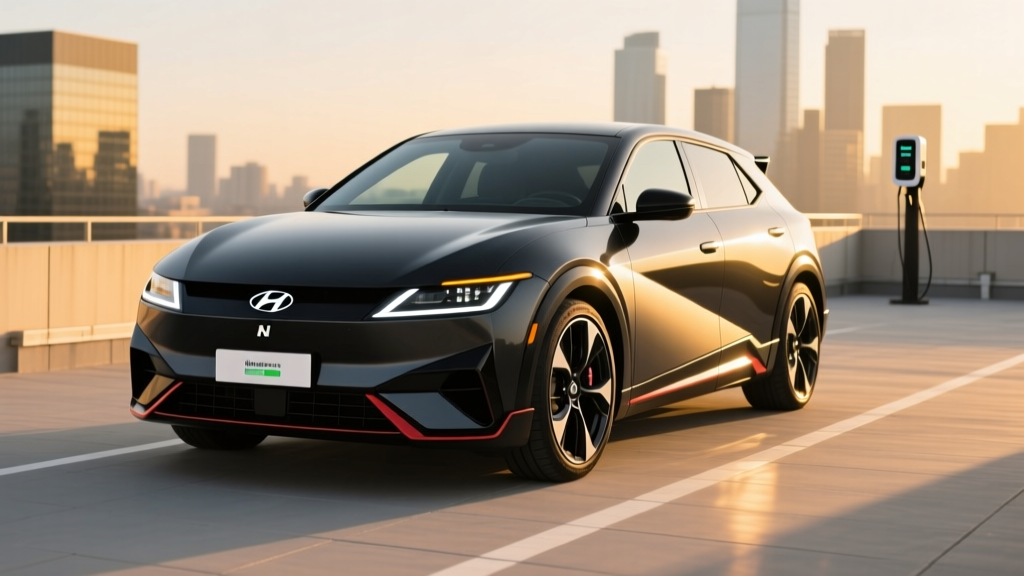
The 2026 Hyundai Ioniq 5 N occupies a rare slot in the electric-vehicle market: a track-capable performance SUV that still functions as a daily driver. Built on Hyundai's E-GMP platform and developed with input from the company's N performance division—the same engineers behind the Elantra N and Veloster N—this EV trades maximum range for maximum engagement. If you're cross-shopping it against the Tesla Model Y Performance or the Porsche Macan Electric, this profile gives you every number you need to decide.
Quick Verdict: Who the Ioniq 5 N Is For
The Ioniq 5 N is best suited for driving enthusiasts who want an EV that can genuinely hold its own on a road course, yet still commute to work on weekdays with acceptable efficiency. It is not the right pick if your top priority is maximum range, lowest cost per mile, or family-hauler cargo space. Think of it as the electric equivalent of a hot hatch on stilts—thrilling, slightly impractical, and endlessly entertaining.
Range and Efficiency: EPA Numbers vs. the Real World
EPA Estimated Range: 221 miles (combined)
Real-World Expectation: 185–205 miles in mixed highway driving; 150–170 miles in sustained cold weather (below 30°F) or aggressive track use. City-only driving with generous regenerative braking can push toward 240 miles.
The 2026 Ioniq 5 N carries an 84.0 kWh usable battery pack (111.0 kWh gross) using NMC (nickel-manganese-cobalt) cell chemistry, chosen for its higher energy density and power delivery characteristics compared to LFP. The EPA rates it at 221 miles combined—a meaningful drop from the standard Ioniq 5's 305-mile Long Range AWD variant, and that gap is the direct result of stickier tires, a lower final-drive ratio, additional cooling hardware, and roughly 400 lbs of extra mass from structural bracing and the performance-oriented drivetrain.
Efficiency lands at 85 MPGe combined, which translates to approximately 40 kWh per 100 miles. For context, the standard Ioniq 5 AWD achieves 110 MPGe (30 kWh/100 mi). On the highway at 75 mph, expect consumption to climb toward 44–48 kWh/100 mi, which compresses range to roughly 175–190 miles before you need to find a charger. According to fueleconomy.gov, this is among the least efficient EVs in its class—a deliberate trade-off for performance capability.
Charging Speed: DC Fast, Level 2, and the 800V Advantage
Hyundai's E-GMP platform supports an 800-volt electrical architecture, which remains one of the fastest-charging setups available in any production EV at this price point. Here is what the 2026 Ioniq 5 N delivers across charging levels:
| Charging Level | Power / Voltage | Speed | Notes |
|---|---|---|---|
| DC Fast Charge (peak) | 238 kW / 800V | 10–80% in ~18 minutes | Requires 350-kW CCS or NACS-compatible station; battery preconditioning active |
| DC Fast Charge (50-kW station) | 50 kW / 400V fallback | 10–80% in ~73 minutes | Common at older ChargePoint and EVgo locations |
| Level 2 Home (240V, 48A) | 11.5 kW | ~28 miles of range per hour; full charge in ~8.5 hours | Requires hardwired 60A circuit or NEMA 14-50 outlet on 50A breaker |
| Level 1 (120V, 12A) | 1.4 kW | ~3.5 miles per hour | Emergency/trickle only; full charge takes 60+ hours |
The 10–80% DC fast-charge time of approximately 18 minutes is a genuine advantage for road trips, but it requires specific conditions: a functioning 350-kW charger (Electrify America, select Tesla Superchargers with the Magic Dock adapter, or Ionity in Europe), a battery that has been preconditioned via the car's navigation-routed charging system, and ambient temperatures above roughly 50°F. In cold weather without preconditioning, that 10–80% session can stretch to 30–35 minutes as the battery management system limits current to protect the cells.
For 2026, Hyundai has equipped the Ioniq 5 N with the NACS (North American Charging Standard) port as standard, replacing the previous CCS1 connector. This grants native access to Tesla's Supercharger network—over 25,000 stalls in North America—without an adapter. Owners who purchased the 2024–2025 model with CCS1 can use Hyundai's official CCS-to-NACS adapter for Supercharger access.
Performance: 641 Horsepower and N-Specific Engineering
| Specification | 2026 Hyundai Ioniq 5 N |
|---|---|
| Horsepower (N Grin Boost) | 641 hp |
| Torque | 568 lb-ft |
| Drivetrain | Dual-motor AWD (front + rear) |
| 0–60 mph | 3.25 seconds |
| Top Speed | 161 mph (electronically limited) |
| Battery Usable Capacity | 84.0 kWh (NMC chemistry) |
| Curb Weight | ~5,015 lbs |
The headline figure is 641 horsepower, but that's only available in 10-second bursts via N Grin Boost mode. In standard driving, the dual-motor setup produces 601 hp continuously. The front motor contributes 227 hp and the rear motor 374 hp in boost mode, with torque vectoring managed by Hyundai's N Torque Distribution system, which can send up to 100% of available torque to either axle.
The 0–60 mph time of 3.25 seconds puts it in supercar territory from a decade ago, but what separates the Ioniq 5 N from a Tesla Model Y Performance (3.5 seconds to 60) is chassis engagement. The N model features an electronically controlled limited-slip differential simulation, N-specific brake regeneration tuned for trail-braking, reinforced body structure with additional welding and adhesive bonding, and a mechanical feel to the steering that most EVs simply cannot replicate. The 84.0 kWh NMC battery pack is mounted low in the chassis, contributing to a center of gravity that helps the 5,015-lb curb weight feel manageable on a road course.
Track-focused features include N Battery Preconditioning (heats or cools the pack before a session for optimal power delivery and charge acceptance), N Race mode (configurable regen, torque split, and stability control settings), and simulated gear shifts with audible and haptic feedback through the N e-Shift system. Whether you find the simulated shifts gimmicky or genuinely engaging depends on your tolerance for synthetic feedback—but the underlying powertrain response is undeniably rapid.
Pricing, Trim Levels, and Federal Tax Credit Eligibility
| Item | Amount |
|---|---|
| Base MSRP (single trim) | $67,475 (including destination) |
| As-Tested (with N Carbon package, matte paint) | $72,925 |
| Federal Tax Credit (§30D) — Maximum | Up to $7,500 (eligibility varies) |
| Effective Price After Max Credit | ~$59,975 |
The 2026 Ioniq 5 N is offered in a single, fully loaded trim. There are no "base" versions to strip down—every car includes the performance-tuned suspension, N-specific 21-inch forged wheels with Pirelli P Zero tires, the 84.0 kWh battery, the full N interior with bucket seats, and the complete suite of driver-assistance features. The only options are paint color (including a $1,000 Performance Blue Matte finish) and the N Carbon Appearance package ($4,450), which adds carbon-fiber mirror caps, side skirts, and a rear spoiler.
Federal tax credit eligibility requires careful attention. Under IRS §30D rules for 2026, the Ioniq 5 N qualifies for up to $7,500 if all conditions are met:
- MSRP cap: The vehicle must have an MSRP at or below $80,000 for SUVs. The Ioniq 5 N's $67,475 base price clears this threshold.
- Buyer income cap: Modified adjusted gross income must not exceed $150,000 (single filer), $225,000 (head of household), or $300,000 (joint filer).
- Battery sourcing: A percentage of critical minerals and battery components must be sourced from the U.S. or free-trade-agreement countries. Hyundai has been progressively shifting its battery supply chain to the SK On plant in Commerce, Georgia, but the exact credit amount (full $7,500 vs. partial $3,750) depends on the specific build month and battery pack origin. Verify with your dealer and consult a tax professional before relying on a specific credit amount.
- Point-of-sale transfer: As of 2024, eligible buyers can transfer the credit to the dealer at purchase, reducing the out-of-pocket cost immediately rather than waiting to claim it on their tax return.
Some states offer additional incentives—California's CVRP program, Colorado's innovative motor vehicle credit, and various utility rebates may stack on top. Check your state's energy office and local utility for current programs, as these change frequently.
Interior, Cargo, and Technology
The Ioniq 5 N's cabin is purpose-built for performance while retaining the retro-futuristic design language of the standard Ioniq 5. Key dimensions and features:
- Front legroom: 41.7 inches
- Rear legroom: 39.4 inches
- Cargo volume (rear seats up): 27.2 cubic feet
- Cargo volume (rear seats folded): 59.3 cubic feet
- Front trunk (frunk): 0.85 cubic feet (significantly smaller than the standard Ioniq 5's 2.0 cu ft, due to additional electronics and cooling hardware)
The N-specific front seats are heavily bolstered sport buckets with integrated headrests and N-logo stitching. They are excellent for lateral support during spirited driving but can feel firm on long highway stretches. Rear seat space is generous for the class—adults ride comfortably—and the flat floor (thanks to the E-GMP skateboard platform) benefits the middle-seat passenger.
Technology highlights include a dual 12.3-inch display setup (instrument cluster + infotainment), wireless Apple CarPlay and Android Auto, Hyundai's Digital Key 2 (NFC-based phone-as-key), a head-up display with N-specific track overlays (lap timer, G-meter, battery temperature), and an 8-speaker Bose audio system. The infotainment system runs Hyundai's latest ccNC (Connected Car Navigation Cockpit) software with over-the-air update capability.
Driver-assistance features fall under Hyundai's SmartSense suite and include:
- Highway Driving Assist 2 (SAE Level 2 — requires hands-on-wheel supervision)
- Adaptive cruise control with stop-and-go
- Lane-keeping assist and lane-centering
- Forward collision-avoidance assist with pedestrian/cyclist detection
- Blind-spot collision-avoidance assist
- Rear cross-traffic collision-avoidance assist
- Remote Smart Parking Assist (the car can park itself in tight spaces while you stand outside)
It is critical to note that Highway Driving Assist 2 is an SAE Level 2 driver-assistance system. It does not drive the car autonomously. The driver must remain attentive, keep hands on the wheel, and be prepared to take over at any moment. It is not comparable to Waymo's Level 4 robotaxi service.
Warranty and Long-Term Ownership
Hyundai backs the 2026 Ioniq 5 N with the following coverage:
- New-vehicle limited warranty: 5 years / 60,000 miles
- Powertrain warranty: 10 years / 100,000 miles
- EV battery warranty: 10 years / 100,000 miles (covers capacity loss below 70% of original state of health)
- Complimentary maintenance: 3 years / 36,000 miles (oil changes not applicable, but covers cabin air filter, tire rotation, and multi-point inspections)
- Roadside assistance: 5 years / unlimited miles
The battery warranty's 70% capacity-retention threshold is standard for the industry and aligns with Tesla, Ford, and Volkswagen. In practice, Hyundai-Kia's E-GMP battery packs have shown strong longevity in real-world fleet data, with most vehicles retaining 90%+ state of health after 60,000 miles. However, the Ioniq 5 N's performance-oriented use pattern—frequent high-discharge events, track sessions, repeated DC fast charging—may accelerate degradation compared to a gently driven commuter EV. If you plan to track the car regularly, monitor state of health through the car's diagnostic menu and avoid consistently charging to 100% or draining below 10%.
How It Compares: Ioniq 5 N vs. Key Rivals
| Specification | 2026 Hyundai Ioniq 5 N | 2026 Tesla Model Y Performance | 2026 Porsche Macan 4 Electric |
|---|---|---|---|
| EPA Range | 221 mi | 285 mi | 308 mi |
| 0–60 mph | 3.25 sec | 3.5 sec | 4.9 sec |
| Horsepower | 641 hp (boost) | 456 hp | 402 hp |
| DC Fast Charge (peak) | 238 kW | 250 kW | 270 kW |
| 10–80% DC Time | ~18 min | ~15 min | ~21 min |
| Base MSRP | $67,475 | $54,990 | $78,800 |
| Track Capability | Excellent (purpose-built) | Moderate (thermal limits after 2–3 laps) | Good (heavy, but well-damped) |
The Ioniq 5 N's closest rival is the Tesla Model Y Performance, which offers more range, a lower price, and access to the Supercharger network natively—but cannot match the Hyundai's chassis depth, braking feel, or sustained track performance. The Porsche Macan 4 Electric is more refined and offers better range but costs significantly more and lacks the raw power and track-focused engineering of the Ioniq 5 N. If your goal is a daily-drivable EV that can genuinely perform at a track day without overheating after three laps, the Ioniq 5 N has no equal at its price point.
Pros
- Class-leading track performance with sustained power delivery and thermal management
- 800V architecture enables 10–80% DC charging in ~18 minutes at capable stations
- NACS port standard for 2026—native Tesla Supercharger access
- Genuine driver engagement: steering feel, brake modulation, and chassis balance exceed EV norms
- Generous 10-year/100,000-mile battery and powertrain warranty
- Spacious rear seat and usable cargo area for a performance vehicle
Cons
- EPA range of 221 miles is low for the price; real-world highway range closer to 185 miles
- Efficiency of 85 MPGe (40 kWh/100 mi) means higher charging costs than most EVs
- $67,475 starting price is steep; tax credit eligibility depends on battery-sourcing rules
- Firm sport seats and stiff suspension tuning may fatigue on long highway trips
- Frunk reduced to 0.85 cu ft—barely fits a charging cable
- Simulated gear shifts (N e-Shift) are polarizing—some drivers find them gimmicky
Frequently Asked Questions
What is the real-world range of the 2026 Hyundai Ioniq 5 N?
The EPA rates the Ioniq 5 N at 221 miles combined. In real-world highway driving at 70–75 mph, expect 185–205 miles. In cold weather below 30°F, range can drop to 150–170 miles due to increased battery resistance and cabin heating demand. Aggressive driving or track use will compress range further, sometimes below 100 miles per charge.
How fast does the Ioniq 5 N charge at home and on the road?
On a 350-kW DC fast charger with battery preconditioning active, the Ioniq 5 N charges from 10% to 80% in approximately 18 minutes at a peak rate of 238 kW. At home on a Level 2 charger (240V, 48 amps, 11.5 kW), it adds roughly 28 miles of range per hour, requiring about 8.5 hours for a full charge from empty.
How much does the Ioniq 5 N cost after the federal tax credit?
With the base MSRP of $67,475 and the maximum $7,500 federal tax credit applied at point of sale, the effective price drops to approximately $59,975. However, the credit depends on your income (≤$150K single / ≤$300K joint), the battery's critical-mineral and component sourcing for the specific build month, and your tax liability. Confirm eligibility with your dealer and a tax professional before purchase.
Is the Ioniq 5 N worth buying over a Tesla Model Y Performance?
If your priority is driving engagement, track capability, and a distinctive performance experience, the Ioniq 5 N is worth the premium. If you value maximum range (285 mi vs. 221 mi), lower cost ($54,990 vs. $67,475), and the most mature charging network, the Model Y Performance is the more practical choice. They serve different buyers.
Does the 2026 Ioniq 5 N qualify for the $7,500 federal EV tax credit?
It can, but eligibility is not guaranteed. The MSRP of $67,475 is under the $80,000 SUV cap, so that condition is met. You must also fall within IRS income limits and the vehicle's battery must meet 2026 critical-mineral and component-sourcing thresholds, which can vary by production batch. Per IRS guidelines, check the specific VIN with your dealer and verify on the IRS clean vehicle credit portal before finalizing your purchase.
Can I tow with the Ioniq 5 N?
The 2026 Ioniq 5 N has a maximum towing capacity of 1,650 pounds when properly equipped with Hyundai's factory tow hitch. This is adequate for a small utility trailer or a pair of dirt bikes, but not for a boat or camper. Towing will significantly reduce range—expect a 30–40% reduction depending on trailer weight and aerodynamics.