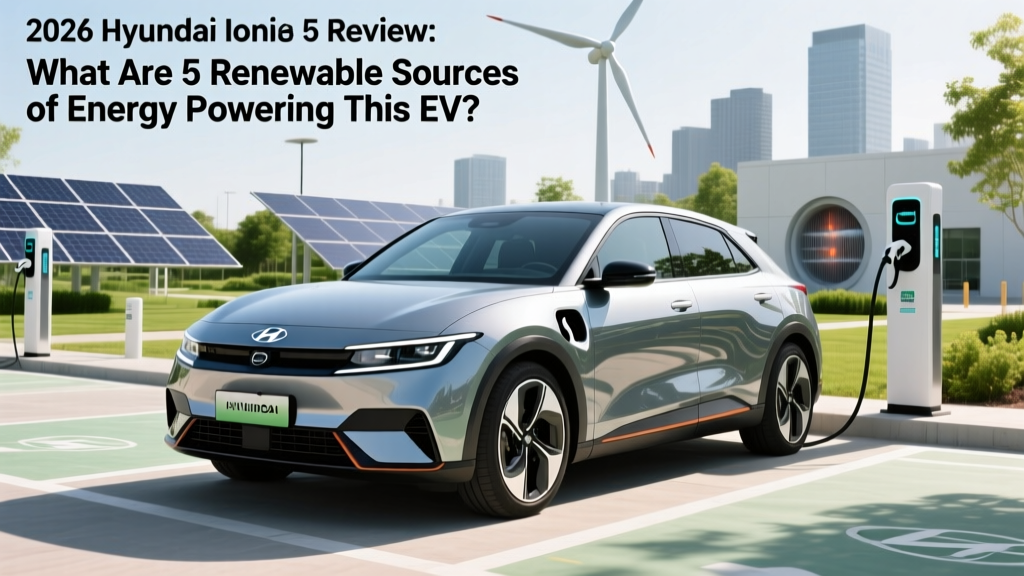
The 2026 Hyundai Ioniq 5 remains one of the most compelling midsize electric crossovers on the market, and it also serves as a perfect lens for answering a question we hear from new EV shoppers: what are 5 renewable sources of energy that can power an electric vehicle? The answer — solar, wind, hydroelectric, geothermal, and biomass — matters more than ever in 2026, because the cleanliness and cost of your electricity directly shape the environmental and financial case for going electric. In this review, we test the Ioniq 5's real-world range, charging speed, pricing, and tax-credit eligibility, while exploring how each renewable source affects what you actually pay per mile.
Quick Verdict: The Ioniq 5 in 2026
Hyundai's E-GMP platform continues to deliver class-leading DC fast charging and a spacious, tech-forward cabin. For 2026, the Ioniq 5 carries over with the larger 84.0 kWh usable battery introduced last year, NACS native port (no adapter needed at Tesla Superchargers), and updated infotainment. It's a top pick for road-trippers and commuters who want a balance of range, charging speed, and value — though rivals like the Tesla Model Y and Kia EV6 press it hard on efficiency and sportiness, respectively.
| Spec | SE/SEL RWD | SEL/Limited AWD |
|---|---|---|
| EPA Range | 318 miles | 290 miles |
| Battery (usable) | 84.0 kWh (NMC) | 84.0 kWh (NMC) |
| MPGe (combined) | 114 MPGe | 101 MPGe |
| Efficiency | 29 kWh/100 mi | 33 kWh/100 mi |
| Peak DC Fast Charge | 240 kW | 240 kW |
| 10–80% DC Time | ~18 minutes | ~18 minutes |
| Level 2 Home Charge | 10.9 kW (~37 mi/hr) | 10.9 kW (~37 mi/hr) |
| 0–60 mph | 7.2 sec | 4.5 sec |
| Horsepower | 168 hp | 320 hp |
| Drivetrain | RWD single motor | Dual-motor AWD |
| Base MSRP | $44,200 | $51,900 (Limited) |
| Battery Warranty | 10 yr / 100,000 mi | |
Range, Efficiency, and Real-World Expectations
The EPA rates the 2026 Ioniq 5 RWD at 318 miles and the AWD at 290 miles. Those are strong numbers, but as with every EV, your actual range depends heavily on speed, temperature, and terrain.
Real-World Range Reality Check
EPA sticker: 318 mi (RWD) / 290 mi (AWD)
Highway (70–75 mph, moderate weather): expect ~260–280 mi (RWD)
Cold weather (below 30°F, mixed driving): expect ~210–245 mi due to cabin heating and increased battery resistance
Best-case city/commute: 300+ mi is achievable with regen-heavy driving and mild temps
The Ioniq 5 uses a heat pump on most trims (standard on SEL and above), which helps preserve range in winter compared to resistance-heater EVs. Still, plan for a 15–25% range hit in sustained sub-freezing conditions — a figure consistent across nearly all lithium-ion EVs. For authoritative EPA figures, we cross-reference fueleconomy.gov.
Charging Speed: Where the Ioniq 5 Still Shines
Hyundai's 800-volt E-GMP architecture remains a genuine advantage in 2026. While many rivals peak around 150–180 kW, the Ioniq 5 sustains a 240 kW peak on compatible CCS/NACS DC fast chargers, filling the 84 kWh pack from 10% to 80% in roughly 18 minutes under ideal conditions. Note that kW is power (the rate of energy flow), while kWh is energy (the battery's capacity) — the distinction is critical when comparing EVs.
| Level | Power | Miles Added per Hour | Typical Use |
|---|---|---|---|
| Level 1 (120V) | ~1.4 kW | ~4 mi/hr | Emergency / overnight trickle |
| Level 2 (240V home) | 10.9 kW | ~37 mi/hr | Daily home charging |
| DC Fast (peak) | 240 kW | ~200+ mi in 18 min | Road trips |
A full 10–80% session on a 350 kW Electrify America or Tesla Supercharger (now NACS-native) station takes around 18–22 minutes depending on battery temperature. Preconditioning via the navigation-routed battery prep feature is essential — arrive cold and you'll see the charge curve taper significantly, stretching that time to 30+ minutes. Above 80% SoC, charging slows dramatically to protect the NMC cells; plan your stops around 80% for the best time efficiency.
Performance and Driving Impressions
The single-motor RWD model delivers 168 hp and a 7.2-second 0–60 time — adequate for commuting but not exciting. The dual-motor AWD bumps output to 320 hp and drops the 0–60 to 4.5 seconds, which is genuinely quick for a family crossover. Ride quality is composed, steering is light but accurate, and the low center of gravity (battery pack under the floor) keeps body roll in check. Regenerative braking offers multiple levels via paddle shifters, including full one-pedal driving in i-Pedal mode.
Interior, Cargo, and Standout Tech
The Ioniq 5's cabin is one of its strongest selling points. Thanks to the E-GMP platform's flat floor and long 118.1-inch wheelbase, rear-seat legroom is a generous 39.4 inches — more than many midsize SUVs. Cargo volume is 27.2 cu ft behind the rear seats and 59.3 cu ft with them folded. The front trunk (frunk) on RWD models adds 2.1 cu ft for cables and small items; AWD trims reduce this to 0.85 cu ft due to the front motor.
Standout tech features include:
- Dual 12.3-inch panoramic displays with wireless Apple CarPlay and Android Auto
- Hyundai SmartSense suite: adaptive cruise with stop-and-go, lane-keeping, highway driving assist (Level 2 SAE — driver must remain engaged)
- Vehicle-to-Load (V2L): power laptops, camping gear, or even another EV via the interior and exterior outlets
- Digital key via NFC and UWB smartphone integration
- Augmented-reality head-up display (Limited trim)
Drawbacks? Road noise is noticeable on coarse pavement, the touch-capacitive climate controls lack physical buttons (a common complaint), and the Limited trim pushes pricing well past $55,000 as-tested.
Pricing, Trims, and Federal Tax Credit Eligibility
For 2026, the Ioniq 5 lineup starts at $44,200 (SE Standard Range, smaller battery — not covered in this review) and $46,700 for the SE Long Range RWD. The popular SEL AWD lands at $49,900, and the fully loaded Limited AWD tops out around $55,600 before options and destination.
| Trim | MSRP | After §30D Credit* |
|---|---|---|
| SE RWD Long Range | $46,700 | $39,200 |
| SEL AWD | $49,900 | $42,400 |
| Limited AWD | $55,600 | $48,100 |
*Assumes buyer meets all IRS §30D requirements. Not guaranteed.
The Ioniq 5 may qualify for up to $7,500 under the federal §30D clean vehicle credit, but eligibility depends on several factors that change regularly:
- MSRP cap: SUVs must be under $80,000 (all Ioniq 5 trims qualify)
- Buyer income cap: AGI must not exceed $150,000 single / $300,000 joint
- Battery sourcing: Critical minerals and battery components must meet phased-in percentages from US or FTA-trade partners — Hyundai has shifted significant battery production to the Georgia Metaplant, improving eligibility
- Point-of-sale transfer: As of 2024, the credit can be applied at purchase as a down-payment reduction
Always confirm current eligibility with your dealer and a tax professional. See IRS.gov clean vehicle credits for the latest rules.
What Are 5 Renewable Sources of Energy — and How Do They Affect Ioniq 5 Ownership?
Charging an EV is only as clean and cheap as the grid powering it. Here are the five major renewable energy sources and what they mean for your Ioniq 5's running costs and carbon footprint:
- Solar: Home rooftop solar paired with a Level 2 charger can drop your per-mile fuel cost to 3–5 cents. The Ioniq 5's 84 kWh battery fills for roughly $2.50–$4.00 on fully amortized solar vs. $12–$15 on average grid rates.
- Wind: Wind-heavy grids (Texas ERCOT, Midwest) often deliver overnight rates under $0.08/kWh — ideal for scheduled home charging. That's ~$6.70 for a full 84 kWh charge.
- Hydroelectric: Pacific Northwest drivers benefit from some of the cheapest, cleanest grid power in the US (~$0.06–$0.09/kWh). Hydro also provides stable baseload, meaning fewer price spikes.
- Geothermal: Regionally limited (California, Nevada, Iceland) but extremely consistent. Geothermal-heavy grids give EV owners reliable low-carbon charging year-round.
- Biomass: Used in some regional grids as a coal replacement. While classified as renewable, lifecycle emissions are debated — check your utility's fuel mix on their annual report.
The practical takeaway: pair the Ioniq 5 with solar or a time-of-use wind/hydro plan and your annual "fuel" cost drops below $500 for 12,000 miles of driving — roughly one-quarter of what a comparable gas SUV costs.
Pros, Cons, and Who Should Buy
Pros
- Class-leading 240 kW DC charging
- Spacious cabin with 39.4" rear legroom
- NACS native — no adapter at Superchargers
- V2L capability for camping/power outages
- Strong 10-yr/100,000-mi battery warranty
Cons
- Noticeable road noise on coarse surfaces
- Touch-capacitive climate controls
- RWD base model feels underpowered
- Frunk nearly useless on AWD trims
- Limited trim pushes past $55K
Best for: Daily commuters with home Level 2 charging, families needing spacious rear seats, and road-trippers who value fast DC charging over maximum range. Consider alternatives if: you prioritize sporty handling (Kia EV6), need 350+ miles of range (Lucid Gravity), or want the largest Supercharger network advantage already baked in (Tesla Model Y).
Frequently Asked Questions
What is the real-world range of the 2026 Ioniq 5?
EPA rates it at 318 miles (RWD) and 290 miles (AWD). Real-world highway driving in moderate weather yields ~260–280 miles; cold weather can drop that to 210–245 miles.
How fast does the Ioniq 5 charge at home and on the road?
At home on a 240V Level 2 charger, it adds ~37 miles per hour (10.9 kW). On a 350 kW DC fast charger, 10–80% takes approximately 18 minutes with a preconditioned battery.
Does the 2026 Ioniq 5 qualify for the federal EV tax credit?
It may qualify for up to $7,500 under IRS §30D, subject to buyer income caps, MSRP limits, and battery-sourcing rules. Georgia-built Ioniq 5 models have strong eligibility, but always verify with your dealer and tax advisor before purchase.
Is the Ioniq 5 worth buying over the Tesla Model Y or Kia EV6?
The Ioniq 5 wins on charging speed and cabin space; the Model Y wins on software and Supercharger convenience; the EV6 wins on sportier driving dynamics. All three share the E-GMP/800V platform (Hyundai/Kia) or comparable architecture and are excellent choices — pick based on your priorities.
What are 5 renewable sources of energy I can use to charge my EV?
Solar, wind, hydroelectric, geothermal, and biomass. Pairing your Ioniq 5 with rooftop solar or a green-energy utility plan can reduce both your per-mile cost and your lifecycle emissions significantly.
Is Hyundai's driver assist self-driving?
No. Hyundai SmartSense and Highway Driving Assist are SAE Level 2 systems — the driver must remain fully engaged, with hands on or near the wheel, at all times.
Sources: fueleconomy.gov, Hyundai News, IRS.gov.