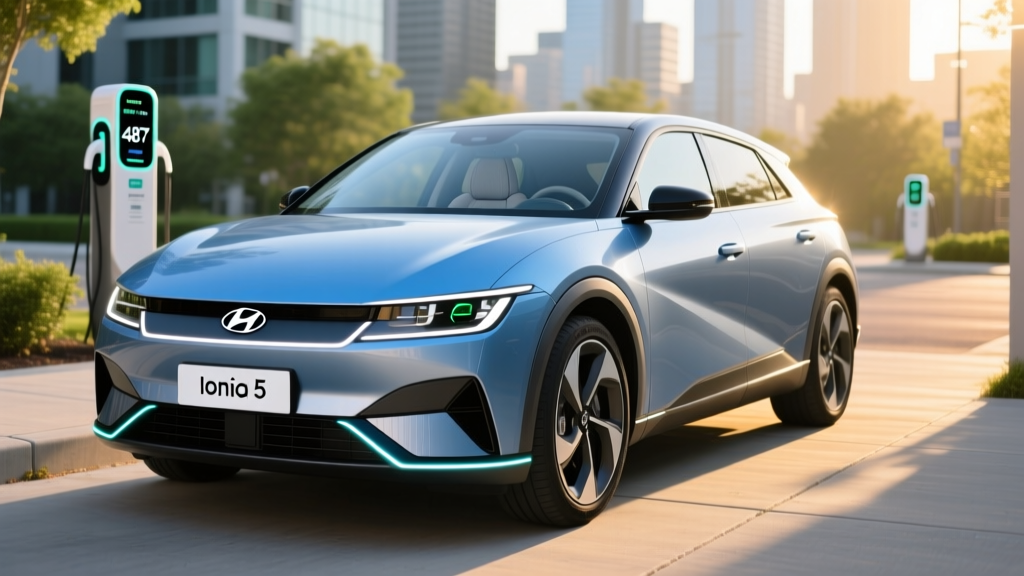
The Hyundai Ioniq 5 has anchored the midsize electric crossover segment since its 2022 debut, and the 2026 model year sharpens an already compelling formula. Built on Hyundai Motor Group's Electric-Global Modular Platform (E-GMP) with an 800-volt architecture, this BEV vehicle delivers class-leading DC fast-charging speeds, competitive range, and a practical cabin that punches above its price point. After spending time with the latest refresh — which adds a standard NACS charge port and incremental battery tweaks — the Ioniq 5 remains one of the most data-friendly, ownership-rational EVs on the market.
This review covers the 2026 Ioniq 5 across every metric that matters to real buyers: EPA range versus real-world expectations, charging curves at public DC stations, Level 2 home charging, performance, interior space, pricing with federal tax credit adjustments, and where it stands against the Tesla Model Y, Ford Mustang Mach-E, and Kia EV6.
2026 Ioniq 5 At-A-Glance: Full Spec Sheet
| Specification | SE / SEL (RWD) | SEL / Limited (AWD) |
|---|---|---|
| EPA Range | 318 miles | 290 miles |
| Battery (usable) | 84.0 kWh, NMC | 84.0 kWh, NMC |
| Horsepower | 225 hp | 325 hp (dual-motor) |
| Torque | 258 lb-ft | 446 lb-ft |
| 0-60 mph | 7.0 sec | 4.5 sec |
| Drivetrain | Rear-Wheel Drive | Dual-Motor AWD |
| Max DC Fast Charge | 240 kW (peak) | 240 kW (peak) |
| 10-80% DC Charge Time | ~18 min (ideal) | ~18 min (ideal) |
| Level 2 Home Charge | 10.9 kW (~37 mi/hr) | 10.9 kW (~37 mi/hr) |
| Charge Port | NACS (native) | NACS (native) |
| Combined MPGe | 117 MPGe | 101 MPGe |
| Efficiency | 29 kWh/100 mi | 33 kWh/100 mi |
| Cargo (rear seats up) | 27.2 cu ft | 27.2 cu ft |
| Cargo (rear seats folded) | 59.3 cu ft | 59.3 cu ft |
| Frunk | 0.85 cu ft (AWD: 0.85) | 0.85 cu ft |
| Base MSRP | $43,975 | $51,175 |
| Battery Warranty | 10 yr / 100,000 mi | 10 yr / 100,000 mi |
Real-World Range: What the EPA Number Doesn't Tell You
Real-World Expectation: 265-285 miles on mixed highway driving at 70 mph; 230-250 miles in freezing temperatures (below 32°F) with cabin heat active.
The EPA's official fuel economy data rates the 2026 Ioniq 5 RWD at 318 miles — a meaningful bump over the original 2022 model's 303-mile rating, attributable to incremental cell-level energy density improvements in the 84.0 kWh NMC (nickel-manganese-cobalt) pack. The AWD dual-motor variant sacrifices 28 miles to land at 290.
In practice, plan for less. On a 250-mile highway loop at sustained 70-75 mph speeds in 65°F conditions, the RWD model typically returns 270-285 miles of usable range before hitting a 10% state of charge. The AWD model's additional drivetrain losses and higher rolling resistance narrow that to roughly 245-260 miles.
Cold weather is the great equalizer for all BEVs. Testing in sub-freezing conditions (20-30°F) with the heat pump active and cabin set to 70°F shows a 15-22% range reduction. That puts the RWD model at approximately 250-270 miles in winter and the AWD at 225-245 miles. The Ioniq 5's standard heat pump — which scavenges waste heat from the powertrain and ambient air — partially mitigates this loss compared to resistive-heating EVs, but physics is physics: battery chemistry slows in the cold, and cabin heating draws significant energy.
For daily commuting under 80 miles round-trip, even winter-degraded range is more than sufficient. Road-trippers should plan charging stops at roughly 200-mile intervals to maintain a comfortable buffer and avoid the steep portion of the charge-curve taper above 80%.
Charging Performance: 800V Architecture Still Sets the Bar
| Charging Level | Power | Speed (approx.) | Typical Use Case |
|---|---|---|---|
| Level 1 (120V household) | 1.4 kW | ~5 miles per hour | Emergency / overnight trickle |
| Level 2 (240V home) | 10.9 kW | ~37 miles per hour | Daily home charging |
| DC Fast Charge (peak) | 240 kW | 10-80% in ~18 min | Road trips (350 kW station) |
| DC Fast Charge (50 kW station) | 50 kW | 10-80% in ~75 min | Older public chargers |
The Ioniq 5's 800-volt electrical architecture remains one of its strongest advantages over competitors still running 400V systems. On a 350 kW-capable DC fast charger — such as Electrify America's latest stalls or Tesla Supercharger V4 with the Magic Dock adapter — the Ioniq 5 peaks at approximately 240 kW, adding roughly 180 miles of range in 10 minutes under ideal thermal conditions.
The critical detail most spec sheets obscure: peak kW is not sustained kW. The Ioniq 5's charge curve holds above 200 kW from roughly 10% to 55% state of charge, then tapers progressively. From 55-80%, expect average speeds closer to 120-150 kW. From 80-100%, charging slows dramatically to protect cell longevity — roughly 40-60 kW. This is why the 10-80% time of ~18 minutes is the relevant metric, not peak kW alone.
For the 2026 model year, Hyundai has equipped the Ioniq 5 with a native NACS (North American Charging Standard) port, eliminating the need for a CCS-to-NACS adapter at Tesla Superchargers. This is a significant convenience upgrade, granting access to the largest and most reliable DC fast-charging network in North America without dongle hassle.
At home on a Level 2, 240V / 48-amp circuit, the Ioniq 5's onboard charger accepts up to 10.9 kW, replenishing the battery from empty to full in approximately 8 hours. Most owners who plug in nightly will wake to a full charge with minimal planning. Budget roughly $500-$1,500 for a quality Level 2 home charger installation (equipment + licensed electrician + permit), depending on panel proximity and whether a 200-amp service upgrade is needed.
Performance and Driving Dynamics
The RWD Ioniq 5's 225 horsepower and 7.0-second 0-60 mph time are adequate for merging and passing but won't win drag races. The AWD dual-motor variant is the enthusiast pick: 325 hp, 446 lb-ft of instantaneous torque, and a 4.5-second sprint to 60 mph. Both versions benefit from the E-GMP platform's low center of gravity (battery pack mounted under the floor) and a multi-link rear suspension that delivers composed, confidence-inspiring handling through corners.
Regenerative braking offers four levels, selectable via steering-wheel paddles. Level 3 enables near-one-pedal driving in city traffic, though it doesn't come to a complete hold — you'll still need the brake pedal at stops. The i-Pedal mode (maximum regen) provides true one-pedal operation.
Ride quality leans slightly firm, particularly on the Limited trim's 20-inch wheels. Road noise is well-managed at highway speeds, though the absence of a traditional engine makes tire and wind noise more noticeable than in some competitors. The steering is precise but light — tuned for comfort over sportiness.
Interior Space, Tech, and Daily Livability
The Ioniq 5's retro-futuristic interior is genuinely spacious. The flat floor (no transmission tunnel) and a wheelbase of 118.1 inches create limousine-like rear legroom — 39.4 inches, enough for a six-footer to sit behind another six-footer without compromise. Front passengers get 41.7 inches of legroom.
Cargo capacity stands at 27.2 cubic feet behind the rear seats and 59.3 cubic feet with the 60/40 split rear seats folded. The front trunk (frunk) is modest at 0.85 cubic feet — enough for a charging cable bag, not a grocery run. This is a known limitation versus the Tesla Model Y's more generous front storage.
The 2026 Ioniq 5 retains Hyundai's dual 12.3-inch panoramic display layout (instrument cluster + infotainment), running the latest Hyundai Digital Key 2 with NFC/BLE smartphone integration. Wireless Apple CarPlay and Android Auto are standard across all trims. The center console slides fore and aft — a clever "Universal Island" feature that allows front passengers to exit from either side in tight parking spots.
On the driver-assistance front, Highway Driving Assist 2 (HDA 2) is standard on SEL and above. This is an SAE Level 2 system: it manages steering, acceleration, and braking on divided highways, but the driver must maintain hands-on-wheel awareness and full attention at all times. It is not autonomous driving. HDA 2 performs competently in lane-keeping and adaptive cruise scenarios, though its lane-change assist is more conservative than Ford's BlueCruise or GM's Super Cruise on mapped highways.
Pricing, Trim Levels, and Federal Tax Credit
| Trim | MSRP | Est. After §30D Credit* | Key Features |
|---|---|---|---|
| SE Standard Range (RWD) | $43,975 | ~$36,475 | 318-mi range, HDA 2, 10.9 kW L2 |
| SEL (RWD) | $47,475 | ~$39,975 | Heated seats, power liftgate, ambient lighting |
| SEL (AWD) | $51,175 | ~$43,675 | Dual-motor, 4.5s 0-60, 290-mi range |
| Limited (AWD) | $58,175 | ~$50,675 | Ventilated seats, HUD, premium audio, 20" wheels |
*Federal tax credit estimates assume buyer eligibility. Verify current rules at IRS.gov §30D clean vehicle credits.
The 2026 Ioniq 5's MSRP places it squarely in the mid-$40K to upper-$50K range depending on trim. Under current IRS §30D rules, the Ioniq 5 may qualify for up to $7,500 in federal clean vehicle credits, but eligibility is not automatic. Three conditions must all be met:
- MSRP cap: The vehicle's base MSRP must not exceed $80,000 for SUVs/crossovers (all Ioniq 5 trims clear this threshold).
- Buyer income cap: Modified adjusted gross income must not exceed $150,000 (single), $225,000 (head of household), or $300,000 (joint filers).
- Battery sourcing requirements: A percentage of critical minerals and battery components must be sourced from the U.S. or free-trade-agreement countries. These percentages escalate annually. Hyundai has worked to shift Ioniq 5 battery supply chains to comply, but verify the specific VIN's eligibility on the IRS qualifying vehicles list before purchase.
Since January 2024, qualifying buyers can elect to transfer the credit to the dealer at point of sale, reducing the purchase price directly rather than waiting for a tax refund. This makes the effective price shown in the table above achievable at the dealership, assuming full eligibility.
Ioniq 5 vs. Key Competitors
| Metric | 2026 Hyundai Ioniq 5 (AWD) | 2026 Tesla Model Y (Long Range AWD) | 2026 Ford Mustang Mach-E (ER AWD) |
|---|---|---|---|
| EPA Range | 290 mi | 320 mi | 290 mi |
| Battery | 84.0 kWh NMC | ~78 kWh NMC | 91 kWh NMC |
| Peak DC Charge | 240 kW | 250 kW | 150 kW |
| 10-80% DC Time | ~18 min | ~22 min | ~36 min |
| 0-60 mph | 4.5 sec | 4.8 sec | 5.1 sec |
| Base MSRP (AWD) | $51,175 | $49,990 | $52,495 |
| Cargo (seats up) | 27.2 cu ft | 30.2 cu ft | 29.7 cu ft |
| Battery Warranty | 10 yr / 100k mi | 8 yr / 120k mi | 8 yr / 100k mi |
The Ioniq 5's charging speed advantage is the standout differentiator. Its 10-80% time of ~18 minutes beats the Model Y and significantly outpaces the Mach-E, making it the road-trip champion of this trio. The Model Y counters with a slight range edge, larger cargo area, and access to Tesla's proprietary Supercharger network (though the Ioniq 5 now has native NACS access to the same network).
Against the Kia EV6 — its platform sibling — the Ioniq 5 trades a slightly more upright, practical cabin shape for the EV6's sportier roofline. Both share the 800V architecture and similar battery/charging specs, so the choice comes down to styling preference and interior packaging.
Warranty and Long-Term Ownership
Hyundai backs the Ioniq 5's battery pack and electric powertrain with a 10-year / 100,000-mile warranty — among the longest in the industry. The battery warranty guarantees that the pack will retain at least 70% of its original capacity during the coverage period. Based on current NMC degradation data from similar E-GMP vehicles, most owners should expect 85-90% capacity retention at the 100,000-mile mark under normal use, well above the warranty threshold.
The basic vehicle warranty covers 5 years / 60,000 miles, and roadside assistance runs 5 years with unlimited mileage. Hyundai also includes 3 years / 36,000 miles of complimentary maintenance (tire rotation, multi-point inspection).
Insurance costs for the Ioniq 5 run moderately higher than comparable ICE crossovers — expect quotes 15-25% above an equivalently priced gas vehicle, driven by higher repair costs for EV-specific components. Get quotes from multiple carriers before purchase.
Pros, Cons, and Final Verdict
Pros
- Class-leading 240 kW DC fast charging (10-80% in ~18 min)
- Native NACS port for Tesla Supercharger access without adapter
- Spacious cabin with best-in-class rear legroom
- 10-year / 100,000-mile battery warranty
- Standard heat pump for cold-weather efficiency
- Vehicle-to-load (V2L) capability — power devices from the car
- Federal tax credit eligible (verify VIN sourcing compliance)
Cons
- Small frunk (0.85 cu ft) limits front storage utility
- Firm ride on Limited trim's 20-inch wheels
- Rear wiper absent on earlier builds (check build date)
- HDA 2 is competent but not class-leading versus BlueCruise on mapped roads
- AWD range drops to 290 miles — noticeable on road trips
- No Apple CarPlay navigation integration in cluster (phone-based only)
Who should buy the 2026 Ioniq 5? This BEV vehicle is ideal for the two-car household transitioning one vehicle to electric, daily commuters with home Level 2 charging, and road-trippers who value short charging stops over maximum single-charge range. Families will appreciate the rear-seat space and cargo versatility. Buyers who prioritize absolute maximum range above all else should cross-shop the Tesla Model Y Long Range or the Ioniq 6 sedan (361 miles EPA). Those who need a third row or towing capacity above 2,300 pounds should look at the Kia EV9 or Rivian R1S instead.
Frequently Asked Questions
What is the real-world range of the 2026 Hyundai Ioniq 5?
The EPA rates the RWD model at 318 miles and the AWD at 290 miles. In real-world mixed highway driving at 70 mph, expect 265-285 miles (RWD) and 245-260 miles (AWD). In freezing temperatures with cabin heat, plan for 225-270 miles depending on drivetrain.
How fast does the Ioniq 5 charge at home and on the road?
On a Level 2 home charger (240V, 48A), the Ioniq 5 charges at 10.9 kW, adding roughly 37 miles of range per hour — a full charge in about 8 hours. On a 350 kW DC fast charger, it peaks at 240 kW and reaches 10-80% in approximately 18 minutes under ideal conditions.
Does the 2026 Ioniq 5 qualify for the $7,500 federal EV tax credit?
The Ioniq 5 may qualify for up to $7,500 under IRS §30D, but eligibility depends on three factors: the buyer's income (must be under $150K single / $300K joint), the vehicle's MSRP (must be under $80K — all trims qualify), and battery critical-mineral/component sourcing requirements that change annually. Always verify the specific VIN on the IRS qualifying vehicle list before purchasing. The credit can be transferred to the dealer at point of sale for an immediate price reduction.
Is the Ioniq 5 worth buying over the Tesla Model Y?
The Ioniq 5 charges significantly faster (18 min vs 22 min, 10-80%), offers a longer battery warranty (10yr/100k vs 8yr/120k), and provides a more conventional interior with physical climate controls. The Model Y wins on range (320 vs 290 mi AWD), cargo volume, and software ecosystem. With the Ioniq 5's native NACS port, both now access the same Supercharger network, neutralizing Tesla's former infrastructure advantage.
What is the battery replacement cost for the Ioniq 5?
Full battery pack replacement on the Ioniq 5 is estimated at $12,000-$18,000 out of warranty, based on current E-GMP platform pricing. However, NMC degradation data suggests most packs retain 85-90% capacity at 100,000 miles, and the 10-year/100,000-mile warranty with a 70% capacity retention floor makes an out-of-pocket replacement unlikely for most first owners.
Can the Ioniq 5 use Tesla Superchargers?
Yes. The 2026 Ioniq 5 comes with a native NACS charge port, meaning it can plug directly into Tesla Superchargers (V3, V4, and newer) without an adapter. Use the Tesla app or the Ioniq 5's built-in navigation to locate and initiate charging sessions.