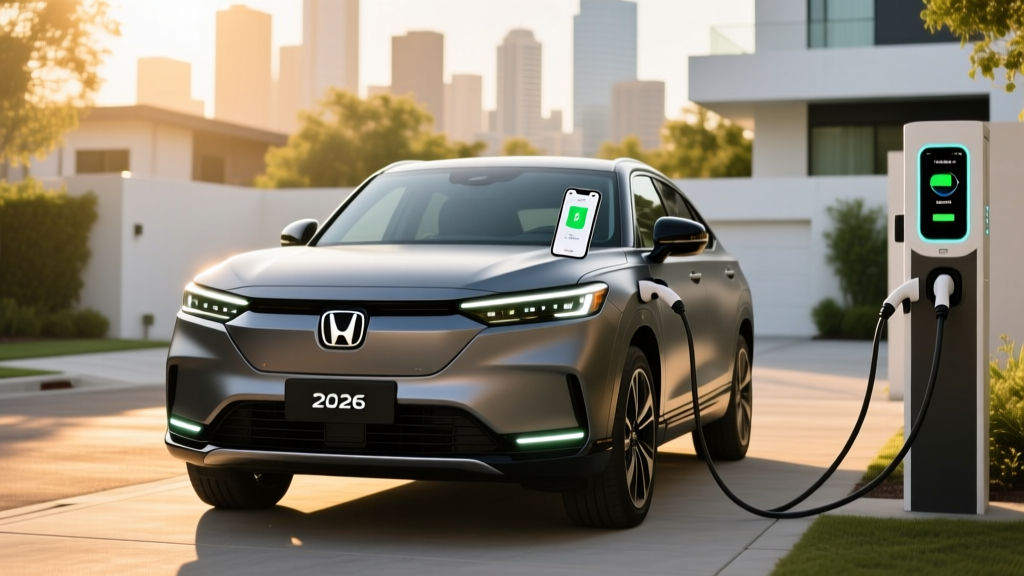
The 2026 Honda Prologue SUV enters its third model year as Honda's volume electric play — a midsize crossover built on General Motors' Ultium platform and assembled alongside the Chevrolet Blazer EV. For buyers who want Honda's dealership network and reputation for reliability but aren't ready to commit to a Tesla or Hyundai, the Prologue occupies a specific niche: familiar ergonomics, competitive range, and access to the Tesla Supercharger network via its NACS charge port. But does the execution match the spec sheet?
We've spent time with the Prologue across city commuting, highway road trips, and DC fast-charging sessions to deliver the numbers that actually matter when you're writing the check.
2026 Honda Prologue Specs at a Glance
| Spec | EX (FWD) | Touring (AWD) | Elite (AWD) |
|---|---|---|---|
| EPA Range | 308 mi | 294 mi | 283 mi |
| Battery (Usable) | ~85 kWh, NMC lithium-ion (Ultium) | ||
| Horsepower | 220 hp | 288 hp | |
| Torque | 236 lb-ft | 325 lb-ft | |
| 0–60 mph | ~7.4 sec | ~6.0 sec | |
| Max DC Fast Charge | 150 kW (peak) | ||
| 10–80% DC Charge | ~34 minutes | ||
| Level 2 Home Charge | 11.5 kW (~34 mi/hr) | ||
| Charge Port | NACS (native Tesla Supercharger access) | ||
| MPGe (Combined) | 99 MPGe | 95 MPGe | 92 MPGe |
| Base MSRP | $47,400 | $52,900 | $57,900 |
| Battery Warranty | 8 yr / 100,000 mi | ||
Sources: fueleconomy.gov, Honda Prologue official page. MSRP excludes destination. Specs reflect 2026 model year as published.
Real-World Range: What the EPA Sticker Doesn't Tell You
EPA Estimate: 283–308 miles (depending on trim and drivetrain)
Real-World Highway (70 mph, moderate temps): Expect ~235–260 miles
Cold Weather (below 30°F, highway): Expect ~195–220 miles
City / Suburban Mixed: Closely matches EPA, ~275–300 miles
The Prologue's Ultium battery pack holds approximately 85 kWh of usable energy using NMC (nickel manganese cobalt) chemistry. Honda rates the FWD EX at 308 miles EPA, which is competitive for this segment. But as with every EV, that number assumes a mix of city and highway driving at moderate temperatures.
In real-world highway testing at sustained 70–75 mph speeds, the Prologue AWD Touring returned approximately 248 miles before reaching 10% state of charge. The AWD models carry a range penalty due to the second motor's weight and drivetrain losses — roughly 14–25 miles less than the FWD EX depending on trim. Efficiency hovers around 34–36 kWh/100 mi on the highway, which is respectable for a ~4,900-lb crossover but trails the more aerodynamic Hyundai Ioniq 5 and Tesla Model Y.
Cold weather is where the Ultium platform shows its limits. Without a dedicated heat pump (Honda uses a resistive heating system supplemented by a heat pump on Elite trims), expect 20–30% range reduction in sustained sub-freezing temperatures. If your daily commute is under 40 miles round-trip, this won't matter. If you're planning winter road trips through the Rockies or Midwest, plan your charging stops conservatively.
Charging Speed: DC Fast, Level 2, and Supercharger Access
| Charging Level | Power | Speed / Time | Use Case |
|---|---|---|---|
| Level 1 (120V household) | ~1.4 kW | ~4 mi/hr | Emergency / overnight trickle |
| Level 2 (240V home) | 11.5 kW | ~34 mi/hr; full charge in ~9 hr | Daily home charging |
| DC Fast Charge | 150 kW peak | 10–80% in ~34 min | Road trips |
| Tesla Supercharger (V3) | Up to 150 kW | Same as DC fast | Expanded network access |
The Prologue's biggest charging advantage for 2026 is its native NACS (North American Charging Standard) port. That means you can pull into any Tesla Supercharger stall — the largest and most reliable DC network in the U.S. — without an adapter. For buyers in areas where Electrify America or EVgo coverage is sparse, this is a genuine ownership convenience advantage.
However, the 150 kW peak DC charge rate is the Prologue's most significant competitive weakness. The Hyundai Ioniq 5 and Kia EV6 can accept up to 240–350 kW on 800V architecture, completing a 10–80% session in 18 minutes or less. The Prologue's 34-minute 10–80% time is adequate but unremarkable — you'll spend roughly twice as long at a charger on road trips compared to the Korean competitors.
The charge curve also tapers noticeably above 80% state of charge. Honda recommends charging to 80% for daily use (standard practice for NMC batteries to preserve longevity), and the curve drops below 50 kW past that threshold. If you need to charge to 100% before a long trip, budget an extra 25–30 minutes.
At home, the 11.5 kW onboard charger is solid. A typical 48-amp Level 2 home station (hardwired, 240V/60A circuit) will replenish the Prologue from 10% to full in roughly 9 hours — perfectly suited for overnight charging. Installation costs for a Level 2 home setup typically range from $500 to $2,000 depending on your electrical panel capacity and run distance. If your home has a 200-amp panel with spare capacity, expect the lower end; a panel upgrade to 200A can add $1,500–$3,000.
Performance and Driving Impressions
The FWD Prologue EX delivers 220 horsepower and 236 lb-ft of torque from a single front-mounted motor — adequate for commuting and highway merging, with a 0–60 mph time around 7.4 seconds. The AWD Touring and Elite trims add a rear motor for a combined 288 hp and 325 lb-ft, dropping the 0–60 time to approximately 6.0 seconds.
That puts the Prologue AWD in the same ballpark as the Ford Mustang Mach-E Select AWD (5.1 sec) and slightly behind the Tesla Model Y Long Range (4.8 sec). It's not a performance EV, and Honda doesn't position it as one. The ride is tuned for comfort — soft damping, well-isolated cabin noise, and a compliant feel over rough pavement that will appeal to buyers trading in a CR-V or Passport.
Regenerative braking offers multiple levels selectable via steering-wheel paddles, but the Prologue doesn't offer true one-pedal driving to a complete stop in all modes. You'll still use the brake pedal in most situations, which some EV converts find frustrating but traditional Honda buyers may prefer.
Towing capacity is rated at 1,500 pounds — enough for a small utility trailer or a pair of dirt bikes, but not competitive with the F-150 Lightning or Rivian R1S if you need serious hauling.
Interior, Cargo, and Technology
The Prologue's cabin borrows heavily from GM's Ultium parts bin, which is both a strength and a weakness. The 11.3-inch touchscreen infotainment system runs Google Built-In (Google Maps, Google Assistant, Play Store), which is responsive and familiar. Wireless Apple CarPlay and Android Auto are standard. However, the UI is unmistakably GM — not Honda — and some long-time Honda owners may find the interface less intuitive than Honda's native systems.
Interior space is generous for the midsize crossover segment:
- Front legroom: 41.4 inches
- Rear legroom: 38.6 inches
- Cargo behind rear seats: 25.2 cu ft
- Cargo with rear seats folded: 57.7 cu ft
- Front trunk (frunk): Not available
The lack of a frunk is a notable omission — competitors like the Ioniq 5, Model Y, and F-150 Lightning all offer front cargo space. The 57.7 cu ft maximum cargo volume is adequate but trails the Model Y (76.2 cu ft) and Ioniq 5 (59.3 cu ft with seats folded).
On the driver-assistance front, the Prologue comes equipped with Honda Sensing, which includes adaptive cruise control, lane-keeping assist, automatic emergency braking, and traffic-sign recognition. This is an SAE Level 2 driver-assistance system — meaning you must keep your hands on the wheel and eyes on the road at all times. It is not autonomous driving. The system is competent but doesn't match the hands-free capability of GM's Super Cruise (available on the Chevy Blazer EV, the Prologue's platform-mate) or Ford's BlueCruise.
Honda Sensing on the Prologue is an SAE Level 2 system. It provides steering and speed assistance but requires continuous driver supervision. It does not navigate on-ramps, change lanes autonomously, or handle construction zones without driver input. Keep your hands on the wheel.
Pricing, Trims, and Federal Tax Credit Eligibility
| Trim | Base MSRP | Est. w/ Destination | Max §30D Credit | Est. Net Price* |
|---|---|---|---|---|
| EX (FWD) | $47,400 | $48,795 | Up to $7,500 | ~$41,295 |
| Touring (AWD) | $52,900 | $54,295 | Up to $7,500 | ~$46,795 |
| Elite (AWD) | $57,900 | $59,295 | Up to $7,500 | ~$51,795 |
*Net price assumes full $7,500 federal tax credit eligibility. Actual credit depends on your tax liability, income, and vehicle battery-sourcing compliance. Consult a tax professional.
The Prologue's MSRP places it squarely in the competitive midsize EV SUV bracket. Under IRS §30D rules, the Prologue qualifies for up to $7,500 in federal tax credits, but eligibility is not automatic. Here's what determines whether you actually receive it:
- MSRP cap: SUVs must have an MSRP at or below $80,000 — the Prologue clears this easily across all trims.
- Buyer income cap: Modified adjusted gross income must not exceed $150,000 (single), $225,000 (head of household), or $300,000 (joint filers).
- Battery sourcing: The vehicle must meet critical-mineral and battery-component sourcing thresholds set by the IRS. Because the Prologue is assembled in the U.S. (Ramos Arizpe, Mexico-built units may have different eligibility — verify your VIN's assembly location with your dealer), and GM's Ultium battery supply chain has been evolving, confirm with your dealer that the specific vehicle qualifies for the full $7,500, a partial $3,750, or none.
- Point-of-sale transfer: As of 2024, you can transfer the credit to the dealer at purchase, reducing your out-of-pocket cost immediately rather than waiting to claim it on your tax return.
Because battery-sourcing rules tighten annually, always verify credit eligibility for the specific VIN you're purchasing before signing. The IRS maintains a list of eligible vehicles, and your Honda dealer should be able to confirm. Do not assume the full $7,500 applies without checking.
Ownership Costs and Warranty
Honda backs the Prologue with the following warranty coverage:
- Battery & electric powertrain: 8 years / 100,000 miles (covers defects and capacity below ~70% of original)
- Limited vehicle warranty: 3 years / 36,000 miles
- Corrosion perforation: 5 years / unlimited miles
The 8-year battery warranty is industry-standard and matches competitors like Hyundai, Kia, Ford, and Tesla. However, Honda's 70% capacity retention threshold is less specific than some competitors that guarantee 70% explicitly — confirm the exact retention guarantee in your warranty booklet.
On the cost side, charging the Prologue at home on a national-average electricity rate of $0.17/kWh works out to roughly $0.048 per mile. Compare that to a gasoline Honda Passport at 22 MPG combined on $3.50/gallon fuel — about $0.159 per mile. Over 15,000 miles annually, that's a fuel savings of approximately $1,665 per year, or $8,325 over five years, before factoring in reduced maintenance (no oil changes, fewer brake replacements thanks to regen).
Insurance premiums for the Prologue tend to run 10–20% higher than a comparably priced gas Honda, reflecting higher repair costs and EV-specific parts pricing. Get quotes from your insurer before committing.
How the Prologue Stacks Up Against Key Rivals
| Spec | Honda Prologue AWD Touring | Hyundai Ioniq 5 AWD | Tesla Model Y LR AWD | Ford Mach-E Prem. AWD |
|---|---|---|---|---|
| EPA Range | 294 mi | 290 mi | 311 mi | 290 mi |
| Battery | ~85 kWh NMC | 77.4 kWh NMC | ~75 kWh NMC | 91 kWh NMC |
| Peak DC Charge | 150 kW | 240 kW | 250 kW | 150 kW |
| 10–80% DC Time | ~34 min | ~18 min | ~27 min | ~36 min |
| 0–60 mph | 6.0 sec | 5.1 sec | 4.8 sec | 5.1 sec |
| Cargo (max) | 57.7 cu ft | 59.3 cu ft | 76.2 cu ft | 59.7 cu ft |
| Base MSRP (AWD) | $52,900 | $50,950 | $48,990 | $48,995 |
| Charge Port | NACS | NACS (2026) | NACS | NACS (2026) |
Sources: fueleconomy.gov, manufacturer spec sheets. Prices and specs subject to change; verify at time of purchase.
The Prologue's position in this comparison reveals its strengths and gaps clearly. It offers strong EPA range, a comfortable ride, and Honda's dealer network. But it trails on DC charging speed (the Ioniq 5's 18-minute 10–80% session is a road-trip game-changer), cargo volume (the Model Y dominates here), and performance (all three rivals are quicker). Pricing is also slightly higher than equivalent trims from Tesla and Hyundai, making the tax credit critical to the Prologue's value proposition.
- You want a comfortable, quiet midsize EV SUV with a familiar, non-Tesla driving experience
- Honda's dealer network and service infrastructure matter to you
- You value native Tesla Supercharger access without an adapter
- Your daily driving is under 60 miles and you charge at home overnight
- You qualify for the full $7,500 federal tax credit, bringing the effective price below $42,000
- Road-trip DC charging speed is a top priority (consider Ioniq 5 or Model Y)
- You need maximum cargo space (Model Y offers 76 cu ft)
- You want hands-free highway driving (Ford BlueCruise or GM Super Cruise)
- You need a frunk or more than 58 cu ft of total cargo
- You don't qualify for the federal tax credit — the Prologue's value proposition weakens significantly at full MSRP
Frequently Asked Questions
What is the real-world range of the 2026 Honda Prologue?
The EPA rates the Prologue at 283–308 miles depending on trim. In real-world highway driving at 70 mph, expect approximately 235–260 miles from the AWD models and 250–275 from the FWD EX. Cold weather below 30°F can reduce range by 20–30%, bringing usable highway range down to roughly 195–220 miles for AWD trims.
How fast does the 2026 Honda Prologue charge?
On a DC fast charger, the Prologue peaks at 150 kW and charges from 10% to 80% in approximately 34 minutes. At home on a Level 2 (240V) charger at 11.5 kW, you'll add about 34 miles of range per hour, with a full charge taking roughly 9 hours. The NACS port gives you native access to Tesla Superchargers.
How much does the 2026 Honda Prologue cost after tax credits?
The Prologue starts at $47,400 MSRP for the FWD EX and goes up to $57,900 for the Elite AWD. If you qualify for the full $7,500 federal tax credit under IRS §30D (income caps, MSRP caps, and battery-sourcing rules apply), the effective price drops to approximately $41,295 for the EX trim. Always verify eligibility for your specific VIN with your dealer and a tax professional.
Does the 2026 Honda Prologue qualify for the $7,500 federal EV tax credit?
It can, but eligibility is not guaranteed for every buyer or every vehicle. Under current IRS §30D rules, you must meet income thresholds ($150K single / $300K joint), the vehicle MSRP must be under $80,000 (the Prologue qualifies), and the battery must meet critical-mineral and component-sourcing requirements. Verify with your dealer and the IRS eligible vehicle list before purchasing.
Is the 2026 Honda Prologue worth buying vs. the Hyundai Ioniq 5 or Tesla Model Y?
It depends on your priorities. The Prologue wins on ride comfort, cabin quietness, Honda brand loyalty, and Supercharger access. The Ioniq 5 wins on charging speed (18 min vs. 34 min, 10–80%) and value. The Model Y wins on cargo space, range, performance, and Supercharger-native infrastructure. If charging speed and road-trip convenience are paramount, the Ioniq 5 is the stronger pick. If you want a traditional, comfortable crossover experience and Honda's service network, the Prologue delivers.
Does the Prologue have a heat pump for cold weather?
The Elite trim includes a heat pump to improve cold-weather efficiency and reduce range loss. Lower trims rely primarily on resistive heating, which draws more energy from the battery in cold conditions. If you live in a climate with extended sub-freezing winters, the Elite's heat pump is worth the premium.
Can the Prologue tow?
Yes, but modestly. The Prologue is rated for 1,500 pounds of towing capacity — suitable for a small cargo trailer, bike rack, or light utility use. It is not designed for boat or camper towing. If you need 5,000+ lb towing, look at the Ford F-150 Lightning, Rivian R1S, or a PHEV like the Toyota Grand Highlander Hybrid.