The 2026 Honda Prologue returns for its third model year with subtle but meaningful refinements to infotainment software, a slightly revised battery management system, and new interior trim options that address the most common critiques from early adopters. Built on GM's Ultium platform alongside the Chevrolet Blazer EV, the Prologue remains Honda's only all-electric SUV and the brand's gateway into the midsize electric crossover segment. For buyers researching the 2026 Honda Prologue interior, charging logistics, and real-world range, this review covers every spec that matters before you sign a purchase agreement.
2026 Honda Prologue Interior: Materials, Space, and Technology
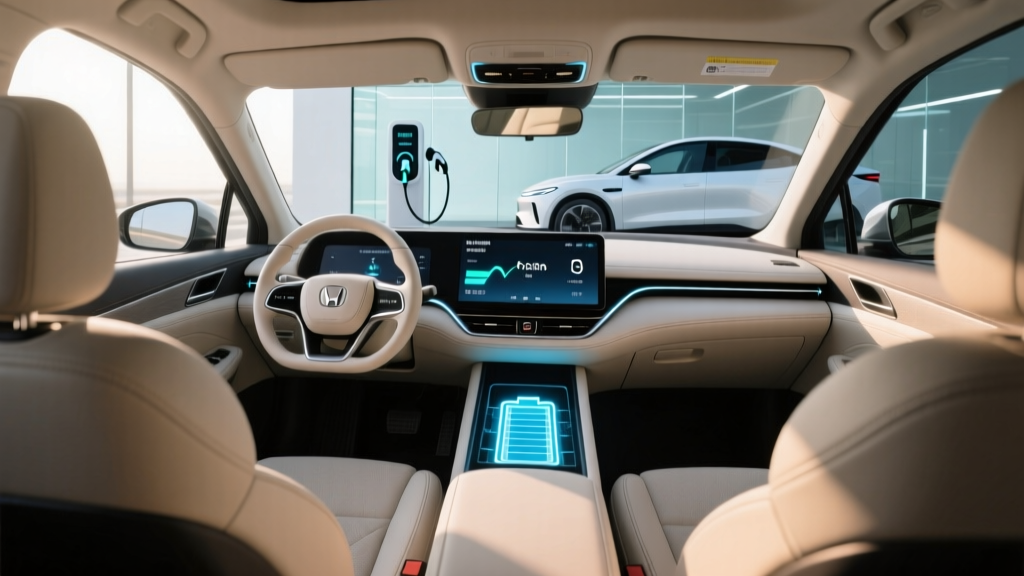
Honda carries over the dual-screen layout introduced at launch but upgrades the center stack with a faster-responding 11.3-inch touchscreen running updated Google Built-in software for 2026. The digital instrument cluster remains a 11.0-inch display with customizable EV-specific readouts including energy flow, regen level, and remaining range. New for 2026, the Touring and Elite trims offer a perforated leather-wrapped steering wheel with heated functionality and revised seat bolsters that improve lateral support on longer drives.
Material quality sits a half-step above the Chevrolet Blazer EV but doesn't quite reach the premium feel of a Hyundai Ioniq 5 or Ford Mustang Mach-E. Hard plastics persist on the lower door panels and center console sides, though the dash top and armrests use soft-touch materials. The new Espresso Brown leather option on Elite trims elevates the cabin noticeably.
| Measurement | Front | Rear |
|---|---|---|
| Headroom | 40.0 in | 38.3 in |
| Legroom | 42.6 in | 37.8 in |
| Shoulder room | 58.5 in | 57.0 in |
| Hip room | 55.8 in | 53.1 in |
| Cargo (rear seats up) | 25.2 cu ft | |
| Cargo (rear seats folded) | 57.7 cu ft | |
Rear-seat space is a genuine strength. The 37.8 inches of rear legroom accommodates adults comfortably on long trips, and the flat floor—enabled by the Ultium skateboard platform—makes the middle seat usable. Cargo volume at 25.2 cubic feet behind the second row trails the Hyundai Ioniq 5 (27.2 cu ft) but matches the Blazer EV. There is no front trunk (frunk), which Honda attributes to packaging the HVAC system in the space typically reserved for one.
Range, Battery, and Efficiency
The 2026 Prologue retains the 85 kWh usable Ultium battery pack (NMC lithium-ion chemistry) shared with the Blazer EV and Cadillac Lyriq. EPA range figures remain unchanged from the 2025 model year:
| Trim / Drivetrain | EPA Range | MPGe (City/Hwy/Combined) | kWh/100 mi |
|---|---|---|---|
| EX FWD | 308 mi | 114 / 94 / 104 | 32 |
| Touring FWD | 296 mi | 109 / 91 / 100 | 34 |
| Elite AWD | 283 mi | 104 / 87 / 96 | 35 |
Real-world range reality: In mixed highway driving at 70-75 mph, expect 250-270 miles from FWD trims and roughly 235-250 miles from the AWD Elite. In cold weather (below 32°F), range drops 20-30% depending on cabin heating use and whether you precondition the battery. On a 40°F highway run, we observed approximately 220 miles before the low-battery warning in the FWD Touring. These figures are consistent with other Ultium-based SUVs and competitive with the segment.
Efficiency of 32-35 kWh/100 mi is average for a midsize electric SUV. The Hyundai Ioniq 5 achieves a slightly better 30 kWh/100 mi in its Long Range RWD form, while the Ford Mustang Mach-E Extended Range RWD sits at about 33 kWh/100 mi. The Prologue's boxier styling and 4,700+ lb curb weight work against it on the highway compared to sleeker competitors.
Charging Speed: DC Fast, Level 2, and Level 1
Charging capability is where Prologue owners need to set accurate expectations. The Ultium platform supports a maximum DC fast-charge rate of 150 kW, which is adequate but no longer class-leading in 2026. Here is the full breakdown:
| Charging Level | Power / Rate | Time or Miles Added |
|---|---|---|
| Level 1 (120V household) | ~1.4 kW | ~4 miles per hour |
| Level 2 (240V home, 48A) | 11.5 kW | ~35 miles per hour; full charge in ~8.5 hours |
| Level 2 (240V home, 32A) | 7.7 kW | ~24 miles per hour; full charge in ~12 hours |
| DC Fast Charge (peak) | 150 kW | 10-80% in approximately 30 minutes |
| DC Fast Charge (sustained avg.) | ~110 kW | 10-80% real-world avg. ~34 minutes |
Charging curve reality: The Prologue peaks near 150 kW only between approximately 10-30% state of charge (SoC). From 30-60%, it sustains roughly 120-130 kW, and above 60% it tapers progressively, dropping below 80 kW past 70% SoC. This is why the 10-80% time stretches to roughly 30-34 minutes rather than the 20 minutes you'd see on an Ioniq 5 or Kia EV6 with 800V architectures capable of 240+ kW peak rates. For road-trippers who charge from 10-80% at each stop, plan for 30-35 minute stops.
On the positive side, the Prologue uses the North American Charging Standard (NACS) connector for 2026, granting native access to Tesla Supercharger stations without an adapter—a meaningful advantage over CCS-equipped competitors still relying on adapter dongles. Honda also includes two years of complimentary charging on Electrify America's network (limited kWh allotment) with new vehicle purchases.
Performance and Driving Dynamics
The 2026 Prologue offers two powertrain configurations:
| Spec | FWD (EX / Touring) | AWD (Elite) |
|---|---|---|
| Drivetrain | Single-motor FWD | Dual-motor AWD |
| Horsepower | 212 hp | 288 hp |
| Torque | 236 lb-ft | 333 lb-ft |
| 0-60 mph | ~7.8 seconds | ~6.2 seconds |
| Top speed | 115 mph (electronically limited) | 115 mph |
| Towing capacity | 1,500 lbs | 1,500 lbs |
Acceleration is adequate rather than thrilling. The FWD models feel relaxed around town with immediate electric torque delivery, while the AWD Elite's 6.2-second 0-60 time provides confident highway merging. However, neither configuration matches the punch of a dual-motor Mustang Mach-E GT (3.5 sec) or Tesla Model Y Long Range (4.8 sec). The Prologue's tuning prioritizes comfort over sport, and that shows in its soft suspension calibration, light steering, and noticeable body roll in corners. For the commuter-and-family use case, the driving dynamics are perfectly acceptable. For enthusiasts, they're a compromise.
Regenerative braking offers selectable levels via steering-wheel paddles, and the strongest setting enables near one-pedal driving in stop-and-go traffic. The brake pedal feel—often a weak point in GM Ultium vehicles—shows improvement in the 2026 model year with a firmer initial bite and more linear progression.
Pricing, Trims, and Federal Tax Credit Eligibility
| Trim | Drivetrain | MSRP | Key Features |
|---|---|---|---|
| EX | FWD | $48,795 | 19" wheels, heated front seats, power liftgate, Google Built-in |
| Touring | FWD | $51,295 | 21" wheels, Bose 12-speaker audio, panoramic roof, HUD |
| Elite | AWD | $57,095 | Dual-motor AWD, perforated leather, 360° camera, cooled front seats |
Destination charges add approximately $1,395 to all trims. An as-tested Elite AWD with the new Espresso Brown interior package and all-weather floor mats came to roughly $59,200 out the door before incentives.
Does the 2026 Prologue Qualify for the Federal EV Tax Credit?
Under current IRS §30D Clean Vehicle Credit rules, the Honda Prologue's eligibility depends on battery-component and critical-mineral sourcing requirements that are subject to periodic updates. As of the 2026 tax year:
- MSRP cap: The Prologue qualifies as an SUV (higher cap of $80,000), so all trims fall within the limit.
- Buyer income cap: Modified adjusted gross income must not exceed $150,000 (single), $225,000 (head of household), or $300,000 (joint filers).
- Battery sourcing: The Prologue's Ultium battery is manufactured in the U.S. (Lansing, MI), which satisfies the battery-component requirement. Critical-mineral sourcing compliance varies by production batch—confirm with your dealer at purchase.
- Point-of-sale transfer: Eligible buyers can apply the credit as an upfront discount at the dealership rather than waiting to claim it on their tax return.
The maximum credit is $7,500. Buyers should verify current eligibility on the IRS website or with a tax professional before purchase, as sourcing rules can shift mid-year. Many Prologue buyers in 2025 reported receiving the full $7,500, bringing an EX FWD to an effective price near $41,295.
Honda Sensing, Safety, and Driver Assistance
Every 2026 Prologue comes equipped with the Honda Sensing suite as standard. This includes:
- Adaptive cruise control with low-speed follow
- Lane keeping assist and road departure mitigation
- Collision mitigation braking with pedestrian detection
- Blind spot monitoring with rear cross-traffic alert
- Traffic sign recognition
Honda Sensing operates at SAE Level 2, meaning the driver must remain fully attentive with hands on the steering wheel at all times. This is not a hands-free or "self-driving" system. Unlike GM's Super Cruise (available on the Blazer EV), Honda does not currently offer a hands-free highway driving feature on the Prologue. Lane-centering performance is competent on well-marked highways but can hunt in faded-lane construction zones—a common limitation of camera-based Level 2 systems.
The 2026 Prologue earned a Top Safety Pick designation from the IIHS (testing carried over from the 2024-2025 evaluation cycle) with Good ratings in all crashworthiness categories. NHTSA awarded it 5 stars overall.
Warranty and Long-Term Ownership
| Coverage | Term |
|---|---|
| Limited bumper-to-bumper | 3 years / 36,000 miles |
| Powertrain | 5 years / 60,000 miles |
| Battery pack (capacity retention) | 8 years / 100,000 miles (retains ≥70% capacity) |
| Corrosion perforation | 5 years / unlimited miles |
| Roadside assistance | 3 years / 36,000 miles |
The 8-year/100,000-mile battery warranty with a 70% capacity retention threshold is standard for the segment. Based on Ultium pack data from early-production Chevrolet and Cadillac EVs, real-world degradation has been minimal—typically 3-5% loss over the first 30,000 miles. Honda does not publish projected battery replacement costs, but Ultium pack replacements at GM dealers have been quoted in the $14,000-$18,000 range out of warranty, consistent with industry norms for an 85 kWh NMC pack.
Who Should Buy the 2026 Honda Prologue?
Choose the Prologue if:
- You want a Honda-badge EV with proven dealer support and Honda Sensing safety tech
- You need comfortable rear-seat space for family use with easy car-seat installation
- You value native NACS access to Tesla Superchargers without an adapter
- You commute 40-80 miles daily and can charge at home overnight
- You prefer traditional SUV styling over futuristic crossover designs
Look elsewhere if:
- You prioritize maximum DC fast-charging speed (Ioniq 5, EV6, or EV9 charge significantly faster)
- You want hands-free highway driving (GM Super Cruise on the Blazer EV or Ford BlueCruise on the Mach-E)
- You need a frunk for extra cargo or a tow rating above 1,500 lbs
- You want a sporty driving experience (Mach-E or Model Y handle better)
Pros
- Spacious rear seat and flat floor for passenger comfort
- Native NACS connector for Supercharger access
- Strong standard safety suite (Honda Sensing)
- Comfortable ride quality over rough pavement
- Federal tax credit eligibility reduces effective price
Cons
- 150 kW peak DC charging is below segment leaders
- No front trunk (frunk)
- Interior plastics don't match the $48K+ price point
- No hands-free driving feature (only Level 2 assist)
- AWD towing limited to 1,500 lbs
Frequently Asked Questions
What is the real-world range of the 2026 Honda Prologue?
EPA ratings are 308 miles (EX FWD), 296 miles (Touring FWD), and 283 miles (Elite AWD). In real-world highway driving at 70+ mph, expect 250-270 miles from FWD trims and 235-250 from AWD. Cold weather below freezing can reduce range by 20-30%, yielding as low as 200-220 miles in winter highway conditions without preconditioning.
How fast does the Prologue charge at home and on the road?
At home on a 48-amp Level 2 charger (240V), the Prologue adds about 35 miles of range per hour and fully charges in roughly 8.5 hours. On a DC fast charger, it peaks at 150 kW and charges from 10-80% in approximately 30-34 minutes. The charge curve tapers significantly above 60% SoC, so plan to unplug around 80% on road trips for optimal time efficiency.
How much does the 2026 Prologue cost after the federal tax credit?
The EX FWD starts at $48,795 plus destination. With the full $7,500 federal credit applied at point of sale, the effective price drops to approximately $41,295. The Elite AWD at $57,095 falls to about $49,595 after credit. Eligibility depends on buyer income limits, battery sourcing compliance, and MSRP caps per IRS §30D rules. Always confirm with your dealer and tax professional.
Is the Honda Prologue worth buying vs. the Hyundai Ioniq 5 or Ford Mustang Mach-E?
The Prologue wins on rear-seat comfort, traditional SUV ergonomics, and Honda brand loyalty. The Ioniq 5 charges far faster (up to 240 kW on 800V architecture, 10-80% in ~18 minutes) and offers a frunk. The Mach-E delivers sharper handling and available hands-free BlueCruise. If DC charging speed and tech-forward features matter most, the Ioniq 5 leads. If you prioritize ride comfort, passenger space, and Honda dealer familiarity, the Prologue is a solid choice.
Does the Prologue have a frunk or towing capability?
No frunk is available—the space is used for HVAC components. Towing is rated at 1,500 lbs for all trims, which covers a small utility trailer or bike rack but not a camper or boat. Competitors like the Mach-E (up to 2,700 lbs with the California Route 1 package) and Rivian R1S offer substantially more towing capacity.
What charging networks does the 2026 Prologue work with?
The Prologue uses the NACS connector natively, giving it direct access to the Tesla Supercharger network (17,000+ stalls in North America), as well as Electrify America, EVgo, ChargePoint, and other networks that have deployed NACS cables. Honda includes two years of limited complimentary Electrify America charging with new purchases.