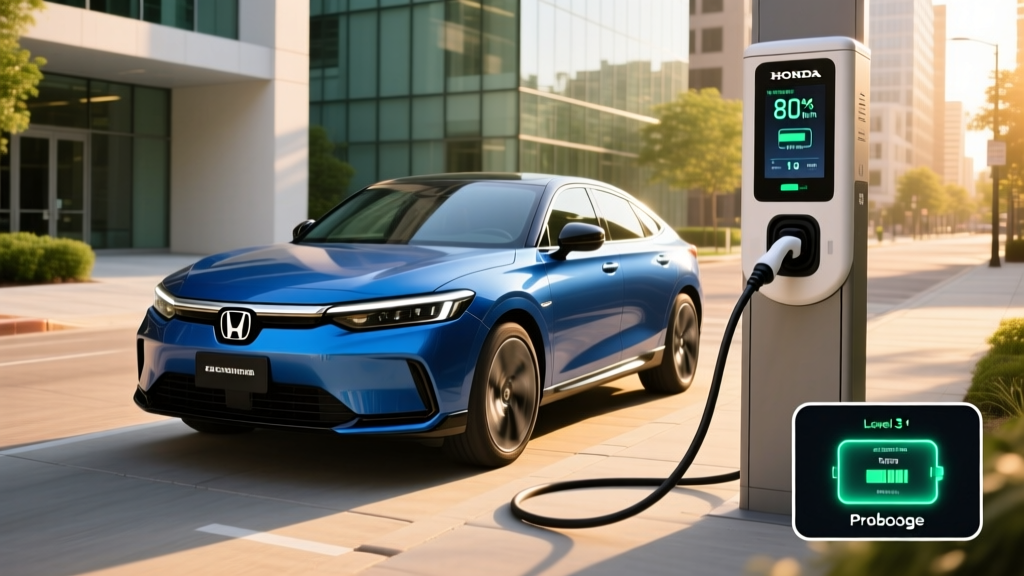
Honda's first dedicated electric SUV returns for 2026 with a familiar formula: General Motors' Ultium platform underneath, Honda's design language on top, and a midsize two-row crossover footprint that competes directly with the Hyundai Ioniq 5, Ford Mustang Mach-E, and Tesla Model Y. The 2026 Honda Prologue EV carries over the 85 kWh (usable) lithium-ion battery pack and available dual-motor all-wheel drive, but Honda has refined software calibration for slightly improved efficiency and added new standard driver-assist features across the lineup.
After spending time with the Prologue in mixed commuting and highway driving, here's what buyers need to know about its real-world range, charging behavior, ownership costs, and where it stacks up in a crowded segment.
Specs at a Glance: 2026 Honda Prologue EV
| Specification | FWD (EX/Touring) | AWD (Elite) |
|---|---|---|
| EPA Range | 296 miles (EX) | 273 miles (Elite) |
| Battery (usable) | 85 kWh, NMC lithium-ion | |
| Horsepower | 220 hp | 288 hp |
| Torque | 236 lb-ft | 325 lb-ft |
| 0–60 mph | ~8.0 sec | ~6.2 sec |
| Max DC Fast Charge | 150 kW peak | |
| 10–80% DC Charge Time | ~35 minutes | |
| Level 2 Home Charging | 11.5 kW (~29 mi/hr) | |
| MPGe (combined) | 99 MPGe | 93 MPGe |
| Efficiency | 34 kWh/100mi | 36 kWh/100mi |
| Cargo (rear seats up) | 25.2 cu ft | |
| Cargo (seats folded) | 57.7 cu ft | |
| Base MSRP | $47,400 (EX) | $52,900 (Elite) |
| Battery Warranty | 8 years / 100,000 miles | |
Real-World Range: What the EPA Sticker Doesn't Tell You
The 85 kWh usable battery uses NMC (nickel manganese cobalt) chemistry, which offers higher energy density than LFP (lithium iron phosphate) but is more sensitive to sustained high states of charge. Honda includes a charge-limit setting in the infotainment system that lets you cap daily charging at 80%—a practice that meaningfully extends long-term battery health. For road trips, you'll want the full 100%, but daily commuters should set and forget the 80% limit.
Compared to the Ioniq 5 Long Range (305 miles EPA) or the Model Y Long Range (320 miles EPA), the Prologue trails slightly on paper. But for the vast majority of commuters driving under 80 miles round-trip, the gap is academic—you're charging at home every night regardless.
Charging Speed: Home, Public, and the Curve Reality
| Charging Level | Power | Speed (miles added) | Typical Use Case |
|---|---|---|---|
| Level 1 (120V outlet) | ~1.4 kW | ~3–4 miles/hour | Emergency/overnight top-off |
| Level 2 (240V home) | 11.5 kW | ~29 miles/hour | Daily home charging (~10 hrs empty-to-full) |
| DC Fast Charge | 150 kW peak | ~170 miles in 30 min | Road trips, 10–80% in ~35 min |
The Prologue's 150 kW peak DC fast-charging rate is its most debated specification. Competitors like the Ioniq 5 and Kia EV6 use 800-volt architectures enabling 230+ kW peak rates, delivering 10–80% charges in roughly 18 minutes. The Prologue's GM Ultium platform operates on a conventional 400-volt architecture, which caps its peak rate and extends the charging curve.
Here's what that means in practice: the Prologue will sustain close to 150 kW between roughly 10% and 40% state of charge. From 40% to 60%, it tapers to approximately 110–120 kW. Above 80%, the rate drops sharply to under 50 kW as the battery management system protects cell longevity. A 10–80% session takes about 35 minutes at a capable 150+ kW station—perfectly acceptable for a lunch stop, but noticeably slower than the 18–22 minute sessions you'd experience in an Ioniq 5 or EV6.
For home charging, the 11.5 kW onboard charger is competitive. A full charge from empty takes roughly 9–10 hours on a Level 2 home station, meaning an overnight session easily replenishes any daily driving. Honda includes a dual-voltage portable charging cord (120V/240V) with the vehicle, though most buyers will want a dedicated wall-mounted Level 2 unit installed by a licensed electrician.
Driving Impressions, Performance, and Efficiency
The Prologue Elite AWD's 288 horsepower and 325 lb-ft of torque deliver confident highway merging and passing. The 6.2-second 0–60 mph time is brisk but not thrilling—this is a family cruiser, not a performance EV. The FWD models at 220 hp feel adequate around town but noticeably less eager at highway speeds.
Ride quality is where the Prologue earns its keep. The GM-sourced suspension tuning is compliant and well-damped, absorbing rough pavement without the floatiness that plagued early Ultium vehicles. Steering is light and predictable. The cabin is quiet at speed, with minimal wind noise and well-suppressed tire roar.
Efficiency in mixed driving lands close to the EPA's 34 kWh/100mi figure for FWD models. AWD variants consume roughly 36 kWh/100mi in practice. For comparison, the Tesla Model Y Long Range achieves around 28 kWh/100mi—meaning the Prologue costs slightly more per mile to operate, though the gap translates to roughly $50–$80 annually for an average driver at residential electricity rates.
Interior Space, Technology, and Daily Livability
The Prologue's 111.5-inch wheelbase translates to generous rear-seat legroom (38.2 inches) and a flat floor that makes the middle seat usable for adults. Cargo capacity at 25.2 cubic feet behind the rear seats is competitive with the Ioniq 5 (27.2 cu ft) but trails the Model Y (30.2 cu ft). Fold the rear seats and you get 57.7 cubic feet—sufficient for furniture-store runs or camping gear.
Honda equips the Prologue with an 11.3-inch touchscreen running Google Built-In, which includes native Google Maps navigation, Google Assistant, and access to the Play Store for apps. The system is responsive and the interface logical, though some buyers may miss Apple CarPlay integration on higher trims (wireless CarPlay and Android Auto are standard on EX and Touring trims but replaced by Google services on Elite). A 11-inch digital instrument cluster provides speed, range, and driver-assist information.
The Honda Sensing suite is standard across all trims and includes adaptive cruise control with stop-and-go, lane-centering assist, blind-spot monitoring, and rear cross-traffic alert. This is SAE Level 2 driver assistance—meaning you must keep your hands on the wheel and eyes on the road at all times. It works well on highways but does not approach the hands-free capability of GM's Super Cruise or Ford's BlueCruise.
Pricing, Trims, and Federal Tax Credit Eligibility
| Trim | Drivetrain | MSRP | Est. After §30D Credit* |
|---|---|---|---|
| EX | FWD | $47,400 | ~$39,900 |
| Touring | FWD | $50,100 | ~$42,600 |
| Elite | AWD | $52,900 | ~$45,400 |
*Federal tax credit estimates assume full eligibility under IRS §30D rules. Actual credit depends on battery component and critical-mineral sourcing requirements, buyer income limits, and MSRP caps. Consult a tax professional.
The 2026 Prologue qualifies for up to $7,500 under the IRS §30D federal clean vehicle credit, provided buyers meet income thresholds (modified adjusted gross income of $150,000 single / $300,000 joint) and the vehicle's MSRP remains under the $80,000 SUV cap. As of the 2026 tax year, the Prologue's battery sourcing compliance has been confirmed by Honda, making it eligible for the full credit.
Buyers can also transfer the credit to the dealer at point of sale under current rules, effectively reducing the purchase price at the dealership rather than waiting for a tax refund. This is a significant cash-flow advantage for buyers who don't want to front the $7,500 and claim it at filing time.
Destination charges add approximately $1,395 to all trims. Honda does not currently offer dealer-installed options packages that significantly alter pricing, keeping the purchase decision relatively straightforward.
How the Prologue Compares to Key Rivals
Against the Hyundai Ioniq 5, the Prologue trades slightly less range and slower DC charging for a more traditional SUV ride height, a softer suspension tune, and Honda's dealer network. The Ioniq 5 charges faster and offers a frunk; the Prologue offers more rear-seat headroom and a more familiar brand experience for first-time EV buyers.
Against the Tesla Model Y, the Prologue is less efficient (higher kWh/100mi), slower to charge, and offers less cargo space. But it provides a more conventional dealership purchase experience, physical buttons for climate controls, and doesn't require buy-in to Tesla's ecosystem. The Model Y remains the efficiency and charging-speed benchmark.
Against the Ford Mustang Mach-E, the Prologue offers comparable range and a more upright seating position but trails in performance (the Mach-E GT hits 0–60 in 3.5 seconds). The Mach-E's BlueCruise offers hands-free highway driving on mapped roads—a feature the Prologue's Honda Sensing suite cannot match.
Pros
- Comfortable, quiet ride quality
- Spacious rear seat and flat floor
- Google Built-In infotainment is responsive
- Honda Sensing driver assists standard on all trims
- Eligible for full $7,500 federal tax credit
- Familiar Honda dealership service network
Cons
- 150 kW DC charging slower than 800V rivals
- Efficiency trails Model Y and Ioniq 5
- No front trunk (frunk)
- No hands-free driving assist option
- Elite AWD trim pushes past $53K before options
- Google Built-In replaces CarPlay on top trim
Who Should Buy the 2026 Honda Prologue EV?
Look elsewhere if: You take frequent 300+ mile road trips and want the fastest possible DC charging (Ioniq 5, EV6), you need maximum cargo capacity (Model Y), or you want hands-free highway driving (Mach-E with BlueCruise, Cadillac Lyriq with Super Cruise).
Frequently Asked Questions
What is the real-world range of the 2026 Honda Prologue EV?
The FWD EX achieves 296 miles EPA, but expect 245–265 miles in real-world highway driving and 210–230 miles in freezing temperatures. The AWD Elite rates at 273 miles EPA, with real-world highway figures around 225–245 miles.
How fast does the Prologue charge at home and on the road?
At home on a 240V Level 2 charger, the Prologue adds about 29 miles per hour (11.5 kW), fully charging overnight. On DC fast chargers, it peaks at 150 kW and completes a 10–80% session in approximately 35 minutes.
Does the 2026 Honda Prologue qualify for the $7,500 federal tax credit?
Yes, as of 2026 the Prologue qualifies for up to $7,500 under IRS §30D, subject to buyer income limits ($150K single / $300K joint MAGI) and the $80K MSRP cap for SUVs. The credit can be transferred to the dealer at point of sale. Always verify current eligibility on irs.gov and consult a tax professional.
Is the Prologue worth buying over the Ioniq 5 or Model Y?
It depends on priorities. The Prologue wins on ride comfort, rear-seat space, and mainstream dealership familiarity. The Ioniq 5 wins on charging speed and the Model Y wins on efficiency and cargo space. All three are strong choices; test-drive each and decide which trade-offs matter to you.
What is the battery warranty on the 2026 Prologue?
Honda covers the battery pack and electric powertrain components for 8 years or 100,000 miles, whichever comes first. The warranty guarantees the battery will retain at least 70% of its original capacity during that period.
Can the Prologue tow?
The Prologue is not rated for towing. Buyers needing towing capability should look at the Ford F-150 Lightning, Rivian R1S, or Hyundai Ioniq 5 (which offers a 1,650-lb tow rating with the appropriate hitch).