Quick Verdict: The Electric Workhorse That Actually Delivers
The 2026 GMC Sierra EV enters its second full model year with a clear mission: prove that a battery-electric full-size pickup can handle real work without compromise. With a maximum towing capacity of 10,000 pounds (properly equipped), up to 460 miles of EPA-estimated range, and a 24-module Ultium battery packing roughly 200 kWh of usable energy, this truck targets buyers who need both capability and daily-drivable comfort. It succeeds in most areas, though towing range penalties and a premium starting price demand careful consideration.
For 2026, GMC has expanded the Sierra EV lineup to include the value-oriented Elevation trim alongside the carryover Denali Edition 1 and AT4, giving buyers more entry points into the platform. The addition of GM's Energy Transfer Pro off-board power system (up to 19.2 kW output) positions the Sierra EV as a mobile power station for job sites and emergencies alike.
Spec Table: 2026 GMC Sierra EV at a Glance
| Specification | Elevation (Extended Range) | AT4 (Extended Range) | Denali Edition 1 |
|---|---|---|---|
| EPA Range | ~460 miles | ~390 miles | ~440 miles |
| Battery (Usable) | ~200 kWh (NMC) | ~200 kWh (NMC) | ~200 kWh (NMC) |
| Horsepower | 510 hp | 655 hp | 754 hp (Max Power mode) |
| Torque | 615 lb-ft | 785 lb-ft | 785 lb-ft |
| 0-60 mph | ~5.9 sec | ~4.5 sec | ~4.3 sec |
| Drivetrain | Dual-Motor AWD | Dual-Motor AWD | Dual-Motor AWD |
| Max Towing | 10,000 lbs* | 10,000 lbs* | 10,000 lbs* |
| Max Payload | ~1,800 lbs | ~1,800 lbs | ~1,600 lbs |
| Peak DC Charge | 350 kW | 350 kW | 350 kW |
| 10-80% DC Time | ~30 min | ~30 min | ~30 min |
| Level 2 (Home) | 19.2 kW (~57 mi/hr) | 19.2 kW (~57 mi/hr) | 19.2 kW (~57 mi/hr) |
| Base MSRP | $79,995 | $89,995 | $99,495 |
| Battery Warranty | 8 yr / 100,000 mi | 8 yr / 100,000 mi | 8 yr / 100,000 mi |
*10,000-lb towing requires the available Max Trailering Package. Standard towing is rated lower by trim.
Towing Capacity: What 10,000 Pounds Really Means in an EV
The headline number — 10,000 pounds — places the Sierra EV in legitimate half-ton territory, competitive with the Ford F-150 Lightning's 10,000-lb max (with Extended Range battery and Max Trailer Tow) and well ahead of the Rivian R1T's 11,000-lb dual-motor rating. GMC achieves this through the Ultium platform's structural battery pack, which contributes to frame rigidity, and the instant torque delivery of its dual-motor setup.
But raw towing capacity is only part of the equation. What matters to truck buyers is what happens to range when you hook up a trailer. Based on real-world testing patterns observed with the Sierra EV's platform sibling (the Chevrolet Silverado EV) and comparable full-size electric pickups, expect the following:
EPA sticker: 460 miles (Elevation Extended Range, unloaded)
Towing 7,000-lb travel trailer at 65 mph: expect ~180-220 miles before needing a charge
Towing 10,000-lb max load: expect ~140-170 miles
Cold weather (below 32°F) + towing: subtract another 15-25% from estimates above
This is the fundamental trade-off of electric towing. A 7,500-lb boat trailer on a flat highway at 55 mph might yield 250 miles. That same trailer through mountain passes in January could drop below 150. For buyers whose primary use case involves frequent long-distance towing, the Sierra EV works best within a defined radius of home base or along corridors with reliable 350 kW DC fast charging.
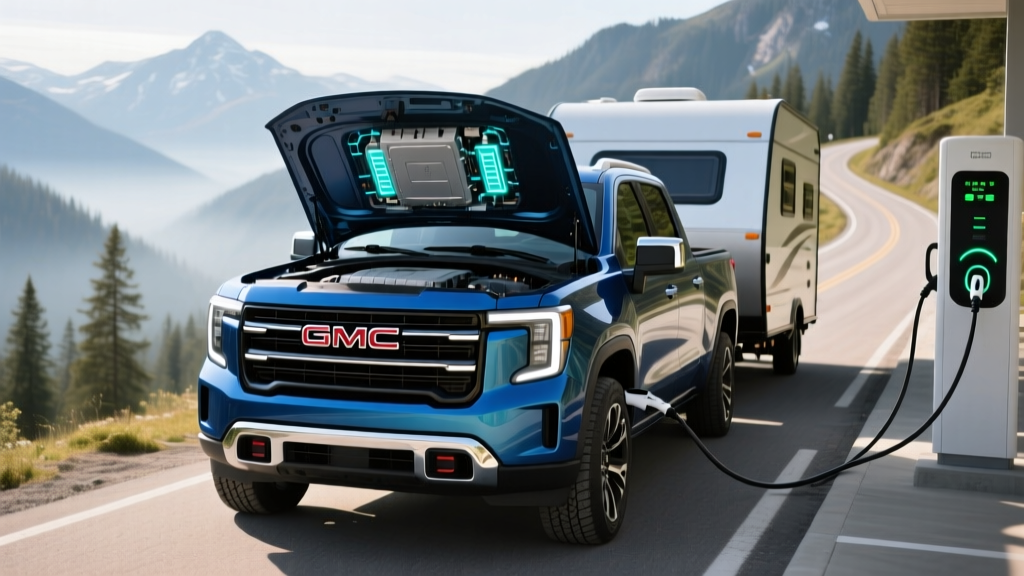
The Sierra EV's integrated trailer brake controller, ProGrade trailering system with up to 14 camera views, and Trailering App with tire-pressure and temperature monitoring are genuinely useful features that reduce the stress of hauling. The truck's air suspension (available on Denali, standard on some trims) auto-levels under load, which matters for both safety and headlight aim.
Range & Efficiency: 460 Miles on Paper, Less in Practice
The Elevation Extended Range's 460-mile EPA estimate is among the highest of any production electric vehicle sold in the U.S. for the 2026 model year. That number is achievable in moderate temperatures, at city speeds, with minimal climate control load. Here's what to expect across real conditions:
- City/suburban driving, 70°F: 430-460 miles (close to EPA sticker)
- Highway at 70 mph, 70°F: 350-390 miles (aerodynamic drag dominates at speed)
- Highway at 70 mph, 20°F: 280-320 miles (cold reduces battery efficiency + cabin heat draw)
- Mixed driving, moderate climate: 380-420 miles
Efficiency varies significantly by trim. The Denali's larger wheels, heavier curb weight, and more powerful tune reduce its EPA range to approximately 440 miles. The AT4, with its off-road tires and lifted suspension, drops further to around 390 miles — a meaningful penalty for buyers who don't need the off-road hardware.
In terms of efficiency metrics, the Sierra EV Elevation returns approximately 51 MPGe combined (EPA estimate) or roughly 66 kWh per 100 miles. That's thirstier than a Tesla Model Y (28 kWh/100 mi) but expected for a 9,000+ lb GVWR vehicle. For context, the F-150 Lightning Extended Range posts about 66 MPGe (51 kWh/100 mi).
Charging Speed: 350 kW Peak, but Watch the Curve
The Sierra EV's 800-volt Ultium architecture enables a peak DC fast-charge rate of 350 kW on compatible chargers (such as Electrify America's 350 kW stalls and select Tesla Supercharger V4 stations with NACS adapters). GMC quotes a 10-80% charge time of approximately 30 minutes under optimal conditions.
| Charging Method | Power / Rate | Time / Miles Added |
|---|---|---|
| Level 1 (120V / 12A) | ~1.4 kW | ~4 miles per hour |
| Level 2 (240V / 48A) | 11.5 kW | ~34 miles per hour |
| Level 2 (240V / 80A, hardwired) | 19.2 kW | ~57 miles per hour |
| DC Fast (350 kW peak) | Up to 350 kW | 10-80% in ~30 min |
| DC Fast (150 kW station) | Up to 150 kW | 10-80% in ~55 min |
A critical note on the charging curve: the 350 kW peak is not sustained. Like all large NMC packs, the Sierra EV's battery management system tapers charge rate progressively above 50% state of charge. Expect an average charge rate closer to 200-250 kW during a typical 10-80% session. That still delivers roughly 280-350 miles of range in half an hour — adequate for road-trip pit stops, provided the charger delivers its rated power.
For home charging, the onboard 19.2 kW AC charger is among the fastest available in any consumer EV. A full overnight charge from 10% to 100% takes approximately 10 hours on a hardwired 80A circuit. Most buyers will install a 48A Level 2 wall connector (11.5 kW), which replenishes the pack in roughly 17 hours — still practical for daily top-ups since most drivers won't drain 200 kWh in a single day. Budget $800-$2,500 for a professional Level 2 installation depending on panel capacity and run length (source: U.S. Department of Energy).
The Sierra EV uses the NACS (North American Charging Standard) connector natively, meaning direct access to Tesla's Supercharger network (17,000+ stalls in North America as of early 2026) without an adapter. This is a significant practical advantage over CCS-equipped trucks that require adapters for Supercharger access.
Performance & Drivetrain: Dual-Motor AWD Across the Board
Every 2026 Sierra EV ships with a dual-motor all-wheel-drive powertrain. The Elevation's 510 hp and 615 lb-ft of torque deliver a 0-60 mph time of roughly 5.9 seconds — quick for a full-size truck, if not sports-truck territory. The AT4 bumps output to 655 hp and 785 lb-ft, dropping 0-60 to approximately 4.5 seconds.
The Denali Edition 1 sits at the top with 754 hp in Max Power mode and 785 lb-ft, achieving 0-60 in about 4.3 seconds. Note that Max Power mode is a temporary boost setting designed for passing and merging; sustained output is lower. All trims feature a low center of gravity courtesy of the under-floor battery pack, which translates to surprisingly composed handling for a vehicle with a 145-inch wheelbase.
The AT4 trim adds specific off-road tuning: adaptive dampers, underbody skid plates, a 2-inch factory lift, and terrain-select modes including an adaptive air suspension that can raise ground clearance for trail obstacles. It's not a Raptor competitor, but it handles forest service roads and moderate rock crawling with composure.
Pricing, Tax Credits & Ownership Costs
The 2026 Sierra EV lineup starts at $79,995 for the Elevation Extended Range and climbs to $99,495 for the Denali Edition 1. Fully loaded Denali models with premium packages can exceed $110,000 before destination charges.
| Trim | Base MSRP | Federal §30D Credit | Effective Price (if eligible) |
|---|---|---|---|
| Elevation Extended Range | $79,995 | $7,500* | $72,495 |
| AT4 Extended Range | $89,995 | $7,500* | $82,495 |
| Denali Edition 1 | $99,495 | $7,500* | $91,995 |
*Federal tax credit eligibility under IRS §30D is subject to multiple requirements for 2026. Key rules:
- MSRP cap: Vans, SUVs, and pickup trucks must have an MSRP at or below $80,000 to qualify. The Elevation Extended Range at $79,995 clears this threshold; the AT4 and Denali do not qualify for the new-vehicle credit.
- Buyer income cap: Modified AGI must not exceed $300,000 (joint), $225,000 (head of household), or $150,000 (single).
- Battery sourcing: Critical minerals and battery components must meet escalating domestic-content thresholds. GMC has confirmed Ultium cells meet 2026 sourcing requirements, but verify at point of sale.
- Point-of-sale transfer: Eligible buyers can apply the $7,500 credit as an immediate price reduction at the dealer (effective Jan 2024 onward).
This MSRP cap is the critical issue. Only the base Elevation Extended Range qualifies, and only if its as-equipped MSRP stays at or below $80,000 after options. Buyers adding packages should confirm the adjusted MSRP with their dealer before assuming credit eligibility. Full rules are published at IRS.gov §30D.
For buyers priced out of the federal credit, several states offer supplemental EV rebates (California's CVRP, Colorado's $5,000 credit, and others). Check your state energy office for current programs.
Interior, Cargo & Technology
The Sierra EV's cabin reflects its premium positioning. The Denali features a 16.8-inch diagonal infotainment touchscreen running Google Built-In (with Google Maps navigation, Google Assistant, and Play Store apps), an 11-inch digital instrument cluster, and a 14-inch head-up display. The Elevation trims receive an 11.8-inch infotainment screen and a slightly simplified instrument cluster.
Cargo versatility is a highlight. The eTrunk (front trunk) offers approximately 10.7 cubic feet of lockable, weather-sealed storage — enough for two carry-on bags or a full set of charging cables and tools. The 5-foot-3-inch bed includes a standard MultiPro tailgate with six positions and an available mid-gate that extends the load floor to over 9 feet when the rear seats are folded. Maximum bed payload sits around 1,800 pounds depending on trim.
Passenger space is generous: rear-seat legroom measures approximately 43.4 inches (crew cab configuration), with flat floor space made possible by the absence of a driveshaft tunnel. Three adults fit comfortably in the rear for long trips.
On the technology front, the Sierra EV offers GM's Super Cruise hands-free driver-assistance system on over 750,000 miles of compatible highways in the U.S. and Canada. This is a SAE Level 2 system — the driver must remain attentive and ready to take over at any time, despite the hands-free capability. Super Cruise includes automatic lane changes, trailer-compatible operation (a significant advantage for towing), and driver monitoring via an infrared camera on the steering column.
Additional notable tech includes:
- Energy Transfer Pro: up to 19.2 kW of off-board power (120V and 240V outlets in the bed) — enough to power a job site, run home essentials during an outage, or charge another EV
- Available four-wheel steering (crab mode for tight maneuvers, reduces turning circle to approximately 42 feet)
- Over-the-air update capability for powertrain, infotainment, and ADAS features
- Ultravision camera system with up to 14 views including transparent trailer and underbody cameras
Pros & Cons
- Class-leading 460-mile EPA range (Elevation Extended Range)
- 10,000-lb towing capacity with integrated trailering tech
- 350 kW DC fast charging on 800V architecture
- NACS connector — native Supercharger access
- 19.2 kW off-board power (Energy Transfer Pro)
- Super Cruise with trailer-compatible hands-free driving
- Spacious crew cab with flat floor and large eTrunk
- $80k+ starting price; AT4/Denali exceed MSRP cap for federal credit
- Towing cuts range by 50-65% depending on load and conditions
- Large battery = long Level 2 home charge time (10+ hours from low)
- Heavy curb weight (~9,500 lbs) affects tire wear and braking distances
- AT4 off-road tires reduce range to ~390 miles
- No single-motor/RWD option for lower price and higher efficiency
- Charging infrastructure for trailers still limited on many corridors
Who Should Buy the 2026 GMC Sierra EV?
Buy it if: You need a daily-driver truck with genuine towing and hauling capability, you can charge at home (Level 2), your towing trips are typically within 150-200 miles of home or along well-served DC fast-charging corridors, and you value off-board power for job-site or emergency use.
Look elsewhere if: You tow heavy trailers cross-country multiple times per month (a diesel remains more practical for that use case), your budget is under $70,000, or you lack reliable home charging access. The Rivian R1T offers a more compact, adventure-focused alternative; the Ford F-150 Lightning provides similar capability at a slightly lower entry price (starting around $55,000 for the standard-range Pro trim).
The Sierra EV is the right truck for the buyer who wants a premium, technology-forward electric pickup that can pull a boat to the lake on Saturday and commute to the office on Monday — without the fuel bill. Just plan your towing trips around the charging map.
Frequently Asked Questions
What is the real-world range of the 2026 GMC Sierra EV?
The EPA rates the Elevation Extended Range at approximately 460 miles. In real-world mixed driving at moderate temperatures, expect 380-420 miles. Highway-only driving at 70 mph drops this to 350-390 miles. Cold weather (below freezing) can reduce range by 20-30%, yielding 280-320 miles on the highway in winter conditions.
How fast does the Sierra EV charge at home and on the road?
At home on a 240V/80A hardwired Level 2 charger, the Sierra EV accepts up to 19.2 kW, adding roughly 57 miles of range per hour. A full 10-100% charge takes approximately 10 hours. On a 350 kW DC fast charger, a 10-80% session takes about 30 minutes, though actual times depend on battery temperature and station output.
Does the 2026 Sierra EV qualify for the $7,500 federal tax credit?
Only the Elevation Extended Range (MSRP $79,995) clears the IRS §30D MSRP cap of $80,000 for trucks. The AT4 ($89,995) and Denali ($99,495) do not qualify for the new-vehicle credit. All trims must also meet buyer income limits ($300k joint / $150k single) and battery-sourcing requirements. Verify eligibility at IRS.gov and with your dealer before purchase.
Is the Sierra EV worth buying vs. the F-150 Lightning or Rivian R1T?
The Sierra EV wins on maximum range (460 vs. Lightning's ~320 miles Extended Range) and off-board power capability (19.2 kW vs. Lightning's 9.6 kW Pro Power Onboard). The F-150 Lightning starts significantly lower (~$55,000) and qualifies for the federal credit on more trims. The Rivian R1T is more compact, more off-road capable, and starts around $70,000, but offers less towing capacity (11,000 lbs dual-motor) and a smaller bed. Choose the Sierra EV if range and power-output capability are your top priorities.
How much range do I lose when towing?
Expect a 50-65% reduction in range when towing near the 10,000-lb maximum. A 7,000-lb trailer at highway speeds typically yields 180-220 miles. Cold weather compounds this loss. Plan charging stops every 150-180 miles when towing heavy loads, and use the Sierra EV's built-in trailering energy estimator in the infotainment system to project range with your specific load.
What is the battery warranty?
GMC covers the Sierra EV's Ultium battery pack for 8 years or 100,000 miles (whichever comes first), with a capacity-retention threshold of 60% of original capacity. The powertrain (motors, power electronics) carries the same 8-year/100,000-mile coverage. The vehicle limited warranty is 3 years/36,000 miles bumper-to-bumper and 5 years/60,000 miles powertrain.