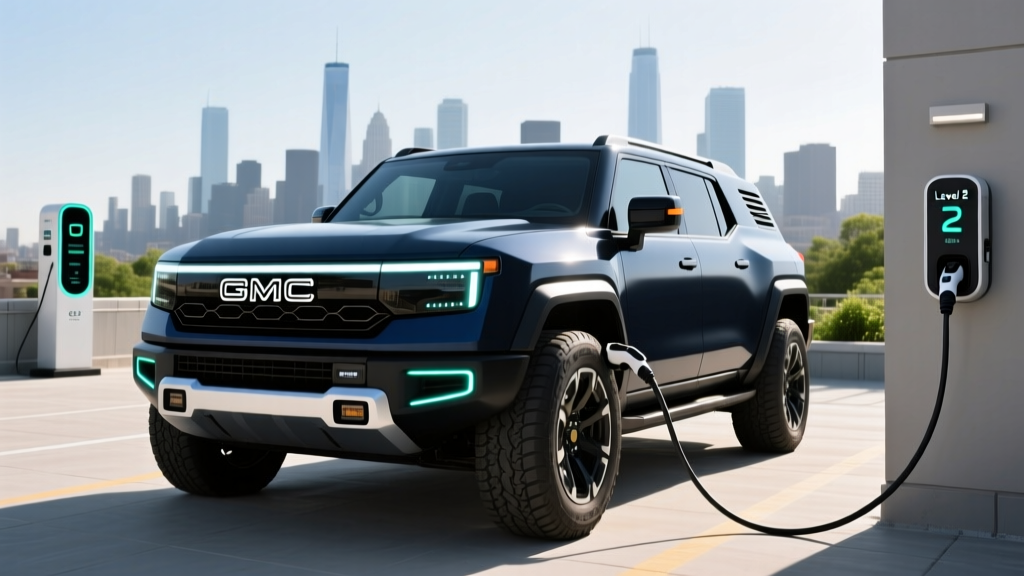
The GMC Hummer EV SUV has always been an exercise in excess — massive dimensions, absurd horsepower, and a footprint that dwarfs everything else in the parking lot. For 2026, the Hummer EV SUV 3X trim slots into the middle of the lineup as the volume play: it keeps the tri-motor powertrain and air suspension but trims the price compared to the range-topping Edition 1. If you're considering this electric behemoth, here's everything you need to know about its real-world range, charging behavior, ownership costs, and whether the federal tax credit actually applies.
| Spec | Value |
|---|---|
| EPA Range (est.) | 314 miles |
| Battery (usable) | ~212 kWh, NMC lithium-ion |
| Powertrain | Tri-motor AWD (1 front, 2 rear) |
| Horsepower | 830 hp |
| 0-60 mph | 3.5 seconds |
| Peak DC Fast Charge | 350 kW |
| 10-80% DC Charge Time | ~30 minutes (est.) |
| Level 2 Charge Rate | 11.5 kW (~14 mi/hr) |
| MPGe (combined) | 47 MPGe |
| Efficiency | ~72 kWh/100 mi |
| Base MSRP (3X) | $106,400 |
| Battery Warranty | 8 years / 100,000 miles |
Range and Efficiency: What the EPA Number Doesn't Tell You
The 2026 Hummer EV SUV 3X carries an estimated EPA range of 314 miles, powered by GM's massive 24-module Ultium battery pack with approximately 212 kWh of usable capacity. That battery uses NMC (nickel-manganese-cobalt) chemistry — chosen for its high energy density, which is essential when you're pushing a 9,000+ pound vehicle. For comparison, that's roughly two to three times the usable capacity of a typical mid-size EV like the Hyundai Ioniq 5.
Real-World Range Expectations
EPA Sticker: 314 miles
Highway (70-75 mph, moderate weather): Expect 250-275 miles. The Hummer's boxy aerodynamics (drag coefficient around 0.40) punish highway efficiency far more than the EPA combined cycle suggests.
Cold Weather (below 30°F): Plan for 200-230 miles. The massive battery pack takes longer to thermally condition, and cabin heating demands are significant in a vehicle this large. GM's heat pump helps, but physics is physics.
City/Suburban: 290-310 miles. Regenerative braking recovers more energy in stop-and-go driving, and lower speeds reduce aero drag.
The efficiency figure — roughly 72 kWh per 100 miles — is poor by EV standards. That's about 2.5 times the energy consumption of a Tesla Model Y. You're paying for the privilege of moving 4.5 tons, and the electricity costs add up if you're doing high-mileage commutes.
Charging Speed: DC Fast, Level 2, and the Curve Reality
The Hummer EV SUV 3X supports up to 350 kW peak DC fast charging via its native CCS1 connector (with NACS adapter access to Tesla Superchargers now broadly available for GM vehicles). That peak number is impressive on paper, but understanding the charge curve is critical for trip planning.
| Charging Level | Power | Speed | Notes |
|---|---|---|---|
| Level 1 (120V) | ~1.4 kW | ~1.7 mi/hr | Essentially unusable for this battery size — a full charge takes over 5 days |
| Level 2 (240V) | 11.5 kW | ~14 mi/hr | Full charge in ~15 hours; overnight top-ups are practical |
| DC Fast Charge | Up to 350 kW | 10-80% in ~30 min | Peak rate sustained only to ~40% SoC; taper significant above 60% |
What the charge curve actually looks like: When you arrive at a 350 kW station with a low state of charge (10-15%), the Hummer will ramp quickly toward its peak rate. However, because of the enormous battery, sustained peak charging is limited. Expect the rate to taper from 350 kW down to around 150-175 kW by 50% SoC, and further to 75-100 kW by 70%. The 10-80% time of roughly 30 minutes is competitive given the battery size, but you won't see 350 kW for the full session. Always precondition the battery via the navigation system before arriving at a DC charger — cold-soaked batteries charge dramatically slower.
For home charging, the 11.5 kW onboard charger adds about 14 miles of range per hour. Most owners will plug in overnight and wake up with 140-180 miles added — sufficient for daily driving but not a full replenishment from empty. If your daily driving exceeds 100 miles, you'll want to ensure consistent nightly charging access.
Performance: 830 Horsepower in a 9,000-Pound SUV
The tri-motor 3X powertrain delivers 830 horsepower and an estimated 1,200 lb-ft of torque through GM's e4WD system (one front motor, two rear motors with torque vectoring). The 0-60 mph sprint lands at approximately 3.5 seconds — remarkable for a vehicle with the footprint of a small apartment.
Watts to Freedom mode (GM's launch control equivalent) preconditions the powertrain and lowers the adaptive air suspension for maximum acceleration. It's a party trick, but one that never fails to surprise passengers.
Beyond straight-line speed, the 3X's rear-wheel steering (up to 10 degrees) and CrabWalk diagonal driving mode make this oversized SUV surprisingly maneuverable in tight spaces. The air suspension offers adjustable ride height from 6.4 to 15.9 inches of ground clearance, supporting legitimate off-road use. Towing capacity is rated at 7,500 pounds when properly equipped, though towing will cut range roughly in half — expect 150-170 miles with a heavy trailer.
Interior Space, Cargo, and Daily Livability
The Hummer EV SUV seats five across two rows. Despite its enormous exterior, interior packaging is constrained by the massive battery pack sitting beneath the floor, which raises the seating position and limits vertical space.
- Front legroom: 42.5 inches
- Rear legroom: 38.9 inches
- Cargo behind rear seats: 35.9 cu ft
- Cargo with rear seats folded: 81.8 cu ft
- Front trunk (frunk): 11.3 cu ft
The cargo area is practical for a large family SUV, and the frunk provides useful additional storage for charging cables and gear. The infinity roof features removable transparent panels (stored in the frunk), giving an open-air experience that few EVs can match.
The infotainment system runs on a 13.4-inch touchscreen with Google Built-In (Maps, Assistant, Play Store), wireless Apple CarPlay and Android Auto, and a 12.3-inch digital instrument cluster. The available 14-speaker Bose audio system is a highlight. Driver assistance comes via GM's Super Cruise — a Level 2 hands-free highway driving system operational on over 750,000 miles of mapped roads in North America.
Super Cruise Is NOT Self-Driving
Super Cruise is an SAE Level 2 driver-assistance system. It handles steering, acceleration, and braking on compatible highways, but the driver must remain attentive. An infrared camera monitors eye gaze and will issue escalating alerts — then disengage — if you look away or close your eyes. You are always legally responsible for the vehicle. This is fundamentally different from Level 4 robotaxi services like Waymo.
Pricing, Trims, and Federal Tax Credit Eligibility
The 2026 GMC Hummer EV SUV lineup includes multiple trims, with the 3X positioned as the performance-oriented mid-tier option:
| Trim | Base MSRP | Est. Federal Credit | Effective Price |
|---|---|---|---|
| 2X (dual-motor) | $98,400 | Up to $7,500* | ~$90,900 |
| 3X (tri-motor) | $106,400 | Up to $7,500* | ~$98,900 |
| 3X with Extreme Off-Road Pkg | $112,400 | Up to $7,500* | ~$104,900 |
*Federal tax credit eligibility is not guaranteed. Under IRS Section 30D, the $7,500 credit for the Hummer EV SUV 3X depends on several factors that buyers must verify:
§30D Credit Checklist for the Hummer EV SUV 3X
- MSRP Cap: SUVs must have an MSRP at or below $80,000. The 3X at $106,400 exceeds this cap and is NOT eligible for the federal purchase credit under current rules.
- Buyer Income Cap: Modified AGI must not exceed $300,000 (joint), $225,000 (head of household), or $150,000 (single).
- Battery Sourcing: Critical minerals and battery component sourcing must meet escalating domestic-content thresholds — relevant for trims that do qualify.
- Point-of-Sale Transfer: Eligible credits can be transferred to the dealer at purchase for an immediate price reduction.
This is a critical point: the 3X trim does not qualify for the §30D federal purchase credit because its MSRP exceeds the $80,000 SUV cap. The lower 2X trim may still exceed the cap depending on options. Always verify current eligibility on the IRS Clean Vehicle Provisions page and consult a tax professional before relying on credit estimates in your purchase decision.
Battery Longevity, Warranty, and Degradation
GM backs the Hummer EV's Ultium battery with an 8-year / 100,000-mile warranty (whichever comes first), guaranteeing the pack will retain at least 70% of its original capacity during that period. California-emissions states may extend this to 10 years / 150,000 miles under CARB requirements.
The 212 kWh NMC pack is among the largest in any production passenger vehicle. NMC chemistry typically shows 10-15% capacity loss over 150,000-200,000 miles under normal use. For the Hummer, even 15% degradation still leaves roughly 267 miles of range — acceptable for most use cases. The battery's active liquid thermal management system works continuously to minimize degradation, though frequent DC fast charging above 80% SoC and regular deep discharges below 10% will accelerate wear.
A full battery replacement out of warranty would be extraordinarily expensive — estimated at $25,000-$35,000+ given the pack size. This is a long-tail risk worth factoring into ownership plans beyond the warranty window.
How It Compares: Hummer EV 3X vs. the Alternatives
The Hummer EV SUV 3X doesn't have direct rivals — nothing else combines this size, this power, and this price in an electric SUV. But buyers cross-shop several alternatives:
| Spec | Hummer EV 3X | Rivian R1S Tri-Motor | Tesla Model X Plaid | Cadillac Escalade IQ |
|---|---|---|---|---|
| Est. Range | 314 mi | ~400 mi | 326 mi | ~460 mi |
| Horsepower | 830 hp | 850 hp | 1,020 hp | 750 hp |
| 0-60 mph | 3.5 sec | 2.9 sec | 2.5 sec | ~4.0 sec |
| Seating | 5 | 7 | 5-7 | 7 |
| Cargo (max) | 81.8 cu ft | 104.7 cu ft | 88.1 cu ft | ~115 cu ft |
| Base Price | $106,400 | $110,000 | $111,090 | $130,000 |
| Tax Credit | No (MSRP cap) | No (MSRP cap) | No (MSRP cap) | No (MSRP cap) |
The Rivian R1S offers more seats, more cargo, and better range in a slightly smaller package. The Model X Plaid is faster and more efficient but aging. The Escalade IQ delivers luxury and space but at a significant premium. The Hummer's unique value proposition is its off-road capability (CrabWalk, Extract Mode, underbody armor) combined with its sheer presence — nothing else looks or feels like it.
Who Should Buy the Hummer EV SUV 3X?
Choose the Hummer EV 3X if: You need serious off-road capability in an EV, you want maximum presence and conversation-starting factor, you have reliable home charging access, and you accept the efficiency penalty as the cost of admission.
Look elsewhere if: You prioritize efficiency or range (the Rivian R1S and Escalade IQ are far better), you need three-row seating, you commute long distances daily (72 kWh/100mi means expensive "fuel" costs), or you need the federal tax credit to make the math work.
Pros
- 830 hp tri-motor performance is genuinely thrilling
- Best-in-class off-road EV capability (Extract Mode, CrabWalk, 15.9" clearance)
- 350 kW DC fast charging is among the fastest available
- Super Cruise hands-free highway driving is well-implemented
- Removable infinity roof panels are unique and fun
- Rear-wheel steering dramatically improves low-speed maneuverability
Cons
- 72 kWh/100mi efficiency makes "fueling" costs high
- Does not qualify for the §30D federal tax credit (MSRP cap)
- Only two rows / five seats despite enormous exterior dimensions
- Real-world highway range drops to ~250 miles
- Level 1 charging is essentially useless — Level 2 home charging is mandatory
- Insurance premiums are high for this price and performance tier
Frequently Asked Questions
What is the real-world range of the 2026 Hummer EV SUV 3X?
The EPA estimates 314 miles combined, but real-world highway driving at 70-75 mph typically yields 250-275 miles. In cold weather (below 30°F), plan for 200-230 miles. City driving with regenerative braking can approach the EPA figure at 290-310 miles. The enormous battery provides a large buffer, but the vehicle's weight and aerodynamic profile limit efficiency significantly at speed.
How fast does the Hummer EV SUV 3X charge at home and on the road?
On DC fast chargers, it peaks at 350 kW and can go from 10-80% in roughly 30 minutes, though the charge curve tapers significantly above 60% SoC. At home on a Level 2 (240V, 48A) connection, the 11.5 kW onboard charger adds about 14 miles per hour — a full charge takes around 15 hours. Level 1 (120V) charging is impractical at roughly 1.7 miles per hour.
Does the 2026 Hummer EV SUV 3X qualify for the federal EV tax credit?
No, not under current IRS §30D rules. The federal purchase credit caps SUV MSRP at $80,000, and the 3X starts at $106,400. Even the base 2X trim exceeds this threshold. Some buyers may qualify for state-level incentives — check your state's energy office or the AFDC incentive database for local programs. Always verify current rules with a tax professional.
How much does it cost to charge the Hummer EV SUV 3X?
At the national average residential electricity rate of ~$0.17/kWh, a full 212 kWh charge costs roughly $36. For DC fast charging at $0.40-$0.50/kWh (common at Electrify America and EVgo stations), expect $85-$105 per session. At 72 kWh/100mi, driving 12,000 miles annually on home charging costs approximately $2,900/year in electricity — significantly more than most EVs but still less than gasoline for a vehicle this size.
Is the Hummer EV SUV 3X worth buying over the Rivian R1S or Tesla Model X?
It depends on your priorities. If off-road capability, unique styling, and sheer presence matter most, the Hummer has no equal. If you need three-row seating, better range, or superior cargo space, the Rivian R1S is the more practical family choice. The Tesla Model X offers the fastest acceleration and best efficiency in this price tier but with an aging interior. Test-drive all three before committing — the Hummer's driving experience is unlike anything else, which is either its greatest strength or its biggest liability depending on your taste.
What's the towing range penalty with the Hummer EV 3X?
Towing at or near the 7,500-pound maximum will roughly halve your range — expect 150-170 miles depending on trailer aerodynamics, terrain, and speed. This is consistent with every large EV on the market. For regular towing, plan charging stops carefully and ensure your destination has adequate charging infrastructure.
The 2026 GMC Hummer EV SUV 3X is not a rational purchase — it's a statement. It's the most capable off-road EV available, absurdly quick, and genuinely fun to drive. But the efficiency penalty, the lack of federal tax credit eligibility, and the real-world range compromises mean buyers should go in with eyes open. If you have home charging, don't commute extreme distances, and value capability and presence above all else, the 3X delivers an experience no other EV can match. If practicality and cost-efficiency rank higher, look to the Rivian R1S or wait for more efficient large-format EVs to reach the market.