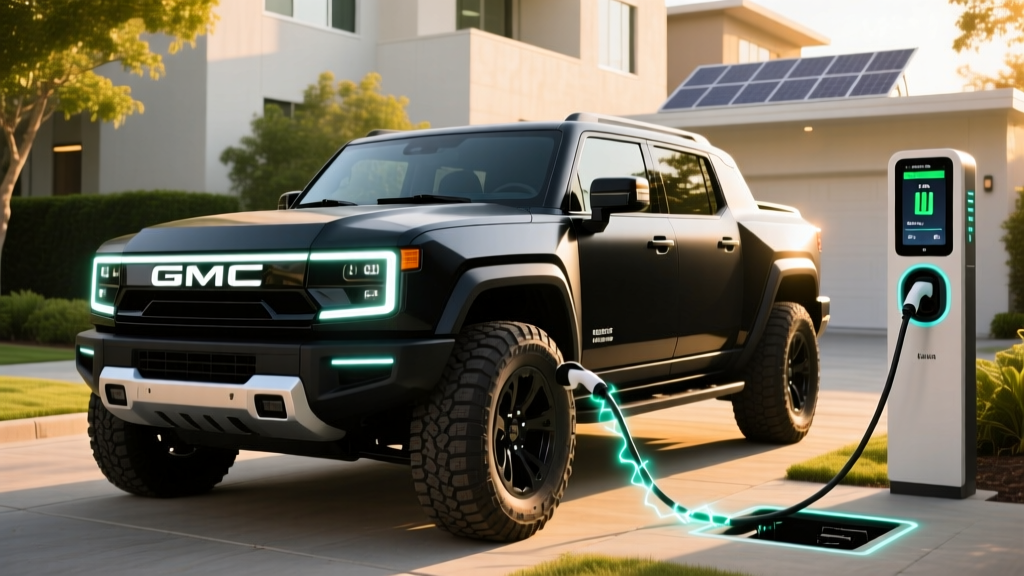
The GMC Hummer EV remains one of the most physically imposing electric vehicles on the road — a 9,000-pound statement of capability that somehow delivers supercar acceleration and legitimate off-road chops. For 2026, GMC has streamlined the lineup while adding incremental software and battery-management refinements. But at nearly six figures before incentives, buyers need to know exactly what they're getting beyond the spectacle. This review breaks down real-world range, charging behavior, ownership costs, and whether the Hummer EV justifies its premium against rivals like the Rivian R1T and Ford F-150 Lightning.
Range, Efficiency, and Real-World Expectations
The 2026 Hummer EV Pickup 2X (dual-motor) carries an EPA-estimated 314 miles of range, while the 3X tri-motor variant pushes that to 329 miles. The SUV body style with its shorter wheelbase drops to 313 miles (2X) and 325 miles (3X). These figures come from a massive Ultium battery pack with approximately 212.7 kWh of usable capacity — one of the largest ever fitted to a production passenger vehicle. The pack uses NCMA (nickel-cobalt-manganese-aluminum) chemistry, an evolution of NMC developed jointly by GM and LG Energy Solution for higher energy density and reduced cobalt content.
EPA 314–329 mi (Pickup) | 313–325 mi (SUV)
Expect approximately 260–285 miles at sustained 70–75 mph highway speeds in moderate temperatures. In cold weather (below 32°F), range drops an additional 15–25%, bringing realistic winter highway range to roughly 200–240 miles depending on cabin heat usage and terrain. The Hummer EV's enormous frontal area and 9,000+ lb curb weight work against highway efficiency — this is a vehicle optimized for capability, not aero efficiency.
Efficiency ratings land at 47 MPGe combined for the 2X Pickup (approximately 72 kWh/100 mi). That's thirstier than a Rivian R1T Dual-Motor (around 73 MPGe / 46 kWh/100 mi) but competitive for a vehicle of this mass. If your commute is mostly city driving with regenerative braking opportunities, you'll see results closer to the EPA sticker. Sustained highway travel is where the Hummer EV's consumption becomes most apparent.
Charging: DC Fast, Level 2, and Infrastructure Realities
The Hummer EV supports up to 350 kW peak DC fast charging on 800-volt-capable stations (though the architecture itself is 400V, GM achieves high charge rates through parallel battery pack configuration). On a 350 kW charger, GMC rates the 10–80% charge at approximately 35 minutes. However, real-world charging curves tell a more nuanced story: peak rates above 300 kW are only sustained in a narrow SoC window (roughly 10–25%), after which the curve tapers progressively. From 50–80%, expect rates closer to 120–150 kW.
| Charging Level | Power / Rate | Miles Added per Hour | Notes |
|---|---|---|---|
| Level 1 (120V) | ~1.4 kW | ~3–4 mi/hr | Emergency/trickle only; full charge takes days |
| Level 2 (240V, 48A) | 11.5 kW | ~28–32 mi/hr | Home overnight standard; ~10–12 hr for 10–80% |
| Level 2 (240V, 80A) | 19.2 kW | ~48–52 mi/hr | Requires upgraded home circuit (100A breaker); ~6–7 hr for 10–80% |
| DC Fast (350 kW peak) | Up to 350 kW | ~100+ mi in 12 min | 10–80% in ~35 min; taper above 60% SoC |
For home charging, the onboard charger accepts up to 19.2 kW on Level 2 — but that requires a hardwired 80-amp circuit and a 100-amp dedicated breaker. Most homes will need an electrical panel upgrade to support this, adding $1,500–$3,000 to installation costs. On a more typical 48-amp Level 2 circuit (the most common home setup), expect roughly 11.5 kW and a full overnight charge from 20% to 80% in about 10–12 hours. Given the pack size, patience and planning are prerequisites for home charging.
The Hummer EV uses the CCS1 connector for DC fast charging as of the 2026 model year. GM has announced a transition to NACS (Tesla Supercharger-compatible) for future models, but current Hummer EV owners will rely on CCS networks like Electrify America, EVgo, and ChargePoint — or use a GM-approved NACS adapter for Supercharger access where available.
Performance and Drivetrain
The Hummer EV's performance numbers border on absurd for a vehicle that weighs as much as two Honda Civics. The tri-motor 3X produces 830 horsepower and a claimed 11,500 lb-ft of wheel torque (not motor torque — an important distinction GMC's marketing sometimes obscures). The 0–60 mph sprint takes just 3.0 seconds in Watts to Freedom mode, which pre-conditions the battery, lowers the adaptive air suspension, and haptically vibrates the seats before launch.
| Specification | 2X (Dual-Motor) | 3X (Tri-Motor) |
|---|---|---|
| Horsepower | 625 hp | 830 hp |
| 0–60 mph | ~4.5 sec | 3.0 sec (WTF mode) |
| Drivetrain | AWD (2 motors) | AWD (3 motors, torque vectoring) |
| EPA Range (Pickup) | 314 mi | 329 mi |
| EPA Range (SUV) | 313 mi | 325 mi |
| Battery (Usable) | ~212.7 kWh (NCMA / Ultium) | |
| Max DC Charge Rate | Up to 350 kW (peak) | |
| 10–80% DC Charge | ~35 minutes | |
| Towing Capacity | 7,500 lbs (est.) | |
| Ground Clearance (max) | 15.9 inches (Extract Mode) | |
The dual-motor 2X is no slouch either, with 625 hp and a 0–60 time around 4.5 seconds. Both variants feature adaptive air suspension with an Extract Mode that raises the vehicle to 15.9 inches of ground clearance for serious off-road obstacles. The 3X's rear dual-motor setup enables torque vectoring across the rear axle, giving the Hummer EV surprising agility for its size and enabling features like CrabWalk (diagonal movement at low speeds) and Tank Turns (360-degree pivots on loose surfaces, off-road only).
Interior, Tech, and Cargo Practicality
Inside, the Hummer EV is dominated by a 13.4-inch diagonal infotainment touchscreen running GM's latest Ultifi software platform, paired with a 12.3-inch driver instrument cluster. The interface is responsive and supports wireless Apple CarPlay and Android Auto. A notable feature is the multi-camera UltraVision system with up to 18 camera views, including underbody cameras for off-road trail navigation — genuinely useful when you can't see what's beneath 9,000 pounds of truck.
The Hummer EV Pickup offers a 5-foot bed with a MultiPro tailgate (six-function) and approximately 81.8 cubic feet of cargo volume behind the front seats in the SUV variant. The frunk (front trunk) on early models was limited due to the massive front motor and electronics, but the 2026 SUV provides roughly 11.3 cubic feet of front storage. Passenger space is generous: front legroom measures 42.5 inches, with rear legroom at 38.9 inches in the pickup — adequate for adults but not class-leading versus the F-150 Lightning's rear seat.
Driver-assistance technology includes GM's Super Cruise on compatible mapped highways — a SAE Level 2 system that allows hands-free driving on over 750,000 miles of compatible roads in the US and Canada. The driver must remain attentive; an infrared camera monitors eye gaze. Super Cruise is not autonomous driving — it requires active supervision and will disengage if the driver looks away for extended periods.
Super Cruise is a Level 2 driver-assistance system. The driver must remain engaged, monitor the road, and be prepared to take over immediately. It does not navigate unmapped roads, construction zones, or adverse weather autonomously. Only Level 4 services (e.g., Waymo in designated geofenced areas) operate without a human driver.
Pricing, Trims, and Federal Tax Credit Eligibility
The 2026 GMC Hummer EV lineup starts at $98,845 for the 2X Pickup (including destination). The 3X Pickup begins at $108,495, while the SUV variants command a premium: $102,345 for the 2X SUV and $112,095 for the 3X SUV. Fully optioned 3X models with the Extreme Off-Road package, Infinity Roof with removable panels, and premium interior can push past $125,000.
| Trim | Base MSRP | Federal §30D Credit | Effective Price (if eligible) |
|---|---|---|---|
| 2X Pickup | $98,845 | Up to $7,500 | ~$91,345 |
| 3X Pickup | $108,495 | Up to $7,500 | ~$100,995 |
| 2X SUV | $102,345 | Up to $7,500 | ~$94,845 |
| 3X SUV | $112,095 | Up to $7,500 | ~$104,595 |
Federal tax credit eligibility is complex and not guaranteed. Under current IRS §30D rules, the Hummer EV qualifies as a light truck, so the $80,000 MSRP cap for trucks applies — and every Hummer EV trim exceeds that cap. This means the Hummer EV does not qualify for the new-vehicle §30D credit of up to $7,500 as of the current tax year. Buyers should verify the latest rules directly with the IRS clean vehicle credit page or consult a tax professional before assuming eligibility.
Some buyers may find relief through the used EV credit (§25E): purchasing a pre-owned Hummer EV at $25,000 or below qualifies for up to $4,000 (30% of sale price), subject to income caps ($75,000 single / $150,000 joint). Given current depreciation curves, qualifying used Hummer EVs at that price point remain rare but may become available as early lease returns enter the market. Point-of-sale transfer of applicable credits is available through registered dealers for eligible vehicles and buyers.
Ownership Costs, Warranty, and Long-Term Outlook
GMC backs the Hummer EV's battery and powertrain with an 8-year/100,000-mile warranty, with a capacity retention guarantee of at least 70% over that period. The bumper-to-bumper warranty covers 3 years/36,000 miles. For a vehicle this expensive, the powertrain coverage is competitive, though some rivals (Hyundai, Kia) offer longer bumper-to-bumper terms.
Insurance costs are significant. Industry data places average annual premiums for the Hummer EV between $2,800 and $4,200 depending on state, driving record, and coverage level — reflecting the vehicle's high repair costs, performance capability, and mass. Get quotes before purchasing.
Maintenance savings versus a gas-powered supertruck are real: no oil changes, no transmission fluid, reduced brake wear from regenerative braking. GM estimates annual maintenance savings of $800–$1,200 versus a comparable internal-combustion truck. Charging costs vary widely: at the national average residential electricity rate of ~$0.16/kWh, a full home charge costs approximately $34 for ~300 miles of range. Public DC fast charging at $0.35–$0.50/kWh raises that to $74–$106 per equivalent fill.
Pros, Cons, and Who Should Buy
- Supercar-level acceleration (3.0s 0–60) in a full-size truck
- Legitimate off-road capability with Extract Mode and underbody armor
- Class-leading battery capacity (~212.7 kWh usable)
- Super Cruise hands-free highway driving on 750,000+ miles of roads
- UltraVision camera system with 18 views for trail navigation
- Removable Infinity Roof panels for open-air driving
- Does NOT qualify for $7,500 federal new-EV credit (exceeds $80K truck MSRP cap)
- Real-world highway range significantly below EPA (260–285 mi typical)
- Cold-weather range loss of 15–25% compounds the range limitation
- Home charging requires expensive panel upgrade for fastest Level 2 rates
- Insurance premiums among the highest in the EV segment
- Enormous footprint — challenging in tight urban parking and garages
- CCS1 connector limits Supercharger access without adapter
Buy it if: You need a genuine off-road-capable electric truck with extreme performance, you have reliable home Level 2 charging, you frequently drive Super Cruise-compatible highways, and budget is not your primary constraint. It's ideal for adventure-oriented buyers who want electric capability without sacrificing trail prowess.
Look elsewhere if: You prioritize efficiency, maximum range, tax-credit savings, or urban practicality. The Rivian R1T offers comparable off-road ability with better efficiency and a smaller footprint. The Ford F-150 Lightning provides more practical daily usability, lower pricing, and broader charging compatibility. If you primarily commute and rarely go off-road, the Hummer EV's compromises outweigh its spectacle.
Frequently Asked Questions
What is the real-world range of the 2026 GMC Hummer EV?
The EPA rates the Hummer EV Pickup at 314–329 miles depending on trim. In real-world highway driving at 70–75 mph, expect 260–285 miles. In cold weather below freezing, plan for 200–240 miles of usable range. The enormous battery helps offset the vehicle's poor aerodynamics and heavy mass, but physics still applies — this is not an efficiency champion.
How fast does the Hummer EV charge at home and on the road?
On a 350 kW DC fast charger, the Hummer EV achieves 10–80% in approximately 35 minutes, though the charge curve tapers significantly above 60% SoC. At home on a standard 48-amp Level 2 circuit (11.5 kW), a 20–80% charge takes roughly 10–12 hours. An 80-amp circuit (19.2 kW) reduces that to 6–7 hours but requires a panel upgrade in most homes.
Does the 2026 Hummer EV qualify for the $7,500 federal tax credit?
No. Under current IRS §30D rules, the Hummer EV exceeds the $80,000 MSRP cap for light trucks, making it ineligible for the new-vehicle federal credit regardless of buyer income or battery sourcing. Some buyers may qualify for the used-EV credit (§25E, up to $4,000) if they purchase a qualifying pre-owned example at $25,000 or less. Always verify current rules at irs.gov.
Is the Hummer EV worth buying versus the Rivian R1T or F-150 Lightning?
It depends entirely on your priorities. The Hummer EV wins on raw performance, battery capacity, and off-road spectacle. The Rivian R1T (starting ~$79,900) is more efficient, more practical for daily use, and offers a tighter turning radius with its quad-motor option. The F-150 Lightning (starting ~$55,000) is the value and practicality leader with NACS charging and available fleet infrastructure. Choose the Hummer EV if you want the ultimate electric statement truck and can absorb the premium.
How long will the Hummer EV battery last?
GMC warranties the Ultium battery for 8 years/100,000 miles with a 70% capacity retention guarantee. Industry data on large-format NCMA packs suggests 15–20% degradation over 150,000–200,000 miles is typical with proper care (avoiding frequent 100% charges and DC fast charging exclusively). A full battery replacement, if ever needed out of warranty, is estimated at $20,000–$30,000+ given the pack's 212.7 kWh capacity — one of the most expensive replacement scenarios in the EV market.
Can the Hummer EV tow, and how does towing affect range?
The Hummer EV is rated to tow up to 7,500 pounds. However, towing at or near maximum capacity typically reduces range by 40–50% based on independent testing of large electric trucks. Expect roughly 150–180 miles of range when towing a heavy trailer at highway speeds — plan charging stops accordingly.
The 2026 GMC Hummer EV is an engineering marvel that prioritizes capability, performance, and presence above all else. Its range, charging, and cost realities demand an informed buyer — one who values what it uniquely delivers and accepts the compromises that come with electrifying a vehicle of this magnitude. For the right owner with the right use case, nothing else compares. For everyone else, the Rivian R1T and F-150 Lightning offer more rational paths to electric truck ownership. Either way, consult fueleconomy.gov for the latest EPA data and verify tax-credit eligibility before signing.