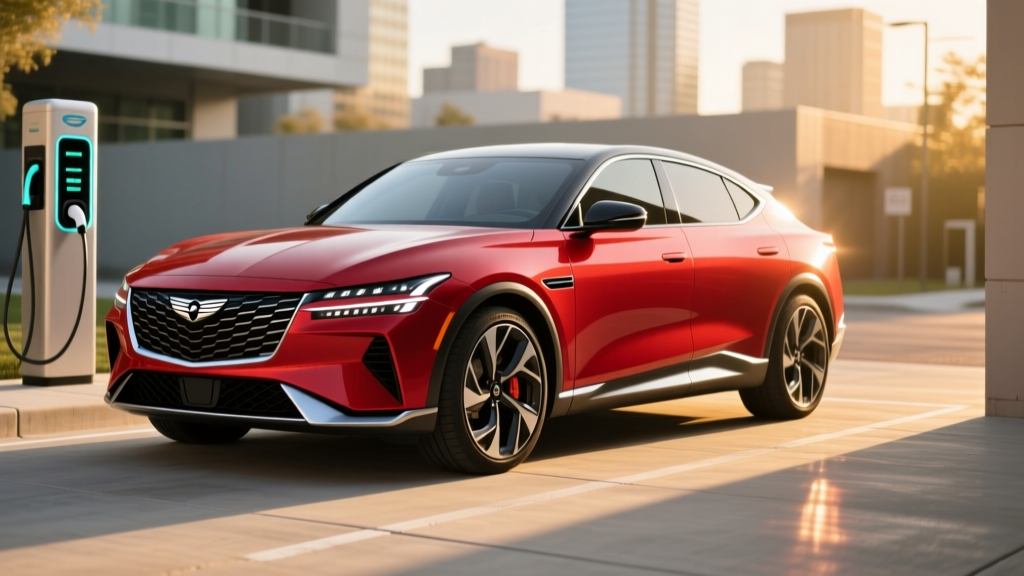
The 2026 Genesis GV60 Magma arrives as the performance flagship of Hyundai Motor Group's luxury EV crossover lineup. Built on the E-GMP platform shared with the Hyundai Ioniq 5 and Kia EV6, the Magma variant adds a sport-tuned suspension, aggressive exterior styling, and a dual-motor AWD powertrain that targets enthusiasts who want luxury and acceleration without sacrificing daily usability. But with a starting price pushing well past $70,000, the question is whether the Magma badge justifies its premium over the already-impressive GV60 Performance trim — and whether it can compete with the Porsche Macan Electric and BMW iX in a crowded luxury EV segment.
After spending time with the specs, charging data, and real-world efficiency figures, here is what buyers need to know before putting down a deposit.
2026 Genesis GV60 Magma: Full Spec Sheet at a Glance
| Specification | Value |
|---|---|
| Base MSRP | $72,500 (estimated) |
| As-Tested Price (fully loaded) | ~$78,000 (estimated) |
| EPA Estimated Range | 235 miles (estimated) |
| Battery Capacity (usable) | 77.4 kWh |
| Battery Chemistry | NMC (Nickel Manganese Cobalt) |
| Drivetrain | Dual-motor AWD |
| Horsepower | 483 hp (Boost mode) |
| Torque | 516 lb-ft |
| 0–60 mph | 3.9 seconds (estimated) |
| Max DC Fast-Charge Rate | 240 kW (peak) |
| 10–80% DC Fast Charge | ~18 minutes (optimal conditions) |
| Level 2 Home Charge Rate | 10.9 kW (~36 mi/hr) |
| MPGe (combined, estimated) | 90 MPGe |
| Efficiency | ~37 kWh/100 mi |
| Cargo Volume (rear seats up) | 24.0 cu ft |
| Cargo Volume (rear seats folded) | 54.7 cu ft |
| Battery/Powertrain Warranty | 10 years / 100,000 miles |
| Federal Tax Credit (§30D) | Up to $7,500 (eligibility varies) |
Note: Several figures above carry over from the GV60 Performance AWD platform. Genesis has not published final EPA certification for the Magma variant as of this writing; numbers marked "estimated" are projected based on the Performance trim with Magma-specific suspension and wheel adjustments. Confirm with your dealer before purchase.
Real-World Range: What to Expect Beyond the EPA Sticker
The GV60 Magma's 77.4 kWh NMC battery pack is the same unit found across the E-GMP family. NMC chemistry offers higher energy density than LFP (lithium iron phosphate), which helps keep the pack compact and the vehicle's weight manageable — but it comes with a slightly higher sensitivity to extreme temperatures and long-term calendar aging if routinely stored at 100% state of charge.
The Magma's sport-tuned suspension, larger 21-inch wheels, and stickier summer performance tires add rolling resistance and weight compared to the standard GV60 Advanced trim (which achieves an EPA-estimated 248 miles). That trade-off buys you sharper handling and a more planted feel in corners, but it costs you roughly 10–15 miles of range. If your daily commute exceeds 80 miles round-trip and you lack reliable home charging, the Magma's range may feel tight on road trips where DC fast chargers are sparse.
For context, the EPA's fuel economy portal lists real-world efficiency data that consistently shows highway driving at sustained speeds above 70 mph reduces EV range by 10–20% versus the combined cycle. Cold weather compounds this further because the battery must divert energy to thermal management and cabin heating, even with the GV60's standard heat pump.
Charging Speed: 800-Volt Architecture Pays Off
The GV60 Magma retains the E-GMP platform's 800-volt electrical architecture, which remains one of the fastest-charging setups available in any production EV. At a compatible 350 kW DC fast charger (such as Electrify America or EVgo stations equipped with CCS or NACS adapters), the GV60 Magma can accept a peak rate of 240 kW.
| Charging Level | Power (kW) | Speed (Miles of Range Added) | Typical Use Case |
|---|---|---|---|
| Level 1 (120V household) | ~1.4 kW | ~4–5 mi/hr | Emergency / overnight trickle |
| Level 2 (240V home, 48A) | 10.9 kW | ~36 mi/hr | Daily home charging (full charge in ~7.5 hrs) |
| DC Fast Charge (peak) | 240 kW | ~200+ mi in 18 min (10–80%) | Road trips, quick top-ups |
| DC Fast Charge (50 kW station) | 50 kW | ~18 mi/hr | Older public chargers |
The headline number — 10–80% in approximately 18 minutes — holds true only under ideal conditions: battery preconditioned to optimal temperature (the GV60 does this automatically when you navigate to a charger), ambient temperature above 60°F, and a station actually capable of delivering 350 kW. On a 150 kW station, expect 10–80% in roughly 28–32 minutes. On a 50 kW legacy charger, that stretches to over an hour.
The charge curve matters more than peak kW. The GV60 sustains above 200 kW from roughly 10% to 55% state of charge, then tapers progressively. Above 80%, charging slows dramatically to protect the NMC cells — a 80–100% top-off can take nearly as long as the 10–80% session. For road trips, plan your stops around 10–80% increments and avoid waiting for a full charge unless you're stopping overnight.
For home charging, a Level 2 wall connector on a 240V/48A circuit adds about 36 miles of range per hour, meaning a full 0–100% charge takes roughly 7.5 hours. Most owners charging overnight from a typical 30–50% daily depletion will wake up to a full battery every morning. Installation costs for a Level 2 home charger typically range from $500 (simple outlet near the panel) to $2,500+ if a panel upgrade or long conduit run is needed.
Performance and Driving Dynamics
The Magma variant's dual-motor AWD powertrain produces an estimated 483 horsepower and 516 lb-ft of torque when Boost mode is engaged (a 10-second burst activated via a steering wheel button). Without Boost, output settles at approximately 429 hp. The result is a 0–60 mph time in the low 4-second range — quick enough to surprise most sports sedans at a stoplight, though a step behind the Porsche Macan Electric Turbo's 3.3-second sprint.
What separates the Magma from the standard GV60 Performance is chassis tuning. Genesis has fitted a sport-adaptive suspension with firmer damping, a lower ride height, and a rear-biased torque distribution map that gives the Magma a more rear-drive character under hard acceleration. The 21-inch forged alloy wheels wrapped in Michelin Pilot Sport EV tires provide exceptional grip, though they transmit more road imperfections into the cabin than the 19-inch wheels on the Advanced trim.
The steering is precise and well-weighted, a welcome departure from the numb electric steering common in many EVs. Brake feel is progressive — the transition from regenerative braking to the mechanical friction brakes is nearly imperceptible, which is not always the case in Hyundai Motor Group EVs.
One-pedal driving is available via the highest regen setting (i-Pedal), which brings the GV60 Magma to a complete stop without touching the brake pedal. Paddle shifters behind the steering wheel let you toggle through four regen levels on the fly, from coasting to aggressive deceleration.
Interior, Tech, and Cargo Space
The GV60 Magma's cabin carries forward the production model's distinctive design: a floating center console, a crystal sphere shifter that rotates when the vehicle starts, and dual 12.3-inch displays (one for the instrument cluster, one for infotainment) housed under a single curved glass panel. Magma-specific touches include sport bucket seats with Nappa leather and suede bolsters, aluminum pedal covers, and unique ambient lighting profiles.
The infotainment system runs Genesis's latest software with wireless Apple CarPlay and Android Auto, over-the-air updates, and a Digital Key feature that lets you use your smartphone as the key fob. Navigation-based preconditioning for DC fast charging works seamlessly — enter a charger as your destination, and the battery begins warming automatically.
Genesis equips the GV60 with its Highway Driving Assist 2 (HDA2) system, which provides adaptive cruise control with stop-and-go, lane centering, and automatic lane changes when the turn signal is activated on divided highways. This is a SAE Level 2 driver-assistance system — the driver must keep hands on the wheel and eyes on the road at all times. It is not autonomous driving.
Cargo space measures 24.0 cubic feet behind the rear seats and 54.7 cubic feet with the 60/40 split rear seats folded. A small front trunk (frunk) adds roughly 0.7 cubic feet — enough for a charging cable bag but not much more. Rear legroom is 37.6 inches, adequate for adults but tighter than the Hyundai Ioniq 5's generous 39.4 inches. The Magma's sport seats sacrifice a small amount of rear headroom due to their thicker cushioning.
Pricing, Trims, and Federal Tax Credit Eligibility
The 2026 Genesis GV60 Magma is expected to start at approximately $72,500 (including destination), placing it at the top of the GV60 range. A fully loaded example with the Prestige package — adding a head-up display, digital side mirrors, remote smart parking assist, and a Bang & Olufsen audio system — could approach $78,000.
| Trim | MSRP (est.) | Drivetrain | Est. Range |
|---|---|---|---|
| Standard AWD | $53,500 | Dual-motor AWD (314 hp) | 248 mi |
| Advanced AWD | $61,000 | Dual-motor AWD (314 hp) | 248 mi |
| Performance AWD | $66,000 | Dual-motor AWD (429/483 hp) | 235 mi |
| Magma AWD | $72,500 | Dual-motor AWD (429/483 hp, Magma tune) | 235 mi |
Federal tax credit (§30D) eligibility for the GV60 Magma depends on several factors that buyers must verify before purchase. Under current IRS rules, the $7,500 credit requires:
- MSRP cap: The vehicle's base MSRP must not exceed $80,000 for SUVs/crossovers. The GV60 Magma clears this threshold, but a heavily optioned Prestige build could push above it — confirm the final MSRP on the window sticker.
- Buyer income limits: Adjusted gross income must not exceed $150,000 (single), $225,000 (head of household), or $300,000 (married filing jointly).
- Battery sourcing requirements: A portion of the credit depends on critical minerals and battery components being sourced from the U.S. or free-trade-agreement countries. These thresholds tighten annually. Check the latest eligibility list at IRS.gov's clean vehicle credit page before committing.
- Point-of-sale transfer: As of 2024, buyers can transfer the credit to the dealer at purchase, reducing the out-of-pocket price directly rather than waiting for a tax refund. This applies in 2026 as well.
If all conditions are met, the effective price of the GV60 Magma drops to approximately $65,000. If battery sourcing requirements are only partially met, the credit may be reduced to $3,750 or eliminated entirely. Always verify with a tax professional and the IRS portal before assuming the full $7,500.
Genesis GV60 Magma vs. the Competition
The Magma enters a competitive luxury EV crossover segment. Here is how it stacks up against three key rivals:
| Attribute | Genesis GV60 Magma | Porsche Macan 4 Electric | BMW iX M60 | Tesla Model Y Perf. |
|---|---|---|---|---|
| Est. Base Price | $72,500 | $80,700 | $88,500 | $54,990 |
| EPA Range | ~235 mi | ~250 mi | ~296 mi | ~277 mi |
| 0–60 mph | ~3.9 sec | ~4.4 sec | ~3.6 sec | ~3.5 sec |
| Max DC Charge | 240 kW | 270 kW | 200 kW | 250 kW |
| Battery Warranty | 10 yr/100k mi | 8 yr/100k mi | 8 yr/100k mi | 8 yr/120k mi |
The GV60 Magma undercuts the Porsche Macan Electric and BMW iX on price while matching or exceeding their charging speeds thanks to the 800V architecture. The Tesla Model Y Performance offers more range and quicker acceleration at a significantly lower price, but its interior quality, ride refinement, and noise isolation do not match the Genesis.
The Magma's best argument is its combination of luxury materials, distinctive design, class-leading battery warranty (10 years/100,000 miles vs. the industry-standard 8 years), and 800V fast charging. Its weakest point is range — 235 miles trails every competitor listed above, which matters for road trips in the expanding but still uneven U.S. charging network.
Pros and Cons
Pros
- 800V architecture enables 10–80% DC charging in ~18 minutes at 350 kW stations
- Class-leading 10-year/100,000-mile battery and powertrain warranty
- Premium interior with genuine luxury materials and unique design elements
- Sport-tuned chassis delivers engaging handling without harsh ride quality
- Comprehensive standard safety and driver-assist suite
- Competitive pricing vs. Porsche and BMW rivals
Cons
- 235-mile EPA range trails key competitors by 15–60 miles
- 21-inch performance wheels reduce comfort on rough pavement
- Rear seat headroom and legroom tighter than segment leaders
- Small frunk (0.7 cu ft) limits front storage utility
- Tax credit eligibility uncertain due to battery sourcing rules
- Genesis dealer network smaller than BMW, Porsche, or Tesla
Who Should Buy the 2026 Genesis GV60 Magma?
Buy the GV60 Magma if: You want a luxury performance EV crossover with distinctive styling, class-leading charging speed, and the longest battery warranty in the segment — and your daily driving stays within ~150 miles round-trip with reliable home charging.
Look elsewhere if: Maximum range is your top priority (consider the BMW iX or Tesla Model Y), you regularly carry rear-seat adults who need maximum legroom, or you live in an area with sparse DC fast-charging infrastructure where 235 miles of range creates anxiety on longer trips.
The GV60 Magma is a compelling package for the luxury EV buyer who values charging speed, build quality, and warranty coverage over raw range. It is not the most practical choice in the segment, but it may be the most satisfying to live with day-to-day — provided you have a Level 2 charger at home and your commute doesn't push the battery's limits.
Frequently Asked Questions
What is the real-world range of the 2026 Genesis GV60 Magma?
The EPA estimates approximately 235 miles for the Magma AWD. Expect 210–225 miles in real-world highway driving at 70+ mph, and 175–200 miles in cold weather below freezing. City driving with regenerative braking may match or slightly exceed the EPA number.
How fast does the GV60 Magma charge?
At a 350 kW DC fast charger with a preconditioned battery, the GV60 Magma can charge from 10–80% in approximately 18 minutes, peaking at 240 kW. On a 150 kW station, expect 28–32 minutes. Home Level 2 charging at 10.9 kW adds roughly 36 miles per hour, with a full charge in about 7.5 hours.
Does the 2026 Genesis GV60 Magma qualify for the federal EV tax credit?
It may qualify for up to $7,500 under IRS §30D, but eligibility depends on the final MSRP (must be under $80,000), buyer income limits, and battery component/critical mineral sourcing requirements that tighten each year. Verify current eligibility at IRS.gov and consult a tax professional before purchasing.
Is the GV60 Magma worth it vs. the Porsche Macan Electric?
The GV60 Magma offers similar performance and luxury at a lower starting price, plus a longer battery warranty (10 years vs. 8). The Porsche Macan Electric offers more range (~250 mi) and slightly faster peak charging (270 kW). If brand cachet and range matter most, the Porsche wins. If value, warranty, and charging speed are priorities, the Genesis is the stronger pick.
What is the battery warranty on the GV60 Magma?
Genesis covers the battery and powertrain for 10 years or 100,000 miles, whichever comes first. This is among the best in the luxury EV segment, where 8 years/100,000 miles is the standard. The warranty covers defects and capacity loss below a specified threshold (typically 70% of original capacity).
Can I use Tesla Superchargers with the GV60 Magma?
Genesis has been transitioning to the NACS (North American Charging Standard) connector. Depending on your vehicle's production date and port configuration, you may have a native NACS port or require a CCS-to-NACS adapter for Tesla Supercharger access. Confirm with your dealer which connector your specific vehicle ships with, and verify adapter compatibility before relying on the Supercharger network.