Quick Verdict: The Entry-Level Mach-E Makes a Compelling Case
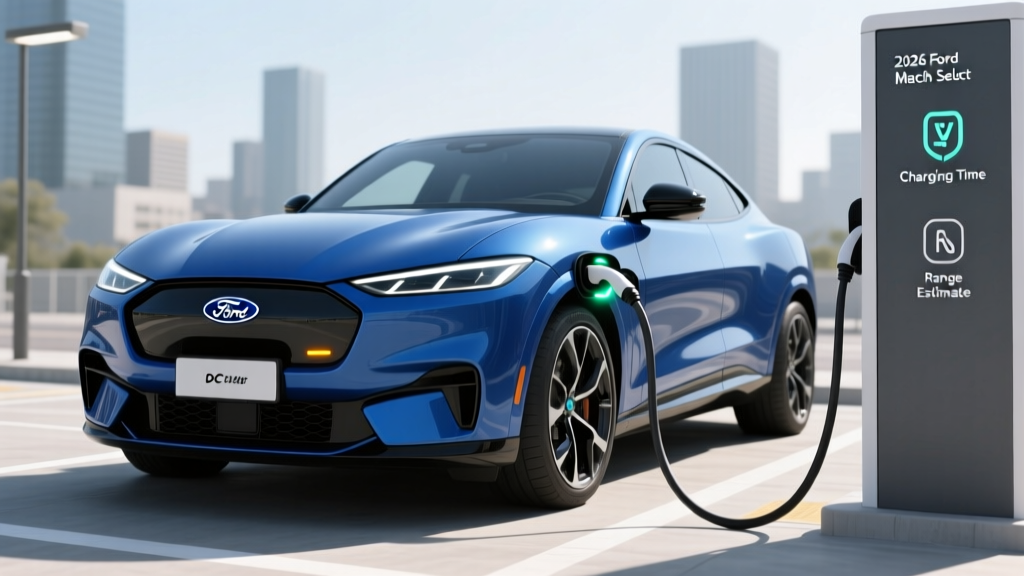
The 2026 Ford Mustang Mach-E Select is the gateway trim to Ford's electric crossover lineup, and it has matured into one of the most pragmatic choices in the mid-size electric SUV segment. With a 70 kWh lithium iron phosphate (LFP) battery, an EPA-estimated 250 miles of range on the standard-range rear-wheel-drive configuration, and a starting MSRP of $39,995 before incentives, the Select trim targets buyers who want solid daily usability without paying for performance they won't use.
Ford's decision to standardize the NACS (North American Charging Standard) port on the 2026 Mach-E lineup means native Tesla Supercharger access — a meaningful advantage over CCS-equipped rivals still relying on adapters. Combined with competitive DC fast-charging speeds, a spacious cabin, and Ford's BlueCruise hands-on-wheel driver-assist system, the Select trim earns its place as a sensible, well-rounded EV for commuters and small families.
But the Select isn't without trade-offs. The LFP battery, while durable and cost-effective, sacrifices some energy density compared to NMC chemistries. And if you regularly drive in sub-freezing climates or take frequent highway road trips, you'll want to understand the real-world range implications before signing the paperwork.
Range, Battery, and Efficiency: What the Numbers Actually Mean
Real-World Expectation: ~210–235 miles on mixed highway driving; ~175–200 miles in cold weather (below 32°F) with cabin heating. City/regenerative driving can match or slightly exceed the EPA sticker.
The 2026 Mach-E Select comes equipped with Ford's Standard Range battery pack: a 70 kWh usable capacity unit using LFP (lithium iron phosphate) chemistry. LFP cells offer distinct advantages — they tolerate regular 100% charging without accelerated degradation, have longer cycle life, and avoid cobalt and nickel sourcing concerns. The trade-off is lower energy density, meaning the pack is physically heavier per kWh stored than an equivalent NMC pack, and range suffers more in extreme cold due to LFP's less favorable low-temperature performance.
| Spec | RWD | AWD (eAWD) |
|---|---|---|
| Battery (usable) | 70 kWh (LFP) | 70 kWh (LFP) |
| EPA Range | 250 miles | 230 miles |
| MPGe (combined) | 105 MPGe | 98 MPGe |
| Efficiency (kWh/100 mi) | 32 kWh/100 mi | 34 kWh/100 mi |
MPGe (miles per gallon equivalent) is the EPA's way of translating electric efficiency into a gasoline-familiar metric. One gallon of gasoline contains roughly 33.7 kWh of energy, so 105 MPGe means the RWD Select uses energy at a rate equivalent to a 105 MPG gas car. For practical trip planning, the kWh/100 mi figure is more useful: at 32 kWh/100 mi, a full 70 kWh charge covers roughly 218 miles of real-world mixed driving.
Source: fueleconomy.gov — the EPA's official EV efficiency database.
Charging Speeds: DC Fast Charging and Home Level 2
Charging speed is where many entry-level EVs falter, but the 2026 Mach-E Select holds its own. The LFP pack supports a peak DC fast-charge rate of 150 kW, and thanks to the battery's thermal management system with preconditioning, it sustains useful charging speeds through the bulk of the curve.
| Charge Level | Power (kW) | Speed | Notes |
|---|---|---|---|
| Level 1 (120V household) | ~1.4 kW | ~4 mi/hr | Emergency/trickle only; ~60 hrs for full charge |
| Level 2 (240V home/public) | 10.5 kW (48A) | ~30 mi/hr | ~7 hrs for 10–80%; overnight full charge |
| DC Fast Charge (peak) | 150 kW | ~10–80% in 32 min | Tapers above 80%; preconditioning recommended |
Understanding the charge curve: The 150 kW peak occurs at low state of charge (roughly 5–30% SoC). As the battery fills past 60%, the rate tapers — first to ~100 kW, then ~50 kW above 80%. This is normal for lithium-ion packs and protects long-term battery health. For road trips, plan stops from 10% to 80% rather than waiting for a full charge; the last 20% can take as long as the first 70%.
The native NACS port is a significant 2026 advantage. Mach-E owners can plug directly into Tesla Supercharger V3 and V4 stalls (up to 150 kW on V3 for non-Tesla vehicles) without an adapter, accessing the most reliable and widespread DC fast-charging network in North America. Electrify America, EVgo, and ChargePoint stations with NACS connectors are also increasingly available.
Home charging setup: The onboard 10.5 kW charger means you'll want a 48-amp Level 2 wall connector on a 60-amp dedicated circuit for maximum speed. Expect to add roughly 30 miles of range per hour of Level 2 charging — enough to fully replenish a daily commute overnight. A licensed electrician will typically charge $500–$1,500 for installation if your panel has capacity, or $2,000–$4,000 if a panel upgrade to 200A service is needed.
Performance: 0-60, Horsepower, and Drivetrain Options
The Select trim prioritizes efficiency over outright speed, but it's no slouch. The single-motor RWD configuration produces 266 horsepower and 317 lb-ft of torque, achieving a 0-60 mph time of approximately 6.3 seconds. That's brisk enough for confident highway merging and passing, with the instant torque delivery that makes EVs feel quicker than their numbers suggest.
Opt for the eAWD dual-motor setup and output rises to 312 horsepower and 428 lb-ft of torque, dropping the 0-60 time to roughly 5.2 seconds. The trade-off is 20 fewer miles of EPA range and a slightly higher curb weight.
| Performance Spec | RWD | eAWD |
|---|---|---|
| Horsepower | 266 hp | 312 hp |
| Torque | 317 lb-ft | 428 lb-ft |
| 0-60 mph | ~6.3 sec | ~5.2 sec |
| Top Speed | 112 mph (governed) | 112 mph (governed) |
| Towing Capacity | 2,200 lbs (with tow pkg) | 2,200 lbs (with tow pkg) |
The Mach-E Select's regenerative braking system offers a true one-pedal driving mode that can bring the vehicle to a complete stop without touching the brake pedal in most city driving. The brake pedal feel has improved over earlier model years, with a more natural transition from regen to friction braking.
Interior, Cargo, and Technology
The Mach-E's cabin remains one of its strongest selling points. The Select trim comes standard with a 15.5-inch vertically oriented touchscreen running Ford's SYNC 4A infotainment system, a 10.2-inch digital instrument cluster, and wireless Apple CarPlay and Android Auto. The portrait screen dominates the dashboard and handles climate controls, navigation, and vehicle settings — though some buyers may miss physical knobs for volume and temperature.
Passenger space is generous for the class:
- Front headroom: 40.4 inches
- Front legroom: 43.3 inches
- Rear headroom: 39.3 inches
- Rear legroom: 38.1 inches
Cargo capacity measures 29.7 cubic feet behind the rear seats and expands to 59.7 cubic feet with the rear seats folded. The front trunk (frunk) adds 4.7 cubic feet of drainable storage — useful for wet items, charging cables, or groceries you want to keep separate from the cabin.
Driver assistance: The Select includes Ford Co-Pilot360 2.0 as standard, featuring automatic emergency braking with pedestrian detection, blind-spot monitoring, lane-keeping assist, rear cross-traffic alert, and adaptive cruise control with stop-and-go. Ford's BlueCruise hands-free highway driving system is available as an option on the Select (standard on higher trims), enabling hands-off-wheel operation on pre-mapped divided highways. BlueCruise is a Level 2 SAE driver-assist system — the driver must remain attentive and eyes-on-road at all times, monitored by an infrared driver-facing camera.
Pricing, Trims, and Federal Tax Credit Eligibility
The 2026 Ford Mustang Mach-E Select starts at $39,995 MSRP (including destination) for the RWD configuration. Adding eAWD costs approximately $3,000, bringing the AWD Select to roughly $42,995. Key options include the BlueCruise package (~$2,100), the Ford Co-Pilot360 Assist 2.0 package, panoramic fixed glass roof, and the Mobile Power Cord with adapters.
| Configuration | MSRP | Est. After §30D Credit | Eligible? |
|---|---|---|---|
| Select RWD | $39,995 | ~$32,495 | Yes (if buyer meets income + sourcing rules) |
| Select eAWD | $42,995 | ~$35,495 | Yes (if buyer meets income + sourcing rules) |
- MSRP cap: SUVs/crossovers must be ≤ $80,000 — the Mach-E Select qualifies easily.
- Buyer income cap: Modified AGI ≤ $150,000 (single) / $300,000 (married filing jointly) / $225,000 (head of household).
- Battery sourcing: Must meet critical minerals and battery component requirements that phase in annually. Ford has worked to qualify the Mach-E's LFP supply chain, but verify current-year compliance on IRS.gov before purchase.
- Point-of-sale transfer: Eligible buyers can transfer the credit to the dealer at purchase, reducing the out-of-pocket price immediately rather than waiting for a tax refund.
- Credit amount: Up to $7,500 ($3,750 for critical minerals + $3,750 for battery components). Partial credit is possible if only one requirement is met.
Note: Tax credit rules are subject to change. Consult a tax professional and verify eligibility at IRS.gov before purchasing.
Warranty and Long-Term Battery Outlook
Ford backs the 2026 Mach-E with a competitive warranty package:
- Bumper-to-bumper: 3 years / 36,000 miles
- Powertrain (including electric motors): 5 years / 60,000 miles
- High-voltage battery: 8 years / 100,000 miles (covers capacity loss below 70% of original)
The LFP chemistry in the Select's battery is a longevity positive. LFP cells typically degrade more slowly than NMC cells over equivalent charge cycles, and Ford's recommendation that LFP owners charge to 100% regularly (unlike NMC packs, which benefit from an 80% daily ceiling) means you get the full usable capacity for daily driving. Published fleet data from LFP-equipped EVs in other markets suggests 8–10% total degradation over 150,000 miles is typical, well within the warranty threshold.
Out-of-warranty battery replacement cost for a 70 kWh pack is estimated at $8,000–$12,000 including labor, though this figure is expected to decline as LFP cell prices continue to fall through 2026.
How It Stacks Up Against Key Competitors
The mid-size electric crossover segment is crowded. Here's how the 2026 Mach-E Select compares to its most direct rivals:
| Spec | Mach-E Select | Tesla Model Y (Standard) | Hyundai Ioniq 5 (SE Std Range) | VW ID.4 (Standard) |
|---|---|---|---|---|
| Base MSRP | $39,995 | $44,990 | $42,600 | $40,790 |
| EPA Range | 250 mi | 280 mi | 220 mi | 206 mi |
| Battery (kWh) | 70 (LFP) | 60 (LFP) | 58 (NMC) | 62 (NMC) |
| Peak DC Charge | 150 kW | 170 kW | 175 kW | 135 kW |
| 10–80% DCFC | ~32 min | ~28 min | ~18 min | ~34 min |
| Native Connector | NACS | NACS | NACS | NACS |
| Cargo (rear seats up) | 29.7 cu ft | 30.2 cu ft | 27.2 cu ft | 30.3 cu ft |
The Mach-E Select undercuts the Tesla Model Y and Hyundai Ioniq 5 on base price while offering more range than the Ioniq 5 Standard Range and VW ID.4. The Tesla Model Y leads on range and charging speed, while the Ioniq 5's 800V architecture delivers the fastest 10–80% charging time in the group. The Mach-E's advantage is its combination of competitive price, strong range, and access to the Supercharger network via native NACS.
Pros, Cons, and Who Should Buy the Mach-E Select
- Lowest MSRP in the mid-size EV crossover segment
- 250-mile EPA range sufficient for most daily driving and moderate road trips
- Native NACS port for direct Supercharger access
- LFP battery — charge to 100% daily without degradation concerns
- Spacious rear seat and generous cargo + frunk
- Standard Co-Pilot360 2.0 safety suite
- Strong eligibility for §30D tax credit (under MSRP cap)
- 150 kW peak DC charging is slower than Ioniq 5 and Model Y
- LFP chemistry loses more range in extreme cold vs. NMC
- No physical climate or volume knobs — all touchscreen
- BlueCruise is optional on Select, not standard
- Towing limited to 2,200 lbs — light-duty only
- AWD reduces range to 230 miles
- You're a daily commuter with ≤50 miles round-trip and home Level 2 charging
- You want the lowest entry price in a proven mid-size electric crossover
- You value native Supercharger access for occasional road trips
- You prefer the durability and 100%-charge-friendly nature of LFP batteries
- You want a spacious cabin for a small family without stepping up to a three-row SUV
- You regularly drive in sub-zero temperatures and need maximum cold-weather range retention
- You take frequent long road trips and want the fastest possible DC charging (consider Ioniq 5)
- You need heavy towing capacity (consider the F-150 Lightning or Rivian R1S)
- You want physical controls and a more traditional dashboard layout
Frequently Asked Questions
What is the real-world range of the 2026 Ford Mustang Mach-E Select?
The EPA rates the RWD Select at 250 miles and the eAWD at 230 miles. In real-world mixed highway driving at 70 mph, expect approximately 210–235 miles (RWD). In cold weather below 32°F with cabin heating active, range can drop to 175–200 miles due to battery chemistry limitations and HVAC energy draw. City driving with regenerative braking can match or slightly exceed the EPA estimate.
How fast does the Mach-E Select charge at home and on the road?
At home on a 240V Level 2 charger (48A), the Mach-E Select charges at up to 10.5 kW, adding roughly 30 miles of range per hour — a full overnight charge from 10% takes about 7 hours. On DC fast chargers, the peak rate is 150 kW, achieving a 10–80% charge in approximately 32 minutes with battery preconditioning enabled.
How much does the 2026 Mach-E Select cost after the federal tax credit?
The Select RWD starts at $39,995 MSRP. If you qualify for the full $7,500 §30D federal tax credit (meeting income, MSRP, and battery-sourcing requirements), the effective price drops to approximately $32,495. The credit can be transferred to the dealer at point of sale for an immediate price reduction. Always verify current-year eligibility at IRS.gov and consult a tax professional.
Does the 2026 Mach-E Select qualify for the $7,500 federal EV tax credit?
The Mach-E Select falls well under the $80,000 MSRP cap for SUVs/crossovers. Eligibility for the full $7,500 credit depends on the buyer's modified adjusted gross income (≤$150K single / ≤$300K joint) and whether Ford's battery meets the current-year critical minerals and battery component sourcing thresholds under §30D. Ford has been working to qualify its LFP supply chain, but the specific credit amount ($3,750 or $7,500) can vary by production batch and model year. Check the fueleconomy.gov tax credit database for the most current determination.
Is the Mach-E Select worth buying over the Tesla Model Y or Hyundai Ioniq 5?
It depends on your priorities. The Mach-E Select wins on base price ($39,995 vs. $44,990 for the Model Y) and offers competitive range with native Supercharger access. The Model Y offers more range (280 mi) and slightly faster charging. The Ioniq 5 charges significantly faster (10–80% in ~18 min) but has less range at 220 miles on the standard-range battery. If budget is your primary concern and 250 miles covers your needs, the Mach-E Select is an excellent value. If road-trip charging speed is paramount, the Ioniq 5's 800V architecture is hard to beat.
Can I charge the Mach-E Select at Tesla Superchargers?
Yes. The 2026 Mach-E comes with a native NACS charge port, allowing direct plug-in at Tesla Supercharger V3 and V4 stations without an adapter. Use the FordPass app or the vehicle's built-in navigation to locate and initiate Supercharger sessions. Tesla's network consistently ranks highest in reliability among DC fast-charging providers.
How long will the LFP battery last?
LFP batteries are known for excellent cycle life and slow degradation. Ford's high-voltage battery warranty covers capacity loss below 70% of original for 8 years or 100,000 miles. Real-world data from LFP-equipped fleets suggests total degradation of roughly 8–10% over 150,000 miles under normal use. Ford recommends charging LFP packs to 100% at least once per week for optimal battery management system calibration.