The Ford Mustang Mach-E remains one of the most recognizable entries in the midsize electric crossover segment, leveraging the Mustang nameplate to draw in buyers who might otherwise default to a Tesla Model Y or Hyundai Ioniq 5. For 2026, Ford continues to refine the Mach-E lineup with incremental updates to battery capacity, charging capability, and software, but the core question remains: does this electric Mustang earn its badge in a market saturated with compelling alternatives?
After spending significant time with the Mach-E across multiple trims and model years, charging it on road trips, and tracking its efficiency in varying conditions, here is the data-driven breakdown you need to make an informed purchase decision.
Range and Efficiency: What the EPA Says vs. What You'll Actually See
The 2026 Mach-E lineup offers two battery packs across rear-wheel-drive (RWD) and all-wheel-drive (AWD/eAWD) configurations. The Standard Range pack delivers an EPA-estimated 250 miles, while the Extended Range pack pushes that figure to an EPA-estimated 320 miles in the RWD California Route 1 trim. Here's how the full lineup breaks down:
| Trim | Drivetrain | Battery Pack | EPA Range | MPGe (Combined) | kWh/100 mi |
|---|---|---|---|---|---|
| Select | RWD | Standard Range | 250 mi | 101 MPGe | 33 |
| Premium | RWD | Extended Range | 310 mi | 101 MPGe | 33 |
| California Route 1 | RWD | Extended Range | 320 mi | 104 MPGe | 32 |
| Premium | eAWD | Extended Range | 290 mi | 96 MPGe | 35 |
| GT | eAWD | Extended Range | 270 mi | 86 MPGe | 39 |
The EPA's 320-mile figure for the California Route 1 is achievable in mild, city-heavy driving at moderate speeds. On sustained highway trips at 70-75 mph, expect closer to 250-270 miles from the Extended Range pack. In cold weather (below 30°F), range drops an additional 15-25% depending on cabin heating use and whether you precondition the battery. A 320-mile EPA rating realistically translates to ~200-220 miles on a freezing winter highway run. Plan your road trips accordingly — the Mach-E's range is competitive but not class-leading.
The Mach-E's efficiency of 32-39 kWh/100 mi (depending on trim) is respectable for its weight class but trails the Hyundai Ioniq 5's ~30 kWh/100 mi. The GT trim's 39 kWh/100 mi reflects the cost of its 480 horsepower — performance trades directly against efficiency here.
Battery, Charging Speed, and Home Setup
The Mach-E uses two lithium-ion battery configurations. The Standard Range pack provides approximately 75.7 kWh usable capacity (NMC chemistry), while the Extended Range pack delivers approximately 91 kWh usable (also NMC). Ford has not adopted LFP (lithium iron phosphate) chemistry for the Mach-E, meaning you get higher energy density but should follow best practices for long-term health — namely, avoiding prolonged storage at 100% state of charge.
DC Fast Charging
The Mach-E supports DC fast charging via the NACS (North American Charging Standard) connector, giving it native access to Tesla's Supercharger network — a significant practical advantage over CCS-only vehicles in areas where Electrify America or other networks have sparse coverage.
| Charging Method | Max Rate | Performance |
|---|---|---|
| DC Fast Charge (NACS) | 150 kW peak | 10-80% in ~41 minutes |
| Level 2 Home (240V, 48A) | 11.5 kW | ~25 miles of range per hour |
| Level 2 Home (240V, 32A) | 7.7 kW | ~17 miles of range per hour |
| Level 1 (120V) | 1.4 kW | ~3 miles of range per hour |
A critical note on the Mach-E's DC fast charging: the 150 kW peak rate is just that — a peak. The charging curve tapers noticeably above 50% state of charge, and sustained rates average closer to 90-110 kW across the full 10-80% session. This means the 41-minute 10-80% time is honest but unremarkable compared to competitors like the Hyundai Ioniq 5 (which peaks at 240 kW on 800V architecture and achieves 10-80% in ~18 minutes). If frequent road-trip charging is central to your use case, this is a meaningful gap.
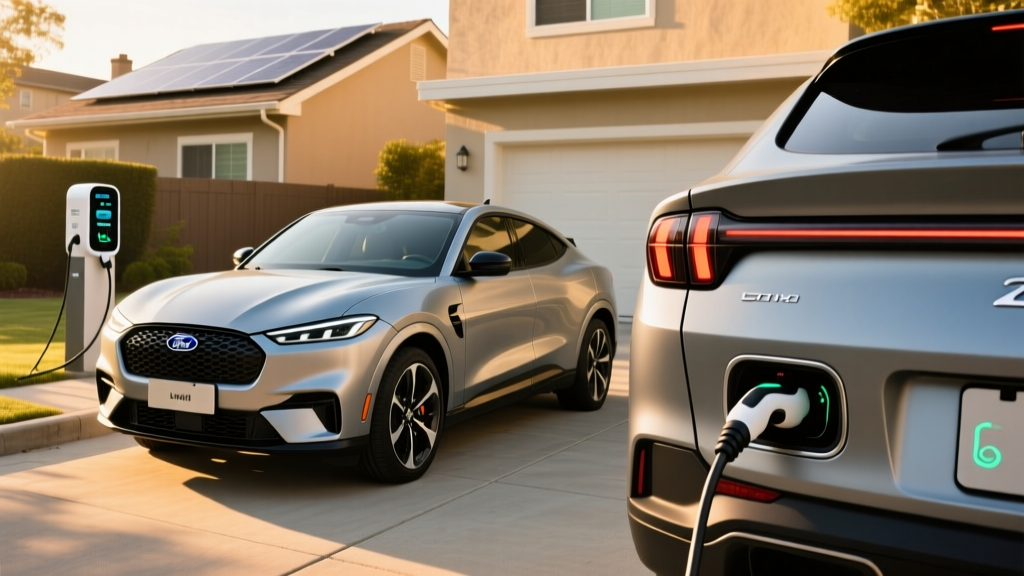
At home on a properly installed 48-amp Level 2 charger (such as Ford's Connected Charge Station), the Extended Range pack charges fully overnight in roughly 8-9 hours. Most owners will find this more than adequate — plug in when you get home, wake up to a full battery. Installation costs for a dedicated 240V/60A circuit typically run $500-$2,000 depending on panel proximity and local permitting, per data from fueleconomy.gov. If your home has an older 100-amp electrical panel, a panel upgrade to 200 amps could add $1,500-$3,000.
Performance and Driving Dynamics
| Trim | Drivetrain | Horsepower | Torque (lb-ft) | 0-60 mph |
|---|---|---|---|---|
| Select / Premium (RWD) | Rear-Wheel Drive | 266 hp | 317 | ~6.3 sec |
| Premium (eAWD) | Dual-Motor AWD | 346 hp | 428 | ~5.1 sec |
| GT | Dual-Motor AWD | 480 hp | 600 | ~3.5 sec |
| GT (Performance Upgrade) | Dual-Motor AWD | 480 hp | 634 | ~3.3 sec |
The base RWD models deliver adequate acceleration for daily commuting and highway merging, but the Mach-E truly comes alive in eAWD and especially GT trims. The GT's 3.5-second 0-60 time puts it in legitimate sports-car territory, and the instant torque delivery makes it feel even quicker in real-world stoplight-to-stoplight driving.
Handling is composed for a crossover of this weight (the Extended Range AWD tips the scales at roughly 4,800 lbs), though the steering lacks the communicative feedback that the Mustang coupe lineage might suggest. Ford's MagneRide adaptive dampers (available on the GT) improve ride quality substantially over rough pavement. Regenerative braking offers multiple modes including a true one-pedal driving experience that can bring the Mach-E to a complete stop without touching the brake pedal.
Interior, Cargo, and Technology
The Mach-E's cabin is defined by its massive 15.5-inch vertically oriented touchscreen running Ford's SYNC 4A infotainment system. The interface is responsive, supports wireless Apple CarPlay and Android Auto, and includes over-the-air (OTA) update capability. A 10.2-inch digital instrument cluster sits behind the steering wheel. Physical buttons are minimal — climate controls are integrated into the touchscreen, which some drivers find distracting.
Practical dimensions:
- Cargo volume (behind rear seats): 29.7 cu ft
- Cargo volume (rear seats folded): 59.7 cu ft
- Front trunk (frunk): 4.7 cu ft (drainable — useful for ice and beverages)
- Rear legroom: 38.1 inches
- Front headroom: 40.4 inches
These cargo figures are competitive with the Model Y (30.2 cu ft behind rear seats) but fall short of the Hyundai Ioniq 5's more boxy, space-maximized interior. The frunk is smaller than the Tesla's but includes a drain plug — a thoughtful touch for tailgating.
Driver assistance comes via Ford BlueCruise, a hands-free driving system rated at SAE Level 2. On pre-qualified divided highways (over 130,000 mapped miles in North America), BlueCruise allows hands-off operation with driver monitoring via an infrared camera. This is not autonomous driving — you must remain attentive, and the system will prompt you to re-engage if it detects inattention. BlueCruise is competent for long highway stints but does not handle city streets, construction zones, or unmapped routes.
BlueCruise, like Tesla Autopilot and GM Super Cruise, is an SAE Level 2 driver-assistance system. The driver must remain engaged and ready to take over at any moment. Full self-driving (SAE Level 4) is currently only available in limited robotaxi services like Waymo — not in any consumer vehicle.
Pricing, Trims, and Federal Tax Credit Eligibility
| Trim | Base MSRP | Estimated Price After §30D Credit* |
|---|---|---|
| Select (RWD, Std Range) | $39,995 | ~$32,495 |
| Premium (RWD, Ext Range) | $46,995 | ~$39,495 |
| California Route 1 (RWD, Ext Range) | $46,495 | ~$38,995 |
| Premium (eAWD, Ext Range) | $49,995 | ~$42,495 |
| GT (eAWD, Ext Range) | $59,995 | ~$52,495 |
*Tax credit estimates assume full $7,500 eligibility under IRS §30D. Actual credit varies based on buyer income, battery sourcing compliance, and MSRP caps. Verify current eligibility at irs.gov.
The federal EV tax credit under IRS §30D offers up to $7,500 for qualifying new EVs, but eligibility hinges on several requirements that change periodically:
- MSRP cap: SUVs/crossovers must be priced at or below $80,000 — all Mach-E trims qualify.
- Buyer income cap: Adjusted gross income must not exceed $150,000 (single), $225,000 (head of household), or $300,000 (joint filers).
- Battery sourcing: Critical minerals and battery components must meet escalating domestic-sourcing thresholds. Ford has worked to localize Mach-E battery supply, but specific compliance can shift model year to model year.
- Point-of-sale transfer: As of 2024, qualifying buyers can transfer the credit to the dealer at purchase, receiving the $7,500 as an immediate price reduction rather than waiting for tax filing.
Always confirm the Mach-E's current §30D status on the official fueleconomy.gov tax credit page before purchasing, as battery-sourcing compliance is subject to change.
Warranty and Long-Term Ownership
Ford backs the Mach-E with the following warranty coverage:
- Battery: 8 years / 100,000 miles (retains minimum 70% capacity)
- Electric powertrain components: 8 years / 100,000 miles
- Bumper-to-bumper: 3 years / 36,000 miles
- Corrosion perforation: 5 years / unlimited miles
The 70% capacity retention threshold over 8 years is industry standard, though some competitors (notably Hyundai/Kia) offer 8-year/100,000-mile battery warranties with no stated retention minimum, which can be more favorable in a warranty claim. Real-world degradation data from Mach-E owners suggests roughly 8-12% capacity loss over the first 100,000 miles under normal use — well within the warranty buffer. NMC batteries like those in the Mach-E tend to show a slightly steeper initial degradation curve compared to LFP packs, but they typically stabilize after the first 20,000-30,000 miles.
Insurance costs for the Mach-E run approximately 15-25% higher than comparable gas-powered crossovers, reflecting the higher repair costs associated with EV battery packs and aluminum body components. Get quotes before committing.
How It Compares: Mach-E vs. Key Competitors
| Spec | Ford Mustang Mach-E (ER RWD) | Tesla Model Y (Long Range) | Hyundai Ioniq 5 (Long Range RWD) |
|---|---|---|---|
| EPA Range | 320 mi | 330 mi | 303 mi |
| Battery (usable) | 91 kWh (NMC) | ~78 kWh (NMC) | 77.4 kWh (NMC) |
| Peak DC Charge | 150 kW | 250 kW | 240 kW (800V) |
| 10-80% DC Time | ~41 min | ~27 min | ~18 min |
| 0-60 mph | ~6.3 sec (RWD) | ~5.0 sec (LR AWD) | ~7.0 sec (RWD) |
| Cargo (behind rear) | 29.7 cu ft | 30.2 cu ft | 27.2 cu ft |
| Base MSRP (comparable) | ~$46,495 | ~$44,990 | ~$46,000 |
| Connector | NACS | NACS | CCS1 (NACS adapter avail.) |
Choose the Mach-E if: You want a comfortable, well-built crossover with Ford dealer support, hands-free BlueCruise highway driving, NACS Supercharger access, and a more traditional automotive interior feel. The GT trim's performance is genuinely thrilling.
Choose the Model Y if: Maximum range, fastest charging, and the most robust Supercharger network access are your top priorities. Tesla's software and OTA ecosystem remain best-in-class, though build quality and service center availability vary.
Choose the Ioniq 5 if: Fastest DC charging (800V architecture), distinctive design, and the best value-per-feature ratio matter most. Its 18-minute 10-80% charge time is a road-trip game advantage, though its CCS connector (with NACS adapter) adds a step.
Pros and Cons
- NACS connector provides native Tesla Supercharger access
- GT trim delivers genuine sports-car acceleration (3.5 sec 0-60)
- BlueCruise hands-free driving is polished on mapped highways
- Comfortable ride quality, especially with MagneRide
- Drainable frunk is practical for outdoor use
- Ford dealer network for service and warranty claims
- DC fast charging at 150 kW trails key competitors significantly
- Real-world highway range drops well below EPA estimates
- Climate controls buried in touchscreen — no physical knobs
- Cargo space slightly less than Model Y and Ioniq 5
- Insurance premiums higher than gas equivalents
- No LFP battery option for buyers who prefer 100% daily charging
Frequently Asked Questions
What is the real-world range of the electric Mustang Mach-E?
The EPA rates the Extended Range RWD Mach-E at 320 miles, but real-world highway driving at 70+ mph typically yields 250-270 miles. In cold weather below 30°F, expect 200-220 miles. The Standard Range models deliver roughly 200-220 miles in mixed real-world use versus their 250-mile EPA rating.
How fast does the Mach-E charge at home and on DC fast chargers?
On a 48-amp Level 2 home charger, the Mach-E adds about 25 miles of range per hour, fully charging the Extended Range pack in 8-9 hours. On DC fast chargers, it peaks at 150 kW and charges 10-80% in approximately 41 minutes — slower than the Ioniq 5 (~18 min) or Model Y (~27 min).
Does the 2026 Mustang Mach-E qualify for the $7,500 federal tax credit?
The Mach-E is eligible for up to $7,500 under IRS §30D, but you must meet income caps ($150K single / $300K joint), the vehicle MSRP must be under $80,000 (all trims qualify), and battery sourcing requirements must be met for the specific build date. Always verify on irs.gov before purchase. The credit can be transferred to the dealer for an immediate price reduction at point of sale.
Is the Mach-E worth buying over a Tesla Model Y?
The Mach-E wins on ride comfort, BlueCruise capability, Ford dealer service access, and interior material quality. The Model Y wins on range (330 mi), charging speed (250 kW peak), cargo space, and software. If charging speed on road trips is your priority, the Model Y or Ioniq 5 are stronger choices. If comfort and traditional dealership support matter more, the Mach-E is compelling.
What are the biggest drawbacks of the Mach-E?
The two most significant limitations are its 150 kW peak DC charging speed (which makes road-trip stops longer than competitors) and its real-world range falling 15-25% below EPA estimates on highway and cold-weather drives. Secondary concerns include touchscreen-only climate controls and higher insurance costs.
Who is the Mustang Mach-E best suited for?
The Mach-E is ideal for daily commuters who charge at home, value a comfortable ride and quiet cabin, and want the security of a widespread Ford dealer network. The eAWD trims suit families in snow-belt states. The GT trim targets enthusiasts who want sports-car acceleration in a practical daily driver. It is less ideal for frequent long-distance road trippers who prioritize the fastest possible charging stops.