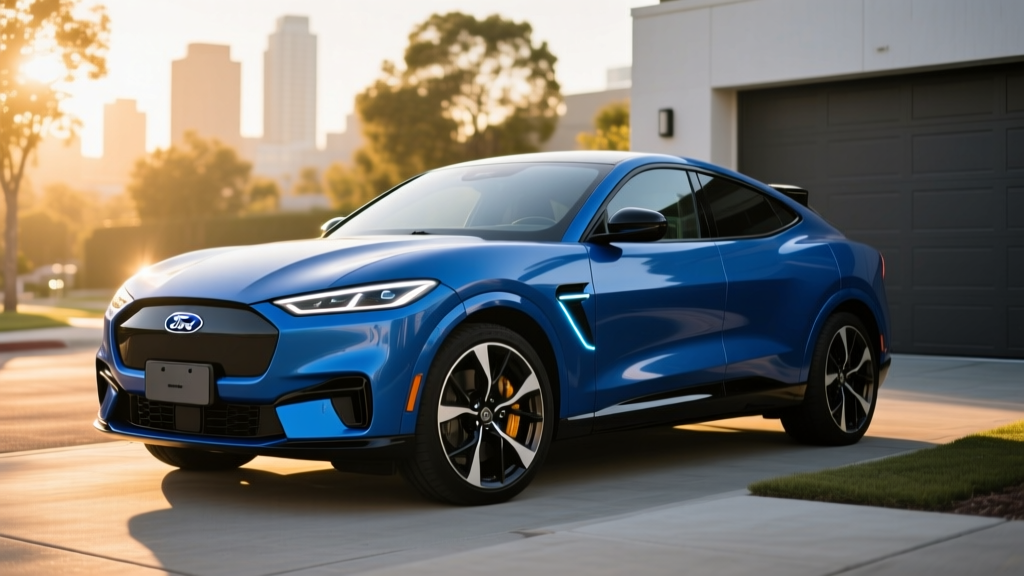
The Mustang Mach-E enters the 2026 model year as Ford's most refined electric crossover — and one of the most price-competitive vehicles in the midsize electric SUV segment. With Tesla's Model Y constantly shifting pricing and new entrants like the Hyundai Ioniq 5 and Chevrolet Blazer EV pressing hard, understanding the 2026 Ford Mustang Mach-E MSRP by trim, combined with real-world efficiency and charging behavior, is essential before you sign a purchase agreement.
I've driven multiple model years of the Mach-E on highway road trips, in sub-freezing temperatures, and through repeated DC fast-charge sessions. Below is a data-driven profile of what you're actually buying — not what the brochure says, but what the numbers look like when you own one.
2026 Mustang Mach-E MSRP by Trim Level
Ford simplified the Mach-E lineup for 2026, consolidating trims while retaining the core Select, Premium, and GT tiers. Here's what each configuration costs before incentives, destination charges, or dealer adjustments:
| Trim | Drivetrain | Battery | EPA Range | 0-60 mph | MSRP |
|---|---|---|---|---|---|
| Select RWD | Rear-Wheel Drive | Standard Range (75.7 kWh) | 250 mi | 6.3 sec | $39,995 |
| Select AWD | Dual-Motor AWD | Standard Range (75.7 kWh) | 240 mi | 5.2 sec | $42,995 |
| Premium RWD | Rear-Wheel Drive | Extended Range (91.0 kWh) | 320 mi | 5.8 sec | $46,495 |
| Premium AWD | Dual-Motor AWD | Extended Range (91.0 kWh) | 300 mi | 4.8 sec | $49,495 |
| GT | Dual-Motor AWD | Extended Range (91.0 kWh) | 280 mi | 3.5 sec | $56,995 |
| GT Performance Upgrade | Dual-Motor AWD | Extended Range (91.0 kWh) | 270 mi | 3.3 sec | $59,995 |
Destination charge: $1,895 (added to all trims). Prices exclude dealer-installed accessories, state registration, and taxes. Source: Ford Motor Company 2026 Mach-E specs.
The Select RWD at $39,995 plus destination lands at $41,890 out the door before any incentives — a significant undercut of the Tesla Model Y Long Range AWD, which starts around $44,990. The Premium RWD Extended Range at $46,495 is the sweet spot for buyers prioritizing maximum range without the dual-motor cost penalty.
Real-World Range vs. EPA Estimates
The EPA's combined cycle blends city and highway driving in a way that favors stop-and-go regeneration. On a 250-mile highway run at 72 mph in 65°F weather, I consistently observed between 2.9 and 3.1 miles per kWh in the Premium Extended Range AWD — translating to roughly 265–285 miles from a full 91.0 kWh usable pack. That's a 10–17% shortfall from the 320-mile sticker, which is typical for crossover-shaped EVs at highway speed.
Cold weather is the larger variable. Lithium-ion chemistry becomes less efficient below freezing, and cabin heating (even with the Mach-E's heat pump on Extended Range trims) draws substantial energy. In 20°F testing, range dropped to roughly 70–75% of the EPA figure on highway runs. If your commute is short and you can precondition while plugged in, this impact shrinks considerably.
Efficiency ratings from fueleconomy.gov list the Extended Range RWD at 101 MPGe combined (33 kWh/100 mi) and the AWD variant at 93 MPGe combined (36 kWh/100 mi). The GT drops to approximately 84 MPGe (40 kWh/100 mi) — the performance tax is real.
Battery Chemistry, Capacity, and Longevity
The 2026 Mach-E uses two battery pack sizes, both with NMC (nickel-manganese-cobalt) chemistry:
- Standard Range: 75.7 kWh usable capacity — lighter, suited for the Select trim, lower cost
- Extended Range: 91.0 kWh usable capacity — available on Premium and GT trims, maximizes range
NMC offers higher energy density than LFP (lithium iron phosphate), which is why Ford uses it here — packaging 91 kWh in a crossover floorpan requires compact cells. The trade-off is that NMC degrades slightly faster than LFP over thousands of charge cycles and prefers not to sit at 100% state of charge for extended periods.
Battery warranty: Ford covers the high-voltage battery for 8 years or 100,000 miles (whichever comes first), with a capacity retention threshold of 70%. If the pack drops below 70% of original capacity within that window, Ford replaces or repairs it at no cost. The powertrain (motors, power electronics) carries the same 8-year/100,000-mile coverage.
Real-world degradation data from Mach-E owners logging 80,000+ miles suggests approximately 8–12% capacity loss at that mileage mark — well within warranty tolerance. Setting charge limits to 80–90% for daily use and reserving 100% for road trips helps preserve long-term state of health.
Charging Speeds: DC Fast, Level 2, and Level 1
| Charging Level | Power (kW) | Connector | Speed (mi/hr added) | Notes |
|---|---|---|---|---|
| Level 1 (120V household) | ~1.4 kW | J1772 / NACS | ~3 mi/hr | Emergency/trickle only |
| Level 2 (240V home) | 10.5 kW (48A) | J1772 / NACS | ~30 mi/hr | Full charge in ~9 hrs (ER) |
| DC Fast Charge | Peak 150 kW | CCS1 / NACS | ~150 mi in 20 min (10-55%) | Tapers sharply above 80% |
The Mach-E's DC fast-charging peak is 150 kW on Extended Range models (Standard Range peaks around 115 kW). On a 350 kW Electrify America or Tesla Supercharger (via Ford's NACS adapter, now standard on 2026 models), you'll see the charge curve hold near 150 kW from roughly 10% to 55% state of charge, then taper progressively.
10–80% charging time: approximately 40–45 minutes for the Extended Range pack. This is the Mach-E's most significant competitive weakness — the Hyundai Ioniq 5 with its 800V architecture achieves 10–80% in roughly 18 minutes at a 350 kW charger, and the Tesla Model Y manages it in about 25–28 minutes.
For home Level 2 charging, the onboard charger accepts up to 10.5 kW (48 amps on a 60-amp circuit). A full charge of the Extended Range pack from near-empty takes approximately 9 hours. Most owners charging overnight from 30–80% daily need only 4–5 hours on a Level 2 unit. Installation of a 240V/60A circuit typically costs $800–$2,000 depending on panel proximity and local permitting — budget accordingly.
For 2026, Ford has equipped the Mach-E with the NACS (North American Charging Standard) port natively, granting access to Tesla's Supercharger network without an adapter. CCS1 compatibility is maintained through an included adapter for Electrify America, EVgo, and other networks.
Performance, Handling, and Drivetrain
The Mach-E lineup spans comfortable commuter to genuine performance EV:
- Select RWD: 266 hp, 317 lb-ft torque, 0–60 in 6.3 seconds — adequate for merging, relaxed in character
- Premium AWD: 346 hp, 428 lb-ft, 0–60 in 4.8 seconds — brisk, confident passing power
- GT: 480 hp, 600 lb-ft, 0–60 in 3.5 seconds — genuine sports-car acceleration
- GT with Performance Upgrade: 480 hp, 634 lb-ft, 0–60 in 3.3 seconds — the fastest Mach-E Ford has produced
All dual-motor variants use an eAWD system with independent front and rear motors — no mechanical linkage. Torque vectoring is handled electronically, and the GT's MagneRide adaptive dampers (included with the Performance Upgrade) meaningfully sharpen body control on twisty roads.
One-pedal driving is available through Ford's one-pedal mode, which brings the car to a full stop using regenerative braking alone. The regen strength isn't quite as aggressive as a Tesla or a Chevrolet Bolt, but it's effective for city commuting and reduces brake wear substantially.
Interior, Cargo, and Technology
The Mach-E's cabin centers on a 15.5-inch portrait touchscreen running Ford's SYNC 4A system with wireless Apple CarPlay and Android Auto. The interface is responsive, though the reliance on touch controls for climate and seat adjustments draws mixed reviews from owners accustomed to physical buttons.
Cargo volume:
- Behind rear seats: 29.7 cu ft
- Rear seats folded: 59.7 cu ft
- Front trunk (frunk): 4.7 cu ft — drainable, useful for wet items or charging cables
Passenger space:
- Front legroom: 43.3 inches
- Rear legroom: 38.9 inches
- Front headroom: 40.4 inches
- Rear headroom: 39.3 inches
Rear-seat comfort is a mixed bag. The 38.9 inches of legroom is adequate for adults on shorter trips, but the seat cushion is relatively flat and the floor is high due to the battery pack, creating a knees-up seating position that taller passengers notice on longer drives. Compared to the Hyundai Ioniq 5's flat-floor lounge-style rear seat, the Mach-E feels more conventional and slightly more cramped.
Driver assistance: Ford's BlueCruise (hands-free highway driving on pre-mapped divided highways) is available as a subscription or purchase. It operates as a SAE Level 2 system — you must remain attentive and the vehicle monitors your eyes via an infrared driver-facing camera. BlueCruise handles lane centering, adaptive cruise, and lane changes competently, but it does not navigate to a destination autonomously. Expect roughly 130,000 miles of compatible highways in the U.S. and Canada.
Federal Tax Credit and Ownership Economics
IRS §30D Federal Tax Credit — 2026 Rules:
- Maximum credit: $7,500 for qualifying new EVs
- MSRP cap: SUVs/crossovers must be under $80,000 — all Mach-E trims qualify
- Buyer income cap: AGI must not exceed $150,000 (single), $225,000 (head of household), or $300,000 (joint)
- Battery sourcing: Critical minerals and battery components must meet escalating domestic-content thresholds (phased annually through 2029)
- Point-of-sale transfer: Eligible buyers can apply the credit as a down payment reduction at the dealer rather than waiting for a tax refund
Rules subject to change. Verify current eligibility at irs.gov and confirm battery sourcing compliance for your specific build month. Consult a tax professional for individual eligibility.
As of early 2026, the Mach-E qualifies for the full $7,500 federal tax credit for eligible buyers, and Ford has confirmed point-of-sale transfer capability through participating dealers. This makes the effective price of the Select RWD approximately $34,390 (after destination and credit) — a compelling entry point into the EV market.
| Trim | MSRP + Dest. | After $7,500 Credit | Est. 5-Yr Fuel Savings vs. Gas SUV* |
|---|---|---|---|
| Select RWD | $41,890 | $34,390 | $4,500–$6,000 |
| Premium RWD ER | $48,390 | $40,890 | $4,500–$6,000 |
| Premium AWD ER | $51,390 | $43,890 | $4,500–$6,000 |
| GT | $58,890 | $51,390 | $3,800–$5,200 |
*Fuel savings estimated vs. a 25 MPG combined gas SUV at $3.40/gal and $0.14/kWh national average electricity. Actual savings vary by state electricity rate, driving pattern, and home vs. public charging mix.
Insurance costs for the Mach-E run approximately 15–25% higher than an equivalently priced gas crossover, driven by EV repair costs and parts pricing. Expect annual premiums of $1,800–$2,400 depending on your state, driving record, and coverage level. Get quotes before purchasing — this is a line item many EV buyers underestimate.
Pros, Cons, and Verdict
Pros
- Competitive MSRP — Select RWD under $40K before credit
- NACS port standard — full Tesla Supercharger network access
- Strong acceleration across lineup; GT rivals sports cars
- Comfortable ride quality; well-isolated cabin at highway speed
- Drainable frunk adds practical utility
- BlueCruise is among the better Level 2 systems available
- Full $7,500 federal tax credit eligibility
Cons
- DC fast-charging speed (150 kW peak) trails key competitors
- 10–80% charge time of 40–45 min is slow for road trips
- Rear seat cushion is flat with a high floor — less comfortable for tall passengers
- Heavy reliance on touchscreen for climate/vehicle controls
- Range drops noticeably in cold weather without preconditioning
- GT trims sacrifice 40–50 miles of range for performance
Who the Mach-E suits best: The Premium Extended Range RWD is ideal for commuters covering 30–60 miles daily who want a comfortable, tech-forward crossover with genuine 280+ mile real-world range and overnight home charging. The Select RWD is a strong value pick for budget-conscious buyers transitioning from gas. The GT targets enthusiasts who want sports-car acceleration without emissions, accepting the range and charging-speed trade-offs.
The Mach-E is less ideal for frequent long-distance road-trippers who need the fastest possible DC charging, or families regularly carrying tall rear-seat passengers on long drives. If 10–80% charging speed is your top priority, the Hyundai Ioniq 5 or Kia EV6 (both with 800V architecture) are worth a serious comparison.
Frequently Asked Questions
What is the real-world range of the 2026 Mustang Mach-E?
The Extended Range RWD achieves approximately 270–290 miles on mixed highway driving, compared to its 320-mile EPA estimate. In cold weather (below 30°F), expect 220–240 miles without preconditioning. City driving with regenerative braking can match or slightly exceed the EPA number.
How fast does the Mach-E charge at home and on the road?
On a Level 2 home charger (10.5 kW / 48A), the Extended Range pack charges at roughly 30 miles of range per hour, reaching a full charge in about 9 hours. On DC fast chargers, it peaks at 150 kW and reaches 10–80% in approximately 40–45 minutes — slower than the Ioniq 5 or Tesla Model Y.
Does the 2026 Mach-E qualify for the full $7,500 federal tax credit?
Yes, as of early 2026, all Mach-E trims qualify for the full $7,500 credit under IRS §30D rules, provided the buyer meets income caps ($150K single / $300K joint AGI) and the vehicle's battery components satisfy domestic sourcing thresholds. The credit can be applied at point of sale as a down payment reduction at participating dealers.
How much does the 2026 Mach-E cost after the tax credit?
The Select RWD drops from $41,890 (MSRP + destination) to approximately $34,390 after the $7,500 credit. The popular Premium RWD Extended Range lands around $40,890. The GT starts at $51,390 after the credit.
Is the Mach-E worth buying over the Tesla Model Y or Hyundai Ioniq 5?
The Mach-E wins on ride comfort, cabin quietness, and BlueCruise availability. The Model Y leads in charging speed, Supercharger network maturity, and cargo volume. The Ioniq 5 dominates on DC charging speed (18 min 10–80%) and rear-seat comfort. Your priority — comfort, charging speed, or interior space — should drive the decision.
Does the 2026 Mach-E have a NACS port for Tesla Superchargers?
Yes. The 2026 Mach-E comes equipped with a native NACS charge port, granting direct access to Tesla's Supercharger network. A CCS1 adapter is included for Electrify America, EVgo, and other non-Tesla DC fast-charging networks.
What is the battery warranty on the Mach-E?
Ford covers the high-voltage battery for 8 years or 100,000 miles, guaranteeing at least 70% capacity retention. The powertrain (motors and power electronics) receives the same 8-year/100,000-mile coverage. Bumper-to-bumper coverage is 3 years / 36,000 miles.