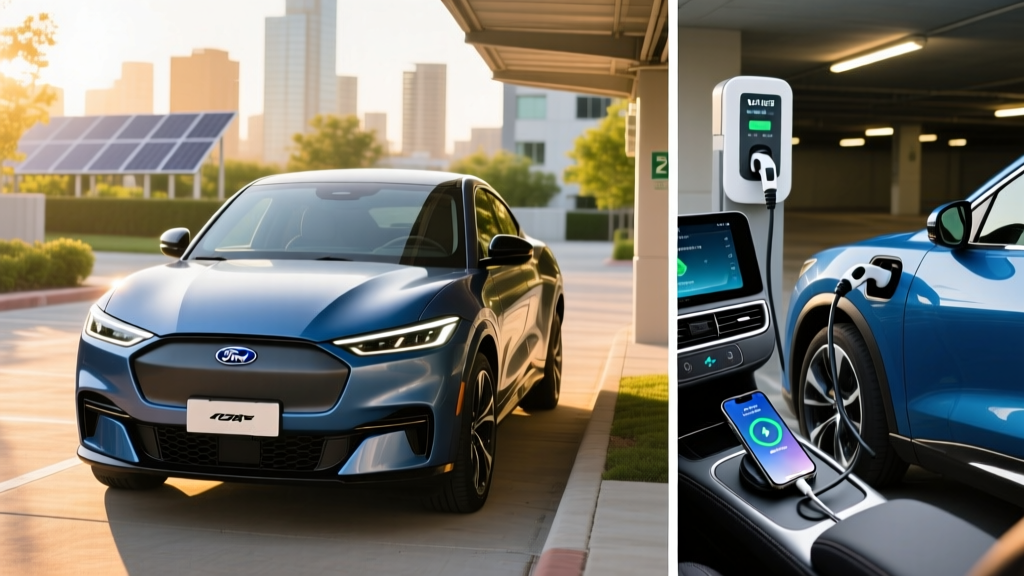
The Ford Mustang Mach-E enters the 2026 model year as one of the most established electric crossovers on the market, but buyer questions persist about its real-world usability, charging practicality, and value after incentives. This guide answers the most-searched 2026 Ford Mustang Mach-E FAQ topics with hard numbers — EPA range, battery chemistry, charge-curve behavior, tax-credit eligibility under current IRS §30D rules, and how it stacks up against the Tesla Model Y, Hyundai Ioniq 5, and Kia EV6.
What Is the Real-World Range of the 2026 Mustang Mach-E?
The 2026 Mach-E lineup offers three battery and drivetrain configurations. The EPA-estimated range peaks at 320 miles on the California Route 1 RWD trim with the Extended Range pack. Here is the full breakdown:
| Trim | Drivetrain | Battery (kWh usable) | EPA Range (mi) | MPGe (combined) | kWh/100 mi |
|---|---|---|---|---|---|
| Select RWD | RWD | 75.7 (LFP) | 250 | 100 | 34 |
| Premium RWD (Ext. Range) | RWD | 91.0 (NMC) | 320 | 104 | 32 |
| Premium AWD (Ext. Range) | AWD dual-motor | 91.0 (NMC) | 290 | 95 | 35 |
| GT AWD | AWD dual-motor | 91.0 (NMC) | 280 | 89 | 38 |
The 320-mile EPA figure for the Premium RWD Extended Range assumes a mix of city and moderate-speed highway driving at ~70°F. Expect 260–280 miles on sustained 75 mph highway trips, and 220–250 miles in sub-30°F winter conditions without preconditioning. The LFP-equipped Select trim holds up better to repeated 100% charging but sacrifices roughly 70 miles of range compared to the NMC Extended Range pack.
Ford sources EPA data via fueleconomy.gov, and independent testing by outlets like Edmunds and MotorTrend has consistently shown the Mach-E Extended Range models falling 10–15% below sticker on cold-weather highway loops.
How Fast Does the 2026 Mach-E Charge at Home and on the Road?
Charging speed is where the Mach-E's generational architecture shows its age compared to 800-volt rivals. The 2026 model retains a 400-volt platform with a peak DC fast-charge rate of 150 kW on Extended Range trims and 115 kW on the Standard Range LFP pack.
| Charge Level | Standard Range (LFP 75.7 kWh) | Extended Range (NMC 91.0 kWh) |
|---|---|---|
| Level 1 (120V, 1.4 kW) | ~4 mi/hr | ~5 mi/hr |
| Level 2 (240V, 11.5 kW / 48A) | ~28 mi/hr (7 hrs 10–100%) | ~34 mi/hr (8 hrs 10–100%) |
| DC Fast Charge (peak kW) | 115 kW peak | 150 kW peak |
| DC 10–80% time | ~42 minutes | ~36 minutes |
The 150 kW peak on the Extended Range pack is only sustained between roughly 15% and 45% State of Charge (SoC). Above 60%, the charge curve tapers sharply — you will see 90 kW by 70% and under 50 kW past 85%. This is typical of 400V NMC architectures, but it means the Mach-E trails the Hyundai Ioniq 5 (which peaks at 240 kW on its 800V system and does 10–80% in ~18 minutes).
For home charging, Ford includes the Ford Mobile Power Cord (dual 120V/240V capable) with every Mach-E. For full Level 2 speed, you will need a hardwired 48-amp wall connector on a 60-amp circuit. Budget $800–$2,200 for a professional Level 2 home installation depending on panel proximity and local permit costs.
The Mach-E uses the CCS1 connector for DC fast charging and the J1772 inlet for Level 2. Ford has announced NACS adapter availability for Supercharger network access, though adapter compatibility should be confirmed with your dealer for the 2026 model year.
How Much Does the 2026 Mach-E Cost After Federal Tax Credits?
Pricing for the 2026 Mach-E starts just under $43,000 and climbs past $60,000 for the GT. Federal tax credit eligibility under IRS §30D depends on MSRP caps, buyer income limits, and battery-component/critical-mineral sourcing requirements that tighten each year.
| Trim | Base MSRP | Est. §30D Credit* | Effective Price After Credit |
|---|---|---|---|
| Select RWD | $42,995 | $3,750–$7,500 | $35,495–$39,245 |
| Premium RWD (Ext. Range) | $48,995 | $3,750–$7,500 | $41,495–$45,245 |
| Premium AWD (Ext. Range) | $51,995 | $3,750–$7,500 | $44,495–$48,245 |
| GT AWD | $61,995 | $0–$7,500 | $54,495–$61,995 |
*Credit amounts are estimates based on 2026 IRS §30D rules. Actual eligibility depends on:
- MSRP cap: SUVs/crossovers must be ≤$80,000 — all Mach-E trims qualify.
- Income cap: Modified AGI ≤$150,000 (single), ≤$225,000 (head of household), ≤$300,000 (joint filers).
- Battery sourcing: Increasing percentages of critical minerals and battery components must be sourced from the US or FTA partners. The partial credit ($3,750) may apply if only one of the two sourcing thresholds is met.
- Point-of-sale transfer: Buyers can elect to transfer the credit to the dealer at purchase, reducing the drive-off price immediately.
The GT trim at $61,995 is under the $80K MSRP cap, but its battery-sourcing profile should be confirmed with Ford closer to your purchase date. Always consult a tax professional before assuming the full $7,500.
Performance, Cargo Space & Technology: What Owners Get
The 2026 Mach-E offers a wide performance envelope. The base Select RWD produces 266 hp and hits 0–60 mph in approximately 6.3 seconds. The GT with the Performance Upgrade delivers 480 hp and 634 lb-ft of torque, reaching 60 mph in 3.5 seconds — supercar territory in a five-seat crossover.
| Trim | Horsepower | Torque (lb-ft) | 0–60 mph (sec) | Drivetrain |
|---|---|---|---|---|
| Select RWD | 266 | 387 | 6.3 | Single-motor RWD |
| Premium RWD (ER) | 290 | 387 | 5.8 | Single-motor RWD |
| Premium AWD (ER) | 346 | 428 | 5.1 | Dual-motor AWD |
| GT AWD | 480 | 634 | 3.5 | Dual-motor AWD |
Cargo space measures 29.7 cubic feet behind the second row and 59.7 cu ft with the rear seats folded. The front trunk (frunk) adds 4.7 cu ft with a drain plug — useful for tailgating or storing wet gear. Rear legroom is 38.1 inches, competitive with the Model Y but tighter than the Ioniq 5's 39.4 inches.
Technology highlights include Ford's SYNC 4A infotainment on a 15.5-inch vertical touchscreen, wireless Apple CarPlay and Android Auto, and the available BlueCruise 1.5 hands-free driving system on over 130,000 miles of pre-mapped divided highways. BlueCruise is a Level 2 SAE driver-assist system — the driver must remain attentive, and a camera monitors eye gaze. It is not autonomous driving.
Notable drawbacks: The Mach-E's ride quality on 20-inch wheels (GT) can be firm over broken pavement. The absence of a rear wiper remains a frequent owner complaint. And the 150 kW DC charge ceiling is increasingly outpaced by competitors.
Warranty Coverage & Battery Longevity
Ford backs the 2026 Mach-E with the following warranty structure:
- Bumper-to-bumper: 3 years / 36,000 miles
- Powertrain: 5 years / 60,000 miles
- Battery & electric components: 8 years / 100,000 miles (capacity retention ≥70% of original)
- Corrosion perforation: 5 years / unlimited miles
The 70% capacity retention threshold at 8 years/100K miles is industry-standard. Real-world data from Mach-E owners on forums and fleet telemetry suggest NMC Extended Range packs are losing roughly 5–8% capacity over the first 60,000 miles under normal use, which aligns with expectations. LFP packs in the Select trim typically show slower degradation and tolerate routine 100% charging better than NMC chemistry.
If out-of-warranty replacement becomes necessary in the 2030s, current EV battery replacement estimates for a ~91 kWh pack range from $12,000 to $18,000 including labor, though prices are expected to decline as cell costs continue falling.
How Does the Mach-E Compare to the Model Y, Ioniq 5 & EV6?
| Spec | Ford Mach-E (Premium ER RWD) | Tesla Model Y (LR RWD) | Hyundai Ioniq 5 (LR RWD) | Kia EV6 (LR RWD) |
|---|---|---|---|---|
| EPA Range | 320 mi | 320 mi | 303 mi | 310 mi |
| Battery (kWh usable) | 91.0 (NMC) | 75.0 (NMC) | 77.4 (NMC) | 77.4 (NMC) |
| DC Peak Charge Rate | 150 kW | 250 kW | 240 kW (800V) | 240 kW (800V) |
| 10–80% DC Time | ~36 min | ~25 min | ~18 min | ~18 min |
| 0–60 mph | 5.8 sec | 5.0 sec | 7.2 sec | 7.3 sec |
| Cargo (rear seats up) | 29.7 cu ft | 30.2 cu ft | 27.2 cu ft | 24.4 cu ft |
| Base MSRP | $48,995 | $44,990 | $47,500 | $47,500 |
The Mach-E matches the Model Y on EPA range but trails significantly on DC charging speed — a 36-minute 10–80% session versus 25 minutes on a Supercharger. The Ioniq 5 and EV6, with their 800V architectures, blow past both on charging, completing 10–80% in roughly 18 minutes. If you road-trip frequently, that 15–20 minute gap per stop compounds quickly.
Where the Mach-E wins is in cargo practicality (29.7 cu ft beats the Ioniq 5 and EV6), ride comfort on most trims, and the availability of BlueCruise for hands-free highway miles. It also tends to score well with IIHS safety evaluations.
- 320-mile EPA range on Premium ER RWD
- Strong cargo space (29.7 cu ft + 4.7 cu ft frunk)
- BlueCruise hands-free highway driving available
- GT trim offers 3.5-sec 0–60 performance
- Comfortable ride on 18/19-inch wheels
- LFP option for buyers who want 100% daily charging
- 150 kW DC peak charge rate trails 800V rivals
- 36-minute 10–80% time on road trips
- No rear wiper
- Firm ride on GT 20-inch wheels
- SYNC 4A interface can be laggy
- Smaller Supercharger access depends on NACS adapter
Who Is the 2026 Mustang Mach-E Best For?
- You want a proven EV from a legacy automaker with widespread dealer service.
- You prioritize cargo space and ride comfort over peak charging speed.
- You drive mostly in-town or regional trips where 320 miles of range eliminates charging stops.
- You want hands-free highway driving (BlueCruise) without Tesla's ecosystem.
- You prefer the LFP battery option for daily 100% charging without degradation worry.
- You road-trip frequently and need the fastest possible DC charging (Ioniq 5 / EV6).
- You want maximum Supercharger network access without adapters (Model Y).
- You need three rows of seating or maximum towing (consider the Kia EV9 or Ford F-150 Lightning).
2026 Mustang Mach-E FAQ
Does the 2026 Mustang Mach-E qualify for the $7,500 federal EV tax credit?
It may qualify for the full $7,500 or a partial $3,750 credit under IRS §30D, depending on battery-component and critical-mineral sourcing compliance for the 2026 tax year. All trims fall under the $80,000 MSRP cap for SUVs/crossovers. Buyer income must not exceed $150K (single), $225K (head of household), or $300K (joint). The credit can be transferred to the dealer at point of sale. Verify current sourcing status with Ford and consult a tax professional before purchase.
What is the real-world highway range of the Mach-E Extended Range?
The EPA rates the Premium RWD Extended Range at 320 miles. In real-world highway driving at 70–75 mph, expect 260–280 miles in mild weather and 220–250 miles in freezing temperatures. Preconditioning the battery while plugged in helps mitigate cold-weather losses.
How long does it take to charge the Mach-E at home?
On a 48-amp Level 2 home charger (11.5 kW), the Extended Range pack charges from 10% to 100% in approximately 8 hours. On a standard 120V outlet (Level 1), expect roughly 4–5 miles of range per hour of charging — sufficient only for overnight top-ups on low-mileage days.
Is the Mustang Mach-E better than the Tesla Model Y?
It depends on your priorities. The Mach-E matches the Model Y Long Range on EPA range (320 mi) and offers more cargo room than the Ioniq 5. However, the Model Y charges faster (250 kW peak), has broader native Supercharger access, and starts at a lower MSRP. The Mach-E wins on ride comfort, dealer service accessibility, and BlueCruise availability.
What battery chemistry does the 2026 Mach-E use?
The Select trim with Standard Range uses LFP (lithium iron phosphate) cells — lower energy density but longer cycle life and tolerance for routine 100% charging. Premium and GT trims with the Extended Range pack use NMC (nickel manganese cobalt) chemistry for higher energy density. Ford recommends charging NMC packs to 80% for daily use and 100% only before long trips.
Can the Mach-E tow?
Yes. When equipped with the optional Class II tow package, AWD Mach-E models are rated for up to 1,500 pounds — enough for a small utility trailer or a pair of dirt bikes. This is modest compared to the F-150 Lightning or Rivian R1S and will reduce range by roughly 20–30% while towing.
Is BlueCruise self-driving?
No. BlueCruise is an SAE Level 2 driver-assistance system. It provides hands-free steering, acceleration, and braking on compatible divided highways, but the driver must remain attentive and ready to take over at any moment. A driver-facing camera monitors eye gaze. It is not a Level 4 autonomous system like Waymo's robotaxi service.
Sources: EPA fueleconomy.gov, IRS §30D Clean Vehicle Credits, Ford Motor Company.