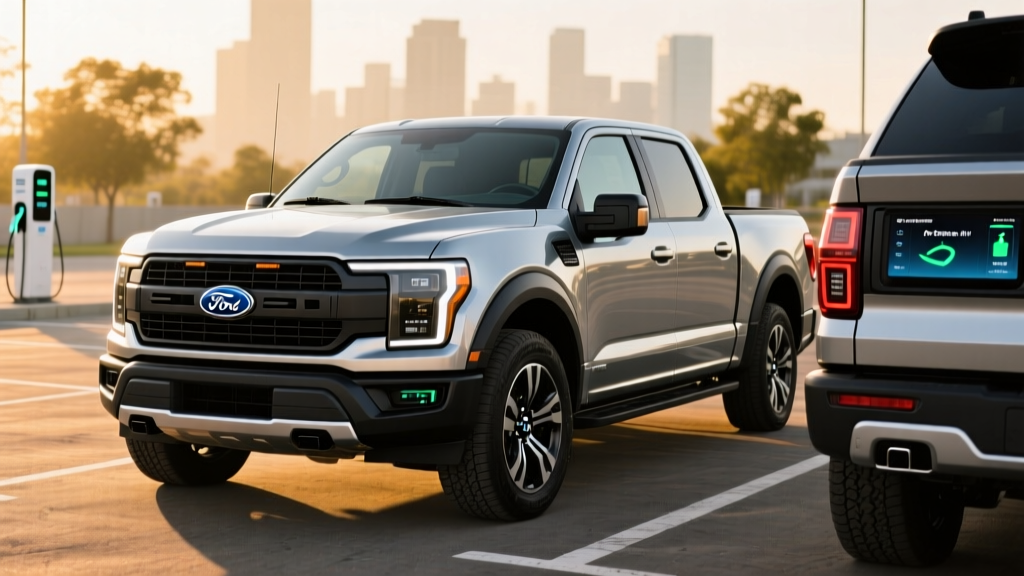
If you've landed here searching for the 2013 Ford F-150 bolt pattern — that's 6x135mm (6-lug, 135mm bolt circle), for the record — you're likely a truck owner who's now eyeing the electric F-150 Lightning and wondering whether your existing wheels, spacers, or accessories carry over. The short answer: the 2026 F-150 Lightning uses a 6x135mm bolt pattern as well, maintaining continuity with Ford's full-size truck lineage. But swapping wheels on a 7,000-pound electric truck involves far more than lug spacing. This review covers the complete 2026 Lightning profile — range, charging, pricing, tax credits, and the wheel-spec nuances that matter when you're outfitting an EV pickup for work or play.
Bolt Pattern and Wheel Compatibility: What Lightning Owners Need to Know
The 2026 Ford F-150 Lightning retains the 6x135mm (6x5.5-inch) bolt pattern shared with its gas-powered F-150 siblings and the earlier 2013 F-150. The center bore is 87.1mm, and the lug nuts are M14 x 1.5. This continuity means many aftermarket wheels designed for the F-150 platform will physically bolt on — but there are critical EV-specific caveats:
- Weight rating: The Lightning's curb weight ranges from 6,171 to 6,893 lbs depending on trim and battery. Any aftermarket wheel must carry a load rating of at least 2,500 lbs per corner to handle the Lightning's gross axle weight ratings safely.
- Offset and backspacing: Ford specifies +44mm offset on most Lightning trims. Deviating significantly alters scrub radius and can interfere with the front e-motor housing and brake calipers.
- Tire pressure monitoring: The Lightning uses direct TPMS sensors. Aftermarket wheels require compatible sensor installation or the truck will throw persistent dash warnings.
- Range impact: Larger or heavier wheels increase rolling mass and aerodynamic drag. Ford's own EPA testing shows the difference between 18-inch and 22-inch wheels can cost 15-25 miles of EPA range on the extended-range battery.
If you're cross-shopping wheel sets from a 2013 F-150, the bolt pattern matches, but the 2013 truck weighed roughly 5,000-5,500 lbs. Wheels rated for that lighter platform may not meet the Lightning's load demands. Always verify the wheel manufacturer's published load rating before mounting.
2026 Ford F-150 Lightning: Core Specifications
| Specification | Standard Range (STD) | Extended Range (ER) |
|---|---|---|
| EPA Range | 240 miles | 320 miles |
| Battery Capacity (usable) | 98 kWh (LFP) | 131 kWh (NMC) |
| Battery Chemistry | Lithium Iron Phosphate | Nickel Manganese Cobalt |
| Max DC Fast Charge | 150 kW | 150 kW |
| 10-80% DC Fast Charge Time | ~38 minutes | ~41 minutes |
| Level 2 Home Charging | 19.2 kW (80A) | 19.2 kW (80A) |
| Level 2 Miles per Hour | ~30 mi/hr | ~30 mi/hr |
| Horsepower | 452 hp | 580 hp |
| Torque | 775 lb-ft | 775 lb-ft |
| 0-60 mph | ~3.8 seconds | |
| Drivetrain | Dual-Motor AWD | Dual-Motor AWD |
| Max Towing (w/ Max Tow Pkg) | 7,700 lbs | 10,000 lbs |
| Payload Capacity | 2,235 lbs | 1,803 lbs |
| MPGe (combined) | 78 MPGe | 70 MPGe |
| Bolt Pattern | 6x135mm, 87.1mm bore, M14x1.5 | |
Range and Efficiency: EPA Sticker vs. Real-World Driving
The EPA rates the 2026 F-150 Lightning Extended Range at 320 miles (Pro trim with 18-inch wheels) and the Standard Range at 240 miles. But EPA numbers are tested under controlled conditions that don't reflect how most truck owners actually drive.
EPA Estimate: 320 miles (Extended Range, Pro/XLT with 18" wheels)
Highway driving (70-75 mph): Expect ~250-275 miles. Aerodynamic drag dominates at highway speed in a truck this size.
Cold weather (below 32°F): Expect ~210-245 miles. The Lightning's battery heating system mitigates some loss, but LFP chemistry in the Standard Range pack is more cold-sensitive than the NMC Extended Range pack.
Towing (5,000+ lb trailer): Expect ~140-170 miles. Towing essentially halves range — plan charging stops accordingly.
Efficiency varies significantly by configuration. The Extended Range Pro achieves 70 MPGe combined (approximately 48 kWh per 100 miles), while the Standard Range model posts 78 MPGe (43 kWh/100mi) thanks to its lighter LFP pack. For context, that's roughly $0.13-$0.16 per mile at the national average residential electricity rate of $0.16/kWh — compared to $0.22-$0.26 per mile for a gas F-150 at $3.50/gallon and 18 MPG combined.
Charging Speed: DC Fast Charging and Home Setup
Charging a 131 kWh battery is a fundamentally different proposition than topping off a sedan. Here's what Lightning owners actually experience across charging levels:
| Charging Level | Power (kW) | Miles Added per Hour | Full Charge Time (ER) |
|---|---|---|---|
| Level 1 (120V / 12A) | 1.4 kW | ~2-3 mi/hr | ~90+ hours |
| Level 2 (240V / 48A) | 11.5 kW | ~19 mi/hr | ~11-12 hours |
| Level 2 (240V / 80A, Ford Charge Station Pro) | 19.2 kW | ~30 mi/hr | ~7-8 hours |
| DC Fast Charge (peak) | 150 kW | ~200+ mi/hr (peak) | 10-80% in ~41 min |
Understanding the charge curve: The Lightning's 150 kW peak DC fast-charge rate applies only between roughly 15-55% state of charge. Above 80%, charging power tapers significantly — often dropping below 50 kW — to protect battery longevity. That means a 10-80% session takes about 41 minutes, but 10-95% can stretch past 70 minutes. Plan road-trip stops around 80% to avoid wasting time at the charger.
For home charging, Ford's Charge Station Pro (80A, hardwired, ~$1,200 for the unit) is the recommended solution for Extended Range owners. It requires a 100-amp dedicated circuit on a 200-amp or larger electrical panel. Installation costs typically run $1,500-$3,500 depending on panel capacity and run length — and if your home has a 100-amp main panel, a $2,000-$4,000 panel upgrade to 200A may be necessary. Consult a licensed electrician for a site-specific assessment.
On the road, the Lightning uses the NACS (North American Charging Standard) connector, granting native access to Tesla Superchargers (V3 and V4) and the expanding network of NACS-equipped Electrify America, EVgo, and ChargePoint stations. Ford's BlueOval Charge Network aggregates over 60,000 public chargers through the FordPass app.
Pricing, Trims, and Federal Tax Credit Eligibility
The 2026 F-150 Lightning lineup spans four trims, with pricing that positions it competitively against both gas F-150s and electric rivals:
| Trim | Battery | Base MSRP | Est. After §30D Credit |
|---|---|---|---|
| Pro (STD) | 98 kWh LFP | $52,490 | ~$44,990* |
| XLT (ER) | 131 kWh NMC | $67,490 | ~$59,990* |
| Lariat (ER) | 131 kWh NMC | $76,490 | ~$68,990* |
| Platinum (ER) | 131 kWh NMC | $92,890 | ~$85,390* |
*Tax credit estimates assume full $7,500 eligibility. Actual credit depends on individual circumstances.
- MSRP cap: Pickup trucks must have an MSRP at or below $80,000 — this eliminates the Platinum trim from credit eligibility.
- Buyer income limits: Modified AGI must not exceed $300,000 (joint), $225,000 (head of household), or $150,000 (single).
- Battery sourcing: A percentage of critical minerals and battery components must be sourced from the U.S. or FTA partners. These percentages increase annually. Verify current-year compliance on IRS.gov's qualified vehicle list.
- Point-of-sale transfer: As of 2024, buyers can transfer the credit to the dealer at purchase, reducing the upfront price rather than waiting for a tax refund. Confirm dealer participation.
- Consult a tax professional — this is general guidance, not tax advice.
The Standard Range Pro at ~$44,990 after the credit (if eligible) is the value leader in the electric truck segment. However, the 240-mile range and LFP pack's cold-weather sensitivity make it best suited for warm-climate commuters with reliable home charging. Most buyers will find the XLT Extended Range at ~$59,990 (after credit) to be the sweet spot — 320 miles, 580 hp, and a full crew cab.
Performance, Capability, and On-Road Behavior
The Lightning's dual-motor all-wheel-drive powertrain delivers performance that redefines what a full-size pickup can do. The Extended Range model's 580 horsepower and 775 lb-ft of torque launch it to 60 mph in approximately 3.8 seconds — territory previously reserved for sports cars, let alone a truck with a 6.5-foot bed and a 6,800-pound curb weight.
That instantaneous electric torque also transforms towing. There's no turbo lag, no transmission hunting for gears on a grade — just linear, immediate thrust. The Extended Range model with the Max Trailer Tow Package rates at 10,000 lbs of towing capacity, and the onboard scales and Smart Hitch system take the guesswork out of payload and tongue-weight calculations.
Ride quality benefits from the independent rear suspension (a Lightning-exclusive change from the gas F-150's solid rear axle). Unloaded, the Lightning rides more like a large SUV than a traditional truck — compliant and composed over highway expansion joints. The tradeoff: that independent rear suspension limits payload to 1,803 lbs on the Extended Range, well below the gas F-150's 3,325-lb max.
Standard driver-assistance features include Ford Co-Pilot360 2.0 with automatic emergency braking, blind-spot monitoring, lane-keeping assist, and rear cross-traffic alert. Available BlueCruise 1.4 enables hands-free driving on over 130,000 miles of pre-mapped divided highways — but this is an SAE Level 2 system, meaning the driver must remain attentive with eyes on the road at all times. A driver-monitoring camera enforces this.
Cargo, Interior Space, and the Mega Power Frunk
The Lightning's most distinctive utility feature is the Mega Power Frunk — a 14.1-cubic-foot front trunk where the engine bay would be. It's lockable, weather-sealed, drainable, and includes four 120V outlets and two USB-C ports. It doubles as a mobile workstation or secure gear locker.
| Measurement | Specification |
|---|---|
| Frunk Volume | 14.1 cu ft |
| Bed Volume (5.5' bed) | 52.8 cu ft |
| Bed Length | 67.1 inches |
| Front Legroom | 43.9 inches |
| Rear Legroom (SuperCrew) | 43.6 inches |
| Rear Headroom | 40.4 inches |
| Max Payload (STD) | 2,235 lbs |
| Max Towing (ER w/ Max Tow) | 10,000 lbs |
The SuperCrew cab offers genuine full-size-adult rear seating with 43.6 inches of legroom — competitive with the best in the segment. The available Pro Power Onboard system (up to 9.6 kW of exportable 240V/120V power through bed-mounted outlets) turns the Lightning into a mobile generator capable of running power tools, a campsite, or even backing up essential home circuits during an outage via the Ford Intelligent Backup Power system (requires the Charge Station Pro and a compatible transfer switch).
The infotainment system centers on a 15.5-inch portrait touchscreen (Lariat and above; 12-inch on Pro/XLT) running Ford's SYNC 4A software with wireless Apple CarPlay, Android Auto, and over-the-air update capability. The available 12-inch digital instrument cluster integrates range, navigation, and towing telemetry clearly.
Battery Warranty, Longevity, and Ownership Costs
Ford covers the Lightning's battery pack with an 8-year / 100,000-mile warranty that guarantees the pack will retain at least 70% of its original capacity during that period. The broader powertrain warranty also runs 5 years / 60,000 miles, with the basic bumper-to-bumper warranty at 3 years / 36,000 miles.
The LFP chemistry in the Standard Range pack generally offers superior cycle life and thermal stability compared to NMC, with less degradation over time — though at the cost of lower energy density (hence the shorter range in a similar physical pack size). The NMC Extended Range pack provides more range but benefits from Ford's active liquid thermal management to mitigate degradation in extreme climates.
According to fueleconomy.gov, the 2026 Lightning Extended Range's estimated annual fuel cost is approximately $1,050 (at $0.16/kWh) compared to roughly $2,650 for a gas F-150 4WD at 19 MPG combined and $3.50/gallon. That's a potential annual savings of $1,600, or $8,000 over five years — before factoring in reduced maintenance (no oil changes, fewer brake replacements thanks to regenerative braking, no transmission fluid).
Insurance costs, however, run higher. Expect Lightning premiums to be 15-30% above a comparable gas F-150 due to higher repair costs, battery replacement risk, and the vehicle's MSRP. Get quotes before purchasing.
Pros, Cons, and Key Competitors
Pros
- Class-leading frunk (14.1 cu ft) with integrated power
- Pro Power Onboard (9.6 kW) for job sites and outages
- 3.8-second 0-60 (ER) — absurd performance for a truck
- NACS connector for native Supercharger access
- Independent rear suspension improves unloaded ride
- Strong federal tax credit eligibility on Pro/XLT/Lariat
- 6x135mm bolt pattern for broad wheel compatibility
Cons
- Range drops sharply when towing (140-170 mi realistic)
- Extended Range battery adds ~700 lbs, reducing payload
- Platinum trim exceeds $80K MSRP cap — no tax credit
- LFP Standard Range pack is cold-sensitive
- Insurance premiums 15-30% above gas F-150
- Home charging may require $2K-$4K panel upgrade
- 150 kW peak DC charge rate trails some rivals' 350 kW peaks
Versus the competition: The Chevrolet Silverado EV (320-440 miles EPA, 200+ kW DC charging, Ultium platform) offers more range and faster charging at higher trims, but at a higher starting price and with a smaller frunk. The Rivian R1T is more refined off-road and offers a quad-motor option, but starts above $70,000 and has a smaller bed. The Tesla Cybertruck offers 340+ miles and 800V architecture, but its polarizing design, limited towing, and stainless-steel body panels make it a niche choice for traditional truck buyers. For fleet and work use, the Lightning remains the most practical and familiar electric pickup available.
Frequently Asked Questions
What is the 2026 Ford F-150 Lightning bolt pattern, and does it match a 2013 F-150?
Yes. Both the 2026 Lightning and the 2013 F-150 use a 6x135mm bolt pattern with an 87.1mm center bore. However, the Lightning is significantly heavier (6,100-6,900 lbs vs. ~5,000-5,500 lbs for a 2013 model), so any wheels carried over must be verified for adequate load rating — at least 2,500 lbs per corner.
What is the real-world range of the F-150 Lightning?
The EPA rates the Extended Range at 320 miles, but real-world highway driving yields approximately 250-275 miles, and cold weather (below freezing) can reduce that to 210-245 miles. Towing cuts range roughly in half to 140-170 miles.
How fast does the Lightning charge at home and on the road?
At home with Ford's 80A Charge Station Pro (19.2 kW), the Extended Range pack charges at roughly 30 miles per hour, reaching full in 7-8 hours. On a 150 kW DC fast charger, the 10-80% session takes approximately 41 minutes, though charging power tapers significantly above 80%.
Does the 2026 F-150 Lightning qualify for the $7,500 federal tax credit?
The Pro, XLT, and Lariat trims (all under the $80,000 MSRP cap for trucks) are potentially eligible for the full $7,500 IRS §30D credit, subject to buyer income limits ($150K single / $300K joint), battery critical-mineral and component sourcing requirements, and point-of-sale dealer participation. The Platinum trim exceeds the MSRP cap and does not qualify. Always verify eligibility on IRS.gov and consult a tax professional.
Is the F-150 Lightning worth buying over a gas F-150?
If you have home charging access, drive under 250 miles daily, and value instant torque, low running costs, and onboard power export, the Lightning offers a compelling ownership experience with an estimated $8,000 fuel savings over five years. If you regularly tow long distances, live in a charging desert, or need maximum payload, a gas or hybrid F-150 remains more practical for those specific use cases.
Can the Lightning power my home during an outage?
Yes. With the available Ford Intelligent Backup Power system (requires Charge Station Pro and a home transfer switch, ~$3,000-$5,000 installed), the Extended Range Lightning can supply up to 9.6 kW to essential home circuits — enough to run lights, a refrigerator, HVAC fan, and outlets for approximately 3 days during a typical outage, per Ford's estimates.
Sources: fueleconomy.gov, Ford.com F-150 Lightning, IRS §30D Qualified Vehicles