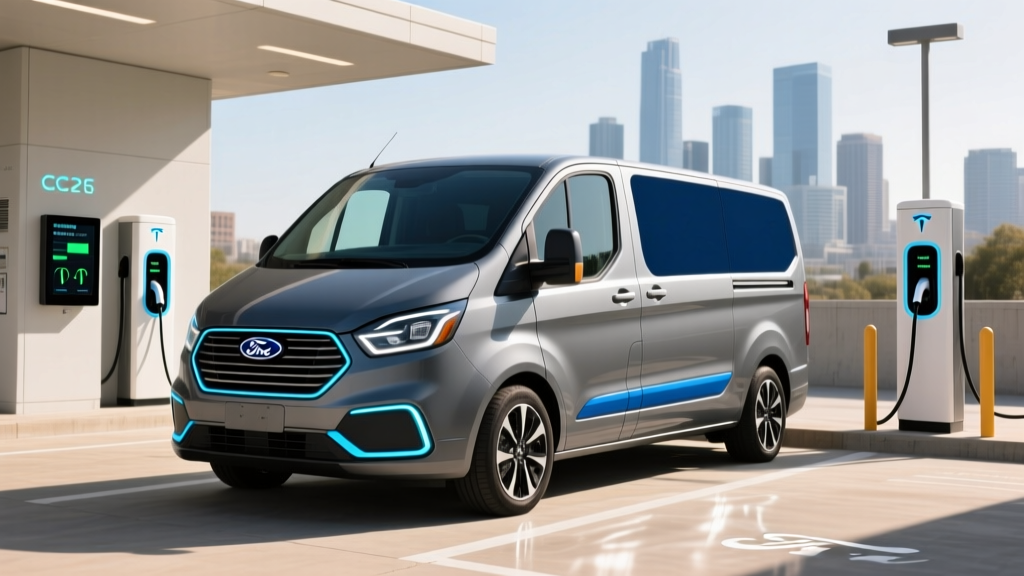
The Ford E-Transit is not trying to be a road-trip machine. It is a purpose-built electric commercial van designed for last-mile delivery, service fleets, and urban logistics — routes that average under 75 miles per day. With the 2026 model year, Ford has refined the E-Transit's powertrain software, expanded its body configurations, and leaned into the commercial tax-credit landscape. If your fleet routes fit within its range envelope, the E-Transit offers compelling total-cost-of-ownership math. If you need 200+ miles of daily range, look at the BrightDrop Zevo 600 instead.
Specs at a Glance: 2026 Ford E-Transit
| Attribute | 2026 E-Transit (Low Roof, 130" WB) | 2026 E-Transit (High Roof, 148" WB) |
|---|---|---|
| EPA Estimated Range | 126 miles | 108–116 miles |
| Battery Capacity (Usable) | 68 kWh | 68 kWh |
| Battery Chemistry | NMC (Nickel Manganese Cobalt) | NMC |
| DC Fast-Charge Peak | 120 kW | 120 kW |
| 10–80% DC Charge Time | ~45 minutes | ~45 minutes |
| Level 2 Charge Rate | 11.3 kW (AC onboard charger) | 11.3 kW |
| Level 2 Time (0–100%) | ~8 hours | ~8 hours |
| Motor Output | 266 hp / 317 lb-ft torque | 266 hp / 317 lb-ft torque |
| Drivetrain | RWD (single rear motor) | RWD |
| 0–60 mph (est.) | ~8.5 seconds (unloaded) | ~9.0 seconds (unloaded) |
| EPA Efficiency | ~2.0 kWh/mile | ~2.2 kWh/mile |
| Max Payload | 3,880 lbs | 3,330 lbs |
| Cargo Volume | 246.7 cu ft | 487.3 cu ft |
| Base MSRP (Cut Van) | ~$52,500 | ~$55,500 |
| Battery/Powertrain Warranty | 8 years / 100,000 miles | 8 years / 100,000 miles |
Real-World Range: What Fleets Actually See
Real-World Expectation: 90–110 miles at highway speeds (65–70 mph) fully loaded; 110–126 miles on stop-and-go urban delivery routes with regenerative braking. In cold weather (below 32°F), expect 20–30% range reduction, bringing usable range to roughly 70–90 miles depending on cabin heating and payload.
The E-Transit's 126-mile EPA rating applies specifically to the low-roof, 130-inch wheelbase cargo van variant. Higher-roof and longer-wheelbase models carry more weight and face greater aerodynamic drag, dropping EPA figures to 108–116 miles. Ford's own E-Transit fleet data suggests most commercial customers drive under 75 miles daily, which keeps the van comfortably within its range envelope for typical delivery and service routes.
The critical variable is payload. A fully loaded E-Transit (approaching its ~3,880-lb max payload on the low-roof model) will consume significantly more energy than an empty van. Urban stop-and-go driving actually favors the E-Transit because regenerative braking recaptures kinetic energy — fleet operators on city routes routinely report efficiency closer to the EPA sticker. Highway driving at sustained 70 mph, especially with a full load, is where range drops most sharply.
Cold weather is the E-Transit's biggest operational constraint. Unlike some passenger EVs, the E-Transit does not offer a standard heat pump (resistive cabin heating draws heavily from the 68 kWh pack). Fleet operators in northern climates should plan for 20–30% range loss in winter months and build route schedules accordingly. Preconditioning the battery while plugged in at the depot helps mitigate this, but it requires disciplined overnight charging infrastructure.
Charging: DC Fast Charge and Depot-Level 2
| Charging Level | Power (kW) | Charge Time | Miles Added per Hour |
|---|---|---|---|
| Level 1 (120V, 12A) | ~1.4 kW | ~48+ hours (0–100%) | ~3–4 mi/hr |
| Level 2 (240V, 48A) | 11.3 kW | ~8 hours (0–100%) | ~25–30 mi/hr |
| DC Fast Charge (CCS) | 120 kW peak | ~45 min (10–80%) | ~130+ mi/hr at peak |
The E-Transit uses a CCS1 connector for DC fast charging and peaks at 120 kW. In practice, that peak rate is sustained roughly between 15% and 40% State of Charge (SoC), after which the charge curve tapers progressively. The 10–80% session takes approximately 45 minutes at a properly rated 150 kW+ DC station. Above 80%, charging slows significantly to protect battery longevity — expect an additional 30+ minutes to reach 100% on DC. For fleet operations, the practical play is to DC-charge to 80% during mid-day breaks and handle the remaining top-up overnight on Level 2.
The onboard AC charger is rated at 11.3 kW, which is competitive for the commercial-van segment. On a 48-amp Level 2 circuit (requiring a 60-amp breaker), a full 0–100% charge takes roughly 8 hours — ideal for overnight depot charging. Most fleet operators will install multiple Level 2 stations (often networked ChargePoint or EVgo commercial units) at their depot, scheduling vehicles to rotate through chargers during off-peak electricity hours to minimize demand charges.
Level 1 charging (standard 120V outlet) is technically possible but impractical for daily fleet use — it adds only 3–4 miles of range per hour. It serves as an emergency backup or for occasional top-offs when depot charging is unavailable.
Performance, Drivetrain, and Driving Dynamics
The E-Transit is powered by a single rear-mounted electric motor producing 266 horsepower and 317 lb-ft of torque, driving the rear wheels. Unloaded 0–60 mph times land around 8.5 seconds for the short-wheelbase model — respectable for a full-size van and meaningfully quicker off the line than the gas-powered Transit at low speeds. Electric torque delivery is immediate, which matters when merging onto highways or pulling away from loading docks with a full cargo bay.
The rear-wheel-drive layout keeps the front wheels free for a tighter turning radius (44.8 feet curb-to-curb on the 130" WB), which is a genuine advantage in urban delivery environments. Ford has tuned the suspension to handle the van's battery weight (the pack sits low under the floor), giving the E-Transit a lower center of gravity than its gas sibling. The result is surprisingly composed handling for a vehicle with a gross vehicle weight rating (GVWR) over 9,500 lbs on some configurations.
Regenerative braking is adjustable through multiple levels via the center console. The strongest regen setting enables near one-pedal driving in city traffic, reducing brake wear — a meaningful maintenance savings for fleets logging heavy stop-and-go miles. The E-Transit also offers Pro Power Onboard, which provides up to 2.4 kW of AC power from the traction battery to run tools, lighting, or equipment at a job site — a feature gas Transits cannot match without a separate generator.
Pricing, Trims, and Federal Tax Credit Eligibility
| Configuration | Base MSRP (2026) | Estimated Federal Credit | Effective Price (est.) |
|---|---|---|---|
| Cargo Van, Low Roof, 130" WB | ~$52,500 | Up to $7,500 (§30D) | ~$45,000 |
| Cargo Van, Medium Roof, 148" WB | ~$54,000 | Up to $7,500 | ~$46,500 |
| Cargo Van, High Roof, 148" WB | ~$55,500 | Up to $7,500 | ~$48,000 |
| Cutaway / Chassis Cab | ~$49,500 | Up to $7,500 | ~$42,000 |
The E-Transit's MSRP sits well under the IRS §30D commercial-vehicle cap (vans and trucks face an $80,000 MSRP ceiling, per IRS guidelines). However, eligibility for the full $7,500 credit depends on three moving targets that change yearly:
- Battery Component Manufacturing: A percentage of battery components must be manufactured or assembled in North America (threshold increases annually through 2029).
- Critical Minerals Sourcing: A percentage of critical minerals must be sourced from the U.S. or FTA-partner countries (threshold also escalates yearly).
- Buyer Income Limits: Modified AGI must not exceed $150,000 (single), $225,000 (head of household), or $300,000 (joint) for the §30D personal credit. Fleet buyers purchasing through a business entity may instead qualify under the §45W commercial clean vehicle credit, which has different rules.
- Point-of-Sale Transfer: As of 2024+, eligible buyers can transfer the credit to the dealer at purchase, reducing the upfront cost immediately rather than waiting for tax filing.
For fleet buyers, the §45W Commercial Clean Vehicle Credit is often more relevant than §30D. This credit offers up to $7,500 for vehicles under 14,000 lbs GVWR (the E-Transit qualifies) and is claimed by the business entity. Consult a tax professional to determine which credit path your operation qualifies for — the interaction between §30D, §45W, and bonus depreciation can significantly alter effective acquisition cost.
Cargo Space, Configurations, and Technology
The E-Transit mirrors the gas Transit's body styles, offering three roof heights (low, medium, high), three body lengths (130", 148", and 148" extended wheelbase), and cargo van, cutaway, and chassis cab configurations. Maximum cargo volume reaches 487.3 cubic feet in the high-roof, extended-length cargo van — identical to the gas Transit, because the battery pack is mounted under the floor and does not intrude into the cargo area.
Interior technology centers on a 12-inch touchscreen running Ford's SYNC 4 system with standard wireless Apple CarPlay and Android Auto, cloud-connected navigation, and Ford Power-Up over-the-air software updates. The E-Transit includes Ford Co-Pilot360 as standard: automatic emergency braking with pedestrian detection, lane-keeping assist, blind-spot monitoring, and a rearview camera. Adaptive cruise control with stop-and-go is available as an option — useful for highway-heavy fleet routes but firmly a SAE Level 2 driver-assistance system requiring continuous driver attention.
Ford's commercial telematics platform, available through Ford Pro, integrates with the E-Transit to provide fleet managers with real-time vehicle location, battery state of charge, charge scheduling, driver behavior scoring, and maintenance alerts. This software layer is where the E-Transit differentiates from aftermarket EV conversions — the telematics are native and deeply integrated with the powertrain.
Pros
- Cargo volume and dimensions identical to gas Transit — no upfit compromise
- Strong regenerative braking reduces brake maintenance in city fleets
- Pro Power Onboard (2.4 kW) eliminates separate job-site generators
- Overnight Level 2 depot charging covers most daily route needs
- Ford Pro telematics integration is fleet-ready out of the box
- Lower operating cost per mile vs. gas Transit (~$0.08–0.12/mi electricity vs. $0.18–0.25/mi fuel)
Cons
- 126-mile EPA range limits use to short, predictable routes
- 20–30% cold-weather range loss is significant in northern climates
- No heat pump standard — cabin heating draws heavily from battery
- 120 kW DC fast-charge peak is modest; 45-min 10–80% is slow vs. passenger EVs
- Higher upfront cost than gas Transit (~$10,000–12,000 premium before credits)
- Limited public DC fast-charger access for large commercial vans (size/height restrictions)
Competitor Comparison: E-Transit vs. BrightDrop Zevo 600 vs. Mercedes eSprinter
| Spec | 2026 Ford E-Transit (130" WB) | 2026 BrightDrop Zevo 600 | 2026 Mercedes-Benz eSprinter (170" WB) |
|---|---|---|---|
| EPA Range | 126 miles | ~250 miles | ~200 miles (est.) |
| Battery | 68 kWh, NMC | ~165 kWh, NMC | ~113 kWh, NMC |
| DC Fast Charge | 120 kW | ~150 kW | ~115 kW |
| Cargo Volume | 246.7 cu ft (low roof) | ~412 cu ft | ~532 cu ft |
| Base MSRP | ~$52,500 | ~$75,000+ | ~$74,000+ |
| Best For | Short urban routes, budget-first fleets | Longer routes, high-volume delivery | Large cargo needs, premium fleet |
The E-Transit wins on price and parts availability. Ford's dealer and service network dwarfs BrightDrop's, and the E-Transit's lower MSRP means faster payback for fleets whose routes fit within 100–120 real-world miles. The BrightDrop Zevo 600 offers roughly double the range, making it viable for longer suburban delivery routes, but at a ~$20,000+ premium. The Mercedes eSprinter provides maximum cargo volume and a more premium cabin but at a steep cost and with a smaller dealer footprint for commercial service.
Who Should Buy the E-Transit?
- Your fleet routes average under 100 miles per day with predictable, repeatable stops
- You have depot-level Level 2 charging infrastructure (or are prepared to install it)
- You want the lowest upfront cost in the electric commercial van segment
- You value Ford's service network and existing fleet-management relationships
- Pro Power Onboard replaces a separate generator in your workflow
- Your routes regularly exceed 130 miles or involve significant highway driving
- You operate in extreme cold climates without heated depot parking
- You need same-day mid-route DC fast charging and cannot accommodate 45-minute stops
- Your van body requires a custom upfit that only fits the eSprinter's larger dimensions
Battery Longevity and Warranty
Ford backs the E-Transit's high-voltage battery and electric powertrain components with an strong>8-year / 100,000-mile warranty (whichever comes first), covering defects and capacity loss below 70% of original capacity. This aligns with industry norms for commercial EVs. The NMC chemistry in the E-Transit offers higher energy density than LFP but is more sensitive to repeated deep cycling and extreme temperatures. Fleet operators should aim to keep daily SoC swings between 20% and 80% where operationally feasible, and use preconditioning during cold-weather depot charging to reduce stress on the pack.
Based on data from early E-Transit fleet deployments (2022–2024 model years), degradation has been modest — most fleets report 3–6% capacity loss over the first 60,000 miles of urban delivery use. High-voltage battery replacement cost, should it be needed out of warranty, is estimated at $15,000–$22,000 depending on labor and pack availability. Ford's commercial service network handles warranty replacements through authorized fleet dealers.
Frequently Asked Questions
What is the real-world range of the Ford E-Transit?
The EPA rates the low-roof E-Transit at 126 miles. In real-world urban delivery use with regenerative braking, fleets typically see 110–126 miles. Highway driving with a full payload drops that to 90–110 miles. Cold weather (below 32°F) can reduce range by 20–30%, yielding roughly 70–90 usable miles depending on conditions and heating demand.
How fast does the E-Transit charge?
On a DC fast charger (CCS1), the E-Transit peaks at 120 kW and charges from 10–80% in approximately 45 minutes. On a Level 2 depot charger (240V, 48A), the 11.3 kW onboard charger delivers a full 0–100% charge in about 8 hours — ideal for overnight fleet scheduling.
Does the E-Transit qualify for the federal EV tax credit?
The E-Transit's MSRP is well below the $80,000 commercial-vehicle cap for the IRS §30D credit. However, full $7,500 eligibility depends on current-year battery sourcing and component manufacturing thresholds, plus buyer income limits for personal purchases. Fleet buyers may qualify under the §45W commercial credit instead. Always verify current eligibility on irs.gov and consult a tax professional.
Is the E-Transit worth buying vs. the gas Transit?
For fleets with routes under 100 miles daily and depot charging access, the E-Transit's lower per-mile energy cost (~$0.08–0.12/mi vs. $0.18–0.25/mi for gas), reduced brake wear from regen, and elimination of oil changes create a payback period of roughly 4–6 years depending on mileage, electricity rates, and credit eligibility. For routes exceeding 140 miles or operations without reliable overnight charging, the gas Transit remains more practical.
Can the E-Transit tow?
Ford rates the E-Transit for up to 7,500 lbs of towing capacity (when properly equipped, on select configurations). However, towing at or near max capacity will significantly reduce range — expect a 30–50% range drop under heavy tow loads. Towing should be planned within the context of your daily route mileage and charging infrastructure.
What charging connector does the E-Transit use?
The E-Transit uses the CCS1 connector for DC fast charging and the J1772 connector for Level 1/Level 2 AC charging. It does not use the NACS (Tesla) connector, though CCS-to-NACS adapters may become available for access to Tesla Supercharger stations as Ford expands passenger-EV access — commercial-vehicle Supercharger access remains limited as of 2026.