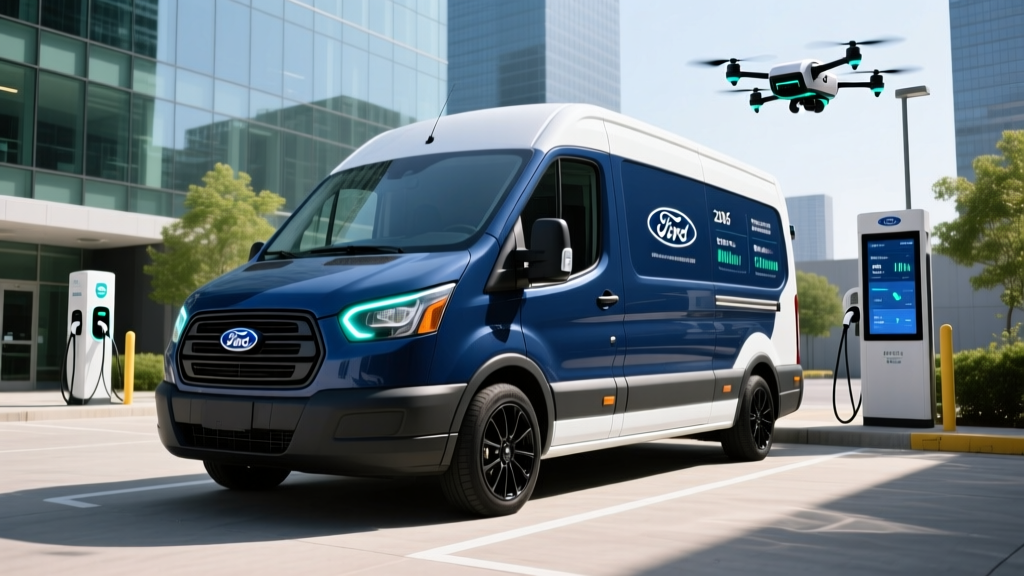
The Ford E-Transit isn't designed to win drag races or impress at Cars & Coffee. It exists to solve a specific, numbers-driven problem: last-mile delivery and commercial fleet operations where daily routes are predictable, depots have overnight charging, and total cost of ownership matters more than 0-60 times. Now in its fourth model year, the 2026 E-Transit has matured into a known quantity — and that predictability is exactly what fleet managers want.
This review covers the 2026 E-Transit's real-world range, charging behavior, payload economics, and whether the federal commercial EV tax credit makes it a smarter buy than a gas-powered Transit. If you're evaluating this van for a fleet or considering it as an owner-operator, here's every number that matters.
2026 E-Transit Specifications at a Glance
| Spec | 2026 Ford E-Transit (Low Roof, 130" WB) |
|---|---|
| EPA Range | 126 miles (Low Roof Cargo); up to 108 mi (High Roof, 148" WB) |
| Battery Capacity | 68 kWh usable (LFP chemistry) |
| Drivetrain | Rear-wheel drive, single motor |
| Horsepower / Torque | 266 hp (198 kW) / 317 lb-ft |
| 0-60 mph | ~8.5 seconds (unladen, est.) |
| Top Speed | 75 mph (electronically governed) |
| Max DC Fast Charge | 115 kW (CCS1) |
| 10-80% DC Fast Charge | ~45 minutes |
| Level 2 Charge Rate | 10.5 kW onboard charger (~22 mi/hr) |
| EPA Efficiency | ~2.0 kWh/mile (varies by body config) |
| Max Payload | Up to 3,330 lbs (Low Roof, 130" WB) |
| Cargo Volume | 246.7 cu ft (Low Roof, 130" WB); up to 487.3 cu ft (High Roof, 148" WB) |
| Base MSRP | ~$51,995 (T-150 Cargo, Low Roof, 130" WB) |
| Battery Warranty | 8 years / 100,000 miles |
Real-World Range: What 126 Miles Actually Means
EPA Sticker: 126 miles (Low Roof Cargo Van, 130" wheelbase)
Real-World City Delivery Route: ~110-120 miles with frequent stops, regen-heavy driving
Real-World Highway (65+ mph, loaded): ~85-100 miles
Cold Weather (below 32°F, cabin heat on): ~75-90 miles — expect 25-35% range loss
The E-Transit's 68 kWh LFP (lithium iron phosphate) battery prioritizes longevity and thermal stability over energy density. For the target use case — depot-based delivery routes under 100 miles — 126 miles of EPA range is adequate. Ford's own fleet telematics data shows the average commercial van drives roughly 74 miles per day, which leaves a comfortable buffer.
But honesty is required here: if your routes involve sustained highway speeds above 60 mph, the E-Transit's boxy aerodynamics punish efficiency hard. The van consumes roughly 2.0 kWh per mile in mixed driving, and that figure climbs to 2.4-2.6 kWh/mile at 70 mph with a full payload. In winter conditions, LFP chemistry loses less capacity to cold than NMC, but cabin heating still draws heavily from the pack. Fleet operators in northern climates should plan for 25-35% range reduction in sub-freezing months and spec routes accordingly.
The good news? LFP batteries tolerate daily 100% charging without the degradation concerns that plague NMC packs. Ford explicitly recommends charging the E-Transit to full for daily use — a significant operational advantage for fleet depots that charge overnight.
Charging Speed and Infrastructure
| Charging Level | Power | Connector | Speed / Time |
|---|---|---|---|
| Level 1 (120V) | ~1.4 kW | J1772 | ~3 mi/hr — not practical for daily fleet use |
| Level 2 (240V) | 10.5 kW | J1772 | ~22 mi/hr; full charge in ~7-8 hours |
| DC Fast Charge | 115 kW peak | CCS1 | 10-80% in ~45 min; 15-80% in ~50 min |
The E-Transit's 115 kW peak DC fast-charge rate is modest by 2026 passenger-EV standards (where 250-350 kW is increasingly common), but it's reasonable for a commercial van that primarily charges at the depot overnight. At a public CCS1 station, the charge curve is fairly flat through 60% SoC, then tapers noticeably above 80%. A 10-80% session takes roughly 45 minutes — long enough that mid-day topping is practical only during scheduled driver lunch breaks.
For overnight depot charging, the 10.5 kW onboard charger is the workhorse. A fully depleted battery reaches 100% in approximately 7-8 hours on a Level 2 station, which aligns perfectly with an overnight shift pattern. Most fleet operators install multiple 40-amp or 48-amp Level 2 chargers (like the ChargePoint CPF45 or EVgo commercial stations) at their depots.
Important kW vs. kWh note: The battery stores 68 kWh of energy. The charger delivers power measured in kW. Think of kWh as the size of the fuel tank and kW as the flow rate of the pump.
Performance, Payload, and Cargo
The E-Transit's 266-hp rear-mounted motor delivers 317 lb-ft of instant torque, which makes it surprisingly responsive in stop-and-go urban delivery scenarios. The 0-60 mph time of roughly 8.5 seconds (unladen) is irrelevant for its purpose, but the low-end torque means the van pulls away from stops confidently even with a full load.
Top speed is electronically governed at 75 mph. This is intentional: it preserves range, reduces tire wear, and keeps the van in the efficiency sweet spot. For fleets operating on surface streets and suburban routes, the governor is a non-issue. For any operation requiring sustained Interstate travel, it's a limitation worth acknowledging — and a signal that this van isn't built for long-haul routes.
Cargo volume spans from 246.7 cubic feet (Low Roof, 130" wheelbase) up to 487.3 cubic feet (High Roof, 148" wheelbase Extended), mirroring the gas Transit's dimensions almost exactly. Ford engineered the battery pack low in the chassis, preserving the flat load floor and identical cargo dimensions. Max payload reaches 3,330 lbs on the T-150 Low Roof Cargo variant, which is competitive with the gas Transit 150's ~3,700-lb payload — a roughly 10% deficit that most fleets can absorb through route planning.
Technology and Driver Assistance
The 2026 E-Transit comes equipped with Ford's SYNC 4 infotainment system on a 12-inch touchscreen, including wireless Apple CarPlay and Android Auto. For fleet managers, the critical feature is the standard Ford Pro Telematics modem, which provides real-time vehicle location, state-of-charge monitoring, geofencing alerts, and driver behavior scoring through the Ford Pro platform.
On the driver-assistance side, Ford Co-Pilot360 is standard, including:
- Pre-Collision Assist with Automatic Emergency Braking
- Lane-Keeping System
- Blind Spot Information System (BLIS) with trailer coverage
- Rear View Camera with dynamic hitch assist
- Available Intelligent Adaptive Cruise Control with Stop & Go
All E-Transit driver-assist features are SAE Level 2. The driver must remain fully engaged, hands on the wheel, eyes on the road. This is not autonomous driving. Ford does not offer hands-free BlueCruise on the E-Transit as of the 2026 model year.
One practical standout: Pro Power Onboard (available, 2.4 kW) turns the E-Transit into a mobile power source for job sites, allowing operators to run power tools, lighting, or small equipment directly from the traction battery. For electricians, HVAC technicians, and mobile service fleets, this eliminates the need for a separate generator.
Pricing, Tax Credits, and Total Cost of Ownership
| Trim / Config | Base MSRP (2026) |
|---|---|
| T-150 Cargo, Low Roof, 130" WB | ~$51,995 |
| T-250 Cargo, Low Roof, 148" WB | ~$54,495 |
| T-350 Cargo, High Roof, 148" WB | ~$57,995 |
| T-350 Cutaway / Chassis Cab | ~$49,995 |
| Destination & Delivery | +$1,795 |
The E-Transit's MSRP is roughly $10,000-$15,000 higher than a comparably equipped gas Transit. The economic case rests entirely on fuel and maintenance savings over the vehicle's service life — and on tax credit eligibility.
Federal Tax Credit: §30D and §45W
For commercial fleet buyers (vehicles purchased for business use, not personal), the relevant credit is typically the §45W Commercial Clean Vehicle Credit, not the consumer §30D credit. Under §45W:
- Credit equals the lesser of 30% of the vehicle's cost or the incremental cost over a comparable ICE vehicle (capped at $7,500 for vehicles under 14,000 lbs GVWR)
- No MSRP cap, no buyer income cap (these apply only to the consumer §30D credit)
- Battery sourcing requirements still apply — critical minerals and battery components must meet phased-in domestic-content thresholds
- The credit is non-refundable and applied against the business's tax liability
For an E-Transit at ~$52,000, the 30% calculation yields $15,600, but the cap for vehicles under 14,000 lbs GVWR limits the credit to $7,500. Most fleet buyers can expect the full $7,500, effectively bringing the T-150 Cargo's net cost to approximately $44,500 — much closer to a loaded gas Transit.
Critical caveat: Battery component and critical-mineral sourcing rules tighten annually. Consult your tax professional and verify current-year eligibility on irs.gov before finalizing a purchase order.
5-Year Operating Cost Comparison
| Cost Factor | E-Transit (Est.) | Gas Transit 150 (Est.) |
|---|---|---|
| Purchase Price (after credit) | ~$44,500 | ~$42,000 |
| Fuel / Electricity (75 mi/day, 260 days/yr, 5 yr) | ~$7,800 (at $0.13/kWh) | ~$21,450 (at $3.50/gal, 16 mpg) |
| Maintenance (5 yr) | ~$2,500 | ~$5,500 |
| Estimated 5-Year Total | ~$54,800 | ~$68,950 |
The E-Transit's fuel savings alone — roughly $13,600 over five years at typical commercial mileage — more than offset the higher purchase price. Maintenance savings (no oil changes, fewer brake replacements thanks to regenerative braking, no transmission fluid) add another ~$3,000. For fleets running vans 6+ years, the TCO advantage compounds significantly.
Battery Warranty and Longevity
Ford backs the E-Transit's LFP battery with an 8-year / 100,000-mile warranty covering defects and capacity loss below 70% of original capacity. LFP chemistry is the right choice for a commercial vehicle: it offers a longer cycle life (typically 3,000+ full cycles vs. ~1,000-1,500 for NMC), superior thermal stability, and tolerance for daily 100% charging without accelerated degradation.
For a fleet van driving 75 miles/day, 260 days/year, that's ~19,500 miles annually. The 100,000-mile warranty covers roughly 5 years of typical use, and LFP packs routinely outlast their warranty periods with minimal degradation. Replacement cost for the full pack, should it be needed out of warranty, is estimated at $12,000-$18,000 based on current LFP pricing trends — though this figure is expected to decline as LFP manufacturing scales.
Pros and Cons
- LFP battery tolerates daily 100% charging — ideal for depot operations
- Identical cargo dimensions to gas Transit — no upfitting compromise
- Low operating cost: ~$0.05/mile electricity vs. ~$0.22/mile gasoline
- Pro Power Onboard eliminates job-site generator need
- Ford Pro telematics standard — fleet management built in
- Strong dealer/service network for commercial vehicles
- 126-mile EPA range limits use to short, predictable routes
- 115 kW DC fast charge is slow by 2026 standards (~45 min 10-80%)
- 75 mph top-speed governor rules out Interstate-heavy routes
- High-roof, long-wheelbase variants lose range (as low as 108 mi)
- No hands-free driving assist (BlueCruise not available)
- Upfront cost premium of $10-15K over gas Transit before credits
Who Should Buy the E-Transit — And Who Shouldn't
Choose the E-Transit if:
- Your daily routes are under 100 miles with depot-based overnight charging
- You operate in urban or suburban delivery environments with low average speeds
- Your fleet qualifies for the §45W commercial clean vehicle credit
- You value reduced maintenance downtime and predictable per-mile energy costs
- You need mobile power for job-site equipment (Pro Power Onboard)
Look elsewhere if:
- Your routes regularly exceed 120 miles or involve sustained highway driving
- You operate in extreme cold without garage/depot preconditioning capability
- You need a crew-cab passenger configuration (E-Transit is cargo/cutaway only)
- You lack access to overnight Level 2 charging at your base of operations
Frequently Asked Questions
What is the real-world range of the 2026 Ford E-Transit?
The EPA rates the Low Roof Cargo E-Transit at 126 miles. In real-world city delivery use with regenerative braking, expect 110-120 miles. Highway driving at 65+ mph with a payload drops range to roughly 85-100 miles. In sub-freezing temperatures, plan for 75-90 miles due to cabin heating demand and cold-chemistry efficiency loss.
How fast does the E-Transit charge at home and on DC fast chargers?
On a Level 2 home or depot charger (240V, 48A), the E-Transit charges at 10.5 kW, adding roughly 22 miles of range per hour and reaching a full charge from empty in 7-8 hours. On a DC fast charger, it peaks at 115 kW and charges from 10-80% in approximately 45 minutes.
Does the E-Transit qualify for the federal EV tax credit?
For commercial/business use, the E-Transit typically qualifies for the §45W Commercial Clean Vehicle Credit of up to $7,500 (capped for vehicles under 14,000 lbs GVWR). This credit has no MSRP cap and no buyer income cap, but battery sourcing requirements apply. For personal purchase, the §30D New Clean Vehicle Credit may apply — but the E-Transit's MSRP exceeds the $80,000 van cap, and buyer income limits apply. Always verify current-year rules on irs.gov with a tax professional.
Is the E-Transit worth buying over a gas Transit?
Financially, yes — if your routes fit the range profile and you have depot charging. The 5-year total cost of ownership is approximately $14,000 lower than a gas Transit, driven by fuel and maintenance savings. Operationally, the range limitation is the dealbreaker: if your routes exceed 100-110 miles reliably, the gas Transit remains the pragmatic choice.
What is the E-Transit's biggest drawback?
Range and charging speed together form the primary limitation. At 126 miles EPA with a 45-minute DC fast-charge session, the E-Transit cannot flex to unexpected long routes or mid-day route extensions without significant operational disruption. It is purpose-built for predictable, short-haul work — and that constraint must drive your purchase decision.
How does the LFP battery hold up over time?
LFP chemistry is among the most durable lithium-ion chemistries available, with cycle lives exceeding 3,000 full charge-discharge cycles. Ford's 8-year/100,000-mile warranty guarantees at least 70% capacity retention. Real-world fleet data from early E-Transit deployments suggests degradation of roughly 2-4% per year under daily 100% charging — meaning the pack should retain 85%+ capacity at the 5-year mark.