The Real Math Behind Buying an EV in 2026
For 2026 model-year shoppers, the financial case for an electric vehicle hinges on a complex web of federal incentives, volatile electricity rates, and higher upfront insurance premiums. While the sticker price of many EVs has dropped significantly—often landing between $35,000 and $45,000 for mainstream models—the total cost of ownership (TCO) requires a calculator, not just a brochure. This guide breaks down the current 2026 EV tax credits and the five-year financial reality of owning a battery electric vehicle (BEV).
Federal EV Tax Credits: IRS §30D Eligibility for 2026
The 2026 EV tax credits are governed by the Inflation Reduction Act (IRA), specifically Internal Revenue Code Section 30D. The maximum credit remains $7,500 for new vehicles and up to $4,000 for used ones, but qualifying is far from automatic. You must satisfy three primary hurdles: income caps, vehicle price caps, and stringent battery-component sourcing.
Income and MSRP Caps
- Modified Adjusted Gross Income (MAGI): $300,000 for joint filers; $225,000 for heads of household; $150,000 for all other filers.
- MSRP Limits: $80,000 for vans, SUVs, and pickup trucks; $55,000 for sedans and other passenger cars.
Battery Sourcing and Critical Minerals
To get the full $7,500, the vehicle must meet two separate $3,750 requirements:
- Battery Components (50% rule): At least 50% of the battery components must be manufactured or assembled in North America.
- Critical Minerals (80% rule): At least 80% of the critical minerals must be extracted or processed in the U.S. or a country with a free-trade agreement.
Because of these rules, many popular models only qualify for $3,750, while others qualify for the full amount. Always check the official IRS eligible vehicle list before signing a purchase agreement.
- Vehicle is assembled in North America (check VIN starting with 1, 4, or 5, or 2 for Canada).
- Your MAGI is below the threshold for your filing status.
- Vehicle MSRP is under the $55k/$80k cap.
- Vehicle meets the 2026 battery sourcing and critical mineral percentages.
- You have sufficient tax liability to use the credit (or use the point-of-sale transfer).
Point-of-Sale Transfer
Since 2024, buyers can transfer the credit to the dealer at the point of sale, treating it as an immediate down payment. This is crucial if your tax liability is lower than the credit amount.
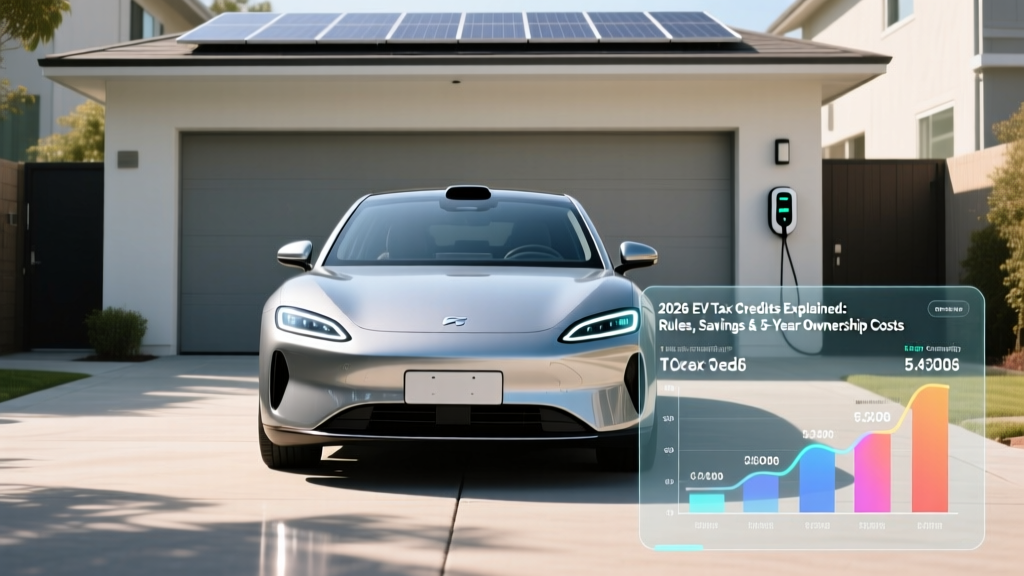
5-Year Total Cost of Ownership Breakdown
Below is a representative TCO for a 2026 mainstream EV (e.g., Tesla Model 3 RWD or Hyundai Ioniq 5 SE) versus a comparable gas-powered sedan (e.g., Toyota Camry). Assumptions: 15,000 miles/year, 70% home charging at $0.16/kWh, 30% public DC charging at $0.45/kWh, and gas at $3.60/gallon.
| Category (5-Year Total) | Mainstream EV (BEV) | Gas Sedan (ICE) | EV Advantage/Disadvantage |
|---|---|---|---|
| Purchase Price (Avg MSRP) | $40,000 | $32,000 | -$8,000 |
| Federal Tax Credit (§30D) | -$7,500 | $0 | +$7,500 |
| Effective Net Purchase | $32,500 | $32,000 | -$500 |
| Fuel/Energy (75k miles) | $5,600 | $9,800 | +$4,200 |
| Maintenance & Repairs | $2,200 | $4,500 | +$2,300 |
| Insurance (5-Year) | $11,500 | $8,500 | -$3,000 |
| Depreciation (Est. Resale) | $18,000 | $14,000 | -$4,000 |
| Total 5-Year TCO | $50,800 | $54,800 | +$4,000 Savings |
Charging vs. Gas: The Cost Per Mile Reality
Electricity prices vary wildly, making this the most volatile part of the TCO equation. We use an efficiency benchmark of 3.5 miles per kWh (approx. 28.5 kWh/100mi) for modern EVs and 30 MPG for the gas baseline.
Scenario A: 100% Home Charging ($0.16/kWh)
- EV Cost: $0.046 per mile
- Gas Cost: $0.12 per mile
- Savings: ~$0.074 per mile
Scenario B: 100% Public DC Fast Charging ($0.45/kWh)
- EV Cost: $0.128 per mile
- Gas Cost: $0.12 per mile
- Savings: -$0.008 per mile (EV is more expensive)
Takeaway: If you cannot install a Level 2 charger at home or at work, the fuel savings of an EV may be negated by the cost of public fast charging.
Maintenance Savings: Where the EV Wins
BEVs have roughly 20 moving parts in the drivetrain compared to nearly 2,000 in an internal combustion engine (ICE). This translates to tangible savings over five years.
| Maintenance Item (5 Years) | EV Cost | Gas Cost | Notes |
|---|---|---|---|
| Oil Changes | $0 | $600 | ICE requires 8-10 changes at $60-$80 each. |
| Brake Pads/Rotors | $150 | $800 | Regen braking reduces pad wear by 70-90%. |
| Transmission Fluid | $0 | $300 | Most EVs use a single-speed reduction gear with "lifetime" fluid. |
| Cabin Air Filter | $200 | $200 | Identical replacement schedule and cost. |
| Tire Rotation/Replacement | $2,000 | $1,600 | EV tires wear 20-30% faster due to weight and instant torque. |
Insurance Costs: The Premium Reality
According to industry data, EV insurance premiums are typically 20% to 35% higher than comparable gas cars. This is due to higher repair costs for battery packs, specialized labor requirements, and the higher initial MSRP. While some manufacturers (like Tesla) offer in-house insurance, most buyers will see a monthly premium increase of $40-$60. Always get a quote from your provider before purchasing.
Depreciation and Resale Value Trends
Depreciation remains the single largest cost of vehicle ownership. In 2026, EV depreciation has stabilized but still lags behind Toyota/Honda ICE reliability benchmarks. While Teslas and Hyundais hold value relatively well, luxury EVs and early-adopter models can see 50-60% value loss over five years. Factors influencing resale include the state of health (SoH) of the battery and the pace of new model releases with better range/charging speeds.
Federal credits are only the start. Many states offer additional rebates:
- California (CVRP): Up to $7,000 for income-qualified buyers (check CARB for status).
- Colorado: Innovative Motor Vehicle Credit (up to $5,000).
- Utility Rebates: Many local utilities offer $500-$1,000 for home charger installation or off-peak charging credits.
Frequently Asked Questions
Can I get the tax credit if I lease an EV?
Technically, the credit goes to the lessor (the bank/manufacturer). However, most manufacturers pass this savings to the lessee as a "lease cash" reduction or capitalized cost reduction. This is often an easier way to bypass the strict battery-sourcing rules of §30D, as leasing falls under different commercial code rules (IRC 45W).
What happens if my tax liability is less than $7,500?
The §30D credit is non-refundable, meaning it can only reduce your tax bill to zero; it won't result in a refund. However, by using the point-of-sale transfer, you can receive the full $7,500 as an immediate discount on the car's price, regardless of your tax liability.
Do I have to pay for a home charger installation?
Yes. While the charger unit itself might cost $400-$700, professional installation for a 240V NEMA 14-50 outlet or hardwired Level 2 unit typically runs $800-$2,000 depending on your electrical panel's capacity. There is also an Alternative Fuel Vehicle Refueling Property Credit (IRC 30C) that covers 30% of installation costs (up to $1,000) if you live in an eligible census tract.