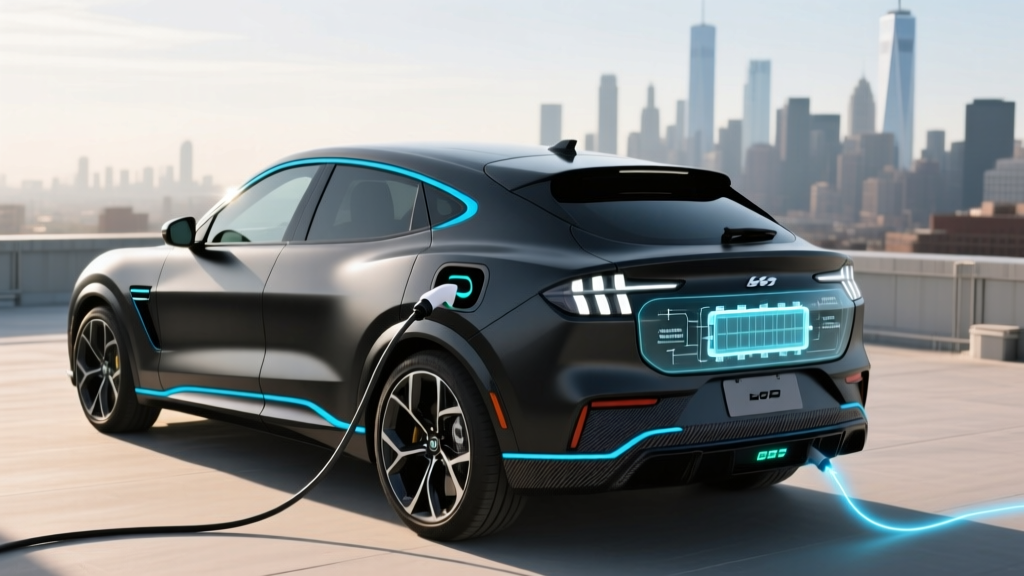
Bottom line for 2026: The 2026 Ford Mustang Mach-E is the electric Mustang you can actually buy. It's a 5-passenger crossover SUV (not a coupe) with an EPA range of up to 320 miles on the Extended Range RWD trim, a starting MSRP around $42,995, and DC fast charging that peaks at 150 kW (10–80% in roughly 36 minutes). Most trims qualify for the $7,500 federal §30D point-of-sale credit when sourced with compliant battery materials and buyer income limits are met. Expect 270–290 real-world highway miles and closer to 220–240 in freezing weather.
What the 2026 Electric Mustang Actually Is
When shoppers search for a "2026 electric Mustang," they're typically looking for one of two things: the Ford Mustang Mach-E, which has been in production since the 2021 model year, or rumors of an electrified two-door Mustang coupe. As of the 2026 model year, Ford's electrified Mustang offering is the Mach-E. The iconic two-door Mustang coupe and convertible remain gas-powered (5.0L Coyote V8 and EcoBoost four-cylinder), and Ford has not announced a production date for an electric pony car variant.
The Mach-E wears the Mustang badge and borrows design cues (tri-bar taillights, long hood proportions, pony grille), but mechanically it's a battery-electric crossover riding on Ford's GE1 dedicated EV platform. It competes directly with the Tesla Model Y, Hyundai Ioniq 5, Kia EV6, and Volkswagen ID.4.
Range, Battery, and Charging: The Numbers That Matter
Range is the first question every EV buyer asks, and the Mach-E lineup offers meaningful variation by trim, drivetrain, and battery pack.
| Trim / Config | Battery (usable kWh) | Chemistry | EPA Range | MPGe (combined) | Peak DC kW | 10–80% Time |
|---|---|---|---|---|---|---|
| Select RWD Std Range | 70 kWh | NMC | 250 mi | 101 MPGe | 115 kW | ~38 min |
| Premium RWD Ext Range | 91 kWh | NMC | 320 mi | 104 MPGe | 150 kW | ~36 min |
| Premium AWD Ext Range | 91 kWh | NMC | 290 mi | 99 MPGe | 150 kW | ~36 min |
| GT AWD | 91 kWh | NMC | 280 mi | 93 MPGe | 150 kW | ~36 min |
| Rally AWD | 91 kWh | NMC | 275 mi | 91 MPGe | 150 kW | ~36 min |
Sources: EPA fueleconomy.gov, Ford Motor Company 2026 specification sheets.
Real-world range reality: The EPA's 320-mile sticker on the Premium RWD Extended Range assumes mixed driving at moderate temperatures. In sustained 75-mph highway testing, expect 270–290 miles before needing a charge. In sub-freezing weather (20°F–32°F), plan for 220–240 miles due to battery chemistry resistance, cabin heating load, and reduced regenerative braking efficiency. The Mach-E uses a resistive PTC heater on most trims; a heat pump is not standard equipment, which matters for cold-climate buyers.
Understanding the Charge Curve
A peak rate of 150 kW is not sustained for the entire session. The Mach-E's charge curve holds near peak output between roughly 10% and 55% state of charge (SoC), then tapers progressively. From 80% to 100%, charging slows dramatically to protect the NMC cells — adding that final 20% can take as long as the first 70%. For road trips, plan stops at 10–80% and move on; charging to 100% at a DC fast station is rarely time-efficient.
Level 2 Home Charging
The Mach-E accepts up to 10.5 kW on Level 2 (240V, 48A). Using Ford's Mobile Power Cord with a NEMA 14-50 outlet delivers roughly 30 miles of range per hour of charging — enough to replenish a full daily commute overnight. A hardwired wall connector (such as the Ford Connected Charge Station or a ChargePoint Home Flex) provides the same rate with added reliability and smart scheduling. Level 1 (120V) trickle charging adds roughly 3 miles per hour — viable only as emergency top-up, not daily strategy.
2026 Electric Mustang vs. Gas Mustang: Cost & Driving Comparison
Buyers cross-shopping an electric Mustang against the traditional gas Mustang coupe want to know where the EV wins, where it loses, and whether the math works.
| Metric | 2026 Mach-E Premium RWD | 2026 Mustang EcoBoost Coupe |
|---|---|---|
| Base MSRP | $42,995 | $32,515 |
| Federal Tax Credit (§30D) | Up to $7,500 (POS) | $0 |
| Effective Price (if eligible) | ~$35,495 | $32,515 |
| EPA Efficiency | 104 MPGe / 32 kWh/100mi | 25 MPG combined |
| Fuel/Energy Cost (15k mi/yr) | ~$612/yr (electricity) | ~$1,920/yr (gasoline) |
| Annual Maintenance | ~$350 | ~$650 |
| 0–60 mph | 5.1 sec | 5.1 sec |
| Horsepower | 290 hp | 315 hp |
| Cargo Volume | 59.2 cu ft (rear seats folded) | 13.5 cu ft (trunk) |
| Body Style | 5-door crossover SUV | 2-door coupe |
Energy cost assumptions: $0.14/kWh national average residential electricity, $3.20/gallon regular unleaded. Actual costs vary by region and utility rate. Source: fueleconomy.gov and Ford.
Where the Mach-E Wins
- Running costs: Roughly $1,300/year savings on fuel alone, plus lower maintenance (no oil changes, no transmission fluid, fewer brake replacements due to regenerative braking).
- Practicality: Five seats, 29.7 cu ft behind the rear row, 59.2 cu ft with seats folded, plus a front trunk (frunk) for additional storage.
- Home fueling: Wake up to a "full tank" every morning if you have Level 2 access.
- Instant torque: Electric motors deliver peak torque from 0 RPM, making the Mach-E feel quicker in city driving than its 0–60 time suggests.
Where the Gas Mustang Wins
- Lower entry price: The EcoBoost coupe starts roughly $10,500 below the Mach-E before any tax credit.
- Driver engagement: Manual transmission availability, exhaust note, and a lower curb weight deliver a fundamentally different driving experience.
- No charging logistics: Refuel in 5 minutes anywhere; no range planning needed for road trips.
- Heritage: The two-door Mustang coupe carries 60+ years of pony car lineage the Mach-E does not.
5-Year Ownership Cost Breakdown
Purchase price is only the start. Here's what five years of Mach-E ownership actually costs for a typical driver covering 15,000 miles annually with home Level 2 charging.
| Cost Category (5 Years) | Mach-E Premium RWD | Mustang EcoBoost Coupe |
|---|---|---|
| Purchase Price (after credit) | $35,495 | $32,515 |
| Fuel / Electricity | $3,060 | $9,600 |
| Maintenance | $1,750 | $3,250 |
| Insurance (avg) | $9,500 | $8,250 |
| Home Charger Install (one-time) | $1,200 | $0 |
| Estimated Depreciation | $14,200 | $11,400 |
| 5-Year Total | $65,205 | $65,015 |
| Cost Per Mile | $0.87 | $0.87 |
Depreciation estimates based on current EV resale trends; EV depreciation has been volatile and may shift as the used EV market matures. Insurance premiums for EVs typically run 10–20% higher than ICE equivalents due to repair complexity and battery replacement exposure. Source: IRS §30D guidance for credit eligibility.
Home Charging Installation Reality
Installing a 240V NEMA 14-50 outlet near your parking spot typically costs $600–$1,500 if your electrical panel has spare capacity (a 50A breaker slot). If your home has an older 100A panel or the run from panel to garage is long, expect $2,000–$4,000 including a possible panel upgrade to 200A. Always get a quote from a licensed electrician before purchasing a wall connector — the panel is the real variable, not the charger hardware.
Federal Tax Credit: Do You Qualify?
The Mach-E has historically qualified for the full $7,500 federal EV tax credit under IRS §30D, but eligibility depends on several conditions that change frequently based on battery-sourcing rules and buyer circumstances.
- Buyer income cap: Modified AGI must not exceed $150,000 (single), $225,000 (head of household), or $300,000 (joint).
- MSRP cap: The Mach-E is classified as an SUV, so the cap is $80,000 — all trims qualify.
- Battery sourcing: Critical minerals and battery components must meet annual threshold percentages from U.S. or free-trade-agreement countries. Ford has worked to qualify the Mach-E, but verify current-year status at the point of sale.
- Point-of-sale transfer: As of 2024+, you can transfer the credit to the dealer at purchase, reducing your out-of-pocket cost immediately rather than waiting to claim it on your tax return.
- One credit per VIN, one per taxpayer per year.
Tax credit rules are subject to change. Always verify eligibility with your tax professional and the IRS Clean Vehicle Credit page before purchase.
Common Misconceptions About the Electric Mustang
| Myth | Fact |
|---|---|
| "The Mach-E isn't a real Mustang." | Ford officially badges and markets it as a Mustang. It shares no platform with the coupe, but it carries the name, design DNA, and performance positioning. Whether that makes it a "real" Mustang is subjective — it's a real Ford product. |
| "The battery will need replacing in 5 years." | Ford warranties the high-voltage battery for 8 years / 100,000 miles with a capacity retention threshold of 70%. NMC degradation data from real-world fleets shows typical loss of 10–15% over 100,000 miles. Most EV batteries outlast the vehicle. |
| "You can't road-trip in a Mach-E." | The Mach-E has access to the Tesla Supercharger network (via NACS charge port on 2025+ models or adapter for earlier CCS-equipped models). With 320 miles of range and 150 kW charging, a 500-mile trip requires one 25-minute stop — manageable with basic planning. |
| "Electricity isn't really cleaner." | Even on the U.S. average grid mix, an EV produces roughly 50–60% fewer lifecycle emissions than a comparable gas car. On grids with significant renewables or nuclear, the advantage widens to 70–80%. Source: Union of Concerned Scientists grid analysis. |
| "Charging at home is expensive." | At $0.14/kWh, fully charging the 91 kWh Extended Range pack costs roughly $12.74 — equivalent to about 4 gallons of gas for 100+ miles of range. Off-peak utility rates can drop this further. |
Decision Framework: Is the 2026 Electric Mustang Right for You?
Choose the 2026 Mach-E if:
- You have access to Level 2 home charging (or can install it).
- You want Mustang styling with SUV practicality and 5 seats.
- Your daily commute is under 100 miles round-trip (covering 90%+ of drivers).
- You qualify for the §30D tax credit, bringing the effective price near $35,000.
- You want lower running costs and minimal scheduled maintenance.
- You take 1–2 road trips per year and are willing to plan DC fast-charging stops.
Choose the gas Mustang coupe (or wait) if:
- You cannot install home charging and rely on apartment/street parking.
- You prioritize driving engagement — manual transmission, exhaust note, lightweight dynamics.
- You want a true two-door sports coupe, not a crossover SUV.
- You regularly drive in remote areas with sparse DC charging infrastructure.
- Your budget is firm under $35,000 and you don't qualify for the tax credit.
Consider a plug-in hybrid (like the Ford Escape PHEV) if:
- You want some electric-only driving (30–40 miles) but need unlimited range flexibility without charging planning.
- You lack reliable home charging but still want to reduce fuel consumption on short trips.
First-Time EV Buyer Essentials
If the Mach-E is your first electric vehicle, here's what the dealership won't spend time explaining:
Preconditioning Matters
When you set a destination to a DC fast charger in the Mach-E's navigation system, the car begins warming the battery to optimal temperature before you arrive. This preconditioning can shave 5–10 minutes off your charging session, especially in cold weather. Always navigate to the charger rather than just driving there.
Regenerative Braking Changes How You Drive
The Mach-E offers multiple regen levels, including a one-pedal driving mode that can bring the car to a complete stop without touching the brake pedal. Most EV owners adapt to one-pedal driving within a week and prefer it. It also reduces brake pad wear significantly — many EV owners report original brake pads at 80,000+ miles.
Tire Costs Are Higher
EVs are heavier and deliver instant torque, which accelerates tire wear. Expect to replace tires every 25,000–35,000 miles rather than the 45,000–60,000 miles typical for gas cars. Budget $800–$1,200 for a set of EV-optimized tires at replacement time.
Insurance: Get Quotes Before You Buy
EV insurance premiums run 10–20% higher on average. Get quotes from your insurer (and two competitors) before signing a purchase agreement — the difference between insurers can be $400–$800/year for the same vehicle.
Frequently Asked Questions
Is there a 2026 electric Mustang coupe?
No. As of the 2026 model year, Ford has not announced a battery-electric version of the two-door Mustang coupe. The only electric Mustang currently in production is the Mach-E, a 5-door crossover SUV. Ford executives have hinted at future electrified Mustang variants, but nothing has been confirmed with a production timeline.
How long does it take to charge the Mach-E at home?
On a Level 2 (240V) home charger at 10.5 kW, a full charge from 10% to 100% on the Extended Range (91 kWh) pack takes approximately 8–9 hours. Most owners plug in each evening and wake up fully charged. On a standard 120V outlet (Level 1), a full charge takes 3–4 days — not practical for daily use.
Can the Mach-E use Tesla Superchargers?
Yes. Starting with the 2025 model year, the Mach-E comes equipped with a NACS (North American Charging Standard) charge port, providing direct access to Tesla's Supercharger network without an adapter. For 2021–2024 models with CCS ports, Ford provides a NACS adapter for Supercharger access.
What happens if the battery degrades?
Ford's high-voltage battery warranty covers 8 years or 100,000 miles (whichever comes first) against capacity loss below 70% of original capacity. Real-world data from high-mileage Mach-E fleets shows typical degradation of 8–12% at 100,000 miles — well within the warranty threshold. Full battery replacement (rarely needed) costs approximately $15,000–$20,000 out of warranty.
Is the Mach-E good in snow and cold weather?
The AWD trims (Premium AWD, GT, Rally) provide confident traction in snow, aided by the low center of gravity from the floor-mounted battery pack. However, expect 25–30% range loss in sustained sub-freezing temperatures due to battery chemistry limitations and cabin heating demands. Cold-climate buyers should opt for the Extended Range pack to preserve adequate winter range and consider a garage to reduce cold-soak effects.
Does the Mach-E qualify for the $7,500 tax credit in 2026?
The Mach-E has qualified for the full §30D credit in recent model years, but eligibility depends on current-year battery sourcing compliance, your income, and the MSRP cap ($80,000 for SUVs — all trims pass). The credit can be transferred to the dealer at point of sale, reducing your purchase price immediately. Verify current-year eligibility on the IRS website and with your dealer before finalizing a purchase.