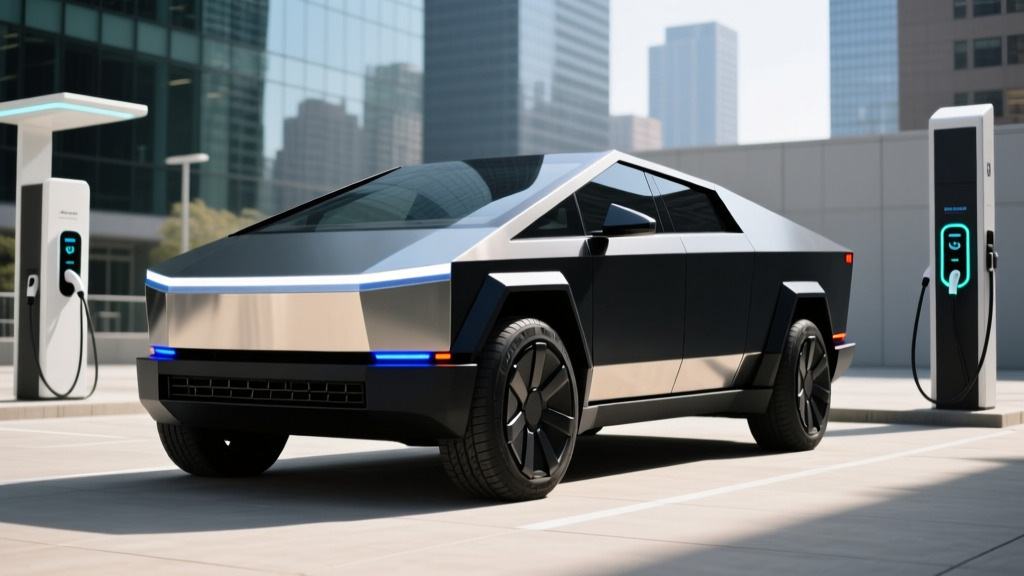
The Tesla Cybertruck remains one of the most polarizing and closely scrutinized electric vehicles on the road. For buyers researching the 2026 model year, the biggest question isn't just whether the stainless-steel exoskeleton fits their driveway — it's what the actual out-of-pocket cost looks like once you factor in trim selection, destination fees, and the federal EV tax credit. This guide breaks down every 2026 Cybertruck variant, what you can realistically expect to pay, and whether the numbers add up against rivals like the Ford F-150 Lightning and Rivian R1T.
2026 Cybertruck Trim Lineup and Base Pricing
Tesla restructured the Cybertruck lineup for 2026, streamlining from the initial launch configuration into three distinct trims. Prices below reflect MSRP before destination charges (currently $1,390) and before any federal or state incentives.
| Trim | Drivetrain | Base MSRP | Est. As-Tested* |
|---|---|---|---|
| Long Range AWD | Dual-Motor AWD | $79,990 | $82,500–$86,000 |
| All-Wheel Drive (Dual Motor) | Dual-Motor AWD | $84,990 | $88,000–$93,000 |
| Cyberbeast (Tri-Motor) | Tri-Motor AWD | $99,990 | $103,000–$110,000 |
*As-tested estimates include common options such as Full Self-Driving (Supervised) capability at $8,000, armor glass upgrade, and accessories. Your configuration will vary.
The entry point for 2026 is the Long Range AWD at $79,990. Tesla previously offered a rear-wheel-drive base model at a lower price point, but that variant was discontinued after limited availability. The Cyberbeast tri-motor flagship pushes past the $100K mark, placing it in direct competition with the Rivian R1T Tri Motor Max and high-trim F-150 Lightning Platinum.
Range, Efficiency, and Real-World Expectations
Tesla equips the 2026 Cybertruck with an NMC (nickel manganese cobalt) lithium-ion battery pack. The usable capacity sits at approximately 123 kWh across dual-motor trims, with the Cyberbeast using the same pack but drawing more energy under hard acceleration.
- Long Range AWD: EPA 340+ miles — expect ~280–310 miles on the highway at 70 mph, and ~230–260 miles in sub-30°F winter conditions.
- All-Wheel Drive (Dual Motor): EPA 315+ miles — expect ~260–290 miles highway, ~210–240 miles in cold weather.
- Cyberbeast: EPA 300+ miles — expect ~245–275 miles highway, ~200–230 miles in cold weather.
The Cybertruck's boxy aerodynamics (drag coefficient ~0.34) and heavy curb weight (~6,600–6,800 lbs) penalize highway efficiency more than sedans or crossovers. Cold weather compounds this — the stainless-steel body doesn't insulate like composite panels, and cabin heating draws significant energy without a standard heat pump on early builds (check your specific VIN for heat-pump inclusion).
Efficiency lands around 68–72 MPGe combined depending on trim, which translates to roughly 48–52 kWh per 100 miles. That's thirsty by EV standards — for comparison, the Ford F-150 Lightning Extended Range achieves about 70 MPGe combined with a smaller 131 kWh pack, while the Rivian R1T Dual Large sits around 73 MPGe. The Cybertruck's mass and aero profile mean you'll spend more per mile at the charger than lighter electric trucks.
Charging Speed: DC Fast Charge and Home Level 2
Charging speed is where Cybertruck ownership gets practical — or frustrating, depending on your setup. Here's what the 2026 model delivers across charging levels:
| Charging Level | Max Power | Speed / Time | Connector |
|---|---|---|---|
| DC Fast Charge (V4 Supercharger) | ~250 kW peak | 10–80% in ~30 min; ~170 miles in 15 min | NACS (native) |
| DC Fast Charge (CCS adapter) | ~200 kW peak (varies by station) | 10–80% in ~38 min | CCS1 via adapter |
| Level 2 Home (48A / 11.5 kW) | 11.5 kW | ~30–37 miles per hour of charging | NACS (Wall Connector) |
| Level 2 Home (32A / 7.7 kW) | 7.7 kW | ~20–25 miles per hour | NACS / J1772 adapter |
| Level 1 (120V household) | ~1.4 kW | ~3–4 miles per hour | Standard outlet |
Charging curve reality check: The Cybertruck peaks at approximately 250 kW on V4 Superchargers, but only between roughly 10–35% state of charge. From 35–60%, the rate tapers to ~180 kW, and above 80% it drops sharply to under 50 kW. That 10–80% time of ~30 minutes assumes battery preconditioning is active (navigation set to a Supercharger). Without preconditioning, add 5–10 minutes to your session, especially in cold weather.
For home charging, Tesla's Wall Connector at 48 amps on a 60-amp circuit is the sweet spot. Expect a full overnight charge from 20% to add roughly 250+ miles — enough for most daily driving. Budget $500–$1,500 for a licensed electrician to install a 240V/60A circuit, plus potential panel upgrades if your home's service is below 200 amps.
Performance and Capability Specs
| Spec | Long Range AWD | Dual Motor AWD | Cyberbeast |
|---|---|---|---|
| Horsepower | ~600 hp | ~600 hp | ~845 hp |
| 0–60 mph | ~4.1 sec | ~3.9 sec | ~2.6 sec |
| Top Speed | 112 mph | 130 mph | 130 mph |
| Max Towing | 11,000 lbs | 11,000 lbs | 11,000 lbs |
| Payload Capacity | ~2,500 lbs | ~2,500 lbs | ~2,500 lbs |
| Drivetrain | Dual-Motor AWD | Dual-Motor AWD | Tri-Motor AWD |
The Cyberbeast's 2.6-second 0–60 time makes it one of the quickest production trucks ever built, though that performance comes at the cost of ~40 miles of EPA range compared to the Long Range. All trims feature adaptive air suspension with up to 16 inches of ground clearance in Extract mode, steer-by-wire steering (no mechanical linkage between wheel and rack), and four-wheel steering for a tighter turning circle than its 247-inch length suggests.
Towing at the 11,000-pound max will slash range by roughly 40–50%, meaning a Cyberbeast towing near capacity should expect ~150–170 miles between charges. Plan accordingly for trailer hauls.
Federal Tax Credit: Does the 2026 Cybertruck Qualify?
This is where many Cybertruck buyers encounter sticker shock — not from the vehicle, but from the tax credit rules. Under current IRS §30D regulations, the Cybertruck faces two significant hurdles:
- ✅ Vehicle classification: Qualifies as a light truck (MSRP cap: $80,000)
- ⚠️ MSRP cap: Only the Long Range AWD at $79,990 clears the $80,000 truck cap — the Dual Motor AWD ($84,990) and Cyberbeast ($99,990) exceed it and are ineligible
- ⚠️ Buyer income limits: AGI must not exceed $150K (single) / $225K (head of household) / $300K (joint)
- ⚠️ Battery sourcing: Critical minerals and battery components must meet escalating domestic-content thresholds — verify current-year compliance on fueleconomy.gov before purchasing
- ✅ Point-of-sale transfer: If eligible, you can transfer the up-to-$7,500 credit to the dealer at purchase, reducing your out-of-pocket cost immediately
| Trim | MSRP | §30D Credit Eligible? | Est. Net Price* |
|---|---|---|---|
| Long Range AWD | $79,990 | Yes (up to $7,500) | ~$73,880 (with full credit) |
| Dual Motor AWD | $84,990 | No (exceeds $80K cap) | $86,380+ (no credit) |
| Cyberbeast | $99,990 | No (exceeds $80K cap) | $101,380+ (no credit) |
*Net price includes $1,390 destination. Actual credit amount depends on battery-sourcing compliance and your tax liability. Consult a tax professional and verify on irs.gov before relying on credit eligibility.
The $80,000 MSRP cap for trucks is the critical constraint. Only the base Long Range AWD qualifies, and even then, adding options like FSD (Supervised) pushes the transaction price above $80K — though the IRS cap applies to base MSRP plus destination, not options or dealer add-ons. State incentives may offer additional savings; check your state's energy office for current programs.
Cargo, Passenger Space, and Daily Practicality
The Cybertruck's 6-foot bed (vault) offers 67 cubic feet of lockable storage with the tonneau cover closed. The bed is 4-foot wide between wheel wells — narrow compared to a traditional F-150's ~50-inch width, which limits standard sheet-of-plywood flat-loading. The powered tonneau cover supports up to 300 pounds of distributed weight.
Front passengers get 41.5 inches of legroom and a commanding view over the yoke-style steering wheel. Rear legroom measures approximately 36 inches — adequate for adults on shorter trips but tight for taller passengers on long hauls. The rear bench folds to expand interior cargo capacity. Total interior storage with rear seats folded adds roughly 20 cubic feet of enclosed space behind the front seats.
The frunk (front trunk) provides approximately 7 cubic feet — enough for a charging cable kit and a small bag. Note that the Cybertruck's angular design and high beltline create significant blind spots; rely on the camera system for parking and lane changes.
Tech, Driver Assistance, and Standout Features
The 2026 Cybertruck runs Tesla's latest infotainment stack on an 18.5-inch center touchscreen with a 9.4-inch rear display. Notable technology includes:
- Steer-by-wire: No mechanical connection between the yoke and wheels — variable ratio adjusts with speed, enabling lock-to-lock steering in under one full turn at low speeds
- Autopilot (standard): SAE Level 2 driver assistance with adaptive cruise, lane centering, and automatic emergency braking
- FSD Supervised ($8,000 option): SAE Level 2 with automated lane changes, navigation-on-autopilot, and traffic light/stop sign recognition — driver must remain fully engaged at all times
- Bioweapon Defense Mode: HEPA filtration system with positive cabin pressure
- Powered bed cover and built-in bed lighting: Integrated LED strips and 120V/240V bed outlets (up to 9.6 kW export capability for job-site power)
- Armor glass: Laminated glass with improved impact resistance (optional on some trims)
Neither Autopilot nor FSD (Supervised) is self-driving. Both are SAE Level 2 systems requiring continuous driver attention, hands-on-wheel monitoring, and readiness to take over instantly. Tesla's camera-only vision system can struggle in heavy rain, fog, construction zones, and faded lane markings. Treat these as convenience features, not autonomy.
Notable drawbacks: The yoke steering is polarizing and takes significant adaptation for three-point turns and parking maneuvers. The stainless-steel body shows fingerprints aggressively and is difficult to repair — panel replacement is often required instead of traditional bodywork. Ride quality on the air suspension has improved over early 2024 builds but remains firm over sharp impacts compared to the F-150 Lightning's more compliant setup. The rear visibility is poor, and the bed width between wheel wells limits utility use cases.
Warranty Coverage and Battery Longevity
| Coverage Area | Term |
|---|---|
| Basic Vehicle Limited Warranty | 4 years / 50,000 miles |
| Battery & Drive Unit Warranty | 8 years / 120,000 miles (min 70% capacity retention) |
| Restraint System | 5 years / 60,000 miles |
| Corrosion Perforation | 12 years / unlimited miles (stainless exoskeleton) |
Tesla's 8-year/120,000-mile battery warranty guarantees at least 70% capacity retention — meaning the pack should still hold ~86 kWh usable after 120K miles under normal use. NMC chemistry typically degrades 10–15% over the first 100,000 miles before leveling off. Real-world data from Tesla's fleet suggests most packs retain 85–90% capacity at 100K miles when charged primarily on Level 2 with daily limits set to 80–90%. Avoid frequent 100% charges and prolonged storage above 90% to maximize longevity.
Battery replacement out of warranty remains expensive — estimates range from $15,000 to $22,000 for a Cybertruck-sized NMC pack, though prices continue to decline. No major third-party refurbishment programs exist yet for the Cybertruck specifically.
Cybertruck vs. Key Competitors: Is It Worth Buying?
| Spec | Cybertruck LR AWD | F-150 Lightning Ext. Range | Rivian R1T Dual Large |
|---|---|---|---|
| Base MSRP | $79,990 | ~$77,995 | ~$79,900 |
| EPA Range | 340+ mi | ~320 mi | ~352 mi |
| Max DC Charge | ~250 kW | ~150 kW | ~220 kW |
| 0–60 mph | ~4.1 sec | ~3.8 sec | ~4.5 sec |
| Max Towing | 11,000 lbs | 10,000 lbs | 11,000 lbs |
| Bed Length | 6 ft | 5.5 ft | 4.5 ft (+ pass-through) |
| §30D Credit Eligible | Yes (base only) | Yes (most trims) | Yes (select trims) |
Choose the Cybertruck if: You want maximum DC fast-charging speed for road trips, value the lockable 6-foot vault bed, prefer the Supercharger network's reliability, and find the design compelling enough to overlook polarizing aesthetics and yoke adaptation.
Choose the F-150 Lightning if: You need a traditional truck experience with a familiar control layout, want broader §30D eligibility across trims, prefer a proven dealer service network, and prioritize ride comfort over acceleration.
Choose the Rivian R1T if: You want the longest EPA range in the segment, value the gear tunnel pass-through storage, prefer a more conventional steering wheel, and prioritize adventure-oriented features like built-in camp kitchen compatibility.
Frequently Asked Questions
What is the real-world range of the 2026 Cybertruck?
On the highway at 70 mph in moderate temperatures, expect 280–310 miles from the Long Range AWD and 245–275 miles from the Cyberbeast. In winter conditions below 30°F, reduce those figures by 20–30%. The Cybertruck's poor aerodynamic profile and heavy weight mean real-world range falls notably short of EPA estimates, especially at sustained highway speeds.
How fast does the Cybertruck charge at home and on the road?
On a V4 Supercharger, the Cybertruck peaks at ~250 kW and charges from 10–80% in approximately 30 minutes with battery preconditioning. At home on a 48-amp Level 2 Tesla Wall Connector, you'll add roughly 30–37 miles of range per hour — a full overnight charge from 20% restores enough range for most drivers. Level 1 (120V) adds only 3–4 miles per hour and is impractical as a primary charging method for a pack this large.
How much does the 2026 Cybertruck cost after tax credits?
Only the Long Range AWD at $79,990 MSRP qualifies for the §30D federal credit (up to $7,500), bringing the net price to approximately $73,880 plus destination — assuming you meet income caps and the battery meets current-year sourcing requirements. The Dual Motor AWD and Cyberbeast exceed the $80,000 truck MSRP cap and receive no federal credit.
Is the Cybertruck worth buying vs. the F-150 Lightning or Rivian R1T?
It depends on your priorities. The Cybertruck leads in DC fast-charging speed and Supercharger network access, making it the best road-trip electric truck. The F-150 Lightning wins on familiarity, service network breadth, and broader tax credit eligibility. The Rivian R1T offers the longest range and best adventure utility. If the Cybertruck's design, steer-by-wire, and bed configuration resonate with you — and you can accept the tax credit limitations — it's a compelling option.
What are the biggest pros and cons?
- Fastest DC charging in the electric truck segment (~250 kW)
- 11,000-lb towing capacity with integrated trailer tech
- Lockable 6-foot vault bed with 240V power export
- Cyberbeast performance (2.6 sec 0–60) is unmatched
- Supercharger network reliability for road trips
- Stainless exoskeleton resists dents and corrosion
- Only base trim qualifies for §30D federal tax credit
- Real-world range significantly below EPA estimates
- Yoke steering requires steep learning curve
- Narrow bed width (48 in between wells) limits utility
- Stainless steel body is difficult and expensive to repair
- Poor rear visibility; relies heavily on cameras
- High energy consumption (48–52 kWh/100 mi)
Does the 2026 Cybertruck qualify for the federal EV tax credit?
The Long Range AWD ($79,990 MSRP) qualifies for up to $7,500 under §30D, provided the buyer's AGI falls within limits ($150K single / $300K joint) and the battery meets current-year critical-mineral and component sourcing thresholds. The Dual Motor AWD and Cyberbeast both exceed the $80,000 MSRP cap for light trucks and are ineligible regardless of buyer income. Always verify current eligibility on fueleconomy.gov and consult a tax professional before making a purchase decision based on credit assumptions.