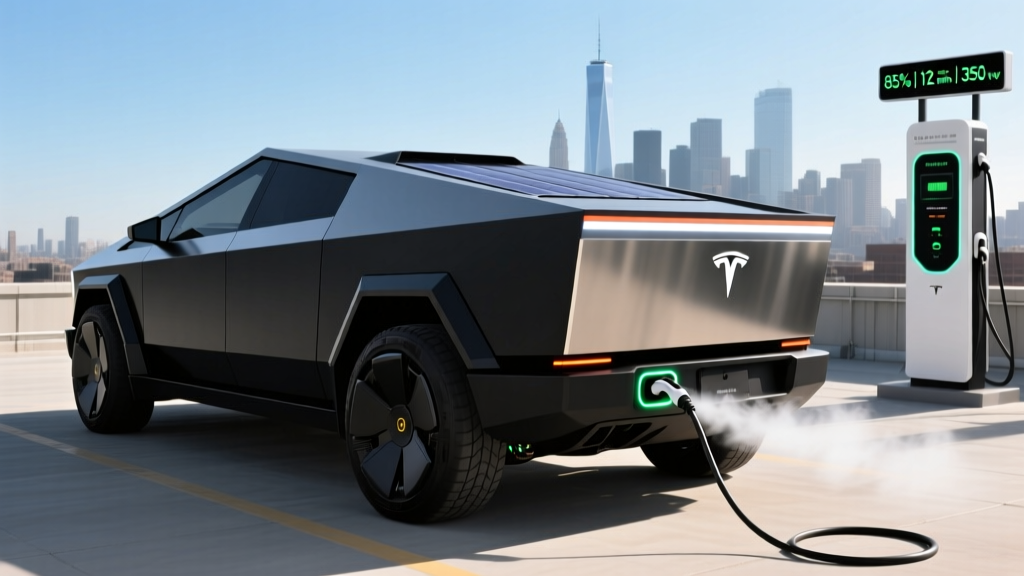
The Tesla Cybertruck entered production in late 2023 and has since become one of the most polarizing vehicles on American roads. For the 2026 model year, the Cybertruck lineup has stabilized into a clearer trim structure after the discontinuation of the base rear-wheel-drive variant that was initially promised at a sub-$61,000 price point. What remains is a full-size electric pickup defined by its stainless-steel exoskeleton, steer-by-wire steering, and a 48-volt electrical architecture that sets it apart from every other truck on the market.
This review examines the 2026 Cybertruck design through the lens that matters most to buyers: real-world range, charging behavior, total cost, and whether its unconventional engineering translates into practical utility. We'll cover the AWD and Cyberbeast trims, the revised Foundation Series packaging, and what ownership actually looks like once you get past the launch hype.
2026 Cybertruck Design: Trims, Pricing, and Tax Credit Eligibility
Tesla simplified the Cybertruck lineup for 2026. The Foundation Series, which carried a $20,000 premium over base pricing during the first year of production, has been phased out. The current lineup consists of two trims, both dual-motor all-wheel drive with air suspension:
| Trim | Base MSRP | Drivetrain | §30D Credit Eligible? | Effective Price* |
|---|---|---|---|---|
| AWD | $79,990 | Dual-Motor AWD | No (MSRP cap) | $79,990 |
| Cyberbeast | $99,990 | Tri-Motor AWD | No (MSRP cap) | $99,990 |
*Effective price assumes no federal credit. The §30D Clean Vehicle Credit imposes an MSRP cap of $80,000 for trucks, vans, and SUVs. The AWD trim at $79,990 technically sits under the cap, but as of 2026, the Cybertruck does not meet the critical-minerals and battery-component sourcing requirements under current IRS rules. Buyers should consult a tax professional and verify eligibility at the point of sale — rules shift annually.
Destination charges add approximately $1,390. Tesla no longer offers the rear-wheel-drive Cybertruck, which had been listed at $60,990 but was never produced in volume before being removed from the configurator.
EPA Range, Battery, and Real-World Efficiency
The 2026 Cybertruck AWD carries an EPA-estimated range of 340 miles, while the tri-motor Cyberbeast is rated at 320 miles. Both trims use the same battery pack — a roughly 123 kWh usable NMC (nickel-manganese-cobalt) lithium-ion pack housed in a structural battery enclosure that serves as a stressed chassis member.
The 340-mile EPA figure assumes a mix of city and highway driving at moderate temperatures. In practice:
- Highway cruising (70-75 mph): Expect 270–295 miles. The Cybertruck's angular stainless-steel body produces a drag coefficient around 0.38 Cd — significantly higher than a Model Y's ~0.23 Cd. Aerodynamic drag dominates at speed.
- City/suburban driving: Range can approach or slightly exceed the EPA estimate thanks to regenerative braking recovering energy in stop-and-go traffic.
- Cold weather (below 32°F): Expect a 20–30% reduction, bringing effective range to 220–260 miles. The Cybertruck does include a heat pump, which mitigates cabin-heating energy draw, but battery chemistry still suffers in cold conditions.
- Towing: Tesla rates the Cybertruck at 11,000 lbs max tow capacity. With a heavy trailer, range drops to roughly 140–180 miles depending on speed and terrain.
Efficiency is rated at approximately 2.0–2.2 kWh/mile depending on trim, which translates to roughly 76–70 MPGe combined. For context, the Ford F-150 Lightning Extended Range achieves about 2.0 kWh/mile with a 131 kWh pack and 320-mile EPA rating — the Cybertruck is competitive here but not class-leading given its weight advantage should theoretically yield better numbers.
| Specification | AWD | Cyberbeast |
|---|---|---|
| EPA Range | 340 miles | 320 miles |
| Battery (Usable) | ~123 kWh, NMC | ~123 kWh, NMC |
| Efficiency | ~2.0 kWh/mi (76 MPGe) | ~2.2 kWh/mi (70 MPGe) |
| 0-60 mph | 4.1 seconds | 2.6 seconds |
| Horsepower | 600 hp | 845 hp |
| Drivetrain | Dual-Motor AWD | Tri-Motor AWD |
| Max Tow Capacity | 11,000 lbs | 11,000 lbs |
| Payload | 2,500 lbs | 2,500 lbs |
| Base MSRP | $79,990 | $99,990 |
Charging Speed: DC Fast Charging and Home Level 2
Charging remains one of the Cybertruck's strongest practical assets, particularly when paired with Tesla's Supercharger network — widely considered the most reliable public DC fast-charging infrastructure in North America.
| Charging Level | Power / Rate | Time / Miles Added |
|---|---|---|
| Level 1 (120V, 12A) | ~1.4 kW | ~3–4 miles per hour |
| Level 2 (240V, 48A Wall Connector) | 11.5 kW | ~34 miles per hour; full charge ~11 hrs |
| DC Fast Charge (Peak) | 250 kW (max) | 10–80% in approximately 28–32 minutes |
| DC Fast Charge (Sustained avg.) | ~150–180 kW avg. | 80–100% adds ~15–20 min (taper curve) |
Charging curve reality: The Cybertruck peaks at 250 kW at low state-of-charge (roughly 5–15% SoC) and sustains above 200 kW through approximately 35–40% SoC. Above 50%, the curve tapers significantly, dropping below 100 kW past 80%. This is typical for large NMC packs, but the 123 kWh capacity means that even the taper phase is adding meaningful range — roughly 3–4 miles per minute above 80%.
Preconditioning matters. The Cybertruck's navigation system will automatically precondition the battery when you route to a Supercharger. If you charge without preconditioning (e.g., arriving at a charger without navigating to it first), peak charge rates can drop to 100–150 kW, extending the 10–80% session to 40+ minutes. Always navigate to the charger in cold weather.
Home charging setup: Tesla's Wall Connector at 48 amps on a 60-amp circuit is the recommended home solution. Installation costs vary widely — expect $500–$1,500 for the electrician work if your panel has capacity, or $2,000–$4,500+ if you need a panel upgrade to 200A service. The Cybertruck's onboard charger accepts up to 11.5 kW on Level 2.
Performance, Drivetrain, and the 2026 Cybertruck Design Engineering
The 2026 Cybertruck design is defined by engineering choices that have no parallel in the current truck market:
Stainless-steel exoskeleton: The body panels are 30X cold-rolled stainless steel, approximately 1.8 mm thick, serving as both exterior skin and structural reinforcement. This eliminates traditional paint — the truck ships in its raw brushed-metal finish. While visually striking, it means scratches and dents behave differently than on painted aluminum or steel; minor scuffs can be buffed with Scotch-Brite pads, but deep dents require panel replacement.
Steer-by-wire: The Cybertruck uses a fully electronic steer-by-wire system with no mechanical connection between the yoke (or optional steering wheel) and the rack. The variable ratio means lock-to-lock is roughly 340 degrees at low speeds (eliminating hand-over-hand maneuvering) and widens at highway speeds for stability. This system also enables the rear-wheel steering, which gives the 20.4-foot-long truck a turning circle of 37.2 feet — comparable to a much smaller sedan.
48-volt architecture: Every Cybertruck runs a 48V low-voltage electrical system rather than the industry-standard 12V. This allows thinner wiring harnesses (reducing weight by roughly 70% in the low-voltage system), more precise control of accessories, and eliminates the traditional 12V lead-acid auxiliary battery. Tesla uses a 48V lithium-iron-phosphate (LFP) auxiliary pack instead.
Air suspension: Adaptive air suspension provides up to 16 inches of ground clearance in Off-Road mode and can lower the truck 2 inches for highway efficiency. It also enables self-leveling under load — critical when towing near the 11,000-lb limit.
The Cyberbeast's tri-motor layout (one front, two rear) produces 845 hp and a 2.6-second 0-60 mph time, making it one of the quickest production vehicles sold in the US. The AWD dual-motor at 600 hp and 4.1 seconds is hardly slow. Both trims include torque vectoring across the rear axle on the Cyberbeast and across both axles on the AWD.
Cargo, Passenger Space, and Practical Utility
The Cybertruck is a crew-cab pickup with a 6-foot composite bed (Tesla calls it the "vault") and seating for five.
- Bed volume: 67 cu ft (with tonneau cover closed); the bed is 4-foot wide between wheel wells, accommodating standard 4×8 sheets of plywood flat.
- Bed length: 72 inches (6 feet) — shorter than a traditional full-size truck bed (typically 6.5–8 feet).
- Frunk: 7.1 cu ft front trunk, useful for charging cables and small cargo.
- Front legroom: 41.4 inches
- Rear legroom: 38.5 inches — adequate for adults but tighter than an F-150 SuperCrew (43.5 inches rear).
- Tonneau cover: Power-operated, lockable, and capable of supporting approximately 300 lbs of distributed weight. It's standard on all trims.
The powered tonneau is a genuine advantage for secure, weather-protected storage, but it limits vertical cargo height. Tall items (motorcycles, furniture) require the cover to be fully retracted, which takes about 12 seconds via the touchscreen or bed button.
Technology, Driver Assistance, and Safety
The Cybertruck runs Tesla's latest infotainment stack on an 18.5-inch center touchscreen and a 9.4-inch rear passenger screen. Key technology features include:
- Autopilot: Standard adaptive cruise control and lane-keeping (SAE Level 2). The driver must remain attentive with hands on the yoke/wheel at all times.
- Full Self-Driving (Supervised): Available as a $8,000 add-on or $99/month subscription. Despite the name, FSD remains an SAE Level 2 system requiring full driver supervision. It handles city streets, intersections, and highway lane changes but is not autonomous driving.
- Camera system: Eight external cameras provide 360-degree visibility, critical given the Cybertruck's high beltline and limited rearward sight lines. A front bumper camera aids in parking-curb clearance.
- Bioweapon Defense Mode: HEPA air filtration system carried over from the Model X.
- Powershare: 120V and 240V bed outlets (up to 9.6 kW output) enable the Cybertruck to power tools at a job site or provide backup home power during outages via a Tesla Powerwall integration.
All Tesla driver-assist features are SAE Level 2. The driver is legally and practically responsible for the vehicle at all times. FSD (Supervised) does not handle construction zones reliably, may not detect stationary emergency vehicles in all conditions, and requires hands-on-yoke monitoring. Tesla's camera-only vision system (no lidar or radar) can struggle in heavy rain, fog, or direct sun glare. Never treat these systems as autonomous.
As of early 2026, the Cybertruck has not been fully crash-tested by the NHTSA or the IIHS. The stainless-steel exoskeleton is theoretically advantageous in crash energy management, but official ratings remain pending — a notable gap for buyers prioritizing verified safety data.
Warranty, Battery Longevity, and Maintenance
| Coverage | Term |
|---|---|
| Basic Vehicle Limited Warranty | 4 years / 50,000 miles |
| Battery & Drive Unit Warranty | 8 years / 120,000 miles (minimum 70% retention) |
| Restraint System | 5 years / 60,000 miles |
| Corrosion Perforation | 12 years / unlimited miles |
The 8-year/120,000-mile battery warranty guarantees at least 70% capacity retention. For a 123 kWh pack, that means Tesla warrants the battery will hold at least ~86 kWh after eight years. Real-world degradation data from early 2024-production Cybertrucks is still limited, but NMC packs in Tesla's Model S/X historically degrade 8–12% over the first 100,000 miles before leveling off.
Maintenance advantages: No oil changes, no transmission fluid, no spark plugs. Brake wear is minimal due to aggressive regenerative braking (the Cybertruck can decelerate at up to 0.3g on regen alone). The primary recurring costs are tire replacement (20-inch or 22-inch tires, $300–$500 per tire), cabin air filter, and wiper fluid. Tesla recommends cabin filter replacement every 2–3 years and brake fluid checks every 2 years.
2026 Cybertruck vs. Key Competitors
The Cybertruck competes in the full-size electric truck segment against the Ford F-150 Lightning, Rivian R1T, and Chevrolet Silverado EV. Here's how the AWD trim stacks up against the most relevant alternatives:
| Spec | Cybertruck AWD | F-150 Lightning (Ext. Range) | Rivian R1T Dual-Motor Max |
|---|---|---|---|
| EPA Range | 340 mi | 320 mi | 410 mi |
| Battery | ~123 kWh NMC | 131 kWh NMC | 149 kWh NMC |
| 0-60 mph | 4.1 sec | ~5.0 sec | ~3.5 sec |
| Max Tow | 11,000 lbs | 10,000 lbs | 11,000 lbs |
| Bed Length | 6 ft | 5.5 ft | 4.5 ft (+ pass-through) |
| Base MSRP | $79,990 | $76,995 | $89,900 |
| §30D Eligible | No (sourcing) | Partial/Yes* | No (MSRP cap) |
*F-150 Lightning eligibility varies by trim and battery sourcing. Verify current-year rules on IRS.gov before purchasing.
The Rivian R1T Max Pack offers the longest range in the segment at 410 miles but starts nearly $10,000 higher. The F-150 Lightning remains the most conventional and approachable electric truck, with the broadest dealer service network. The Cybertruck's advantages are its charging network access, steer-by-wire maneuverability, and the Powershare bi-directional capability.
Choose the Cybertruck AWD if: You want the most range-efficient Cybertruck trim, value Tesla's Supercharger network for road trips, need Powershare for job-site or backup power, and accept the polarizing design and lack of crash-test ratings.
Choose the Cyberbeast if: Performance is a priority and you're willing to trade 20 miles of range and $20,000 for 845 hp and tri-motor torque vectoring.
Look elsewhere if: You need verified safety ratings, prefer a traditional dealer service experience, want federal tax credit eligibility, need more than 6 feet of bed length, or prioritize rear-seat legroom for tall passengers.
- 340-mile EPA range is competitive for the segment
- 250 kW DC fast charging with strong Supercharger network
- Steer-by-wire + rear steering = exceptional maneuverability
- 9.6 kW Powershare bi-directional power output
- Stainless-steel body eliminates paint maintenance
- 48V architecture is a genuine engineering advance
- No federal tax credit under current §30D sourcing rules
- Real-world highway range drops to ~270–295 miles
- No NHTSA or IIHS crash-test ratings as of early 2026
- 6-foot bed is shorter than most full-size competitors
- Rear legroom (38.5 in) is tight for the crew-cab segment
- Stainless-steel body repairs require specialized service
Frequently Asked Questions
What is the real-world range of the 2026 Cybertruck?
The EPA rates the AWD at 340 miles and the Cyberbeast at 320 miles. Real-world highway driving at 70-75 mph typically yields 270–295 miles. In cold weather (below freezing), expect 220–260 miles. City driving with regenerative braking can approach the EPA figure.
How fast does the Cybertruck charge?
On a DC fast charger, the Cybertruck peaks at 250 kW and charges from 10–80% in approximately 28–32 minutes, with the sustained average closer to 150–180 kW. At home on a Level 2 Tesla Wall Connector (48A/11.5 kW), a full charge takes about 11 hours, adding roughly 34 miles of range per hour.
Does the 2026 Cybertruck qualify for the federal EV tax credit?
As of 2026, the Cybertruck does not qualify for the full $7,500 §30D Clean Vehicle Credit. While the AWD trim's $79,990 MSRP sits under the $80,000 truck cap, the vehicle does not meet the critical-minerals and battery-component sourcing requirements mandated by the Inflation Reduction Act. Buyer income caps ($150K single / $300K joint) also apply. Always verify current rules on IRS.gov and consult a tax professional.
Is the Cybertruck worth buying vs. the F-150 Lightning or Rivian R1T?
The Cybertruck excels in Supercharger network access, maneuverability via steer-by-wire, and bi-directional power output. The F-150 Lightning offers a more conventional truck experience, broader dealer service, and potential tax credit eligibility. The Rivian R1T Max delivers the longest range (410 miles EPA) and a more refined interior but at a higher price. Your choice depends on whether Tesla's ecosystem and the Cybertruck's unique engineering outweigh its gaps in safety ratings and bed length.
What are the biggest drawbacks of the 2026 Cybertruck design?
The main concerns are the lack of NHTSA/IIHS crash-test data, a 6-foot bed that's shorter than most full-size trucks, tight rear-seat legroom, stainless-steel repair complexity, and ineligibility for the federal tax credit. The steer-by-wire system, while innovative, also means that any electronic failure could theoretically disable steering — Tesla has built in redundancy, but the system has no long-term reliability track record.
How long will the Cybertruck battery last?
Tesla warranties the battery for 8 years or 120,000 miles with a minimum 70% capacity retention. Based on historical NMC pack data from the Model S and Model X, expect 8–12% degradation over the first 100,000 miles, with the curve flattening afterward. A full pack replacement outside warranty currently costs approximately $15,000–$20,000 based on Tesla service estimates, though this is expected to decline as battery costs fall.