Quick Verdict: A Purpose-Built Electric Workhorse
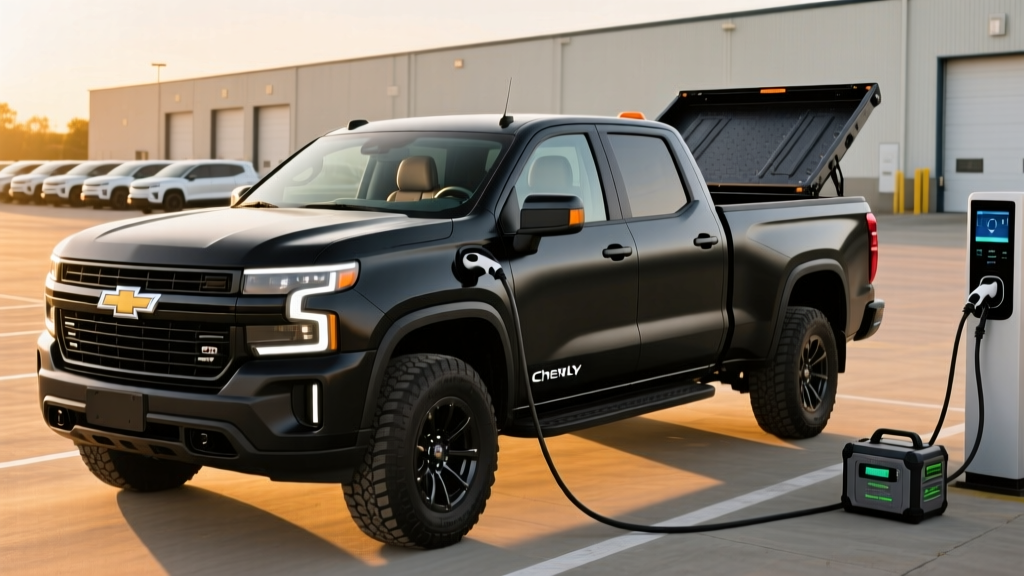
The 2026 Chevy Silverado EV Work Truck (WT) is not trying to be a luxury electric pickup. It's a fleet-grade, commercial-focused BEV that prioritizes utility, depot charging, and total cost of ownership over leather seats and 0-60 bragging rights. With a GM-estimated 240 miles of range, up to 350 kW DC fast charging, and a starting MSRP of $39,900, it undercuts the Ford F-150 Lightning Pro on price while offering competitive capability for the last-mile delivery, job-site, and municipal fleet buyer.
But "work truck" means real trade-offs. The interior is spartan, the bed is shorter than a standard Silverado, and the 240-mile EPA range shrinks noticeably under load or in cold weather. This review breaks down exactly what you're getting — the numbers, the limitations, and who should actually put this on a purchase order.
Range and Efficiency: 240 EPA Miles, With Caveats
Real-World Expectation: 180–210 miles at highway speeds (70+ mph); 150–175 miles when towing 5,000+ lbs; expect 20–30% range loss in sub-30°F temperatures. For mixed city/highway fleet routes under 65 mph, 220+ miles is achievable.
The Silverado EV WT uses a large Ultium battery pack with usable capacity of approximately 200 kWh (NMC chemistry — nickel manganese cobalt, which GM uses across the Ultium platform for energy density). That's one of the largest battery packs in any production EV, and it's the reason a truck this size can hit 240 miles despite a boxy, heavy platform.
Efficiency comes in at roughly 51 MPGe combined (approximately 66 kWh/100 miles) per fueleconomy.gov. That's expected for a 8,000+ lb GVWR electric truck — the Rivian R1T and F-150 Lightning are in a similar ballpark. For fleet managers calculating energy cost, at the national commercial average of $0.13/kWh, you're looking at roughly $8.58 per 100 miles of driving, compared to approximately $18–22 for a gas Silverado 1500 at 18 MPG combined.
The critical fleet consideration: most commercial routes are under 150 miles round-trip. For those use cases, the 240-mile range provides a comfortable buffer even with HVAC load and cold-weather degradation. For longer regional routes, DC fast charging becomes the operational linchpin.
Charging: 350 kW Peak, But Sustained Curve Matters More
| Charging Level | Power / Rate | Speed (miles added) | Notes |
|---|---|---|---|
| Level 1 (120V) | 1.4 kW | ~3 mi/hr | Emergency/trickle only |
| Level 2 (240V, 48A) | 11.5 kW | ~27 mi/hr | Overnight depot charging; 0–100% in ~19 hours |
| Level 2 (240V, 80A) | 19.2 kW | ~45 mi/hr | Requires upgraded onboard charger and hardwired station |
| DC Fast Charge | Up to 350 kW | ~100 miles in ~10 min (peak) | 10–80% in approximately 30–35 minutes on a 350 kW charger |
The Silverado EV WT supports up to 350 kW peak DC fast charging on compatible CCS or NACS stations (GM has transitioned to the NACS connector for 2026 models, with Tesla Supercharger access included via the NACS port and adapter). However, as with all EVs, peak rate is not sustained rate.
The Ultium platform's charge curve holds strong from roughly 10–50% SoC, where you'll see rates above 250 kW. From 50–80%, the curve tapers progressively — this is normal battery-management behavior to protect cell longevity. Expect the 10–80% session to take approximately 30–35 minutes on a properly rated 350 kW charger. On more common 150 kW public chargers, plan for 50–60 minutes for the same session.
For fleet depots, the practical play is Level 2 overnight charging. At 11.5 kW (48 amps), a depleted pack needs roughly 19 hours for a full charge — adequate for daily-use trucks that return to base each evening. Fleets with higher utilization should spec the 19.2 kW onboard charger option and install 80-amp hardwired Level 2 stations, cutting full-charge time to about 11 hours. Consult a licensed electrician for panel capacity assessment before committing to multiple 80-amp circuits.
Performance and Capability: Towing, Payload, and Drivetrain
| Specification | 2026 Silverado EV WT |
|---|---|
| Drivetrain | Dual-motor AWD (e4WD) |
| Horsepower | 510 hp |
| Torque | 615 lb-ft |
| 0–60 mph | ~5.8 seconds (est.) |
| Max Towing Capacity | 10,000 lbs (with max trailering pkg) |
| Max Payload | ~1,800 lbs |
| Bed Length | 5 ft 11 in (with fixed mid-gate); extends to ~9 ft with mid-gate open |
| Front Trunk (eTrunk) | ~10.2 cu ft lockable |
The dual-motor AWD powertrain delivers 510 horsepower and 615 lb-ft of torque — more than adequate for a work truck, and the instant torque delivery makes low-speed job-site maneuvering and trailer hookups feel effortless. The 0–60 time of roughly 5.8 seconds is quick for an 8,000-lb truck, though that's not the metric that matters here.
Towing is where the Silverado EV WT makes its case. The 10,000-lb max towing capacity (with the available max trailering package) is competitive with the F-150 Lightning Pro's 10,000 lbs. But towing at capacity will slash range significantly — expect 150 miles or less with a heavy trailer at highway speeds. For fleets that tow daily over long distances, this remains a hard limitation of current BEV truck tech.
The Multi-Flex Midgate is the Silverado EV's standout utility feature. It allows the partition between the cab and bed to fold down, extending the effective load floor from roughly 5'11" to over 9 feet — enough for lumber, ladders, or conduit runs while keeping the tailgate closed and secure. The lockable eTrunk up front adds weatherproof storage for tools, cords, and job-site gear that you don't want bouncing around in the bed.
Interior, Tech, and Driver Assistance
The WT trim is deliberately basic. You get a 7-inch digital driver display and an 11-inch diagonal infotainment touchscreen running Google Built-In (Google Maps, Google Assistant, Play Store). Wireless Apple CarPlay and Android Auto are standard. The cabin uses durable, wipeable materials — vinyl seating surfaces and rubberized floor coverings that fleet managers will appreciate.
Notable tech features include:
- Chevy Safety Assist suite: automatic emergency braking, forward collision alert, lane keep assist, following distance indicator, automatic high beams
- HD Surround Vision (available): camera views for trailer hitching and tight job-site navigation
- ProGrade Trailering System (available): trailer light test, hitch guidance, trailer tire pressure monitoring
- OnStar connectivity with remote diagnostics and fleet management integration
- Super Cruise (available on higher trims, not standard on WT): GM's hands-on-wheel Level 2 highway driving assist, operational on 400,000+ miles of mapped roads
The biggest interior drawback: rear seat space. The Silverado EV uses a fixed rear seat with less legroom than the crew-cab Silverado ICE trucks that fleet buyers may be accustomed to. If your crew regularly carries three or four passengers, measure the rear legroom (~35.9 inches) against your needs before ordering.
Pricing, Tax Credits, and Total Cost of Ownership
| Trim | Base MSRP | Est. After Federal Credit* |
|---|---|---|
| WT (Work Truck) 4WT Standard Range | $39,900 | $32,400 |
| WT (Work Truck) 4WT Extended Range | $49,900 | $42,400 |
*Federal tax credit shown at the maximum $7,500 under IRS §30D. Actual eligibility depends on multiple requirements detailed below.
- MSRP Cap: Vans and pickup trucks must be under $80,000 MSRP — the Silverado EV WT qualifies on all current trims.
- Buyer Income Cap: Modified AGI must not exceed $150,000 (single), $225,000 (head of household), or $300,000 (joint filers).
- Battery Component Sourcing: Increasing percentages of battery components must be manufactured or assembled in North America (phased thresholds per the Inflation Reduction Act).
- Critical Minerals: A percentage of critical minerals must be sourced from the U.S. or FTA-partner countries.
- Fleet/Commercial Purchases: The commercial clean vehicle credit (§45W) may apply to business purchases — consult a tax professional for your specific situation.
- Point-of-Sale Transfer: Eligible buyers can transfer the credit to the dealer at purchase, reducing the upfront price directly.
For fleet buyers, the total cost of ownership equation is where the Silverado EV WT makes its strongest argument. Commercial electricity rates are typically $0.10–0.14/kWh, translating to roughly $7–9 per 100 miles of energy cost versus $18–24 for a comparable gas Silverado 1500. Over a 5-year/125,000-mile ownership cycle, fuel savings alone can reach $12,000–18,000. Add reduced maintenance (no oil changes, fewer brake replacements thanks to regenerative braking, no transmission service) and the TCO advantage becomes compelling for high-utilization fleets — provided depot charging is feasible.
Warranty and Long-Term Durability
GM backs the Silverado EV with:
- Battery & Propulsion (Powertrain): 8 years / 100,000 miles (whichever comes first), with a capacity retention threshold of approximately 60% — meaning GM warrants the battery will retain at least 60% of original capacity within the warranty period. Industry data from Ultium-based vehicles is still limited, but GM's LMR (liquid-cooled modular) battery architecture includes robust thermal management designed for commercial duty cycles.
- Bumper-to-Bumper: 3 years / 36,000 miles
- Corrosion Protection: 6 years / 100,000 miles
- Roadside Assistance: 5 years / 60,000 miles
The NMC chemistry in the Ultium pack prioritizes energy density over the extreme cycle life of LFP (lithium iron phosphate) batteries. For fleet vehicles that undergo daily deep cycling, monitoring State of Health (SoH) via the OnStar diagnostics portal is recommended. Real-world degradation data for the Ultium platform is still accumulating — fleets should budget conservatively for potential battery service beyond the warranty window, though replacement cost estimates for a 200 kWh pack currently run $25,000–35,000+ if ever needed out of warranty.
Pros and Cons
- Aggressive $39,900 starting price for a full-size electric truck
- 350 kW DC fast charging capability — among the fastest in the segment
- Multi-Flex Midgate extends usable bed length to 9+ feet
- Lockable eTrunk adds secure, weatherproof front storage
- 10,000-lb towing capacity with available trailering package
- Strong fleet TCO economics vs. gas equivalents at high mileage
- Google Built-In infotainment with native Google Maps navigation
- 240-mile range limits regional/long-haul applications, especially when towing
- Real-world range drops significantly in cold weather and under load
- WT trim interior is spartan — no premium options on base model
- Rear seat legroom is tighter than ICE Silverado crew cabs
- 19-hour Level 2 full charge requires depot discipline or 80A upgrade
- Bed length (5'11") is shorter than standard 6.5' or 8' ICE truck beds without midgate
- NMC battery chemistry may degrade faster than LFP under heavy daily cycling
Who Should Buy the 2026 Silverado EV Work Truck?
- You operate a fleet with predictable daily routes under 150 miles round-trip
- You have (or can install) depot Level 2 charging infrastructure
- You want to reduce per-mile energy and maintenance costs over a 5-year fleet lifecycle
- Your payloads and towing needs stay within the 10,000-lb / 1,800-lb limits
- You value the midgate for long-material transport
- Your routes regularly exceed 200 miles or involve frequent heavy towing over distance
- You need a full-size rear seat for crew transport
- You lack charging infrastructure at home or at a depot
- You want a premium interior or luxury features on your work truck
Frequently Asked Questions
What is the real-world range of the 2026 Silverado EV Work Truck?
The EPA estimates 240 miles. In real-world driving, expect 180–210 miles at sustained highway speeds, and as low as 150 miles when towing at or near capacity. Cold weather (below 30°F) can reduce range by 20–30% without preconditioning.
How fast does the Silverado EV WT charge at home and on the road?
On a 350 kW DC fast charger, 10–80% takes approximately 30–35 minutes. At home or at a depot on a 48-amp Level 2 charger (11.5 kW), a full charge takes roughly 19 hours. An available 80-amp Level 2 setup (19.2 kW) cuts that to about 11 hours.
Does the 2026 Silverado EV qualify for the $7,500 federal tax credit?
It can, subject to IRS §30D rules. The WT's MSRP is well under the $80,000 truck cap. However, buyer income limits, battery component sourcing requirements, and critical minerals thresholds all apply. Commercial fleet buyers may qualify under §45W instead. Always verify current eligibility on irs.gov or with a tax professional before purchase.
Is the Silverado EV WT worth it vs. the Ford F-150 Lightning Pro?
The Silverado EV WT starts $39,900 vs. the F-150 Lightning Pro at approximately $42,995 (2026 pricing), giving Chevy a price edge. The Lightning offers a slightly larger standard bed (5.5 ft vs. 5 ft 11 in, both short by ICE standards) and a more established dealer service network for commercial accounts. The Silverado EV counters with a larger battery, faster peak DC charging, and the midgate utility feature. For fleets already invested in GM/OnStar fleet management, the Silverado EV WT is the natural choice.
Can I tow a trailer with the Silverado EV WT without destroying range?
You can tow up to 10,000 lbs, but range will drop significantly — expect 140–170 miles with a heavy trailer at highway speeds. For short job-site tows under 20 miles, it's a non-issue. For long-distance towing, plan charging stops carefully and recognize that towing a heavy trailer at 70 mph is the worst-case scenario for any EV's efficiency.
What's the battery replacement cost if it fails out of warranty?
Current estimates for a ~200 kWh Ultium NMC pack are $25,000–35,000+ for parts and labor. However, the 8-year/100,000-mile warranty covers capacity below ~60%, and real-world Ultium degradation data is still being collected. Most fleet vehicles will reach end-of-service life before requiring a full pack replacement, but it's a cost to model into long-term ownership projections.