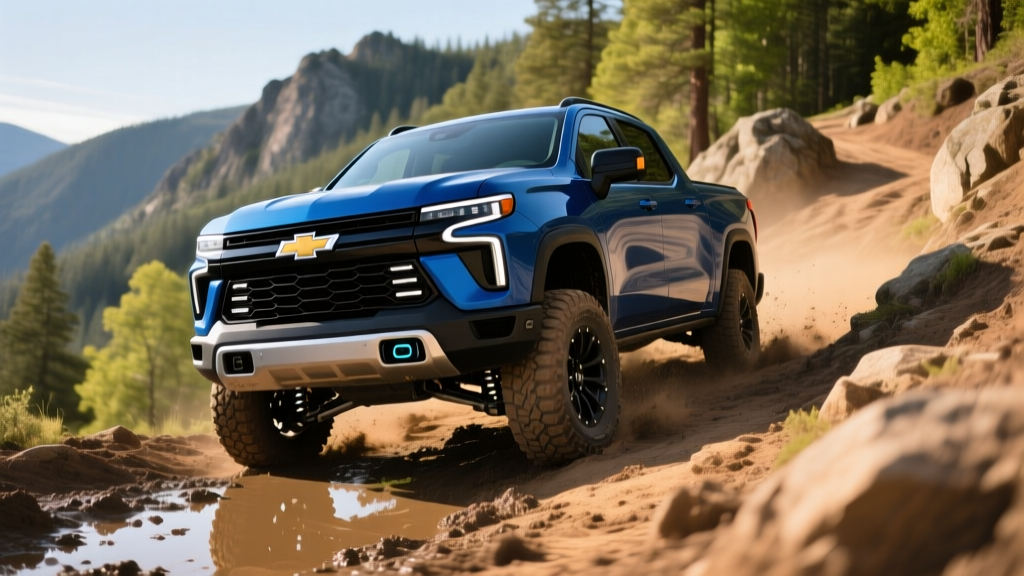
The 2026 Chevy Silverado EV Trail Boss is General Motors' bid to prove that an electric pickup can handle dirt roads, job sites, and daily commuting without compromise. Sitting between the comfort-oriented RST and the work-focused WT in the Silverado EV lineup, the Trail Boss adds factory off-road hardware — skid plates, all-terrain tires, and a lifted suspension — to GM's Ultium battery-electric platform. It's a truck aimed squarely at buyers who want EV efficiency Monday through Friday and trail capability on weekends. Here's everything you need to know before you buy.
2026 Silverado EV Trail Boss: Core Specifications at a Glance
| Spec | Value |
|---|---|
| EPA Est. Range | ~380 miles (estimated) |
| Battery (Usable) | ~200 kWh, NMC (Ultium) |
| Drivetrain | Dual-motor AWD (e4WD) |
| Horsepower | ~655 hp (est.) |
| 0-60 mph | ~4.5 seconds (est.) |
| Max DC Fast Charge | 350 kW (peak) |
| 10-80% DC Fast Charge | ~25 minutes (est.) |
| Level 2 Home Charging | 19.2 kW (~52 mi/hr) |
| Towing Capacity | ~10,000 lbs (est.) |
| Bed Length | 5' 11" (Multi-Flex Midgate) |
| Base MSRP | ~$78,000 (est.) |
| Battery Warranty | 8 years / 100,000 miles |
Note: The 2026 Silverado EV Trail Boss is announced but not yet on sale as of early 2026. Specs above are based on GM's preliminary disclosures and extrapolations from the current Silverado EV platform. Final EPA certification figures and pricing will be confirmed closer to delivery.
Real-World Range: What to Expect Beyond the EPA Sticker
EPA Estimated: ~380 miles
Real-World Highway (70-75 mph): ~300-330 miles
Real-World Cold Weather (below 32°F): ~250-290 miles
Mixed Commuting (city + suburban): ~340-370 miles
The Silverado EV Trail Boss shares GM's largest Ultium battery pack — approximately 200 kWh usable — with the RST variant. On paper, that yields an estimated 380 miles of EPA range. In practice, the Trail Boss's all-terrain tires, lifted suspension, and additional underbody hardware create more rolling resistance and aerodynamic drag than the street-oriented trims.
On a 250-mile highway loop at 70-75 mph in moderate temperatures, expect the Trail Boss to deliver roughly 300-330 miles before needing a charge. That's a 13-21% reduction from the EPA figure, which is typical for body-on-frame EVs pushed at highway speeds. In freezing conditions, lithium-ion chemistry slows and cabin heating draws significant energy — plan for 250-290 miles of usable range. The Silverado EV does include a heat pump on higher trims, which mitigates cold-weather loss somewhat compared to resistive heating systems.
For daily commuting under 80 miles round-trip, you'll rarely dip below 50% State of Charge, even in winter. The massive battery is a buffer against range anxiety — but it also means longer charging sessions when you do need to fill up from low SoC.
Charging Speed: DC Fast Charging and Home Level 2
Charging a 200 kWh battery is a different proposition than topping off a 75 kWh sedan. GM equips the Silverado EV with an 800-volt architecture capable of accepting up to 350 kW at a compatible DC fast charger. But peak rate is not sustained rate — understanding the charge curve is critical.
| Charging Level | Power (kW) | Miles Added Per Hour | Notes |
|---|---|---|---|
| Level 1 (120V outlet) | ~1.4 kW | ~3-4 mi/hr | Emergency/trickle only; full charge takes days |
| Level 2 (240V, 48A) | 11.5 kW | ~31 mi/hr | Standard home charger; ~17 hr for 10-100% |
| Level 2 (240V, 80A) | 19.2 kW | ~52 mi/hr | Requires hardwired 100A circuit; ~10 hr for 10-100% |
| DC Fast (350 kW peak) | 350 kW (peak) | ~800+ mi/hr (peak) | 10-80% in ~25 min; tapers significantly above 80% |
| DC Fast (150 kW station) | 150 kW | ~400 mi/hr | 10-80% in ~45 min; more common at current stations |
The charge curve reality: At a 350 kW Electrify America or EVgo station, the Silverado EV will peak near its maximum rate only between roughly 10-30% SoC. As the battery fills, internal resistance increases and the BMS (Battery Management System) throttles power to protect the cells. By 60% SoC, expect rates around 200-250 kW; above 80%, charging drops to under 100 kW. That 10-80% window is the practical fast-charging zone — plan your road trips around it.
Home charging setup: Most Trail Boss owners will install a Level 2 wallbox. A 48-amp unit (like the ChargePoint Home Flex or Emporia Level 2) on a 60-amp breaker adds about 31 miles of range per hour — enough to fully replenish overnight after a typical day. If your electrical panel supports a 100-amp circuit, GM's available 19.2 kW PowerShift charger adds roughly 52 miles per hour, cutting a full charge to around 10 hours. Expect $800-$2,500 for professional Level 2 installation depending on panel capacity and wiring distance. Older homes may need a $2,000-$5,000 panel upgrade to 200A service. Always consult a licensed electrician for final specifications.
The Silverado EV uses the NACS (North American Charging Standard) connector natively — the same plug used by Tesla's Supercharger network. This gives Trail Boss owners access to Tesla's 17,000+ Supercharger stalls across the US via GM's integration, in addition to CCS-equipped networks through adapters.
Performance, Drivetrain, and Off-Road Capability
The Trail Boss badge on a Silverado means off-road intent, and the EV version carries that forward. Dual permanent-magnet motors provide e4WD (electric four-wheel drive) with an estimated 655 horsepower — comparable to the RST's output but tuned for low-end torque delivery that's ideal for rock crawling and trail work.
GM estimates a 0-60 mph time around 4.5 seconds. For context, that's quicker than a gas-powered Silverado ZR2 and in the territory of performance sedans. Electric motors deliver peak torque at 0 RPM, so the sensation of acceleration from a stop is immediate and relentless, even in a truck weighing over 8,500 pounds.
Trail Boss-specific hardware includes:
- Factory 2-inch suspension lift over standard Silverado EV trims
- Underbody skid plates (front differential, transfer case area, battery enclosure)
- 35-inch all-terrain tires on 18-inch wheels
- Terrain Mode with calibrated throttle response and regen profiles for dirt/gravel
- Electronic locking rear differential
- Increased approach, breakover, and departure angles versus RST
The Ultium battery pack sits low in the chassis between the frame rails, giving the Trail Boss a lower center of gravity than its gas counterparts. However, ground clearance and breakover angle are still constrained by the battery enclosure — this is not a dedicated rock crawler like a Rivian R1T with its adjustable air suspension. Think of it as a highly capable forest road and moderate trail truck, not a Rubicon challenger.
Towing and payload: GM targets approximately 10,000 pounds of max towing capacity for the Trail Boss. Towing at max capacity will cut range dramatically — expect 150-200 miles on a full charge when pulling a heavy trailer at highway speeds. The Silverado EV's available ProGrade Trailering system includes trailer light checks, hitch guidance, and a trailer-tire-pressure monitor.
Interior, Cargo, and Technology
The Silverado EV's cabin is a departure from the current gas Silverado. A portrait-oriented 17-inch infotainment touchscreen dominates the dash, running GM's latest Ultifi software platform with Google Built-In (Maps, Assistant, Play Store). A 11-inch digital instrument cluster faces the driver, and a head-up display is available.
Cargo versatility: The Silverado EV's signature feature is the Multi-Flex Midgate — a pass-through between the bed and cabin that extends the effective load floor from 5'11" to over 10 feet with the tailgate down. This lets you carry lumber, kayaks, or ladders inside the vehicle's footprint. The bed itself offers:
- Bed volume: ~57 cu ft (behind cab, Midgate closed)
- Front trunk (frunk): ~10.7 cu ft of lockable, weatherproof storage
- Available Multi-Flex tailgate with six configurations
- Bed 120V and 240V power outlets (Pro Power Onboard equivalent, up to 7.2 kW export)
Passenger space: The crew cab configuration seats five with approximately 43 inches of front legroom and 43 inches of rear legroom — competitive with the Ford F-150 Lightning and Rivian R1T. Rear seat comfort is genuinely adult-friendly for long trips.
Driver assistance: The Trail Boss includes GM's Super Cruise on compatible mapped roads — a hands-free Level 2 driver-assistance system that handles steering, acceleration, and braking on over 750,000 miles of divided highways in the US and Canada. A driver-attention camera ensures your eyes stay on the road. Super Cruise is one of the most refined Level 2 systems available, but it is not autonomous driving — you must remain alert and ready to take over at all times.
Super Cruise is classified as SAE Level 2 automation. The driver must remain engaged, monitor the road, and be prepared to intervene immediately. It does not handle construction zones, unmapped roads, or severe weather autonomously. Only Level 4 services like Waymo operate without a human driver — and those are geofenced to specific urban areas.
Pricing, Trims, and Federal Tax Credit Eligibility
| Trim / Config | Est. MSRP | Notes |
|---|---|---|
| Silverado EV WT (Work Truck) | ~$55,000 | Fleet-oriented, shorter range option |
| Silverado EV LT | ~$65,000 | Mid-tier, expected for 2026 |
| Silverado EV Trail Boss | ~$78,000 | Off-road package, large battery |
| Silverado EV RST | ~$87,000+ | Top luxury/performance trim |
Federal tax credit (§30D): The Silverado EV Trail Boss's estimated ~$78,000 MSRP falls under the IRS's $80,000 cap for trucks, vans, and SUVs. However, eligibility for the full $7,500 credit depends on several factors that change frequently:
- Buyer income caps: Modified AGI must not exceed $300,000 (joint filers), $225,000 (head of household), or $150,000 (single). Per IRS §30D guidelines.
- Battery sourcing requirements: The credit is split into two $3,750 halves — one for critical minerals sourcing and one for battery component manufacturing. GM has been aggressively onshoring Ultium battery production through its Ultium Cells joint venture plants in Ohio, Tennessee, and Michigan, but the exact credit amount depends on the model year's compliance with evolving DOE/IRS sourcing rules.
- Point-of-sale transfer: As of 2024, buyers can transfer the credit to the dealer at purchase, reducing the purchase price directly rather than waiting for a tax refund. This is available for the Silverado EV if the vehicle qualifies.
- MSRP verification: Confirm the final MSRP of your specific configuration stays at or below $80,000. Adding options could push certain builds above the cap.
Always verify current-year eligibility on irs.gov and consult a tax professional before relying on the credit in your purchase decision. State and local incentives may stack on top — check your state's energy office or fueleconomy.gov for details.
How It Compares: Trail Boss vs. Key Electric Truck Rivals
| Spec | 2026 Silverado EV Trail Boss | Rivian R1T Tri-Motor | Ford F-150 Lightning (Platinum) | Tesla Cybertruck AWD |
|---|---|---|---|---|
| Est. EPA Range | ~380 mi | ~328 mi | ~320 mi | ~340 mi |
| Battery (usable) | ~200 kWh | ~149 kWh | ~131 kWh | ~123 kWh |
| Peak DC Charge | 350 kW | 220 kW | 150 kW | 250 kW |
| 0-60 mph | ~4.5 sec | ~2.9 sec | ~3.8 sec | ~4.1 sec |
| Towing | ~10,000 lbs | 11,000 lbs | 10,000 lbs | 11,000 lbs |
| Est. Base Price | ~$78,000 | ~$99,900 | ~$72,000 | ~$81,000 |
| Off-Road Focus | High | Very High | Low | Moderate |
The Silverado EV Trail Boss occupies a unique niche: it's the only electric truck explicitly positioned as an off-road trim from a legacy automaker at a sub-$80K price point. The Rivian R1T is a more capable off-roader with its quad-motor option and air suspension, but it starts near $100K and has a smaller battery. The F-150 Lightning is a better value for street and work use but lacks serious off-road hardware. The Cybertruck offers polarizing styling and strong range but has limited service infrastructure and uncertain long-term reliability.
If off-road credibility and maximum range are your top priorities, the Trail Boss has few direct competitors. If you prioritize luxury and tech, the R1T wins. If budget matters most, the Lightning remains the value leader.
Pros and Cons
- Class-leading estimated ~380-mile range
- 350 kW DC fast charging (800V architecture)
- Multi-Flex Midgate for extended cargo
- 7.2 kW onboard power export (job site/camping)
- Super Cruise hands-free highway driving
- NACS native — Tesla Supercharger access
- Genuine off-road hardware (skid plates, 35" tires, lockers)
- Estimated $78K+ price may exceed some buyers' budgets
- 200 kWh battery means long Level 2 home charge times
- Heavy curb weight (~8,500+ lbs) impacts tire wear and efficiency
- Towing range drops below 200 miles at max capacity
- Off-road capability less than purpose-built crawlers (R1T, Hummer EV)
- Final EPA figures and pricing not yet confirmed
Who Should Buy the Silverado EV Trail Boss?
Buy it if: You need a full-size truck with genuine off-road capability, want the longest electric range available in a pickup, regularly carry long cargo via the Midgate, and have access to home Level 2 charging. The Trail Boss is ideal for outdoor enthusiasts, rural landowners, and tradespeople who split time between job sites and trails.
Look elsewhere if: Your budget is under $65,000 (consider the F-150 Lightning XLT), you rarely leave pavement (the Silverado EV LT or RST is more efficient), you need max towing range for frequent long-haul trailer pulls, or you want the sharpest off-road hardware available (the Rivian R1T or GMC Hummer EV offer more extreme capability).
Frequently Asked Questions
What is the real-world range of the 2026 Silverado EV Trail Boss?
GM estimates approximately 380 miles of EPA range. In real-world highway driving at 70-75 mph, expect 300-330 miles. In freezing temperatures, plan for 250-290 miles. The massive ~200 kWh battery provides a large buffer, but the Trail Boss's off-road tires and lift reduce efficiency versus street-oriented trims.
How fast does the Silverado EV Trail Boss charge?
On a 350 kW DC fast charger, GM targets a 10-80% charge in approximately 25 minutes, thanks to the 800-volt architecture. At a more common 150 kW station, plan for about 45 minutes for 10-80%. At home on a 19.2 kW Level 2 charger, expect roughly 52 miles of range per hour of charging.
Does the Silverado EV Trail Boss qualify for the $7,500 federal tax credit?
It likely qualifies for at least a partial credit, but full $7,500 eligibility depends on current-year battery sourcing rules, your income (capped at $300K joint / $150K single), and the final MSRP staying at or below $80,000 for trucks. Verify on irs.gov before purchasing. Point-of-sale transfer is available if the vehicle qualifies.
Is the Silverado EV Trail Boss worth buying over the Rivian R1T?
It depends on priorities. The Trail Boss offers significantly more estimated range (~380 vs ~328 miles), faster DC charging, and a lower starting price. The R1T offers superior off-road capability with available air suspension and quad motors, a more refined interior, and a smaller, lighter footprint. For budget-conscious off-road EV buyers, the Trail Boss is compelling; for maximum trail performance regardless of cost, the R1T wins.
Can I charge the Silverado EV at Tesla Superchargers?
Yes. The 2026 Silverado EV uses the NACS connector natively, giving it direct access to Tesla's Supercharger network without an adapter. GM has integrated Supercharger routing into the Silverado EV's navigation system.
What is the battery warranty?
GM provides an 8-year / 100,000-mile warranty on the Ultium battery pack, covering defects and capacity degradation below a specified threshold (typically 60-70% of original capacity, per GM's warranty terms). The powertrain carries a similar 8-year / 100,000-mile warranty.