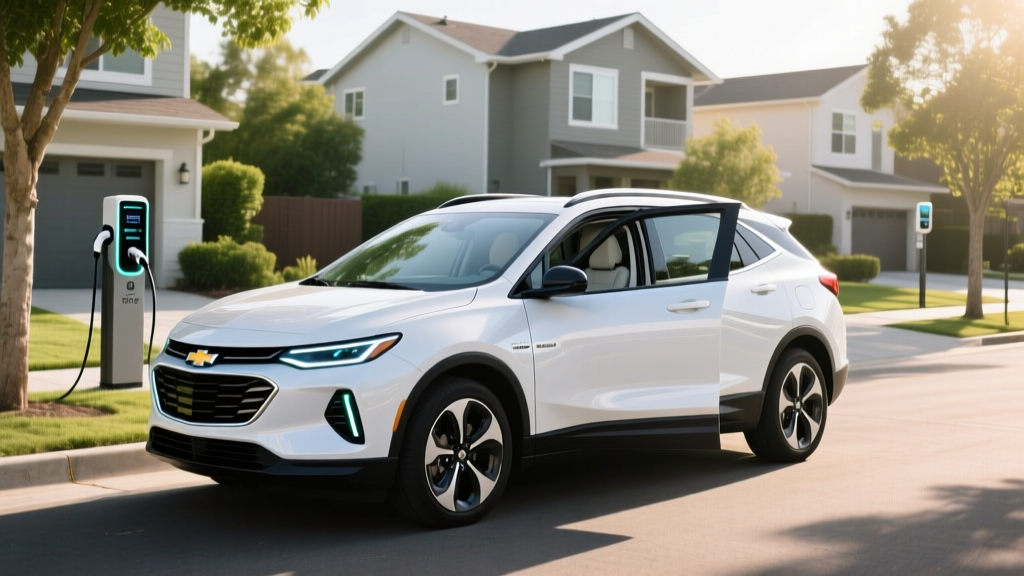
The affordable electric crossover segment is no longer a one-horse race, and the 2026 Chevrolet Equinox EV is a prime reason why. Built on GM's Ultium platform, the Equinox EV delivers over 300 miles of EPA-estimated range at a price point that undercuts most rivals — and that's before any federal incentives. After spending time with the specs, charging data, and real-world efficiency patterns, here's a data-driven breakdown of what the 2026 Equinox EV actually offers daily drivers and families.
Range and Efficiency: The 319-Mile Promise vs. Reality
The headline number is compelling: the front-wheel-drive Equinox EV 3LT with the larger battery pack earns an EPA-estimated 319 miles of range. That's among the highest in its class and a genuine differentiator at this price point. The dual-motor all-wheel-drive variant drops to approximately 285 miles EPA, which is still competitive.
The EPA 319-mile figure assumes mixed driving at moderate temperatures. In real-world conditions, plan for:
- Highway cruising (70-75 mph): ~255–275 miles — aerodynamic drag cuts efficiency roughly 15–20% vs. city driving
- City/commute driving: ~300–315 miles — regenerative braking recovers energy in stop-and-go traffic
- Cold weather (below 30°F): ~230–260 miles — battery chemistry and cabin heating reduce range 20–25%; preconditioning while plugged in helps significantly
Efficiency on the FWD model lands around 115 MPGe combined (roughly 29 kWh/100 miles), per fueleconomy.gov. That's solid for a crossover in this weight class, though the Hyundai Ioniq 5 and Tesla Model Y edge slightly ahead in pure efficiency. The Equinox EV trades some efficiency for a larger usable battery, which is how it achieves that 319-mile sticker.
Battery Chemistry and Capacity: What's Under the Floor
The 2026 Equinox EV uses GM's Ultium battery architecture. The larger pack provides approximately 85 kWh of usable capacity (gross capacity is slightly higher, with a buffer to protect long-term health). GM has utilized NMC (nickel manganese cobalt) chemistry in the Ultium platform, which offers higher energy density than LFP — that's what allows 319 miles in a vehicle of this size.
The trade-off with NMC versus LFP (lithium iron phosphate) is well-documented: NMC gives you more range per kilogram, but LFP generally offers longer cycle life and can be charged to 100% daily without degradation concerns. If you're a driver who wants to charge to 100% every night and never think about it, this is worth noting. For the Equinox EV, GM recommends an 80% daily charge limit for optimal battery longevity, reserving 100% for road trips.
| Spec | FWD 3LT (Large Battery) | AWD (Dual Motor) |
|---|---|---|
| EPA Range | 319 mi | ~285 mi |
| Usable Battery | ~85 kWh (NMC) | ~85 kWh (NMC) |
| Horsepower | ~213 hp | ~288 hp |
| 0-60 mph | ~8.0 sec | ~6.5 sec |
| Max DC Charge Rate | ~150 kW | ~150 kW |
| 10-80% DC Time | ~35 min | ~35 min |
| Level 2 (240V) | 11.5 kW (~34 mi/hr) | 11.5 kW (~34 mi/hr) |
| MPGe (combined) | ~115 MPGe | ~103 MPGe |
| Cargo (behind rear) | 26.4 cu ft | 26.4 cu ft |
| Cargo (rear folded) | 57.2 cu ft | 57.2 cu ft |
| Base MSRP | ~$33,600 | ~$39,200 |
Charging Speeds: DC Fast Charge and Home Level 2
Charging is where buyers need to look past peak numbers and understand the full curve. The Equinox EV supports a peak DC fast-charge rate of approximately 150 kW on compatible CCS connectors (GM is transitioning to NACS for 2025+ models, so 2026 models may include the NACS port natively or via adapter — check with your dealer for the specific connector on your build).
At 150 kW peak, a 10–80% charge takes roughly 35 minutes. That's competitive but not class-leading. For context, the Hyundai Ioniq 5 with its 800V architecture can do 10–80% in about 18 minutes at a 350 kW charger. The Equinox EV's charging curve tapers noticeably above 60% SoC, which is typical for NMC batteries at this charge rate but means the last 20% takes disproportionately longer.
| Charging Level | Power | Speed | Use Case |
|---|---|---|---|
| Level 1 (120V) | ~1.4 kW | ~4 mi/hr | Overnight trickle, emergencies |
| Level 2 (240V, 48A) | 11.5 kW | ~34 mi/hr | Daily home charging, full charge in ~9 hrs |
| DC Fast Charge | Up to 150 kW | 10-80% in ~35 min | Road trips, quick top-ups |
For home Level 2 charging, the onboard charger accepts up to 11.5 kW, which adds roughly 34 miles of range per hour. A full 0–100% charge on Level 2 takes about 9 hours — easily done overnight with a properly installed 240V/48A home charger. Expect a Level 2 home installation to run $800–$2,000 depending on your panel capacity and run length; if your home has a 200-amp panel with spare capacity, you're on the lower end.
Performance and Drivetrain
The Equinox EV isn't positioned as a performance vehicle, and the numbers reflect that. The single-motor FWD model produces approximately 213 horsepower and reaches 60 mph in about 8.0 seconds — adequate for merging and passing but noticeably less punchy than a Model Y Long Range. The dual-motor AWD variant bumps output to roughly 288 hp with a ~6.5-second 0-60 time, which feels properly quick for daily driving.
Ride quality is a strength. The Ultium platform's low center of gravity (battery pack under the floor) keeps body roll controlled, and the suspension tuning favors comfort over sportiness. Road noise is well-managed at highway speeds. One-pedal driving with strong regenerative braking is available and works well in city traffic, though the regen isn't quite aggressive enough to eliminate friction-brake use entirely at higher speeds.
Towing capacity is limited — GM rates the Equinox EV at approximately 1,500 pounds when properly equipped, which covers a small utility trailer but rules out most boat or camper trailers. If towing is a priority, the Ford F-150 Lightning or Rivian R1S are in a different league.
Interior, Cargo, and Technology
Inside, the Equinox EV is dominated by a 17.7-inch diagonal infotainment touchscreen running Google Built-in (Google Maps, Google Assistant, Play Store). It's one of the largest screens in the segment and the interface is responsive, though the sheer size means some icons are positioned far from the driver. Wireless Apple CarPlay and Android Auto are standard.
Passenger space is generous for the class: ~41.5 inches of front legroom and ~37.8 inches of rear legroom, making the back seat viable for adults on longer trips. Cargo volume is 26.4 cubic feet behind the rear seats and 57.2 cubic feet with them folded — competitive with the RAV4 and CR-V gas crossovers. Note that the Equinox EV does not offer a front trunk (frunk), which is a missed opportunity for additional sealed storage.
On the driver-assistance front, Chevy's Super Cruise is available on higher trims, enabling hands-free driving on over 400,000 miles of compatible highways in the US and Canada. This is a SAE Level 2 system — you must remain attentive, and the infrared camera monitors your eyes. It's one of the most polished Level 2 systems available, but it is not autonomous driving. Standard safety tech includes automatic emergency braking, lane-keep assist, adaptive cruise control, and rear cross-traffic alert.
Super Cruise is an SAE Level 2 system. The driver must remain engaged, eyes on the road (monitored by cabin camera), and ready to take over at any time. It operates only on pre-mapped divided highways. It does not handle construction zones, unmapped roads, or severe weather autonomously.
Pricing, Trims, and Federal Tax Credit Eligibility
The 2026 Equinox EV lineup starts at approximately $33,600 MSRP for the base 2LT FWD trim and climbs to around $43,400 for a fully loaded 3RS AWD. Here's how the primary trims break down:
| Trim | Drivetrain | MSRP | Est. After §30D Credit* |
|---|---|---|---|
| 2LT | FWD | ~$33,600 | ~$26,100 |
| 3LT | FWD | ~$36,600 | ~$29,100 |
| 3RS | FWD | ~$38,200 | ~$30,700 |
| 3RS AWD | AWD | ~$43,400 | ~$35,900 |
*Estimated prices assume full $7,500 §30D credit eligibility. Actual eligibility depends on buyer income, battery sourcing, and MSRP caps. See details below.
Does the Equinox EV Qualify for the Federal EV Tax Credit?
Under current IRS rules for the §30D Clean Vehicle Credit, the Equinox EV is eligible for up to $7,500, provided the buyer and vehicle meet all requirements. Because the Equinox EV is assembled in the US (at GM's Factory ZERO in Michigan), it clears the North American assembly requirement. The critical considerations:
- MSRP cap: SUVs/crossovers must have an MSRP at or below $80,000 — all Equinox EV trims qualify
- Buyer income cap: Modified AGI must not exceed $150,000 (single), $225,000 (head of household), or $300,000 (joint)
- Battery sourcing: A percentage of critical minerals and battery components must be sourced from the US or FTA partners — GM has been increasing domestic sourcing, but the exact dollar amount ($3,750 for minerals + $3,750 for components) can shift yearly; confirm with your dealer and the IRS eligible vehicle list
- Point-of-sale transfer: You can transfer the credit to the dealer at purchase for an immediate price reduction, rather than waiting to claim it on your tax return
The bottom line: most Equinox EV buyers shopping mid-range trims will be eligible for the full $7,500, making a 3LT FWD effectively a sub-$30,000 electric crossover with 319 miles of range. That's exceptional value. However, always verify current-year eligibility on irs.gov before purchasing, as sourcing rules are updated periodically.
Ownership Costs, Warranty, and Long-Term Outlook
Chevrolet backs the Equinox EV's battery and powertrain with an 8-year/100,000-mile warranty, which covers defects and battery capacity loss below a specified threshold (typically 60–70% retention, though confirm the exact figure in your warranty booklet). The bumper-to-bumper warranty is 3 years/36,000 miles.
On the cost side, electricity for the Equinox EV at the US average rate of ~$0.16/kWh works out to roughly $0.047 per mile — compared to about $0.13–$0.15 per mile for a 28-MPG gas crossover at $3.50/gallon. Over 15,000 miles annually, that's an annual fuel savings of approximately $1,300–$1,500. Insurance premiums for EVs tend to run 10–20% higher than comparable gas vehicles, so factor in roughly $150–$300/year extra depending on your profile.
Maintenance is minimal: no oil changes, no transmission fluid, brake pads last significantly longer thanks to regenerative braking. The main scheduled items are tire rotations, cabin air filter, and coolant checks. GM estimates EV maintenance costs at roughly 50–60% of a comparable gas vehicle over five years.
How It Compares: Equinox EV vs. the Competition
The Equinox EV's natural rivals include the Hyundai Ioniq 5, Tesla Model Y, Ford Mustang Mach-E, and Volkswagen ID.4. Here's how the key numbers stack up:
| Metric | Equinox EV 3LT FWD | Ioniq 5 SEL RWD | Model Y LR | VW ID.4 Pro S |
|---|---|---|---|---|
| EPA Range | 319 mi | 303 mi | 310 mi | 291 mi |
| Peak DC Charge | 150 kW | ~175 kW (800V) | 250 kW | 175 kW |
| 10-80% DC Time | ~35 min | ~18 min | ~25 min | ~28 min |
| Base MSRP (comparable) | ~$36,600 | ~$46,650 | ~$44,990 | ~$44,995 |
| Super Cruise / L2+ | Available | No | Autopilot (FSD opt.) | Travel Assist |
The Equinox EV's clear advantage is price-to-range ratio. Nothing else in this segment offers 319 miles at $33,600 before incentives. Where it falls short is DC charging speed — if you road-trip frequently and value minimal charging stops, the Ioniq 5's 800V architecture or the Tesla Supercharger network's reliability are meaningful advantages.
- Class-leading 319-mile EPA range at a sub-$34K starting price
- Eligible for full $7,500 federal tax credit (most trims/buyers)
- Super Cruise hands-free highway driving available
- Spacious rear seat and competitive cargo volume
- Google Built-in infotainment with large 17.7" display
- Comfortable ride quality and low cabin noise
- DC fast charging slower than Ioniq 5 and Model Y (~35 min 10-80%)
- No front trunk (frunk) for additional storage
- FWD base model is modestly powered (8.0 sec 0-60)
- Towing limited to ~1,500 lbs
- NMC battery — daily 100% charging not recommended
- Real-world highway range drops to ~255-275 mi
Who Should Buy the 2026 Equinox EV?
- You want maximum range per dollar — 319 miles at ~$26K after the tax credit is unmatched
- Your daily commute is under 80 miles round-trip and you can charge at home
- You value Super Cruise for highway-heavy commutes or road trips
- You need a practical family crossover with good rear-seat space and cargo room
- You road-trip frequently and need the fastest possible DC charging (consider Ioniq 5 or Model Y)
- You need AWD with serious performance (the AWD Equinox EV is adequate, not thrilling)
- Towing capacity matters (look at the F-150 Lightning or Rivian)
- You want to charge to 100% daily without battery-health concerns (consider an LFP-equipped vehicle like the Tesla Model 3 RWD)
Frequently Asked Questions
What is the real-world range of the 2026 Equinox EV?
The EPA estimates 319 miles for the FWD model and ~285 miles for AWD. In real-world highway driving at 70-75 mph, expect approximately 255–275 miles. In cold weather (below 30°F), range can drop to 230–260 miles. City driving with regenerative braking gets closest to the EPA sticker, around 300–315 miles.
How fast does the Equinox EV charge at home and on the road?
At home on a 240V Level 2 charger (48A), the Equinox EV charges at up to 11.5 kW, adding about 34 miles of range per hour. A full charge from empty takes roughly 9 hours. On a DC fast charger, it peaks at approximately 150 kW and can go from 10% to 80% in about 35 minutes. Plan for longer stops if charging past 80%, as the curve tapers significantly.
How much does the Equinox EV cost after federal tax credits?
The base 2LT FWD starts at approximately $33,600 MSRP. With the full $7,500 federal §30D tax credit (assuming eligibility), the effective price drops to roughly $26,100. Mid-range 3LT FWD models land around $29,100 after credit. Eligibility depends on buyer income (under $150K single / $300K joint), battery sourcing requirements, and MSRP caps — all Equinox EV trims fall under the $80,000 SUV cap.
Is the Equinox EV worth buying vs. the Ioniq 5 or Model Y?
It depends on your priorities. The Equinox EV wins on price-to-range — no competitor matches 319 miles at this price point after tax credits. The Ioniq 5 charges significantly faster (18 min vs. 35 min, 10-80%) thanks to its 800V architecture, which matters for frequent road-trippers. The Model Y benefits from Tesla's Supercharger network reliability and stronger performance, but costs more and may have limited tax credit eligibility depending on the year and sourcing. For budget-conscious buyers who mostly drive locally, the Equinox EV is the strongest value play.
What are the biggest drawbacks of the Equinox EV?
The main limitations are its relatively slow DC fast charging compared to rivals, the lack of a frunk, modest acceleration in the FWD model, and a 1,500-lb towing limit. Additionally, the NMC battery chemistry means GM recommends limiting daily charges to 80% for long-term health — if you want a "charge to 100% and forget it" experience, an LFP battery vehicle may suit you better.
Does the Equinox EV qualify for the $7,500 federal EV tax credit?
Yes, the Equinox EV qualifies for up to $7,500 under §30D, as it is assembled in North America (Factory ZERO, Michigan) and falls under the $80,000 MSRP cap for SUVs. However, your personal eligibility depends on income limits and the battery's critical-mineral and component sourcing meeting the current year's thresholds. The credit can be transferred to the dealer at point of sale for an immediate price reduction. Always verify on the IRS eligible vehicles page before purchasing.