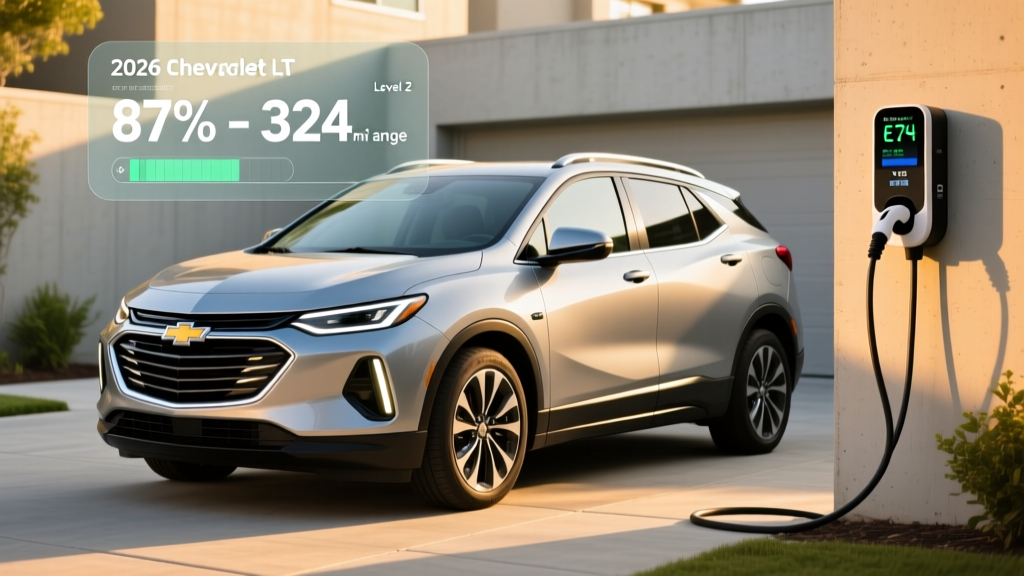
The 2026 Chevrolet Equinox EV LT occupies a rare position in the electric-vehicle market: a mainstream compact crossover that undercuts nearly every rival on price while delivering over 300 miles of EPA-estimated range. Built on GM's Ultium platform and priced from $33,600 before incentives, the LT trim is the volume play — the entry point for buyers who want practicality over performance flash. After spending time with the specs and cross-referencing real-world efficiency data, here's exactly what you're getting, what you're giving up, and whether the LT trim is the smart buy in the Equinox EV lineup.
Range and Efficiency: 319 Miles on Paper, Less on the Interstate
EPA estimate: 319 miles (LT FWD with the larger battery). In mixed driving, expect 270–290 miles. On sustained highway runs at 70–75 mph, plan for 240–260 miles. In freezing temperatures (below 32°F), range can drop to 200–230 miles depending on cabin heating use and whether you precondition the battery.
The Equinox EV LT is available with two battery configurations. The standard-range FWD model uses a smaller pack rated at roughly 85 kWh of usable capacity, while the extended-range FWD variant — the one that achieves the headline 319-mile EPA figure — carries a larger pack at approximately 102 kWh usable. Both use NCMA (nickel-cobalt-manganese-aluminum) cathode chemistry, GM's preferred Ultium cell format, which balances energy density with thermal stability. This is not an LFP (lithium iron phosphate) battery, so you'll want to follow the typical NMC best practice: daily charging to 80% and reserving 100% fills for road trips.
Efficiency on the extended-range FWD model lands around 3.0–3.2 kWh/mile, translating to roughly 112 MPGe combined per EPA data on fueleconomy.gov. That's competitive with the Hyundai Ioniq 5 and slightly behind the Tesla Model Y, but respectable for a crossover in this weight class (roughly 4,700 lbs curb weight for the extended-range FWD).
Charging Speed: 170 kW Peak, But Watch the Curve
| Level | Max Rate | Speed / Time | Connector |
|---|---|---|---|
| Level 1 (120V) | ~1.4 kW | ~3–4 miles/hour | Standard outlet |
| Level 2 (240V) | 11.5 kW (48A) | ~34 miles/hour; full charge ~10 hrs | J1772 / NACS (2026 models) |
| DC Fast Charge | 170 kW peak | 10–80% in ~30 minutes | NACS (native); CCS via adapter |
The 170 kW peak DC fast-charging rate is adequate but not class-leading. Competitors like the Hyundai Ioniq 5 (240 kW peak on 800V architecture) and the Kia EV6 can pull significantly more power at the top of the charge curve. In practice, the Equinox EV LT sustains roughly 130–150 kW through the 20–60% state-of-charge window before tapering to under 80 kW above 70% SoC. That taper is the reason the 10–80% session takes about 30 minutes rather than the sub-20-minute sessions you'll see on 800V vehicles.
For 2026, GM has fully transitioned the Equinox EV to the NACS (North American Charging Standard) connector, meaning native access to Tesla Supercharger stalls — a significant infrastructure advantage over CCS-only rivals. If you're charging at older Electrify America or EVgo stations with CCS1 plugs, GM provides a CCS-to-NACS adapter.
Home Level 2 charging at 11.5 kW is strong for this segment. On a 48-amp hardwired Level 2 station, you'll recover roughly 34 miles of range per hour, meaning a depleted extended-range battery reaches full in about 10 hours — practical for overnight replenishment. Note that you'll need a 60-amp circuit for a hardwired 48A charger; factor in $500–$1,500 for professional installation depending on your panel's proximity to the garage.
Performance and Drivetrain: Adequate, Not Thrilling
| Spec | FWD | AWD (if available on LT) |
|---|---|---|
| Horsepower | 213 hp | 288 hp |
| Torque | 236 lb-ft | 343 lb-ft |
| 0–60 mph | ~8.0 sec | ~6.5 sec |
| Drivetrain | Single-motor FWD | Dual-motor AWD |
| Towing Capacity | Not rated | Not rated |
The LT trim in FWD form with 213 hp is tuned for commuting efficiency, not stoplight sprints. The 8.0-second 0–60 time is perfectly acceptable for highway merging and daily driving but won't impress anyone coming from a Tesla Model Y Performance or even the Equinox EV's own RS trim (which offers up to 288 hp in AWD configuration). Regenerative braking is adjustable via steering-wheel paddles, and one-pedal driving mode is available — it brings the vehicle to a complete stop without touching the brake pedal, which is ideal for city traffic.
Ride quality is a strength. The Ultium platform's low-slung battery pack gives the Equinox EV a planted feel through corners, and the suspension tuning absorbs pavement imperfections well. Road noise is moderate — not luxury-quiet, but on par with the segment.
Interior, Cargo, and Technology
The cabin is where the LT trim shows its budget roots — but not offensively so. Cloth seating is standard (leatherette requires stepping up to RS or Activ trims), and the dashboard layout is dominated by a 17.7-inch diagonal infotainment touchscreen running GM's Google Built-in platform. That means native Google Maps navigation, Google Assistant voice control, and access to the Play Store for apps — no phone projection required, though wireless Apple CarPlay and Android Auto are both supported.
A 11.0-inch digital instrument cluster sits behind the steering wheel, displaying range, speed, and driver-assist status. The center console offers decent small-item storage, and there's no frunk (front trunk) — the space under the hood houses HVAC and power-electronics hardware.
| Measurement | Spec |
|---|---|
| Cargo (behind 2nd row) | 26.4 cu ft |
| Cargo (2nd row folded) | 57.2 cu ft |
| Front legroom | 41.3 in |
| Rear legroom | 37.8 in |
| Frunk | None |
Rear-seat legroom is tight compared to the Hyundai Ioniq 5 (which offers 39.4 inches rear) but adequate for adults on shorter trips. The 26.4 cu ft of cargo space behind the second row is competitive for the compact crossover class. Families with bulky strollers or frequent Costco runs will appreciate the 57.2 cu ft with seats folded, though the load floor isn't perfectly flat.
Standard driver-assistance technology includes Chevy Safety Assist: automatic emergency braking, forward collision alert, lane-keeping assist, lane-departure warning, following-distance indicator, and IntelliBeam automatic high beams. Adaptive cruise control is available as an option on LT (standard on higher trims). GM's Super Cruise hands-free highway driving system is not offered on the LT trim — that's reserved for the Activ and RS trims with the appropriate package. Note: Super Cruise is an SAE Level 2 system, meaning the driver must remain attentive even when hands are off the wheel.
Pricing, Trims, and Federal Tax Credit Eligibility
| Trim / Config | MSRP | Est. After §30D Credit |
|---|---|---|
| LT FWD (Standard Range) | ~$33,600 | ~$26,100* |
| LT FWD (Extended Range) | ~$36,600 | ~$29,100* |
| LT AWD (Extended Range) | ~$39,600 | ~$32,100* |
*Tax credit amounts assume full $7,500 eligibility under IRS §30D. Actual credit varies based on battery sourcing, buyer income, and MSRP caps. Verify at irs.gov or with a tax professional. The credit can be transferred to the dealer at point of sale as an upfront discount.
The Equinox EV LT's tax-credit position is one of its strongest selling points. At an MSRP well below the $55,000 SUV cap set by §30D, it clears the vehicle-price requirement easily. The critical question is battery-component and critical-minerals sourcing: GM has been steadily reshoring Ultium battery production through its joint venture with LG Energy Solution (Ultium Cells LLC) in Ohio, Tennessee, and Michigan. For the 2026 model year, the Equinox EV is expected to meet both the battery-component and critical-minerals thresholds for the full $7,500 credit — but buyers should confirm current eligibility on fueleconomy.gov's tax credit tracker before purchasing, as sourcing rules tighten annually.
Income caps apply: modified adjusted gross income (MAGI) must not exceed $150,000 for single filers, $225,000 for head-of-household, or $300,000 for joint filers. If you exceed these thresholds, the credit phases out entirely.
Warranty and Long-Term Ownership
Chevrolet backs the Equinox EV with a competitive warranty package:
- Battery & Drive Unit: 8 years / 100,000 miles (whichever comes first), covering defects and capacity loss below ~70% of original capacity
- Bumper-to-Bumper (Limited): 3 years / 36,000 miles
- Powertrain (non-battery): 5 years / 60,000 miles
- Corrosion: 6 years / 100,000 miles
- Roadside Assistance: 5 years / 60,000 miles
The 8-year/100,000-mile battery warranty is industry-standard and aligns with federal requirements for emissions-related components. GM defines a battery defect as falling below approximately 70% state of health (SoH) within the warranty period. Real-world Ultium degradation data is still limited given the platform's relative newness, but NCMA chemistry with GM's active thermal management system should yield degradation curves in line with industry norms: roughly 8–12% capacity loss over the first 100,000 miles based on comparable NMC packs. Owners can monitor SoH through the myChevrolet app.
Insurance costs for the Equinox EV tend to run 10–20% higher than the gas-powered Equinox, consistent with the EV segment broadly. Get quotes from your carrier before purchasing — the premium difference can eat into fuel-cost savings if you drive fewer than 10,000 miles annually.
How It Compares: Equinox EV LT vs. the Competition
| Spec | 2026 Equinox EV LT FWD | Hyundai Ioniq 5 SE Std Range | Tesla Model Y RWD |
|---|---|---|---|
| Base MSRP | ~$33,600 | ~$42,000 | ~$44,990 |
| EPA Range | 319 mi (ext.) | 240 mi (std.) | 320 mi |
| Peak DC Charge | 170 kW | 175 kW (800V) | ~170 kW |
| 0–60 mph | ~8.0 sec | ~7.4 sec | ~6.5 sec |
| NACS Native | Yes (2026) | Adapter required | Yes |
| §30D Credit Eligible | Likely full $7,500 | Partial/none (Korea-built) | Partial (sourcing varies) |
The Equinox EV LT's price advantage is stark: roughly $8,000–$11,000 less than the Ioniq 5 or Model Y before credits, and potentially $15,000+ less after the §30D credit applies to the Chevy but not to the Korea-built Ioniq 5. If budget is your primary constraint and you don't need the Ioniq 5's faster 800V charging or the Model Y's Supercharger-native ecosystem (which the 2026 Equinox EV now matches with NACS), the LT is the value play.
Where the competitors win: the Ioniq 5 offers a more spacious rear seat and available 800V ultra-fast charging; the Model Y delivers sharper performance, a more polished software experience, and access to the Supercharger network without any adapter. Both also offer frunks. The Equinox EV LT trades those niceties for a significantly lower entry price.
Verdict: Who Should Buy the 2026 Equinox EV LT?
Buy the Equinox EV LT if:
- You want the lowest-cost path to a 300+ mile EV with federal tax credit eligibility
- Your daily commute is under 80 miles round-trip and you can charge at home
- You value NACS native access to the Supercharger network for road trips
- You prefer a traditional crossover driving position and familiar infotainment layout
Look elsewhere if:
- You regularly carry rear-seat adults who need generous legroom (check the Ioniq 5)
- You want the fastest DC charging sessions available (Ioniq 5/EV6 with 800V)
- Performance and acceleration matter to you (Model Y or Equinox EV RS AWD)
- You need a frunk for additional enclosed storage
Frequently Asked Questions
What is the real-world range of the 2026 Equinox EV LT?
The EPA rates the extended-range FWD model at 319 miles. In real-world mixed driving at moderate temperatures, expect 270–290 miles. Highway driving at 75 mph reduces that to roughly 240–260 miles. In sub-freezing winter conditions, plan for 200–230 miles depending on how aggressively you use cabin heat. Preconditioning the battery while plugged in helps mitigate cold-weather range loss.
Does the 2026 Equinox EV LT qualify for the $7,500 federal tax credit?
It is expected to qualify for the full $7,500 under IRS §30D for the 2026 model year, given its US-assembled Ultium battery and MSRP well below the $55,000 SUV cap. However, eligibility depends on your income (MAGI caps: $150K single / $300K joint), the specific battery-sourcing compliance at time of purchase, and any rule changes. Always verify on irs.gov and with your tax professional. The credit can be transferred to the dealer as a point-of-sale discount, reducing your out-of-pocket cost immediately.
How fast does the Equinox EV LT charge at home and on the road?
At home on a 240V Level 2 charger (48A / 11.5 kW), the Equinox EV LT gains approximately 34 miles of range per hour, fully replenishing overnight in about 10 hours. On DC fast chargers, it peaks at 170 kW and charges from 10–80% in approximately 30 minutes. The charge curve tapers meaningfully above 70% SoC, so it's most efficient to charge to 80% on road trips and move on rather than waiting for a full fill.
Is the Equinox EV LT worth buying over the Tesla Model Y or Hyundai Ioniq 5?
It depends on your priorities. If minimizing purchase price is paramount and you qualify for the full §30D credit, the Equinox EV LT can land under $27,000 effective cost — thousands less than either rival. If you prioritize rear-seat space, faster charging, or a more premium interior, the Ioniq 5 and Model Y are stronger choices. The Equinox EV LT is the best value play, not the best overall EV in the segment.
Does the Equinox EV LT have Super Cruise?
No. GM's hands-free Super Cruise driver-assistance system is not available on the LT trim. It's offered on higher trims (Activ, RS) with the appropriate option package. The LT does include Chevy Safety Assist with automatic emergency braking, lane-keeping, and available adaptive cruise control — all SAE Level 2 features requiring active driver supervision.
What is the battery warranty on the 2026 Equinox EV?
Chevrolet provides an 8-year / 100,000-mile warranty on the high-voltage battery and electric drive unit. This covers manufacturing defects and significant capacity loss (typically defined as dropping below ~70% of original capacity). The bumper-to-bumper limited warranty runs 3 years / 36,000 miles.