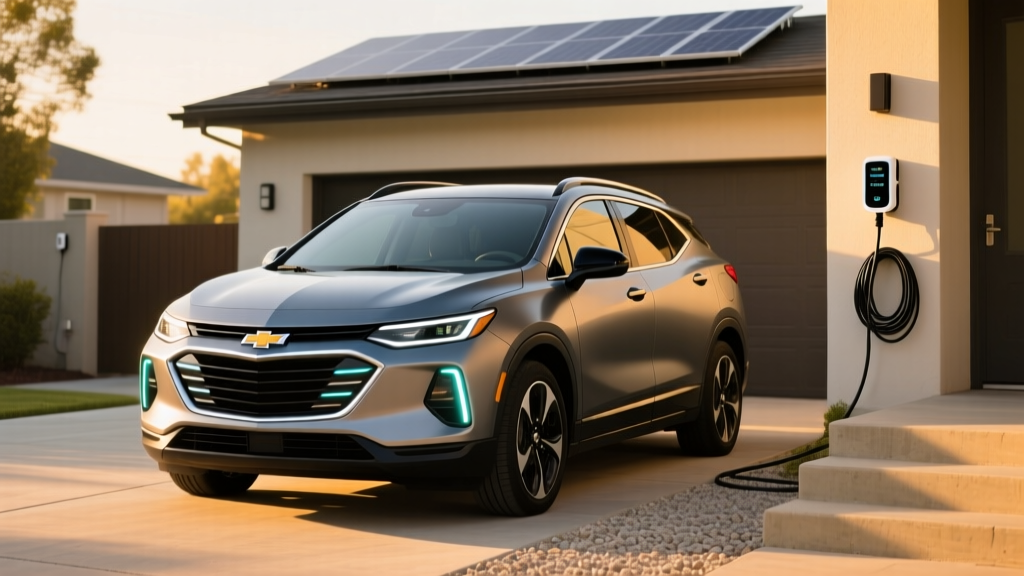
The 2026 Chevrolet Equinox EV occupies a rare position in the electric vehicle market: an affordable, long-range crossover that undercuts most competitors on price while delivering over 300 miles of EPA-estimated range. For buyers scanning 2026 Chevy Equinox EV lease deals, the sticker price is only the starting point. Lease payments, federal tax credit eligibility, home charging costs, insurance premiums, and long-term depreciation all shape what you'll actually spend over five years.
This guide dissects the real ownership economics of the 2026 Equinox EV — whether you lease or buy — with exact figures on energy costs, maintenance savings, IRS §30D credit qualification, and the insurance reality that catch many first-time EV buyers off guard.
2026 Equinox EV at a Glance: Specs That Drive Ownership Cost
Before running the numbers, here are the specifications that directly impact your wallet. The 2026 Equinox EV rides on GM's Ultium platform and is available in LT and RS trims with front-wheel drive or all-wheel drive configurations.
| Specification | LT FWD | RS AWD |
|---|---|---|
| Base MSRP | $33,600 | $41,900 |
| EPA Range | 319 miles | 285 miles |
| Battery (usable) | 85 kWh (NMC) | 85 kWh (NMC) |
| Efficiency | ~3.5 mi/kWh (114 MPGe) | ~3.1 mi/kWh (102 MPGe) |
| Max DC Fast Charge | 150 kW peak | 150 kW peak |
| 10–80% DC Fast Charge | ~30 minutes | ~30 minutes |
| Level 2 Charge Rate | 11.5 kW | 11.5 kW |
| Horsepower | 213 hp | 288 hp |
| 0–60 mph | ~8.0 sec | ~6.3 sec |
| Battery/Powertrain Warranty | 8 years / 100,000 miles | |
How Much Does It Really Cost to Own an Equinox EV Over 5 Years?
The most common question from EV shoppers is whether going electric actually saves money. The answer depends heavily on your driving habits, local electricity rates, insurance market, and whether you capture the federal tax credit. Below is a five-year total cost of ownership (TCO) estimate for the 2026 Equinox EV LT FWD, assuming 15,000 miles driven annually, home charging at the national average electricity rate, and a comparable gas-powered compact SUV as a baseline.
| Cost Category | Equinox EV LT FWD | Gas Crossover (28 MPG Combined) |
|---|---|---|
| Purchase Price (MSRP) | $33,600 | $32,000 |
| Federal Tax Credit (§30D) | –$7,500 (if eligible) | $0 |
| Effective Purchase Price | $26,100 | $32,000 |
| Fuel / Energy (5 yrs, 75k mi) | $3,857 (14¢/kWh avg) | $9,375 ($3.50/gal, 28 MPG) |
| Maintenance (5 yrs) | $1,800 | $4,200 |
| Insurance (5 yrs) | $9,750 ($1,950/yr avg) | $7,500 ($1,500/yr avg) |
| Depreciation (est. 5 yrs) | $14,500 (~55%) | $13,000 (~41%) |
| Total 5-Year Cost | $30,007 | $34,075 |
The bottom line: With the full $7,500 federal tax credit, the Equinox EV saves roughly $4,000 over five years compared to a similarly priced gas crossover — primarily through fuel and maintenance savings that more than offset higher insurance premiums. Without the credit, the math tightens considerably, and depreciation becomes the deciding factor.
Federal Tax Credit: Do You Qualify for §30D on the Equinox EV?
The IRS §30D Clean Vehicle Credit offers up to $7,500 for qualifying new EVs, but eligibility is not automatic. The 2026 Equinox EV is assembled in the United States (at GM's Spring Hill, Tennessee plant), which clears the first hurdle. However, you must also satisfy income limits, MSRP caps, and battery component/critical mineral sourcing requirements.
- Vehicle MSRP cap: SUVs, vans, and pickups must be under $80,000. All Equinox EV trims qualify.
- Buyer income cap (MAGI): $150,000 single / $225,000 head of household / $300,000 married filing jointly. You must fall under the cap in either the purchase year or the prior year.
- Assembly: Vehicle must undergo final assembly in North America. The Equinox EV qualifies (Spring Hill, TN).
- Battery components: A percentage of battery components must be manufactured or assembled in North America (threshold increases annually through 2029).
- Critical minerals: A percentage of critical minerals must be sourced from the U.S. or a free-trade agreement partner (threshold increases annually).
- Credit split: $3,750 for meeting the battery component requirement + $3,750 for meeting the critical minerals requirement = up to $7,500 total.
- Point-of-sale transfer: As of 2024, you can transfer the credit to the dealer at purchase, reducing your out-of-pocket cost immediately rather than waiting to claim it on your tax return. This applies to leases as well — the dealer may pass the credit through as a capitalized cost reduction.
- One vehicle per VIN, one credit per taxpayer per year.
Source: IRS.gov — Clean Vehicle Credits. Rules are subject to legislative change; verify current-year requirements with a tax professional before purchasing.
For lease deals specifically, there's an important nuance: under the "commercial clean vehicle credit" (§45W), the leasing company (the legal owner of the vehicle) may claim the credit and pass savings to you through lower monthly payments. This pathway can sometimes bypass the MSRP and income restrictions that apply to §30D purchases. Ask the dealer explicitly whether their advertised lease incentives already factor in the federal credit.
Charging Cost vs. Gas: The Per-Mile Math
The Equinox EV LT FWD achieves roughly 3.5 miles per kWh, which translates to about 28.6 kWh per 100 miles. At the U.S. residential average electricity rate of $0.14 per kWh (as of early 2026, per EIA data), home charging costs approximately $0.04 per mile.
| Scenario | Cost Per Mile | Annual Cost (15,000 mi) |
|---|---|---|
| Home charging ($0.14/kWh) | $0.04 | $600 |
| Public DC fast charging ($0.35/kWh avg) | $0.10 | $1,500 |
| Gas crossover (28 MPG, $3.50/gal) | $0.125 | $1,875 |
If you charge primarily at home — which the vast majority of EV owners do — the fuel savings are substantial: roughly $1,275 per year compared to a 28 MPG gas crossover. Over five years, that's $6,375 in fuel savings. However, if you rely exclusively on public DC fast charging networks like Electrify America or EVgo at $0.30–$0.48 per kWh, your per-mile cost rises to $0.09–$0.14, erasing much of the advantage. Home charging access is the single biggest variable in EV operating cost.
For Equinox EV owners without home charging access, the cost proposition shifts. Some utilities offer off-peak EV charging rates as low as $0.06–$0.08 per kWh, which would drop your per-mile cost to $0.02. Check with your local utility about dedicated EV rate plans before signing a lease.
Maintenance Savings: Where EVs Quietly Win
Electric vehicles eliminate several recurring maintenance items that gas car owners pay for every year. The Equinox EV has no engine oil, no transmission fluid, no spark plugs, no timing belt, and no exhaust system. Regenerative braking dramatically reduces brake pad wear — many EV owners report original brake pads lasting 80,000–100,000+ miles.
| Service Item | Equinox EV Cost | Gas Crossover Cost |
|---|---|---|
| Oil changes (every 5,000–7,500 mi) | $0 | $750–$1,000 |
| Transmission fluid service | $0 | $200–$400 |
| Brake pads (front + rear) | $0–$200 (regen extends life) | $600–$1,000 |
| Engine air filter | $0 | $150–$250 |
| Coolant service | $100–$150 | $200–$300 |
| Tire rotation & replacement | $1,200 (EVs wear tires faster) | $1,000 |
| Cabin air filter, wipers, misc. | $350 | $400 |
| Total Estimated (5 yrs) | $1,650–$1,900 | $3,300–$4,350 |
The one area where EVs can cost more is tires. The Equinox EV weighs over 4,400 pounds (battery mass) and delivers instant torque, both of which accelerate tire wear. Budget for a tire replacement around 30,000–40,000 miles. Still, the net maintenance savings over five years typically run $1,500–$2,400 — meaningful money that rarely appears in lease advertisements.
Insurance Cost Reality: The Expense Most Buyers Overlook
EV insurance premiums are typically 15–30% higher than equivalent gas vehicles, and the Equinox EV is no exception. The reasons are structural:
- Higher repair costs: Battery packs are expensive to replace after collision damage, and insurers price this risk into premiums.
- Specialized repair network: Fewer body shops are certified to work on high-voltage EV systems, increasing labor rates.
- Vehicle cost: Even at $33,600, the Equinox EV carries a higher replacement value than many gas compacts.
- Total-loss thresholds: Minor battery damage can push a repair estimate past the total-loss threshold, increasing insurer payouts.
For the Equinox EV, expect annual premiums in the range of $1,800–$2,200 depending on your state, driving record, age, and coverage level. That's roughly $300–$500 more per year than a comparable gas crossover. Always get insurance quotes before signing a lease. In some states, the difference is negligible; in others, it can erase your fuel savings.
Some insurers — including Geico, Progressive, and State Farm — offer EV-specific discounts or bundle savings. GM also has a relationship with OnStar-based insurance programs that can offer usage-based discounts for safe driving.
Depreciation and Resale Value: The EV Market's Moving Target
EV depreciation has been volatile. Between 2023 and 2025, aggressive price cuts by Tesla and increased competition compressed used EV values across the board. According to iSeeCars and Kelley Blue Book data, mainstream EVs depreciated an average of 50–60% over three years during this period — steeper than the gas vehicle average of roughly 40–45%.
The Equinox EV faces several depreciation headwinds and tailwinds:
- Headwind: Rapid EV technology advancement means a 2026 model may look dated by 2031 as faster-charging, longer-range competitors arrive.
- Headwind: Federal and state incentives on new EVs effectively lower the "real" purchase price, which drags down used values.
- Tailwind: GM's 8-year/100,000-mile battery warranty provides confidence to second-hand buyers.
- Tailwind: The Equinox EV's sub-$35,000 starting price means it's already near the floor — there's less premium to deflate compared to $60,000+ luxury EVs.
- Tailwind: As charging infrastructure matures and consumer comfort with EVs grows, demand for affordable used EVs is expected to strengthen.
For a five-year ownership estimate, budget for roughly 50–55% depreciation on the Equinox EV (pre-tax-credit). If you purchased at $33,600 and claimed the $7,500 credit (effective cost $26,100), your depreciation on the actual cash outlay is far less painful — closer to 40% on money actually spent. This is why the tax credit is so pivotal to the ownership equation.
State, Local, and Utility Incentives: Stack the Savings
Federal incentives get the headlines, but state and utility rebates can add $500–$5,000+ on top of the §30D credit, depending on where you live and charge.
- California: Clean Vehicle Rebate Project (CVRP) — up to $2,000 for income-qualified buyers (program funding varies by year).
- Colorado: State EV tax credit — up to $5,000 for vehicles under $50,000 MSRP (2026 rules; income caps apply).
- New York: Drive Clean Rebate — up to $2,000 point-of-sale rebate (income-tiered).
- Utility rebates: Many electric utilities offer $250–$1,000 rebates for purchasing an EV, plus additional rebates ($300–$700) for installing a Level 2 home charger. Examples include PG&E, ConEdison, Xcel Energy, and Duke Energy.
- HOV lane access: Several states (CA, CO, FL, GA, MD, NJ, NY, VA, and others) offer single-occupant HOV lane access for EVs — a non-monetary perk with real commute-time value.
Incentive programs change frequently. Check your state's energy office website and your utility's EV program page for current offerings. The AFDC State Laws and Incentives database is a reliable starting point.
When evaluating 2026 Chevy Equinox EV lease deals, ask the dealer whether they've applied all available federal, state, and utility incentives to the capitalized cost. Some dealers include them; others expect you to claim rebates independently after delivery.
Making the Lease-vs-Buy Decision on the Equinox EV
Lease the Equinox EV if:
- You want to hedge against EV depreciation uncertainty
- You drive under 15,000 miles/year (typical lease limit; excess mileage fees are $0.15–$0.25/mi)
- You want the lowest monthly payment and plan to upgrade every 3 years
- The dealer applies the §30D credit as a capitalized cost reduction on the lease
Buy the Equinox EV if:
- You drive over 15,000 miles/year (lease penalties add up fast)
- You plan to keep the vehicle 5+ years, maximizing fuel and maintenance savings
- You qualify for the full $7,500 §30D credit and can use it at point of sale
- You want to modify the vehicle (window tint, wheels, roof rack) without lease restrictions
Frequently Asked Questions
Can I get the $7,500 tax credit on a leased Equinox EV?
Technically, the §30D credit applies to purchases. However, under §45W (commercial clean vehicle credit), the leasing company — as the legal owner — can claim the credit and pass savings through as a lower capitalized cost or reduced monthly payments. Most major leasing companies do this. Confirm with the dealer that the advertised lease payment already reflects the credit.
What is the Equinox EV's real-world highway range?
The LT FWD is EPA-rated at 319 miles. In real-world highway driving at 70–75 mph in moderate temperatures (55–75°F), expect 260–285 miles. In winter conditions below 32°F, plan for 220–245 miles. The AWD RS trim, rated at 285 miles EPA, delivers roughly 235–255 miles on the highway in moderate weather.
How long does it take to charge the Equinox EV at home?
With a Level 2 home charger at 11.5 kW (48-amp circuit, 60-amp breaker), a full 0–100% charge takes approximately 8.5 hours. Most owners plug in overnight and wake up to a full battery. On a standard 120V outlet (Level 1), you'll add roughly 3–4 miles per hour of charging — suitable only for topping off or very low daily mileage.
Does the Equinox EV support NACS (Tesla Supercharger) charging?
Yes. GM transitioned its North American EVs to the NACS connector starting with the 2025 model year. The 2026 Equinox EV comes equipped with a native NACS charge port and can access Tesla Supercharger stations (V3 and V4) as well as other NACS-equipped public networks. This significantly expands your DC fast charging options beyond CCS-only networks.
What happens if the battery degrades significantly?
GM warrants the Ultium battery pack for 8 years or 100,000 miles against defects and excessive capacity loss (typically defined as falling below 60–70% of original capacity). Real-world data from GM's Ultium-platform vehicles suggests annual degradation of roughly 1.5–2.5% under normal use. After 5 years and 75,000 miles, expect approximately 88–92% of original capacity remaining — still well within the warranty threshold.
Are 2026 Equinox EV lease deals better than 2025 deals?
Lease attractiveness depends on residual values, money factors (the lease equivalent of interest rate), and manufacturer incentives, all of which shift monthly. GM has been aggressive with Equinox EV leasing incentives to drive volume. Compare the total lease cost (monthly payment × term + due at signing + disposition fee + any mileage overages) rather than focusing on the monthly payment alone. A $299/month lease with $4,500 due at signing is not necessarily better than a $349/month lease with $1,500 due at signing over the same term.