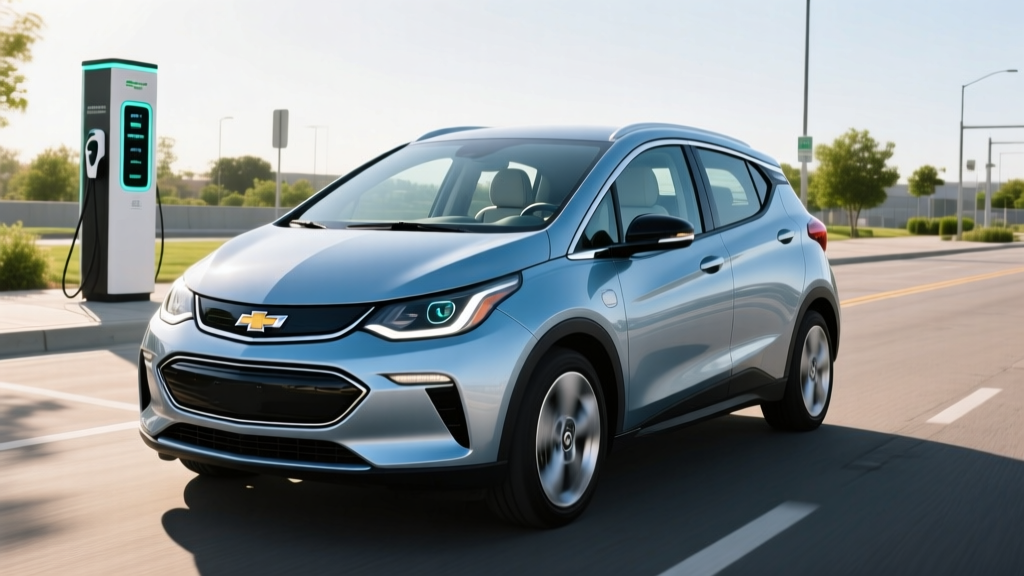
The Chevrolet Bolt EV remains one of the most compelling budget-friendly electric vehicles on the market in 2026. After a brief discontinuation, GM revived the Bolt on the updated Ultium-adjacent BEV3 platform with faster charging, a refreshed interior, and a larger battery. But for cost-conscious EV shoppers, the question isn't just about range and price — it's about whether this compact hatchback can protect your family. This review examines the 2026 Chevy Bolt safety rating alongside every spec that matters: real-world range, charging speed, tax credit eligibility, and how it stacks up against rivals like the Hyundai Kona Electric and Nissan Leaf.
2026 Chevy Bolt Safety Rating: NHTSA and IIHS Breakdown
The 2026 Chevy Bolt safety rating is a critical purchase factor for families and daily commuters. The National Highway Traffic Safety Administration (NHTSA) awarded the Bolt EV a 5-Star Overall Safety Rating, the highest score in its program. Here's how it scored across crash-test categories:
| Test Category | Rating |
|---|---|
| Overall | ★★★★★ (5/5) |
| Frontal Crash | ★★★★★ (5/5) |
| Side Crash | ★★★★★ (5/5) |
| Rollover | ★★★★☆ (4/5) |
The Insurance Institute for Highway Safety (IIHS) rated the Bolt as a Top Safety Pick, earning "Good" ratings in all crashworthiness categories. Its standard automatic emergency braking system earned a "Superior" rating for vehicle-to-vehicle and vehicle-to-pedestrian front crash prevention. Headlight performance, historically a weak spot for GM compacts, improved to an "Acceptable" rating on trims equipped with the uplevel LED projector lamps.
Range, Battery, and Efficiency: The Real-World Numbers
The 2026 Bolt EV is powered by a 65 kWh usable lithium-ion battery using GM's latest-generation NMC (nickel manganese cobalt) chemistry. This is an upgrade from the pre-hiatus Bolt's 65 kWh pack, now with improved thermal management for faster DC charging and better cold-weather resilience. The EPA rates the Bolt at 120 MPGe combined (122 city / 118 highway), translating to roughly 28 kWh per 100 miles.
Real-World Expectation: In mixed city/highway driving at moderate temperatures (65–80°F), expect 235–250 miles. On sustained 75 mph highway runs, plan for 210–225 miles. In freezing temperatures (below 32°F) without preconditioning, range can drop to 170–195 miles. The Bolt does not come standard with a heat pump — it uses resistive cabin heating, which increases energy draw in cold weather.
| Spec | Value |
|---|---|
| EPA Range | 259 miles |
| Battery (usable) | 65 kWh, NMC chemistry |
| Efficiency | 120 MPGe / 28 kWh/100mi |
| Motor | Single front-mounted permanent magnet |
| Horsepower | 200 hp |
| Torque | 266 lb-ft |
| 0–60 mph | 6.5 seconds |
| Drivetrain | FWD |
| Curb Weight | ~3,650 lbs |
The single-motor front-wheel-drive layout delivers 200 hp and 266 lb-ft of instant torque. The 0–60 mph time of 6.5 seconds is brisk for the segment and more than adequate for highway merging. No AWD option is available — if you need all-wheel traction, you'll need to look at the Bolt EUV (if still offered) or competitors like the Hyundai Kona Electric AWD.
Charging Speed: DC Fast Charge and Home Level 2
The biggest criticism of the pre-2024 Bolt was its painfully slow 55 kW DC fast-charging cap. The 2026 model fixes this with a significantly upgraded charge architecture. The Bolt now supports a peak 150 kW DC fast-charge rate via its standard CCS1 connector (with a NACS adapter available for Tesla Supercharger access).
| Level | Power | Speed | Notes |
|---|---|---|---|
| Level 1 (120V) | ~1.4 kW | ~4 miles/hour | Emergency/trickle only |
| Level 2 (240V, 48A) | 11.5 kW | ~38 miles/hour | Full charge in ~7 hours |
| DC Fast Charge | Peak 150 kW | 10–80% in ~28 min | Sustained ~95 kW average; tapers above 80% |
The 10–80% DC fast charge takes approximately 28 minutes on a capable 150+ kW station. The charge curve is the important detail: the Bolt peaks near 150 kW between 10–30% state of charge, then tapers to around 90–100 kW through the mid-range, and drops sharply above 80%. This is typical for NMC packs without extreme preconditioning. On a road trip, plan your stops around 20–80% charges to minimize time at the charger.
For home charging, the onboard 11.5 kW Level 2 charger is competitive. A full 0–100% charge on a 48-amp Level 2 home station takes about 7 hours — easily an overnight top-up. If your home electrical panel supports a 60-amp circuit (required for 48A continuous draw), installation typically runs $800–$2,000 depending on panel proximity and local permit costs. A licensed electrician should confirm your panel's capacity before committing to a charger purchase.
Pricing, Trims, and Federal Tax Credit Eligibility
The 2026 Bolt EV is offered in two trims. Pricing remains one of its strongest selling points in a market where the average new EV transaction price exceeds $52,000.
| Trim | Base MSRP | Key Features |
|---|---|---|
| 1LT | $28,900 | 11" infotainment, Chevy Safety Assist, heated front seats, 17" alloy wheels |
| 2LT | $32,400 | Leatherette seats, Bose 7-speaker audio, 360° camera, adaptive cruise, wireless CarPlay/Android Auto |
An as-tested 2LT with the optional Sun and Sound package and metallic paint landed around $34,800 before incentives.
Does the 2026 Chevy Bolt Qualify for the Federal EV Tax Credit?
The 2026 Bolt EV qualifies for the full $7,500 federal tax credit under IRS §30D, provided the buyer meets income requirements. As a domestically assembled vehicle with battery components and critical minerals sourced to meet 2026 thresholds, the Bolt clears the manufacturing and sourcing requirements. The credit can be applied as a point-of-sale price reduction, bringing the effective 1LT price to approximately $21,400.
- MSRP Cap: Vehicle MSRP must be ≤ $55,000 (sedans/hatchbacks). Bolt at $28,900–$34,800 qualifies. ✓
- Buyer Income Cap: AGI ≤ $150,000 (single), ≤ $300,000 (joint), ≤ $225,000 (head of household). Confirm with your tax professional.
- Battery Sourcing: Bolt meets 2026 critical mineral and battery component thresholds per GM's supply chain disclosures. ✓
- Assembly: Final assembly in the United States (Orion Township, MI). ✓
- Point-of-Sale Transfer: Available — apply the $7,500 at purchase rather than waiting for tax filing.
Source: IRS §30D Guidelines. Rules are current for 2026 and subject to legislative change. Consult a tax professional for personal eligibility.
Interior Space, Cargo, and Technology
The Bolt is a compact hatchback, and interior dimensions reflect that. Front-seat passengers get 42.1 inches of legroom and 40.2 inches of headroom — surprisingly generous for the segment. Rear legroom is tighter at 35.8 inches, which will feel snug for adults over six feet on longer trips. The rear seat comfortably fits two adults or three children.
Cargo volume behind the rear seats is 16.3 cubic feet, expanding to 57.2 cubic feet with the 60/40 rear seats folded. There is no frunk (front trunk) — the space under the hood houses the motor and power electronics. For comparison, the Hyundai Kona Electric offers 17.4 cu ft rear cargo, and the Volkswagen ID.4 provides 30.3 cu ft.
The infotainment system centers on an 11-inch diagonal touchscreen running GM's latest Ultifi software platform. Wireless Apple CarPlay and Android Auto are standard on 2LT and optional on 1LT. A 8-inch digital driver cluster displays range, energy flow, and navigation prompts. The 2LT adds a 360-degree surround-view camera and a 7-speaker Bose premium audio system.
Chevy Safety Assist is standard across all trims and includes:
- Automatic Emergency Braking with pedestrian detection
- Forward Collision Alert
- Lane Keep Assist with Lane Departure Warning
- Following Distance Indicator
- IntelliBeam automatic high beams
- Rear Cross Traffic Alert (2LT standard, 1LT optional)
Adaptive Cruise Control is standard on 2LT and available as a $495 option on 1LT. GM's Super Cruise hands-free driving system is not available on the Bolt — that feature is reserved for higher-tier GM vehicles like the Equinox EV and Blazer EV.
Warranty Coverage and Battery Longevity
GM backs the 2026 Bolt EV with the following warranty structure:
| Coverage | Term |
|---|---|
| Bumper-to-Bumper | 3 years / 36,000 miles |
| Powertrain | 5 years / 60,000 miles |
| Battery & EV Components | 8 years / 100,000 miles (≥70% capacity retention) |
| Corrosion | 6 years / 100,000 miles |
| Roadside Assistance | 5 years / 60,000 miles |
The 8-year/100,000-mile battery warranty guarantees that the pack will retain at least 70% of its original capacity. In practice, GM's NMC packs have demonstrated strong longevity — independent fleet data from the previous-generation Bolt showed an average of 90–93% capacity retention at 80,000 miles. The improved thermal management in the 2026 model should sustain or improve on that trajectory.
If out-of-warranty battery replacement were ever needed, current estimates for a 65 kWh NMC pack from GM range between $9,000 and $13,000 including labor — though prices are expected to decline as battery manufacturing scales and recycling matures.
Pros and Cons: An Honest Assessment
✅ Pros
- Lowest effective price in the EV segment after $7,500 credit (~$21,400)
- 5-Star NHTSA overall safety rating; IIHS Top Safety Pick
- 259-mile EPA range covers most daily commutes with margin
- 150 kW DC fast charging is a massive upgrade over prior generation
- Chevy Safety Assist standard on every trim
- Strong 8-year/100,000-mile battery warranty
- Tight turning radius, easy to park in urban environments
❌ Cons
- FWD only — no AWD option for snow-belt buyers
- No heat pump — cold-weather range loss is significant (~25–30%)
- Rear seat is tight for tall adults (35.8" legroom)
- No frunk for additional storage
- Super Cruise not available — only basic Level 2 assists
- DC fast-charge curve tapers aggressively above 80%
- Cargo volume (16.3 cu ft) trails crossover competitors
Who Should Buy the 2026 Chevy Bolt EV?
Choose the Bolt EV if:
- You want the most affordable new EV after tax credits
- Your daily commute is under 80 miles round-trip
- You primarily drive in moderate climates or have garage parking
- You value top safety ratings in a budget-friendly package
- You can install a Level 2 home charger and rarely need public DC fast charging
Look elsewhere if:
- You need AWD for harsh winters (consider the Hyundai Kona Electric AWD or Subaru Solterra)
- You regularly take 300+ mile road trips and need faster charging (the Hyundai Ioniq 5 charges at 240 kW)
- You need spacious rear seating for adults or large cargo capacity
- You live in a consistently cold climate where heat-pump efficiency matters (the Tesla Model 3 and VW ID.4 include heat pumps)
How the Bolt Compares to Key Competitors
| Spec | Chevy Bolt EV | Hyundai Kona Electric | Nissan Leaf |
|---|---|---|---|
| EPA Range | 259 mi | 261 mi | 212 mi (SV+) |
| Battery | 65 kWh NMC | 64.8 kWh NMC | 60 kWh NMC |
| DC Fast Charge | 150 kW | 100 kW | 100 kW |
| 0–60 mph | 6.5 sec | 7.2 sec | 7.4 sec |
| Base MSRP | $28,900 | $34,000 | $30,500 |
| After $7,500 Credit | ~$21,400 | ~$26,500 | ~$23,000 |
| NHTSA Overall | 5 Stars | 5 Stars | 5 Stars |
| AWD Available? | No | Yes | No |
| Heat Pump? | No | Yes | No |
The Bolt's primary advantages are price and DC charging speed. At $28,900 before incentives, it undercuts the Kona Electric by over $5,000 and charges 50% faster on DC. The Kona counters with available AWD and a standard heat pump, making it a better pick for cold-climate buyers willing to pay the premium. The Nissan Leaf, while competitively priced, trails in both range and charging speed — and its CHAdeMO connector is increasingly unsupported at newer public charging stations.
Frequently Asked Questions
What is the real-world range of the 2026 Chevy Bolt?
The EPA rates the Bolt at 259 miles. In real-world mixed driving at moderate temperatures, expect 235–250 miles. Sustained highway driving at 75 mph reduces that to roughly 210–225 miles. In sub-freezing weather without preconditioning, range can drop to 170–195 miles due to the lack of a heat pump and resistive cabin heating.
How fast does the 2026 Bolt charge at home and on DC fast chargers?
On a DC fast charger, the Bolt peaks at 150 kW and charges from 10–80% in approximately 28 minutes, though the charge curve tapers above 80%. At home on a 240V Level 2 charger (48 amps / 11.5 kW), a full charge takes about 7 hours, adding roughly 38 miles of range per hour of charging.
How much does the 2026 Chevy Bolt cost after the federal tax credit?
The 1LT starts at $28,900 MSRP. With the full $7,500 federal tax credit applied at point of sale, the effective price drops to approximately $21,400. The 2LT at $32,400 drops to roughly $24,900 after credit. Eligibility depends on buyer income (≤$150K single / ≤$300K joint) and is subject to current IRS §30D rules.
Is the 2026 Chevy Bolt worth buying vs. the Hyundai Kona Electric?
If price is your top priority and you live in a moderate climate, the Bolt is the stronger value — $5,000+ cheaper after incentives with faster DC charging. If you need AWD, a heat pump for cold weather, or more rear cargo space, the Kona Electric justifies its premium. Both carry 5-star NHTSA ratings.
Does the 2026 Chevy Bolt qualify for the federal EV tax credit?
Yes. The 2026 Bolt EV qualifies for the full $7,500 credit under IRS §30D. It meets the MSRP cap (under $55,000), final assembly (US-built), and battery sourcing/critical mineral requirements. Buyer income limits apply. The credit can be transferred to the dealer at point of sale as an immediate price reduction.
What is the Chevy Bolt's safety rating in 2026?
The 2026 Chevy Bolt earned a 5-Star Overall rating from NHTSA (5/5 in frontal and side crash, 4/5 in rollover) and was named an IIHS Top Safety Pick with "Good" ratings in all crashworthiness tests and "Superior" front crash prevention.