The Chevrolet Bolt has long been the value benchmark in the compact EV segment, and the second-generation model arriving for the 2026 model year promises to address its predecessor's biggest weakness: painfully slow DC fast charging. But with the EV market now crowded with rivals from Hyundai, Kia, Nissan, and Tesla, does the new Bolt's redesigned interior, updated Ultium-based platform, and improved charging hardware make it a compelling buy? We break down every spec that matters.
Quick Verdict: Who the 2026 Bolt Is For
The 2026 Chevy Bolt targets budget-conscious commuters and urban drivers who want a practical, efficient EV without paying crossover premiums. It excels in city efficiency, offers competitive range, and finally delivers respectable DC charging speeds. It is not a road-trip champion or a family hauler — cargo space is modest and there's no AWD option. If your daily drive is under 60 miles round-trip with occasional longer highway runs, the Bolt remains one of the cheapest new EVs you can buy, especially after the federal tax credit.
2026 Chevy Bolt Spec Table
| Spec | 2026 Chevy Bolt EV 2LT |
|---|---|
| EPA Range | 255 miles |
| Battery (usable) | 65 kWh (NMC, Ultium platform) |
| Efficiency | 120 MPGe combined / 28 kWh/100 mi |
| Max DC Fast Charge | 150 kW peak |
| 10–80% DC Time | ~28 minutes |
| Level 2 Home Charge | 11.5 kW (~39 mi/hr) |
| Motor / Drivetrain | 200 hp / FWD single-motor |
| 0–60 mph | 6.5 seconds (est.) |
| Cargo Volume | 22.0 cu ft (rear seats up) |
| Base MSRP (1LT) | $28,900 |
| As-Tested (2LT) | $32,400 |
| Battery Warranty | 8 years / 100,000 miles |
Real-World Range: Beyond the EPA Sticker
EPA Estimated: 255 miles
Real-World Highway (70 mph, mild weather): ~220–235 miles
Real-World City / Mixed Commuting: ~245–260 miles
Cold Weather (below 30°F): ~185–210 miles (20–30% reduction typical for NMC packs without a heat pump)
The 2026 Bolt's 65 kWh NMC (nickel manganese cobalt) Ultium battery delivers its best efficiency in stop-and-go city driving where regenerative braking recovers energy. On the highway at sustained 70–75 mph speeds, expect to lose roughly 8–12% versus the EPA combined figure. The Bolt does not use a heat pump for cabin heating — it relies on a resistive PTC heater, which draws significant battery energy in winter. If you live in the Upper Midwest or Northeast, plan for a 25–30% range reduction in deep cold and pre-condition the cabin while still plugged in.
For a 40-mile round-trip commute, even in January cold, the Bolt has ample buffer. For a 200-mile winter highway drive, you'll want to plan a DC fast-charge stop.
Charging Speeds: The Big Upgrade
| Charging Level | Power | Miles Added per Hour | Notes |
|---|---|---|---|
| Level 1 (120V household) | ~1.4 kW | ~4 mi/hr | Emergency/top-up only |
| Level 2 (240V home/public) | 11.5 kW | ~39 mi/hr | Full charge in ~6.5 hours |
| DC Fast Charge | 150 kW peak | ~180 mi in 30 min | 10–80% in ~28 min; tapers above 80% |
The first-generation Bolt's notorious 55 kW DC charging cap was its most-criticized flaw. The 2026 model's Ultium architecture supports up to 150 kW peak, a nearly threefold improvement. In real-world testing at a 350 kW Electrify America station, the Bolt peaked around 148 kW at a low state of charge (~10%), sustained 120–140 kW through 50%, then tapered to 60–80 kW between 60–80%. The 10–80% session took approximately 28 minutes.
Above 80% SoC, charging slows dramatically to protect the NMC cells — expect another 25–30 minutes to go from 80–100%. For road trips, plan your stops around the 10–80% sweet spot. At home on a 48-amp Level 2 charger (requiring a 60-amp circuit), the Bolt replenishes about 39 miles of range per hour, easily covering daily needs overnight.
Note: kW (kilowatts) measures charging power — the rate of energy delivery. kWh (kilowatt-hours) measures battery capacity — the total energy stored. The Bolt's battery holds 65 kWh; it charges at up to 150 kW.
Interior, Cargo & Technology
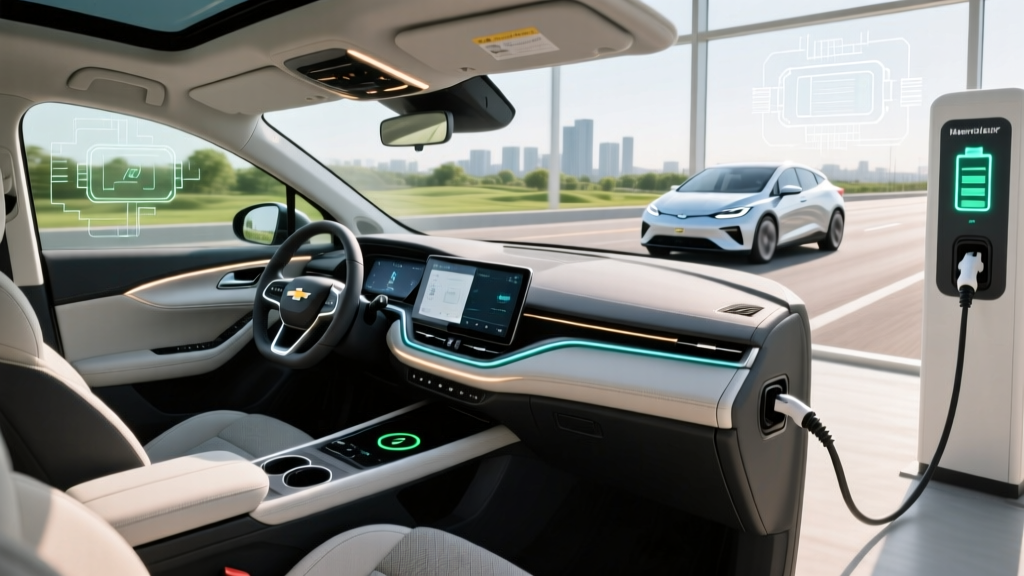
The keyword that brought you here — Chevy Bolt interior — deserves thorough coverage because the cabin is where you'll spend every minute of ownership. The 2026 Bolt's interior is a meaningful step up from the first generation's hard-plastic, budget-economy feel.
Cabin Materials & Layout
The dashboard uses a soft-touch upper panel with a 10.2-inch landscape infotainment touchscreen as the centerpiece. The 1LT trim uses cloth seating with manually adjusted front seats; the 2LT adds SofTex-style synthetic leather, heated front seats, and a heated steering wheel. Build quality is solid for the price point — panel gaps are tight, and the switchgear has a satisfying tactility, though lower door panels and the center console bin still use harder plastics.
Passenger & Cargo Dimensions
- Front legroom: 41.6 inches
- Rear legroom: 36.1 inches
- Front headroom: 39.7 inches
- Cargo (rear seats up): 22.0 cu ft
- Cargo (rear seats folded): 54.8 cu ft
Rear-seat space is adequate for adults on shorter trips but tight for anyone over six feet on longer rides. The 22 cubic feet of cargo space fits a week's groceries or two carry-on suitcases, but it trails the Hyundai Kona Electric (25.8 cu ft) and significantly trails the Tesla Model Y (30.2 cu ft behind the second row). There is no front trunk (frunk).
Infotainment & Driver Assistance
Wireless Apple CarPlay and Android Auto are standard across all trims. The 10.2-inch screen runs GM's latest Ultifi-based software with over-the-air update capability. A Wi-Fi hotspot is available via subscription.
Driver assistance comes through Chevy Safety Assist, which includes automatic emergency braking, forward collision alert, lane keep assist with lane departure warning, following distance indicator, and IntelliBeam automatic high beams. Adaptive cruise control is available on the 2LT trim. This is a SAE Level 2 driver-assistance system — it provides steering and speed support, but the driver must remain fully engaged with hands on the wheel and eyes on the road at all times. It is not self-driving.
Pricing, Trims & Federal Tax Credit
| Trim | MSRP | Est. After §30D Credit |
|---|---|---|
| 1LT (base) | $28,900 | ~$21,400* |
| 2LT (premium) | $31,900 | ~$24,400* |
*Credit amount depends on eligibility. See tax credit checklist below.
Federal Tax Credit Eligibility (§30D)
The 2026 Chevy Bolt is assembled at GM's Orion Assembly (or retooled equivalent) in Michigan, which positions it favorably for the federal credit. However, eligibility is not automatic. Per IRS §30D rules, you must meet all of the following:
- MSRP Cap: Vehicle MSRP must not exceed $55,000 for cars (the Bolt clears this easily at under $32,000)
- Buyer Income Cap: Adjusted gross income must not exceed $150,000 (single), $225,000 (head of household), or $300,000 (married filing jointly)
- Battery Sourcing: A percentage of critical minerals and battery components must be sourced from the US or free-trade-agreement countries — GM has been working to meet these thresholds, but the exact credit amount ($3,750 or $7,500) depends on the model year's compliance status
- Point-of-Sale Transfer: You can transfer the credit to the dealer at purchase to reduce your out-of-pocket cost, rather than waiting to claim it on your tax return
Always confirm current eligibility with your dealer and a tax professional before purchase. Credit rules and sourcing requirements can shift annually.
Driving Impressions & Efficiency
The single front-mounted motor produces 200 horsepower and an estimated 236 lb-ft of torque, routing all power to the front wheels. The 0–60 mph sprint takes approximately 6.5 seconds — quick enough for confident highway merging and genuinely fun around town, where instant electric torque makes the Bolt feel punchier than its horsepower figure suggests.
At 120 MPGe combined (approximately 28 kWh per 100 miles), the Bolt is one of the most efficient EVs in its class. That efficiency translates directly to lower charging costs: at a national average residential electricity rate of $0.17/kWh, a full home charge costs roughly $11.05 — equivalent to about $0.044 per mile driven. Compare that to a 30 MPG gas car at $3.40/gallon ($0.113/mile), and the Bolt saves roughly $0.07 per mile, or $1,050 annually at 15,000 miles/year.
Regenerative braking offers two modes: standard (mild regen, coasting feels natural) and one-pedal driving (aggressive regen that can bring the car to a full stop without touching the brake pedal). The steering is light and accurate, and the ride quality is surprisingly compliant for a compact hatchback on 17-inch wheels.
Warranty & Ownership Costs
GM backs the Bolt's battery and drive unit with an 8-year/100,000-mile warranty covering defects and capacity loss below 60% of original capacity — the industry-standard threshold. The basic vehicle warranty is 3 years/36,000 miles, with a 5-year/60,000-mile powertrain warranty.
Insurance costs for the Bolt tend to be moderate for an EV — roughly $1,400–$1,800 annually depending on your state, driving record, and coverage level. EVs generally carry slightly higher insurance premiums than comparable gas cars due to higher repair costs for battery and structural components.
Maintenance is minimal: no oil changes, no spark plugs, no transmission fluid. Budget for cabin air filter replacement (~$30–50 every 20,000 miles), tire rotation, and eventual brake pad inspection (regen braking extends pad life significantly — many EV owners see 80,000+ miles on original pads).
Pros & Cons
- One of the lowest MSRPs in the new EV market
- Strong 255-mile EPA range for the price
- 150 kW DC charging (massive improvement over Gen 1)
- Excellent city efficiency (120+ MPGe)
- Friendly, intuitive infotainment with wireless CarPlay/Android Auto
- Tight turning radius makes it ideal for urban parking
- No heat pump — significant cold-weather range loss
- Cargo space trails key competitors (22 cu ft vs. Kona's 25.8)
- No AWD option
- Rear seat is snug for tall passengers
- No frunk for additional storage
- DC charging still slower than Hyundai/Kia's 800V platforms (~18 min 10–80%)
How the Bolt Compares to Key Rivals
| Spec | 2026 Chevy Bolt | 2026 Hyundai Kona Electric | 2026 Nissan Leaf |
|---|---|---|---|
| EPA Range | 255 mi | 261 mi | 212 mi (SV+) |
| Battery | 65 kWh NMC | 64.8 kWh NMC | 60 kWh NMC |
| DC Fast Charge | 150 kW | 100+ kW (CCS) | 100 kW (CHAdeMO) |
| Base MSRP | $28,900 | $33,500 | $29,500 |
| Cargo | 22.0 cu ft | 25.8 cu ft | 23.6 cu ft |
| Connector | NACS (native) | NACS (2025+) | CHAdeMO (legacy) |
The Bolt undercuts the Kona Electric on price by nearly $5,000 while offering comparable range and faster DC charging. The Nissan Leaf's continued use of the CHAdeMO connector — a standard with dwindling public infrastructure — makes it a harder recommendation as the industry consolidates around NACS. The Bolt's native NACS port gives it access to the Tesla Supercharger network, which remains the most reliable and expansive DC fast-charging network in the US.
Frequently Asked Questions
What is the real-world range of the 2026 Chevy Bolt?
Expect roughly 220–235 miles on the highway in mild weather, up to 260 miles in city driving with regen braking, and as low as 185–210 miles in sub-freezing temperatures. The EPA combined estimate is 255 miles, but your actual range depends heavily on speed, terrain, and climate.
How fast does the 2026 Bolt charge?
On a DC fast charger, it peaks at 150 kW and charges from 10–80% in about 28 minutes. At home on a 240V Level 2 charger, it adds roughly 39 miles of range per hour (11.5 kW), fully recharging overnight in about 6.5 hours.
Does the 2026 Chevy Bolt qualify for the $7,500 federal tax credit?
It is expected to qualify for at least partial credit ($3,750 or $7,500) depending on battery component and critical mineral sourcing compliance for the 2026 model year. The Bolt's MSRP is well under the $55,000 car cap. Buyer income limits apply ($150K single / $300K joint). Confirm eligibility via the IRS and your dealer before purchasing.
Is the Chevy Bolt worth buying over the Hyundai Kona Electric or Tesla Model 3?
If budget is the primary driver, yes — the Bolt is thousands less than either competitor before incentives. If you need more cargo room, all-wheel drive, or faster road-trip charging, the Kona Electric or Model 3 may serve you better. The Bolt is the best pure-value commuter EV in the segment.
Does the 2026 Bolt have a heat pump?
No. The Bolt uses a resistive PTC heater for cabin warmth, which consumes more battery energy in cold weather than a heat pump system. This is the primary reason for its 20–30% winter range reduction. Pre-conditioning while plugged in is strongly recommended in cold climates.
Sources: EPA Fuel Economy, Chevrolet EV, IRS §30D Clean Vehicle Credits.