Quick Verdict: The Budget EV King Returns Refreshed
The 2026 Chevy Bolt EV enters its second generation on GM's updated BEV3 platform, addressing the two biggest complaints from the previous generation: DC fast-charge speed and interior quality. With an EPA-estimated 255 miles of range, a starting MSRP around $28,800, and potential eligibility for the full $7,500 federal tax credit under IRS §30D, the Bolt remains the most affordable long-range electric vehicle in the U.S. market. It's not the fastest-charging or most spacious EV you can buy, but as a daily commuter and budget-conscious entry point into electric ownership, it is genuinely hard to beat.
2026 Chevy Bolt EV Specifications
| Specification | Value |
|---|---|
| EPA Range | 255 miles |
| Battery Capacity (usable) | 65 kWh |
| Battery Chemistry | NMC (Nickel Manganese Cobalt) |
| Drivetrain | FWD (single motor) |
| Horsepower | 200 hp |
| Torque | 266 lb-ft |
| 0-60 mph | ~6.5 seconds |
| Top Speed | 93 mph (electronically limited) |
| EPA Efficiency | 120 MPGe combined / 28 kWh/100 mi |
| DC Fast Charge (peak) | 85 kW (CCS/NACS via adapter) |
| DC 10-80% Time | ~35 minutes |
| Level 2 Charge Rate | 11.5 kW (~39 mi/hr) |
| Level 1 (120V) Charge Rate | ~1.4 kW (~4 mi/hr) |
| Cargo Volume (rear seats up) | 21.8 cu ft |
| Cargo Volume (rear seats folded) | 54.7 cu ft |
| Rear Legroom | 36.1 inches |
| Battery/Powertrain Warranty | 8 years / 100,000 miles |
| Base MSRP (1LT) | $28,800 |
| As-Tested (2LT w/ options) | ~$34,500 |
Range and Efficiency: 255 Miles on Paper, What You'll Actually Get
The 2026 Bolt's 65 kWh usable NMC battery delivers an EPA-estimated 255 miles, which places it solidly in the mid-range for affordable EVs — behind the Hyundai Kona Electric (261 mi) but ahead of the Nissan Leaf (212 mi). According to fueleconomy.gov, the Bolt achieves 120 MPGe combined, translating to roughly 28 kWh per 100 miles of driving.
That efficiency figure is genuinely strong for a crossover-shaped hatchback. To put it in practical terms: charging at home with an average U.S. electricity rate of $0.16/kWh, you'll spend approximately $4.48 to "refuel" 100 miles of range — compared to roughly $10-12 for a 30 MPG gas car at $3.30/gallon.
The real-world caveat matters here. The Bolt's FWD layout and relatively modest 200 hp motor mean it doesn't suffer the efficiency penalties of heavier AWD EVs. However, NMC chemistry loses more capacity in extreme cold than LFP alternatives. Owners in northern climates should budget for a 20-30% range reduction in sustained sub-freezing temperatures, especially if using resistive cabin heat (the Bolt does not include a heat pump in the base 1LT trim; it is standard on 2LT).
Charging: Faster Than Before, But Still Not Class-Leading
The previous-generation Bolt's biggest weakness was its painfully slow 55 kW DC fast-charging speed. The 2026 model improves that to an 85 kW peak, which is a meaningful step forward — but still trails competitors like the Hyundai Kona Electric (100+ kW) and the Hyundai Ioniq 5 (240 kW on 800V architecture).
| Charging Level | Power | Speed (miles added) | Notes |
|---|---|---|---|
| Level 1 (120V household) | ~1.4 kW | ~4 miles/hour | Overnight top-up only; full charge ~46 hours |
| Level 2 (240V home) | 11.5 kW | ~39 miles/hour | Full 0-100% in ~6.5 hours |
| DC Fast Charge (peak) | 85 kW | ~150 miles in 30 min | 10-80% in ~35 min; tapers significantly above 80% |
The 10-80% DC fast-charge time of roughly 35 minutes is acceptable for road-trip charging stops but not exceptional. The charge curve is the real story: the Bolt holds near its 85 kW peak through approximately 40% State of Charge, then tapers to ~55 kW by 60% SoC, and drops further to ~30 kW above 80%. This is typical for NMC batteries without advanced thermal preconditioning. If you're planning long highway trips, factor in 35-40 minute stops every 180-200 miles.
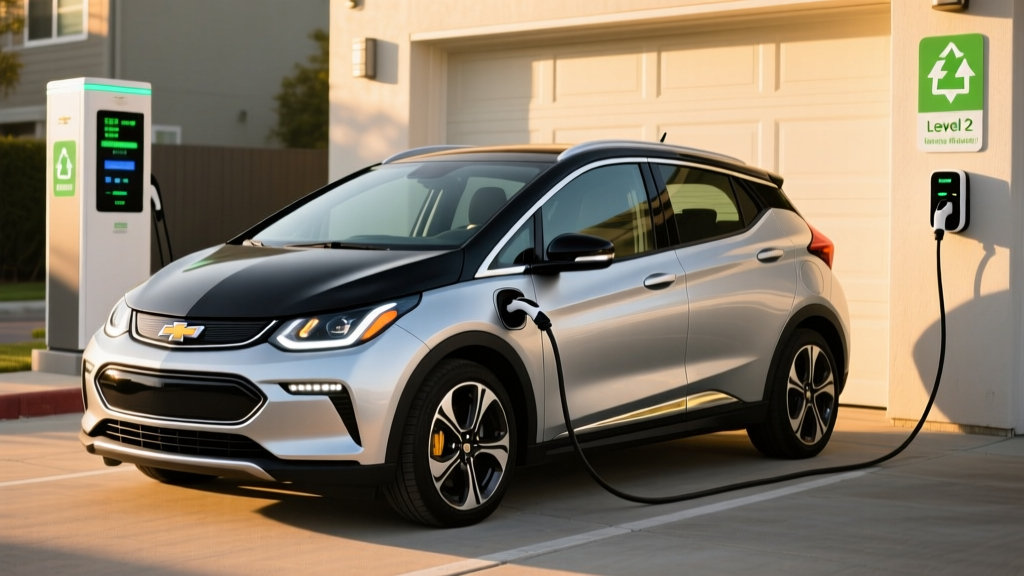
On Level 2 home charging, the 11.5 kW onboard charger is a highlight. With a 48-amp hardwired Level 2 station, you'll add roughly 39 miles of range per hour and achieve a full charge in about 6.5 hours — meaning any overnight session easily refills the battery. This is faster than many competitors that cap at 7.2 or 9.6 kW onboard.
Connector note: The 2026 Bolt ships with a CCS1 inlet. GM has committed to the NACS (Tesla-style) connector for newer models, and a NACS adapter is available for Supercharger access. Check with your dealer on adapter inclusion and compatibility with the latest Chevrolet EV app.
Performance and Driving Dynamics
The single front-mounted motor produces 200 horsepower and 266 lb-ft of torque — adequate for merging, passing, and city driving but not thrilling. The 0-60 mph time of approximately 6.5 seconds puts it in the same bracket as a well-equipped Honda Civic. The instant torque delivery makes the Bolt feel quicker than its numbers suggest around town, where 0-30 mph acceleration is punchy and responsive.
Ride quality is a notable improvement over the previous generation. The BEV3 platform gives the Bolt a slightly longer wheelbase, and GM has retuned the suspension for better compliance over rough pavement. The low center of gravity (battery pack under the floor) keeps body roll well-controlled through corners. Regenerative braking offers multiple modes, including a one-pedal driving setting that can bring the car to a complete stop without touching the brake pedal — a feature many EV owners quickly come to prefer.
The Bolt is strictly a front-wheel-drive vehicle with no AWD option. This is a deliberate cost-saving choice that keeps the MSRP low, but it means the Bolt is not suited for buyers who need all-weather traction beyond what winter tires can provide. Towing capacity is not rated — this is a commuter hatchback, not a utility vehicle.
Interior, Tech, and Cargo Space
The 2026 Bolt's interior represents a meaningful step up from the plasticky, budget feel of its predecessor. The dashboard now features an 11-inch digital instrument cluster and an 11.3-inch infotainment touchscreen running GM's latest Google Built-in software, which includes native Google Maps navigation, Google Assistant voice control, and access to the Play Store for apps.
Wireless Apple CarPlay and Android Auto are standard across all trims. A wireless phone charging pad is included on 2LT. The center console has been redesigned with a more intuitive layout, and soft-touch materials now cover the dashboard and upper door panels — areas that were hard plastic before.
Cargo space is generous for the vehicle's compact footprint: 21.8 cubic feet behind the rear seats and 54.7 cubic feet with the 60/40 split rear seats folded flat. That's competitive with the Hyundai Kona Electric and substantially more than the Nissan Leaf. Rear legroom at 36.1 inches is adequate for adults on shorter trips, though taller passengers may find it snug on longer rides.
Driver Assistance and Safety
The 2026 Bolt comes standard with Chevy Safety Assist, a Level 2 (SAE) driver-assistance suite that includes:
- Automatic Emergency Braking with pedestrian detection
- Lane Keep Assist with Lane Departure Warning
- Adaptive Cruise Control (stop-and-go capable)
- Following Distance Indicator
- IntelliBeam automatic high beams
- Rear Cross Traffic Alert
For safety ratings, the Bolt's predecessor earned top marks from NHTSA, and the 2026 model is expected to perform similarly with its reinforced BEV3 structure. Check NHTSA.gov and IIHS.org for the latest crash-test results as they become available.
Pricing, Trims, and Federal Tax Credit Eligibility
The 2026 Chevy Bolt EV is offered in two trims:
| Trim | MSRP | Key Features | Est. Price After §30D Credit* |
|---|---|---|---|
| 1LT | $28,800 | 255-mi range, 11.3" touchscreen, Chevy Safety Assist, wireless CarPlay/Android Auto | ~$21,300 |
| 2LT | $32,400 | Adds: heated seats (front + rear), heat pump, Bose audio, EV route planning, adaptive cruise | ~$24,900 |
*Tax credit estimates assume buyer meets all IRS §30D requirements. Actual eligibility varies.
Does the 2026 Bolt Qualify for the $7,500 Federal Tax Credit?
The Bolt is a strong candidate for the full $7,500 federal EV tax credit under IRS §30D, but eligibility depends on several factors that buyers must verify:
- MSRP cap: The Bolt's MSRP (under $33,000) falls well below the $55,000 cap for cars and $80,000 cap for SUVs/trucks.
- Buyer income limits: Modified adjusted gross income must not exceed $150,000 (single), $225,000 (head of household), or $300,000 (joint filers).
- Battery sourcing: The Bolt's battery must meet critical mineral and battery component sourcing requirements that phase in more strictly each year. GM sources NMC cells from Ultium Cells (a joint venture with LG Energy Solution, with U.S. manufacturing in Ohio and Tennessee). Verify current-year compliance on the IRS qualified vehicle list before purchasing.
- Point-of-sale transfer: As of 2024, eligible buyers can transfer the credit to the dealer at the point of sale, reducing the purchase price directly rather than waiting for a tax refund.
- Tax liability: The credit is non-refundable — you must have at least $7,500 in federal tax liability to benefit (unless using the point-of-sale transfer option, which bypasses this requirement).
Always confirm eligibility with a tax professional and check the latest IRS qualified vehicle list before finalizing your purchase. Rules change annually, and battery-sourcing requirements tighten each year.
Who Should Buy the 2026 Chevy Bolt EV?
- You want the lowest-cost new EV with 250+ miles of range
- You primarily commute and drive in urban or suburban settings
- You have access to Level 2 home charging and rarely road-trip more than 200 miles
- You qualify for the federal tax credit and want to maximize savings
- You value cargo practicality in a compact footprint
- You need fast road-trip charging (sub-20-minute 10-80% stops)
- You require AWD for snow-belt driving
- You regularly carry four adults on long trips
- You want hands-free highway driving (Super Cruise / BlueCruise)
- You need towing capability
Pros
- Lowest MSRP of any 250+ mile EV in the U.S.
- Strong 11.5 kW Level 2 onboard charger for fast home charging
- Generous cargo space (54.7 cu ft) for a compact hatchback
- Google Built-in infotainment with native navigation
- Likely eligible for full $7,500 federal tax credit
- Competitive 120 MPGe efficiency keeps running costs low
Cons
- 85 kW DC fast charging trails competitors (Kona, Ioniq 5)
- No AWD option — FWD only
- No Super Cruise or hands-free driving available
- Rear legroom is tight for taller passengers
- No heat pump on base 1LT trim (cold-weather range impact)
- Top speed limited to 93 mph
Frequently Asked Questions
What is the real-world range of the 2026 Chevy Bolt?
The EPA estimates 255 miles. In real-world highway driving at 70-75 mph, expect 215-230 miles. In cold weather below 30°F, range can drop to 180-200 miles. City driving with regenerative braking may yield 260-270 miles.
How fast does the 2026 Bolt charge?
On DC fast charging, the Bolt peaks at 85 kW and charges from 10-80% in approximately 35 minutes. On a Level 2 home charger (240V, 48A), it charges at 11.5 kW, adding about 39 miles per hour and achieving a full charge in roughly 6.5 hours.
How much does the 2026 Bolt cost after tax credits?
The 1LT starts at $28,800 and the 2LT at $32,400. If you qualify for the full $7,500 federal tax credit under IRS §30D, effective prices drop to approximately $21,300 (1LT) and $24,900 (2LT). Eligibility depends on income, battery sourcing, and MSRP requirements.
Is the 2026 Bolt worth buying over the Hyundai Kona Electric or Nissan Leaf?
The Bolt offers the best value proposition if price is your primary concern — it undercuts most competitors while delivering 255 miles of range and strong cargo utility. The Kona Electric offers slightly more range and faster DC charging, while the Leaf is less competitive on both range and charging. If road-trip charging speed matters to you, the Kona is a better choice.
Does the 2026 Bolt have a heat pump?
The heat pump is standard on the 2LT trim but not available on the base 1LT. If you live in a cold climate, the 2LT is strongly recommended to minimize winter range loss.
What is the Bolt's battery warranty?
GM covers the Bolt's battery and electric powertrain for 8 years or 100,000 miles, whichever comes first. The warranty guarantees the battery will retain a minimum level of capacity (typically 60-70% of original capacity, per GM's warranty documentation).