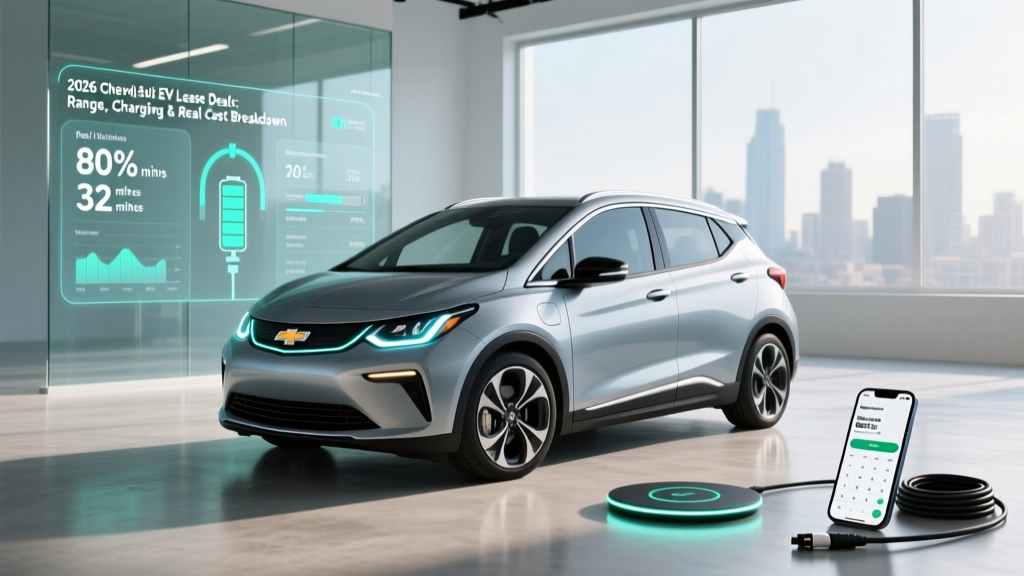
If you've searched for chevy bolt leasing deals lately, you've probably noticed something unusual: Chevrolet's sub-$30,000 electric hatchback keeps showing up with monthly payments that undercut gas compacts. That's not an accident. The Bolt EV occupies a rare position in the 2026 EV market — low MSRP, full federal tax-credit eligibility, and a battery large enough for genuine daily use — and those three factors collide to produce some of the most aggressive lease offers in the segment.
But a low monthly payment only matters if the car actually fits your life. Below, we run the Bolt EV through every number that counts: EPA range versus what you'll really see on a cold January commute, DC fast-charge behavior on a 50-kW CCS plug, LFP battery longevity, cargo space with the rear seats folded, and the exact math behind leasing versus buying with the §30D credit applied at point of sale.
2026 Chevy Bolt EV: Core Specs at a Glance
| Spec | Value |
|---|---|
| EPA Range | 259 miles |
| Battery (usable) | ~65 kWh, LFP (lithium iron phosphate) |
| Max DC Fast Charge | 55 kW (CCS1) |
| 10–80% DC Time | ~55 minutes |
| Level 2 Home Charge | 11.5 kW (~39 mi/hr) |
| Motor Output | 200 hp / 266 lb-ft torque |
| Drivetrain | FWD, single-speed reduction |
| 0–60 mph | ~6.5 seconds |
| EPA Efficiency | 120 MPGe combined (28 kWh/100 mi) |
| Cargo (rear seats up) | 16.6 cu ft |
| Cargo (rear seats folded) | 57.0 cu ft |
| Rear Legroom | 36.0 inches |
| Battery Warranty | 8 years / 100,000 miles |
| Base MSRP (1LT) | $28,785 (incl. destination) |
| As-Tested (2LT w/ Sun & Sound) | ~$34,200 |
Real-World Range: What 259 EPA Miles Actually Means
EPA Sticker: 259 miles
Real-World Expectation: 220–245 miles in mixed driving; 185–210 miles sustained highway at 70+ mph; 160–190 miles in sub-30°F weather with cabin heat.
The Bolt EV's 259-mile EPA figure is legitimate for suburban commutes at 35–50 mph with mild temperatures — exactly where LFP chemistry shines. LFP cells tolerate frequent 100% charges better than NMC, so you can top off every night without the degradation guilt you'd feel with a nickel-rich pack.
Where the Bolt loses ground is highway speed. Its compact crossover shape and single-speed gearing mean efficiency drops sharply above 65 mph. On a 75-mph interstate run at 70°F, expect roughly 210 miles before the low-battery warning. Drop the ambient temperature to 20°F and run the resistive cabin heater (the Bolt still lacks a heat pump in 2026), and that number contracts to roughly 170 miles. If your daily round trip exceeds 150 miles in winter, the Bolt demands careful planning.
Charging Speed: The Bolt's Most Honest Limitation
| Level | Power | Miles Added per Hour | Notes |
|---|---|---|---|
| Level 1 (120V) | 1.4 kW | ~4 mi/hr | Emergency / overnight trickle only |
| Level 2 (240V, 48A) | 11.5 kW | ~39 mi/hr | Full charge in ~6.5 hours |
| DC Fast (CCS1) | 55 kW peak | ~150 mi/hr (peak) | 10–80% in ~55 min; tapers above 80% |
Here's the number every prospective Bolt lessee must internalize: 55 kW peak DC fast-charge rate. In a market where Hyundai Ioniq 5 and Tesla Model Y pull 150–250 kW at the same Electrify America or EVgo station, the Bolt takes roughly three times as long to add 200 miles of range.
For home-centric owners who charge overnight on Level 2, this barely matters — you wake up to a full battery every morning at roughly $0.04 per mile (assuming $0.14/kWh electricity). But if your routine involves frequent 200+ mile road trips, the Bolt's 55-kW ceiling turns a 30-minute lunch stop into a 55-minute sit. The charge curve is relatively flat from 10–70% (sustaining near 50 kW), then tapers to ~30 kW above 80%. Plan accordingly.
One note on connector compatibility: the 2026 Bolt EV still ships with a CCS1 port. Chevrolet has confirmed NACS adoption for future models, but current Bolt owners will rely on CCS-to-NACS adapters at Tesla Superchargers — an extra $150–$200 accessory purchase and one more cable to manage.
How Chevy Bolt Leasing Deals Actually Work in 2026
The reason Chevy Bolt leasing deals consistently undercut competitors comes down to one mechanism: the federal §30D tax credit can be applied as a capitalized-cost reduction at the point of lease. Because the Bolt EV's battery meets critical-mineral and component-sourcing requirements, and its MSRP falls well under the $55,000 passenger-car cap, it qualifies for the full $7,500.
| Line Item | Amount |
|---|---|
| Base MSRP | $28,785 |
| Dealer add-ons / fees | ~$900 |
| Gross cap cost | ~$29,685 |
| §30D credit applied as cap reduction | –$7,500 |
| Net cap cost | ~$22,185 |
| Residual (55% × MSRP) | $15,832 |
| Depreciation over 36 months | ~$6,353 |
| Rent charge (money factor ~0.00210) | ~$1,600 |
| Estimated monthly payment (0 down, before tax) | ~$220–$260/mo |
A few critical caveats from the IRS §30D guidelines:
- Income cap: Modified AGI must not exceed $150,000 (single), $225,000 (head of household), or $300,000 (joint).
- MSRP cap: Vehicle MSRP must be ≤$55,000 for sedans/hatchbacks (Bolt qualifies easily at ~$29K).
- Battery sourcing: Critical minerals and battery components must meet escalating domestic/free-trade-partner percentages. GM has confirmed Bolt compliance for 2026.
- Point-of-sale transfer: You elect to transfer the credit to the dealer at signing; the dealer reduces your cap cost by $7,500. You must still file IRS Form 8936 with your tax return to confirm eligibility.
If your income exceeds the cap, the $7,500 disappears and your lease payment jumps by roughly $200/month. Always verify eligibility with a tax professional before signing.
Performance, Tech, and Daily Livability
The Bolt's 200-hp front motor delivers a genuinely fun 0–60 time of ~6.5 seconds — brisk enough for confident highway merging and stoplight sprints. Torque arrives instantly (as with all EVs), and the one-pedal driving mode with aggressive regen lets you navigate stop-and-go traffic with minimal brake-pedal use. The low center of gravity from the floor-mounted battery gives it surprisingly flat cornering for a tall hatchback.
Inside, the 10.2-inch diagonal infotainment screen runs GM's current software with wireless Apple CarPlay and Android Auto. The 2LT trim adds a Bose 7-speaker system, heated front seats, a heated steering wheel, and a 360-degree camera. Chevy Safety Assist 2 comes standard across both trims: automatic emergency braking, lane-keep assist, following-distance indicator, and adaptive cruise control.
Driver-Assist Level: Chevy Safety Assist 2 is SAE Level 2 — it provides steering and speed assistance but requires continuous driver attention. This is not autonomous driving. GM's hands-free Super Cruise is not available on the Bolt platform.
The standout practical feature is cargo flexibility. With 16.6 cu ft behind the rear seats (enough for a week of groceries for a family of four) and 57.0 cu ft with seats folded (a full-size dog crate or several suitcases), the Bolt punches above its exterior footprint. Rear legroom of 36.0 inches is adequate for adults on short trips but snug for tall passengers on longer drives.
Who the Bolt EV Suits — and Who Should Look Elsewhere
Lease the Bolt EV if:
- Your daily commute is under 100 miles round-trip
- You have Level 2 home charging (or can install it)
- You rarely drive more than 200 miles in a single day
- You want the lowest possible EV monthly payment
- You value LFP battery longevity and frequent 100% charging
Look at competitors if:
- You road-trip frequently and need 150+ kW DC fast charging
- You need AWD for snow-belt winters
- You regularly carry tall adults in the rear seats
- You want hands-free highway driving (Super Cruise / BlueCruise)
Bolt EV vs. Key Competitors: Where the Lease Math Lands
Against the Hyundai Kona Electric (261 mi EPA, ~$34,000 MSRP), the Bolt wins on price by $5,000+ but loses on DC charging speed (Kona peaks at ~100 kW). Against the Nissan LEAF (212 mi EPA, CHAdeMO connector), the Bolt dominates on range and connector standardization. The Tesla Model 3 RWD (~$40,000) offers vastly superior charging, Supercharger network access, and performance — but at a lease payment $150–$200/month higher after credits.
The Bolt's competitive moat is pure affordability. No other 250+ mile EV undercuts it on monthly cost when the §30D credit applies. If your priority is minimizing monthly spend while driving electric, the Bolt has no peer in 2026.
Pros, Cons, and the Verdict on Bolt Leasing
Pros
- Lowest lease payment among 250+ mi EVs (often $220–$260/mo)
- LFP battery tolerates daily 100% charging; excellent cycle life
- Full $7,500 §30D credit eligibility with point-of-sale transfer
- Fun 200-hp FWD with instant torque and one-pedal regen
- Surprisingly useful 57 cu ft cargo with seats folded
- Standard wireless CarPlay/Android Auto and Safety Assist 2
Cons
- 55-kW DC fast charging is painfully slow for road trips
- No heat pump — cold-weather range loss is significant
- CCS1 port requires adapter for Tesla Supercharger access
- Rear seat is tight for tall adults on long drives
- No Super Cruise / hands-free driving option
- Resale value uncertain as newer platforms arrive
Frequently Asked Questions
What is the real-world range of the 2026 Chevy Bolt EV?
The EPA rates the Bolt EV at 259 miles. In real-world mixed suburban driving at moderate temperatures, expect 220–245 miles. Sustained 75-mph highway driving drops that to ~210 miles, and sub-30°F winter conditions with cabin heat can reduce range to 160–190 miles. The LFP battery allows daily 100% charging without significant degradation concerns.
How fast does the Bolt EV charge at home and on the road?
On a 240V Level 2 home charger (48A), the Bolt charges at 11.5 kW, adding roughly 39 miles of range per hour — a full charge in about 6.5 hours. On DC fast chargers, it peaks at 55 kW, reaching 10–80% in approximately 55 minutes. This is the Bolt's primary weakness for road-trip use.
How much does a Chevy Bolt EV lease cost after tax credits?
With the $7,500 federal §30D credit applied as a capitalized-cost reduction, typical 36-month leases on a 1LT trim run $220–$260 per month with little or no money down (before tax and title). Your exact payment depends on dealer pricing, money factor, residual, and whether you exceed IRS income caps ($150K single / $300K joint).
Does the 2026 Bolt EV qualify for the federal EV tax credit?
Yes. The Bolt EV qualifies for the full $7,500 under current IRS §30D rules. Its MSRP is well below the $55,000 cap, and GM has confirmed battery-sourcing compliance. You must still meet personal income limits and file Form 8936. The credit can be transferred to the dealer at lease signing to reduce your monthly payment.
Is leasing the Bolt better than buying it?
Leasing is attractive if you want the lowest monthly payment, plan to upgrade in 3 years, and don't exceed typical mileage limits (10K–15K/yr). Buying makes more sense if you drive high annual miles, want to keep the car 7+ years to maximize the LFP battery's long cycle life, or want to avoid lease-end disposition fees. Either way, the $7,500 credit applies — as a cap reduction in a lease, or as a direct credit on your tax return when purchasing.
What are the Bolt EV's biggest drawbacks?
The 55-kW DC fast-charge ceiling is the single biggest limitation — it makes road trips significantly slower than in competing EVs. The lack of a heat pump hurts cold-weather range. The CCS1 connector requires an adapter for Tesla Supercharger access. And the rear seat, while usable, is tight for taller passengers.
How long will the Bolt's LFP battery last?
LFP (lithium iron phosphate) chemistry is known for superior cycle life compared to NMC — typically 2,000–3,000+ full cycles before reaching 80% capacity retention. At 259 miles per cycle, that translates to well over 500,000 miles of theoretical battery life before significant degradation. GM backs the battery with an 8-year / 100,000-mile warranty guaranteeing minimum capacity retention (typically 60–70% threshold — verify your specific contract). Real-world Bolt owners from earlier model years report minimal degradation, and the LFP pack should perform at least as well.
Sources: EPA Fuel Economy, IRS §30D Clean Vehicle Credits, Chevrolet official specifications. All pricing and credit rules reflect 2026 model-year data; confirm with your dealer and tax professional before signing.