The original Chevrolet Bolt EV was discontinued after the 2023 model year, but GM brought it back for 2025 on the Ultium platform — and the 2026 model year carries forward with meaningful refinements. The headline for returning buyers and cross-shoppers alike is the Chevy Bolt EV interior redesign, which finally sheds the budget-plastic feel of the first generation in favor of a cleaner, tech-forward cabin. But an updated interior only matters if the fundamentals — range, charging speed, and price — hold up against a field that now includes the Hyundai Kona Electric, Nissan Leaf successor, and a growing crop of sub-$35,000 EVs. Here's everything you need to know about the 2026 Bolt EV.
Quick Verdict: Who the 2026 Bolt EV Is For
The 2026 Bolt EV is a compact hatchback built for daily commuters and urban dwellers who need an affordable, efficient EV with respectable range and vastly improved cabin quality over its predecessor. It's not a road-trip champion — DC fast charging remains adequate but not class-leading — and it doesn't offer AWD or towing capability. If your priority is sub-$30,000 pricing, strong city efficiency, and a cabin that no longer feels like a penalty box, the Bolt EV deserves a serious look.
Range, Battery & Real-World Efficiency
The 2026 Bolt EV uses a 65 kWh usable LFP (lithium iron phosphate) battery pack on GM's Ultium platform. LFP chemistry trades some energy density for superior cycle life, thermal stability, and lower cost — a smart choice for a value-oriented EV that most owners will charge to 100% daily.
| Spec | Value |
|---|---|
| EPA Estimated Range | 255 miles |
| Battery Capacity (Usable) | 65 kWh |
| Battery Chemistry | LFP (Lithium Iron Phosphate) |
| Efficiency | 120 MPGe combined / 28 kWh/100 mi |
| Drivetrain | FWD, Single Motor |
| Horsepower | 200 hp |
| Torque | 236 lb-ft |
| 0–60 mph | ~6.8 seconds |
Real-World Range Expectations
EPA sticker: 255 miles.
Real-world highway (70–75 mph): Expect roughly 215–230 miles. The Bolt EV's boxy hatchback shape creates more drag at speed than sleeker competitors.
Cold weather (below 30°F): LFP packs are more susceptible to cold-weather range loss than NMC chemistries. Plan for 175–200 miles in freezing conditions without preconditioning. The standard heat pump helps, but LFP's cold sensitivity is a known trade-off.
City/commuter driving: 250–265 miles is achievable thanks to strong regenerative braking and low-speed efficiency.
According to fueleconomy.gov, the Bolt EV's combined 120 MPGe places it among the most efficient EVs in its class, trailing only the Hyundai Ioniq 6 and Tesla Model 3 RWD in overall efficiency rankings.
Charging Speed: DC Fast & Home Level 2
Charging is where the Bolt EV shows its value-oriented positioning. The Ultium platform supports faster charging than the old Bolt's notoriously slow CCS setup, but it doesn't match the 200+ kW peaks of rivals like the Ioniq 5 or Model 3.
| Charging Level | Power / Rate | Speed |
|---|---|---|
| Level 1 (120V household) | ~1.4 kW | ~4 miles per hour |
| Level 2 (240V home/public) | 11.5 kW (48A) | ~38 miles per hour; full charge in ~6 hours |
| DC Fast Charge (CCS/NACS) | 150 kW peak | 10–80% in ~28 minutes |
The 150 kW peak DC rate is a major improvement over the original Bolt's 55 kW cap, but the charge curve tapers noticeably above 60% SoC. In practice, you'll see sustained rates around 110–130 kW through the mid-range, then a gradual decline. For road trips, plan 25–30 minute stops at 150+ kW chargers to go from 15% to 80%.
GM has adopted the NACS (Tesla-style) connector as standard on the 2026 Bolt EV, with a CCS adapter available. This grants access to Tesla Supercharger stations — a significant infrastructure advantage over CCS-only vehicles.
The Interior Redesign: What Actually Changed
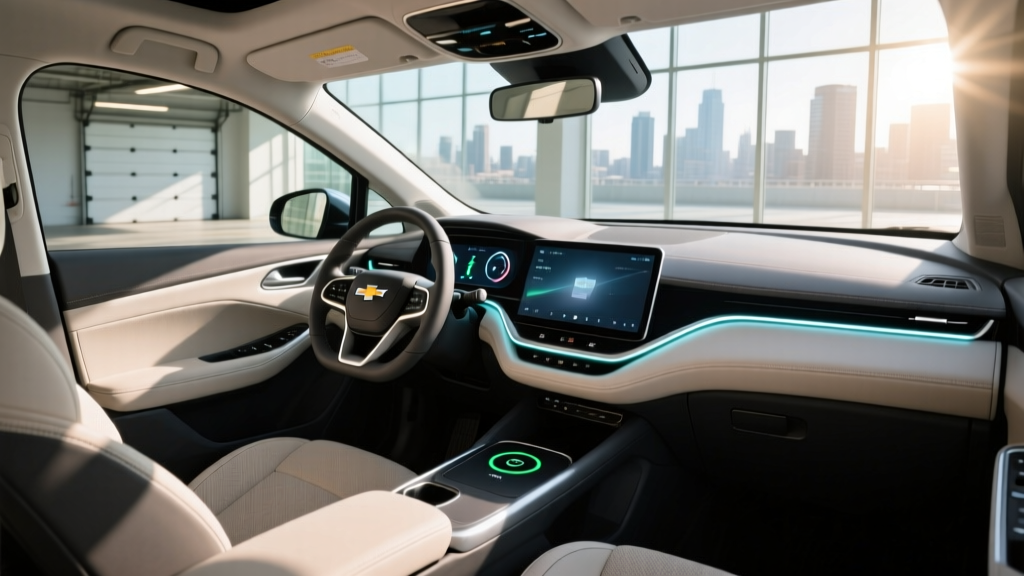
The Chevy Bolt EV interior redesign for this generation addresses nearly every complaint owners had about the 2017–2023 model. The dashboard now features a layered, soft-touch design with an 11-inch digital instrument cluster and a center-mounted 11.3-inch infotainment touchscreen running GM's latest Ultifi-based interface. Wireless Apple CarPlay and Android Auto are standard across all trims.
Material quality has taken a clear step up. The base 2LT trim uses cloth-and-leatherette seating with padded door panels and a leather-wrapped steering wheel. The top Premier trim adds perforated leatherette seats, a heated steering wheel, and ambient interior lighting. Hard plastics still appear on the lower door panels and center console sides, but they're no longer the dominant surface.
Cargo and passenger space:
- Rear legroom: 36.1 inches (adequate for adults on shorter trips)
- Cargo behind rear seats: 23.2 cu ft
- Cargo with rear seats folded: 56.4 cu ft
- No front trunk (frunk) — the Ultium platform packaging in this wheelbase doesn't accommodate one
The cabin is noticeably quieter than the first-generation Bolt, thanks to improved sound deadening and the absence of the old model's high-frequency motor whine at low speeds.
Technology & Driver Assistance
Every 2026 Bolt EV comes equipped with Chevy Safety Assist, GM's Level 2 driver-assistance suite (per SAE definitions, Level 2 requires continuous driver supervision — this is not self-driving). The package includes:
- Adaptive cruise control with stop-and-go
- Lane-keeping assist with lane-centering
- Automatic emergency braking with pedestrian detection
- Following distance indicator
- Intelligent speed assist
Super Cruise — GM's hands-free highway driving system — is available as a $2,500 option on the Premier trim and requires a mapped divided highway. It remains one of the best Level 2 systems available, with robust driver-monitoring via an infrared camera on the steering column.
The infotainment system supports over-the-air updates, and a built-in Wi-Fi hotspot is included for the first three years. One notable omission: no vehicle-to-load (V2L) capability, meaning you can't use the Bolt EV as a mobile power source for camping or outages.
Pricing, Trims & Federal Tax Credit
The 2026 Bolt EV is offered in two trims. Pricing is aggressive, positioning it as one of the most affordable new EVs in the U.S. market.
| Trim | Base MSRP | Est. Federal Credit | Effective Price |
|---|---|---|---|
| 2LT | $28,900 | Up to $7,500* | ~$21,400 |
| Premier | $33,400 | Up to $7,500* | ~$25,900 |
Federal tax credit eligibility (§30D): The Bolt EV is assembled in Orion Township, Michigan, and GM has confirmed that both trims meet the critical-minerals and battery-component sourcing requirements for the full $7,500 credit as of the 2026 tax year. However, buyer eligibility depends on:
- Income caps: Modified AGI must not exceed $150,000 (single), $225,000 (head of household), or $300,000 (joint filers).
- MSRP cap: The Bolt EV's MSRP is well under the $55,000 cap for passenger cars.
- Point-of-sale transfer: Eligible buyers can apply the credit as an immediate price reduction at the dealership rather than waiting to claim it on their tax return.
Verify current eligibility on the IRS qualified vehicles list before purchasing, as sourcing requirements and credit amounts can change.
Pros, Cons & Competitive Position
Pros
- Starting under $29,000 — one of the cheapest new EVs available
- LFP battery offers excellent longevity and daily 100% charging without degradation concerns
- Significantly upgraded interior materials and tech over the prior generation
- NACS connector provides native Supercharger access
- Strong city efficiency at 120 MPGe combined
- Qualifies for full $7,500 federal tax credit (subject to income/sourcing rules)
Cons
- 150 kW peak DC charging is slower than Hyundai/Kia and Tesla competitors
- Real-world highway range drops to ~215–230 miles at 75 mph
- LFP cold-weather range loss is more pronounced than NMC packs
- No frunk for additional cargo storage
- Super Cruise limited to Premier trim and costs $2,500 extra
- No V2L capability
Is it worth buying vs. competitors? If your budget is firm at $30,000 or less (after credit), the Bolt EV has few rivals. The Hyundai Kona Electric starts higher and offers similar range. The Tesla Model 3 RWD is faster-charging and has a stronger Supercharger network, but costs roughly $10,000 more before credits. The Bolt EV wins on pure value; it loses on road-trip charging speed and brand cachet.
Warranty & Ownership Costs
GM backs the 2026 Bolt EV with competitive warranty coverage:
- Battery & powertrain: 8 years / 100,000 miles (whichever comes first), covering capacity retention below 70% of original
- Limited vehicle warranty: 3 years / 36,000 miles bumper-to-bumper
- Corrosion coverage: 6 years / 100,000 miles
The LFP battery chemistry should provide peace of mind for long-term ownership. LFP cells are rated for 3,000+ full charge cycles before significant degradation — far more than most owners will accumulate in a decade of driving. At 15,000 miles per year, the Bolt EV's estimated annual electricity cost is approximately $550 (based on the U.S. average of $0.16/kWh), compared to roughly $1,800 in gasoline for a 30 MPG compact car.
Frequently Asked Questions
What is the real-world range of the 2026 Chevy Bolt EV?
The EPA rates it at 255 miles. In real-world highway driving at 70–75 mph, expect 215–230 miles. In freezing temperatures, LFP chemistry can reduce range to 175–200 miles without preconditioning. City commuters using regenerative braking can approach or slightly exceed the EPA number.
How fast does the Bolt EV charge at home and on the road?
At home on a 240V Level 2 charger (11.5 kW), the Bolt EV adds about 38 miles of range per hour and charges fully in roughly 6 hours. On DC fast chargers, it peaks at 150 kW and reaches 10–80% in approximately 28 minutes, though the charge curve tapers above 60%.
Does the 2026 Bolt EV qualify for the $7,500 federal tax credit?
Yes — as of the 2026 tax year, GM confirms the Bolt EV meets §30D battery-sourcing and critical-minerals requirements for the full $7,500 credit. Buyer income must fall under IRS caps ($150K single / $300K joint), and the credit can be applied at the point of sale. Always verify on the IRS qualified-vehicles list before purchase.
What's the biggest change in the Chevy Bolt EV interior redesign?
The cabin moves from hard-plastic, budget-oriented materials to a layered dashboard with soft-touch surfaces, an 11.3-inch infotainment screen, an 11-inch digital gauge cluster, and available leatherette seating. It's a substantial upgrade that brings the Bolt EV's interior quality closer to competitors like the Kona Electric and Volkswagen ID.4.
Is the Bolt EV a good road-trip car?
It's adequate but not ideal. The 255-mile range requires stops every 180–200 real-world miles on the highway, and the 150 kW peak charging rate means ~28-minute stops at 10–80%. NACS access to Superchargers helps with station availability, but vehicles like the Model 3 or Ioniq 5 with 200+ kW charging are better suited for frequent long-distance travel.