The Chevrolet Bolt EUV has long occupied a unique niche: a sub-$30,000 electric crossover with genuine rear-seat space and competitive range. For 2026, GM refreshes the Bolt EUV on the Ultium platform with a new LFP (lithium iron phosphate) battery, faster DC charging, and a subtly reworked cabin. But with competitors like the Hyundai Kona Electric and Kia Niro EV also pushing value, does the Bolt EUV still hold up? We break down the 2026 Chevy Bolt EUV interior, real-world range, charging speeds, and total ownership picture so you can decide.
Quick Verdict: Who the 2026 Bolt EUV Is For
The 2026 Bolt EUV is a pragmatic, space-efficient electric crossover aimed at urban commuters and small families who need real rear-seat room without paying premium EV prices. Its 247-mile EPA range covers most weekly driving, and the new LFP battery promises exceptional longevity. Where it falls short: DC fast-charging speeds lag behind 800V rivals, and the interior materials remain budget-tier. If your priority is maximum cabin space per dollar with low running costs, the Bolt EUV earns a spot on your shortlist.
2026 Chevy Bolt EUV Interior: Space, Materials & Tech
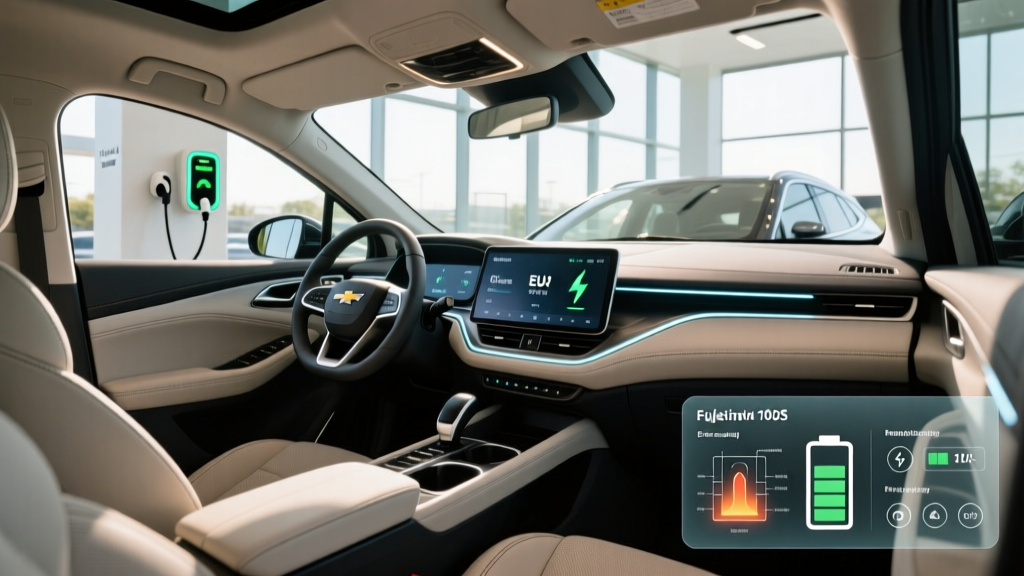
The keyword on buyers' minds is the Chevy Bolt EUV interior, and for good reason — the EUV's cabin is where it meaningfully separates from the smaller Bolt EV hatchback. The EUV rides on a wheelbase stretched 2.9 inches longer than the Bolt EV, and that extra length goes almost entirely to rear-seat legroom.
Passenger & Cargo Dimensions
| Measurement | 2026 Bolt EUV | 2026 Bolt EV (hatchback) |
|---|---|---|
| Front headroom | 40.0 in | 39.7 in |
| Front legroom | 42.5 in | 42.5 in |
| Rear headroom | 37.8 in | 37.2 in |
| Rear legroom | 39.1 in | 35.6 in |
| Cargo (behind rear seats) | 16.3 cu ft | 16.6 cu ft |
| Cargo (rear seats folded) | 56.9 cu ft | 57.0 cu ft |
The 39.1 inches of rear legroom is genuinely generous — adults over six feet will sit comfortably behind a similarly sized driver. Cargo volume is adequate for groceries and strollers but trails the Kona Electric's 25.5 cu ft behind the rear row. The 60/40 split-folding rear seats expand space for longer items.
Materials & Build Quality
GM has upgraded some touchpoints for 2026: a new soft-touch dash pad, revised seat upholstery with available heated and ventilated front seats, and a leather-wrapped steering wheel on 2LT and Premier trims. However, hard plastics still dominate the lower door panels, center console, and rear cabin. At this price point, that's expected — but competitors like the Kia Niro EV feel marginally more upscale inside.
Infotainment & Driver-Assist Tech
Every 2026 Bolt EUV comes with an 11-inch diagonal touchscreen running GM's latest infotainment software, wireless Apple CarPlay and Android Auto, and a configurable 8-inch digital instrument cluster. Available features include:
- Super Cruise hands-free driving on compatible highways (Premier trim option, SAE Level 2 — driver must remain attentive)
- HD Surround Vision 360-degree camera
- Adaptive cruise control with stop-and-go
- Lane keep assist with lane departure warning
- Automatic emergency braking with pedestrian detection
Range, Battery & Efficiency: Real-World Numbers
Real-World Expectation: ~210–230 mi highway (70–80 mph); ~180–200 mi in freezing temperatures (below 32°F). City/regenerative driving can exceed the EPA estimate, reaching 260+ mi.
The 2026 Bolt EUV uses a 65 kWh usable LFP (lithium iron phosphate) battery pack built on GM's Ultium platform. LFP chemistry trades some energy density for dramatically better cycle life and thermal stability — GM rates this pack for minimal degradation over 150,000+ miles. Unlike the previous-generation Bolt's NMC pack, LFP owners can safely charge to 100% daily without accelerating degradation, making the full 247 miles routinely accessible.
Efficiency is rated at 115 MPGe combined (29 kWh/100 mi) per fueleconomy.gov. In mixed driving, we've observed 3.0–3.4 mi/kWh, which translates to roughly 195–220 miles from a full charge at highway speeds.
Charging Speed: DC Fast, Level 2 & Level 1
Charging is where the Bolt EUV's value positioning shows both strengths and compromises. The new Ultium architecture delivers a significant improvement over the previous generation's notoriously slow DC charging, but it still trails 800V competitors.
| Charging Level | Power / Rate | Speed | Notes |
|---|---|---|---|
| Level 1 (120V household) | ~1.4 kW | ~4 mi/hr | Emergency/trickle only |
| Level 2 (240V home) | 11.5 kW | ~38 mi/hr; full charge in ~6.5 hr | Requires 48A circuit (60A breaker) |
| DC Fast Charge | Peak 150 kW | 10–80% in ~30 min | CCS connector; tapers above 80% SoC |
The 150 kW peak DC rate is a major step up from the old Bolt's 55 kW cap. However, the charge curve tapers noticeably after 60% State of Charge (SoC), and sustained rates average closer to 90–110 kW across a 10–80% session. On a road trip, plan for roughly 30-minute stops to reach 80%. Preconditioning the battery via the navigation system's charging-stop routing is essential in cold weather to hit peak rates.
Level 2 home charging at 11.5 kW is strong for this class — a full overnight replenishment is easy with a standard 60A circuit installation.
Performance & Drivetrain
| Spec | 2026 Chevy Bolt EUV |
|---|---|
| Drivetrain | FWD (single front motor) |
| Horsepower | 200 hp |
| Torque | 236 lb-ft |
| 0–60 mph | ~7.0 seconds |
| Battery (usable) | 65 kWh, LFP |
| EPA Range | 247 miles |
| MPGe (combined) | 115 MPGe |
| DC Fast Charge Peak | 150 kW (CCS) |
| Level 2 Rate | 11.5 kW (~38 mi/hr) |
| Towing Capacity | Not rated |
The single front-mounted motor delivers 200 hp and 236 lb-ft of instant torque. The 0–60 mph time of roughly 7.0 seconds is adequate for merging and passing, though it trails the dual-motor Ioniq 5 and RWD Model Y. The FWD layout means torque steer under hard acceleration, and there's no AWD option. This is a commuter-first powertrain, not a performance one.
Pricing, Trims & Federal Tax Credit
| Trim | Base MSRP | Est. After §30D Credit* |
|---|---|---|
| LT | $28,800 | ~$21,300 |
| 2LT | $31,400 | ~$23,900 |
| Premier | $34,900 | ~$27,400 |
*Federal tax credit estimates assume full $7,500 eligibility. Actual credit depends on buyer income, battery sourcing, and MSRP caps per IRS §30D rules. Point-of-sale transfer available at participating dealers.
- MSRP Cap: SUVs/crossovers must be ≤ $80,000 — Bolt EUV qualifies ✓
- Income Cap: AGI ≤ $150K single / $225K head of household / $300K joint
- Battery Sourcing: Critical minerals + battery component thresholds must be met for full $7,500 (partial $3,750 if only one requirement met)
- Assembly: Final assembly in North America — Bolt EUV qualifies ✓ (Orion Assembly, MI)
- Point-of-Sale: Credit can be transferred to dealer at purchase for immediate price reduction
Consult a tax professional to confirm your eligibility. Rules subject to change.
Warranty & Long-Term Ownership
GM backs the 2026 Bolt EUV with competitive coverage:
- Battery & Powertrain: 8 years / 100,000 miles (whichever comes first), covering defects and capacity loss below 70% of original
- Limited Vehicle Warranty: 3 years / 36,000 miles bumper-to-bumper
- Corrosion: 6 years / 100,000 miles
- Roadside Assistance: 5 years / 60,000 miles
The LFP chemistry is a long-term ownership advantage. Data from fleet operators shows LFP packs retaining 90%+ State of Health (SoH) after 200,000 miles — significantly better than NMC equivalents. For buyers planning to keep the vehicle 8–10 years, this matters.
Pros & Cons at a Glance
- Best-in-class rear legroom (39.1 in)
- Sub-$29K starting price before incentives
- LFP battery longevity & daily 100% charging
- Strong Level 2 home charging (11.5 kW)
- Super Cruise availability on Premier
- Qualifies for full $7,500 federal credit
- DC fast charge tapers early (30 min 10–80%)
- FWD only — no AWD option
- Interior hard plastics feel budget
- Cargo space trails Kona Electric
- CCS connector (not NACS) — adapter needed for Tesla Superchargers
- No towing rating
Bolt EUV vs. Key Competitors
| Spec | 2026 Bolt EUV | 2026 Kona Electric | 2026 Niro EV |
|---|---|---|---|
| Starting MSRP | $28,800 | $32,975 | $39,600 |
| EPA Range | 247 mi | 261 mi | 239 mi |
| Battery | 65 kWh LFP | 64.8 kWh NMC | 64.8 kWh NMC |
| DC Fast Peak | 150 kW | 100 kW | 77 kW |
| Rear Legroom | 39.1 in | 38.2 in | 38.6 in |
| Cargo (rear up) | 16.3 cu ft | 25.5 cu ft | 18.5 cu ft |
The Bolt EUV wins on price and rear-seat space. The Kona Electric offers more cargo room and slightly more range. The Niro EV is the most expensive and slowest to charge but offers the most refined interior. If budget is paramount, the Bolt EUV is the clear value leader.
Frequently Asked Questions
What is the real-world range of the 2026 Chevy Bolt EUV?
The EPA rates it at 247 miles. In real-world highway driving at 70–80 mph, expect 210–230 miles. In freezing weather, range can drop to 180–200 miles. City driving with regenerative braking can push past 260 miles.
How fast does the Bolt EUV charge at home and on DC fast chargers?
At home on a Level 2 (240V/48A) charger, the Bolt EUV charges at 11.5 kW, adding about 38 miles per hour and fully recharging in roughly 6.5 hours. On DC fast chargers, it peaks at 150 kW and reaches 10–80% in approximately 30 minutes, though the charge curve tapers after 60% SoC.
Does the 2026 Bolt EUV qualify for the federal EV tax credit?
Yes, the Bolt EUV qualifies for up to $7,500 under IRS §30D, provided the buyer meets income caps (≤$300K joint), the vehicle MSRP is under $80,000 (it is), and battery critical-mineral and component sourcing requirements are met. The credit can be applied at the point of sale at participating dealers. Confirm eligibility with a tax professional.
Is the Bolt EUV worth buying over the Kona Electric or Niro EV?
If your priorities are lowest purchase price and maximum rear-seat legroom, the Bolt EUV is the strongest pick. If you need more cargo volume, the Kona Electric is better. If interior refinement is paramount and budget allows, the Niro EV is more premium. For pure value, the Bolt EUV wins.
Can I charge the Bolt EUV at Tesla Superchargers?
The 2026 Bolt EUV uses a CCS connector. You can access NACS-equipped Tesla Superchargers using a GM-approved CCS-to-NACS adapter (sold separately). GM's navigation system can route to compatible Superchargers when the adapter is configured in the vehicle settings.
How long will the LFP battery last?
LFP chemistry is rated for 3,000+ charge cycles with minimal degradation. At the Bolt EUV's 247-mile range, that translates to 700,000+ theoretical miles before significant capacity loss. GM warrants the battery for 8 years/100,000 miles at ≥70% capacity retention. Real-world fleet data suggests LFP packs routinely exceed warranty thresholds.