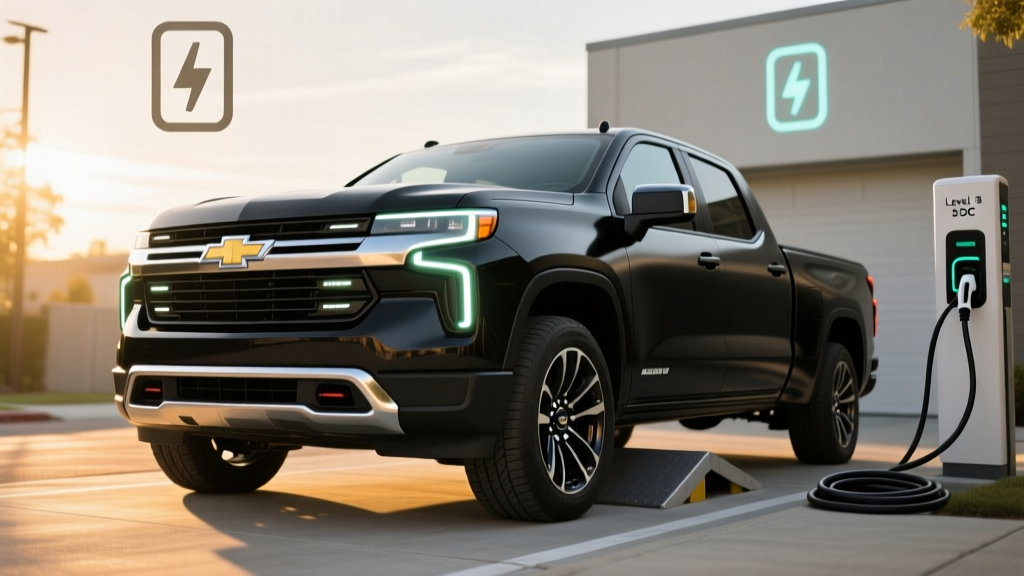
The 2026 Chevrolet Silverado EV LT is the mainstream workhorse of Chevy's electric truck lineup. Sitting below the premium RST and above the commercial-focused WT (Work Truck), the LT trim targets fleet buyers, contractors, and everyday truck owners who need capability without paying for performance-truck theatrics. Built on GM's Ultium platform with a dual-motor AWD layout, the Silverado EV LT offers serious payload, fast DC charging, and a usable battery pack that prioritizes longevity over maximum range. Here's everything you need to know before you buy.
Range, Battery, and Real-World Efficiency
Real-World Expectation: Plan for ~310–340 miles on extended-range highway trips at 70+ mph; cold-weather (below 30°F) can reduce range by 20–30%, dropping usable miles to roughly 270–310 on the Extended Range pack.
The 2026 Silverado EV LT comes in two battery configurations. The Standard Range model carries an estimated ~170 kWh usable Ultium battery (NMC lithium-ion chemistry), while the Extended Range variant pushes that to approximately ~200 kWh usable — one of the largest battery packs in any production vehicle. GM uses a double-stacked pouch-cell architecture across the Ultium platform, which aids thermal management but adds significant weight (curb weight exceeds 8,700 lbs on Extended Range models).
NMC chemistry gives the Silverado EV LT higher energy density than LFP alternatives, meaning more range per pound — critical for a truck this size. The trade-off is that NMC cells are more sensitive to sustained high state-of-charge storage; GM recommends daily charging to 80% and only charging to 100% before long trips to maximize long-term battery health.
Efficiency on the EPA cycle lands around 56 MPGe combined for the Standard Range LT and roughly 52 MPGe for the Extended Range (heavier pack). In terms of energy consumption, expect approximately 60–64 kWh per 100 miles in mixed driving. Highway-only efficiency is worse — closer to 68–72 kWh/100mi at sustained 75 mph speeds, which is typical for a large, boxy truck fighting aerodynamic drag.
| Spec | Standard Range LT | Extended Range LT |
|---|---|---|
| EPA Range | ~390 mi | ~460 mi |
| Battery (usable) | ~170 kWh (NMC) | ~200 kWh (NMC) |
| Drivetrain | Dual-Motor AWD | Dual-Motor AWD |
| Horsepower | ~510 hp | ~645 hp |
| 0–60 mph | ~5.5 sec | ~4.5 sec |
| Max DC Charge Rate | ~350 kW | ~350 kW |
| 10–80% DC Charge | ~32 min | ~40 min |
| Level 2 Charge Rate | 19.2 kW (~52 mi/hr) | 19.2 kW (~52 mi/hr) |
| Max Towing | 10,000 lbs | 10,000 lbs |
| Max Payload | ~1,800 lbs | ~1,600 lbs |
| MPGe (combined) | ~56 MPGe | ~52 MPGe |
| Base MSRP | ~$55,000 | ~$63,000 |
Charging Speed: DC Fast and Home Level 2
The Silverado EV LT supports up to 350 kW peak DC fast charging on compatible CCS/NACS stations. However — and this is critical — peak rate is not sustained rate. The charge curve on the Ultium platform ramps quickly to ~300–350 kW between 10–30% SoC, then progressively tapers. By 60% SoC, you'll see roughly 180–220 kW, and above 80%, the rate drops sharply to protect cell health.
For the Standard Range (~170 kWh pack), a 10–80% session takes approximately 32 minutes on a 350 kW-capable station. The Extended Range (~200 kWh pack) needs closer to 40 minutes for the same 10–80% window — the larger battery takes longer even at the same peak charge rate.
| Charge Level | Power (kW) | Miles of Range Added per Hour | Full Charge Time (10–100%) |
|---|---|---|---|
| Level 1 (120V / 12A) | ~1.4 kW | ~3 mi/hr | ~6+ days (Extended Range) |
| Level 2 (240V / 80A) | 19.2 kW | ~52 mi/hr | ~9–11 hours |
| DC Fast (peak 350 kW) | Up to 350 kW | ~700+ mi/hr (peak) | 10–80% in ~32–40 min |
At home, the Silverado EV LT accepts up to 19.2 kW on Level 2 (240V, 80-amp circuit, requiring a 100-amp breaker). This is one of the highest AC charge rates available in any EV, and it means you can add roughly 52 miles of range per hour of charging. A full overnight charge (10 hours) replenishes about 500 miles — more than enough to top off even the Extended Range pack while you sleep.
Home charging installation note: A 19.2 kW Level 2 setup requires a 100-amp dedicated breaker and 80-amp continuous circuit. Many homes with 200-amp main panels will need a panel upgrade (adding $2,000–$4,000 to installation). Always have a licensed electrician evaluate your panel capacity before purchasing a charger. The Silverado EV LT uses the NACS (Tesla-style) connector for the 2026 model year, with CCS adapter compatibility for non-Tesla networks.
Performance and Drivetrain
Every 2026 Silverado EV LT comes with dual-motor all-wheel drive as standard. The Standard Range produces approximately 510 horsepower and hits 0–60 mph in about 5.5 seconds. The Extended Range bumps output to roughly 645 hp with a 0–60 time near 4.5 seconds — genuinely quick for a truck that weighs over four tons.
GM's e4WD system distributes torque independently between front and rear motors, providing excellent traction in rain, snow, and off-road conditions. The truck also features an adaptive air suspension on higher trims (available as an option on the LT), which aids both ride comfort and aerodynamic efficiency at highway speeds by lowering the ride height automatically.
Towing capacity is rated at 10,000 pounds across both battery configurations when properly equipped with the Max Tow package. Payload ranges from approximately 1,600 lbs (Extended Range, due to heavier battery) to 1,800 lbs (Standard Range). For context, a gas-powered Silverado 1500 can tow up to ~13,300 lbs, so heavy-duty towing buyers may still prefer the ICE variant — but for boat trailers, campers, and utility trailers under 10,000 lbs, the EV is fully capable.
Range impact of towing: Expect a 40–50% range reduction when towing near max capacity at highway speeds. A 460-mile Extended Range truck may deliver only 230–275 miles while towing 9,000+ lbs. Plan charging stops accordingly.
Pricing, Tax Credits, and Ownership Cost
The 2026 Silverado EV LT starts at an estimated $55,000 MSRP for the Standard Range and $63,000 for the Extended Range. Add destination charges (~$1,995) and common options (Max Tow package, premium audio, bed accessories) and a well-equipped Extended Range LT can reach $68,000–$72,000 before incentives.
| Trim | Base MSRP | As-Tested (typical) | Federal §30D Credit | Effective Price |
|---|---|---|---|---|
| LT Standard Range | ~$55,000 | ~$58,000 | Up to $7,500* | ~$50,500 |
| LT Extended Range | ~$63,000 | ~$68,000 | Up to $7,500* | ~$60,500 |
*Federal tax credit caveats: The IRS §30D Clean Vehicle Credit provides up to $7,500, but eligibility depends on multiple factors that change frequently:
- MSRP cap: Trucks/vans/SUVs must have an MSRP at or below $80,000 (the Silverado EV LT qualifies).
- Buyer income cap: Modified AGI must not exceed $150,000 (single), $225,000 (head of household), or $300,000 (joint filers).
- Battery sourcing: The $7,500 credit splits into two halves — $3,750 for critical minerals and $3,750 for battery components, each with escalating domestic-content thresholds that tighten annually. Check the latest IRS guidance for current-year sourcing requirements.
- Point-of-sale transfer: As of 2024+, you can transfer the credit to the dealer at purchase, reducing your out-of-pocket cost immediately rather than waiting for tax filing.
Always confirm your specific eligibility with a tax professional and verify the vehicle's credit status on fueleconomy.gov before purchasing. State and local incentives may stack on top — check your state's energy office for details.
Interior, Cargo, and Technology
The Silverado EV LT uses GM's 17.7-inch diagonal infotainment touchscreen running the latest Google Built-in system with native Google Maps navigation, Google Assistant voice control, and access to the Play Store for apps. A 11-inch digital driver display replaces traditional gauges. Wireless Apple CarPlay and Android Auto are standard, along with a Wi-Fi hotspot.
Passenger space is generous. Front legroom measures approximately 44.5 inches, with rear legroom at 43.1 inches — competitive with crew-cab gas Silverados. The flat floor (no transmission tunnel) makes the rear middle seat genuinely usable for adults on longer trips.
The 5-foot bed (shorter than the gas Silverado's 5'8" or 6'6" options) offers about 53 cubic feet of cargo volume. The Multi-Flex tailgate includes a load-stop feature and integrated steps. A front trunk (frunk) adds approximately 10.2 cubic feet of lockable, weatherproof storage — useful for tools, charging cables, or groceries.
ProPower Onboard equivalent: The Silverado EV LT supports up to 9.6 kW of vehicle-to-load (V2L) power through bed-mounted and cabin outlets, enough to run power tools at a job site, tailgate appliances, or provide emergency home backup during outages. This is a standout feature for contractors and outdoor enthusiasts.
Driver assistance comes via Chevy Safety Assist and available Super Cruise (GM's hands-free highway driving system — SAE Level 2, requiring driver attention at all times). Super Cruise works on over 750,000 miles of mapped highways in North America and includes automatic lane changes on supported routes. It is not self-driving — you must remain alert and keep your eyes on the road.
Pros, Cons, and the Competition
Pros
- Class-leading 19.2 kW Level 2 home charging speed
- 9.6 kW V2L power output for job-site and emergency use
- Up to 460 miles EPA range (Extended Range)
- Strong 10,000-lb towing capacity
- Spacious crew-cab interior with flat floor
- Super Cruise hands-free driving on mapped highways
- Qualifies for up to $7,500 federal tax credit (verify eligibility)
Cons
- Very heavy — 8,700+ lbs hurts efficiency and tire wear
- 5-foot bed is shorter than gas Silverado options
- Extended Range DC charge takes ~40 min (10–80%) due to large battery
- Towing cuts range by 40–50%
- Home charging install may require panel upgrade ($2K–$4K extra)
- Starting price above $55K even before options
- NMC battery requires 80% daily charge discipline for longevity
Versus the competition: The Silverado EV LT competes directly with the Ford F-150 Lightning (Lariat/XLT trims), the Rivian R1T (Dual-Motor), and the Tesla Cybertruck (AWD). The F-150 Lightning is lighter and more efficient but offers less range and slower Level 2 charging. The R1T is more refined and off-road capable but significantly pricier. The Cybertruck offers polarizing styling and a stainless exoskeleton but has a smaller bed and no traditional tailgate. The Silverado EV LT's combination of high Level 2 charge speed, large battery, and V2L capability makes it the best choice for buyers who prioritize home charging speed and job-site utility.
Warranty and Battery Longevity
Chevrolet covers the 2026 Silverado EV LT with a 3-year/36,000-mile bumper-to-bumper warranty and a 5-year/60,000-mile powertrain warranty. The battery pack carries an 8-year/100,000-mile warranty against defects and excessive degradation — GM guarantees the battery will retain at least 70% of its original capacity during the warranty period. Based on Ultium platform data from earlier GM EVs, real-world degradation over 100,000 miles is expected to be in the 8–12% range under normal use, meaning most owners will retain 88–92% capacity well within the warranty window.
Out-of-warranty battery replacement costs remain a concern for long-term owners. Current estimates for an Ultium pack replacement range from $15,000 to $25,000 depending on the configuration, though prices are expected to decline as battery costs fall and recycling infrastructure matures.
Frequently Asked Questions
What is the real-world range of the 2026 Silverado EV LT?
The EPA rates the Extended Range LT at approximately 460 miles and the Standard Range at 390 miles. In real-world highway driving at 70–75 mph, expect about 310–340 miles (Extended) and 270–300 miles (Standard). Cold weather below 30°F can reduce those figures by 20–30%. Towing near max capacity cuts range roughly in half.
How fast does the Silverado EV LT charge?
On a 350 kW DC fast charger, the Standard Range LT charges from 10–80% in approximately 32 minutes; the Extended Range takes about 40 minutes. At home on a 19.2 kW Level 2 charger, both versions add roughly 52 miles of range per hour, with a full overnight charge replenishing the entire battery.
Does the 2026 Silverado EV LT qualify for the federal EV tax credit?
It is eligible for up to $7,500 under IRS §30D, provided the buyer meets income caps ($150K single / $300K joint), the MSRP is under $80,000 (it is), and the battery meets current-year critical-mineral and component sourcing thresholds. The credit can be transferred to the dealer at point of sale. Always verify current eligibility on IRS.gov and consult a tax professional.
Is the Silverado EV LT worth buying vs the F-150 Lightning or Rivian R1T?
Choose the Silverado EV LT if you need the fastest home Level 2 charging (19.2 kW), high V2L output for job-site tools, and maximum range in a full-size truck. Choose the F-150 Lightning if you want a lighter, more efficient truck with a longer bed. Choose the Rivian R1T if you prioritize off-road capability and premium interior quality and are willing to pay more.
Can I tow with the Silverado EV LT?
Yes — up to 10,000 lbs when properly equipped. However, towing significantly impacts range (expect a 40–50% reduction). For frequent heavy towing over long distances, a diesel or gas truck may still be more practical. For local towing and moderate distances with planned charging, the Silverado EV LT handles the task well.
What battery chemistry does the Silverado EV LT use?
The 2026 Silverado EV LT uses GM's Ultium NMC (nickel manganese cobalt) lithium-ion pouch cells. NMC offers higher energy density than LFP chemistry, which is important for a truck this size. For best longevity, charge to 80% daily and only charge to 100% before long trips.
Sources: EPA Fuel Economy, Chevrolet Silverado EV Configurator, IRS Clean Vehicle Credits.