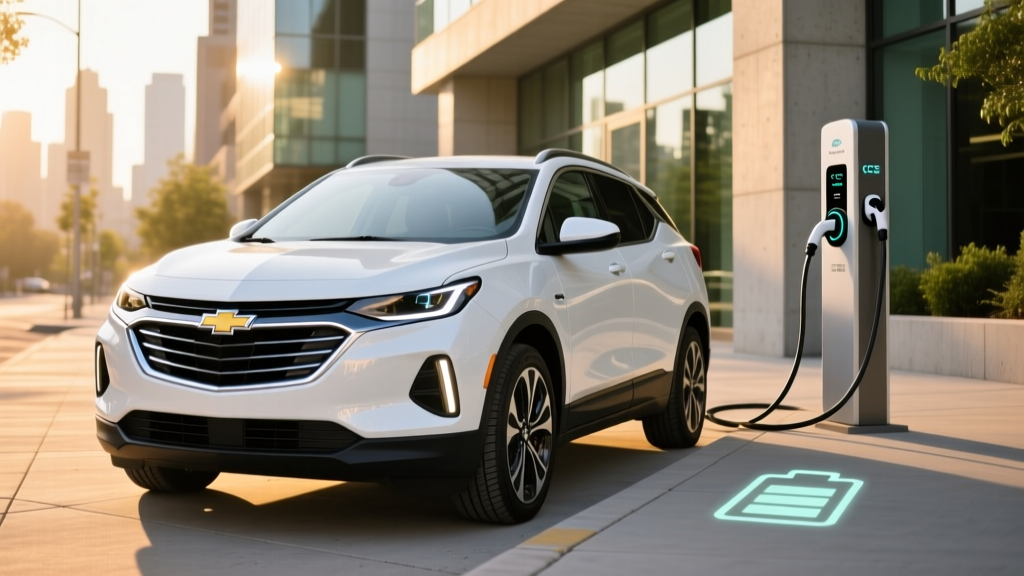
The 2026 Chevrolet Equinox EV occupies a rare position in the electric vehicle market: a mainstream, midsize electric crossover that undercuts most competitors on price while delivering over 300 miles of EPA-estimated range. After spending time with Chevy's Ultium-based compact SUV, we've compiled the exact numbers buyers need — from real-world highway range and DC fast-charging curves to federal tax credit eligibility under current IRS §30D rules.
This isn't a luxury EV pretending to be practical. The Equinox EV is engineered for the buyer who wants electric commuting without the premium badge tax, and for 2026, Chevrolet has refined the formula with updated software, improved thermal management, and broader trim availability. Here's what the spec sheet actually means for your daily driving and wallet.
2026 Equinox EV Specs at a Glance
| Specification | 2LT (FWD) | 3LT (FWD) | RS (AWD) |
|---|---|---|---|
| EPA Range | 319 mi | 319 mi | 285 mi |
| Battery (usable) | 85 kWh | 85 kWh | 85 kWh |
| Chemistry | NMC (Ultium) | NMC (Ultium) | NMC (Ultium) |
| Horsepower | 213 hp | 213 hp | 288 hp |
| 0-60 mph | 8.3 sec | 8.3 sec | 5.9 sec |
| Max DC Charge | 150 kW | 150 kW | 150 kW |
| 10-80% DC Time | ~34 min | ~34 min | ~34 min |
| Level 2 Rate | 11.5 kW | 11.5 kW | 11.5 kW |
| MPGe (combined) | 109 MPGe | 109 MPGe | 95 MPGe |
| Base MSRP | $33,600 | $36,300 | $43,400 |
Range and Efficiency: What the EPA Number Doesn't Tell You
The front-wheel-drive 2026 Equinox EV carries an EPA-estimated 319 miles of range on a full charge, placing it among the longest-range vehicles in its price class. The all-wheel-drive RS trim drops to 285 miles — a meaningful 34-mile penalty for the dual-motor traction advantage.
Efficiency lands at 109 MPGe combined for FWD trims, which equates to roughly 31 kWh per 100 miles. That's competitive with the Hyundai Ioniq 5 and slightly behind the Tesla Model Y, but the Equinox EV's lower purchase price offsets the marginal per-mile electricity cost difference for most buyers.
Charging Speed: DC Fast Charging and Home Setup
The Equinox EV's 85 kWh Ultium battery accepts up to 150 kW on a DC fast charger. Chevrolet quotes a 10–80% charge time of approximately 34 minutes. In practice, the charge curve peaks near 150 kW only between roughly 15% and 40% state of charge, then tapers progressively — dropping to around 90–100 kW by 60% and slowing further above 80%. This is standard behavior for NMC chemistry and thermal management protecting the pack, but it means a 10–90% session will take closer to 50 minutes.
| Charging Level | Power | Miles Added per Hour | Typical Use Case |
|---|---|---|---|
| Level 1 (120V) | 1.4 kW | ~4 mi/hr | Emergency / overnight trickle |
| Level 2 (240V, 48A) | 11.5 kW | ~34 mi/hr | Home / workplace daily charging |
| DC Fast Charge | 150 kW peak | ~170 mi in 20 min | Road trips / public stations |
For home charging, the Equinox EV's 11.5 kW onboard charger is a strong point. On a properly installed 240V/48A Level 2 circuit, you'll recover roughly 34 miles of range per hour — meaning a full overnight session (8–10 hours) easily replenishes a depleted battery. Most daily commuters will need only 2–3 hours of Level 2 charging to replace their daily driving. Budget $500–$1,500 for a quality Level 2 home charger plus professional installation by a licensed electrician, depending on your panel capacity and run length.
The Equinox EV uses the CCS1 connector for DC fast charging on 2LT and 3LT trims. Chevrolet has confirmed that NACS (Tesla Supercharger-compatible) adoption is rolling out across the Ultium lineup, and 2026 models may ship with either a native NACS port or an included adapter depending on production date. Verify your specific vehicle's connector at purchase — this directly affects your access to Tesla's Supercharger network, which remains the most reliable DC fast-charging infrastructure in the U.S.
Performance and Drivetrain
The front-wheel-drive Equinox EV produces 213 horsepower from its single front-mounted motor, delivering a 0–60 mph time of approximately 8.3 seconds. It's adequate for merging and passing but won't win stoplight races. The ride quality is composed, with the Ultium platform's low center of gravity contributing to confident handling that belies the vehicle's curb weight of roughly 4,500 pounds.
Step up to the RS trim with dual-motor all-wheel drive, and output rises to 288 horsepower with a 0–60 time of 5.9 seconds. The AWD system provides tangible traction benefits in rain and snow, and the additional torque makes highway overtaking noticeably easier. The trade-off is the 34-mile range reduction and a $7,000+ price premium over the base 2LT.
Towing capacity is rated at 1,500 pounds across all trims — sufficient for a small utility trailer or a couple of dirt bikes, but not a boat or camper. This is a family crossover, not a truck substitute.
Pricing, Trims, and Federal Tax Credit Eligibility
The 2026 Equinox EV lineup starts at $33,600 for the 2LT FWD, making it one of the most affordable 300+ mile EVs available new. The mid-range 3LT FWD adds premium features at $36,300, while the performance-oriented RS AWD tops out at $43,400. Destination charges add approximately $1,395.
| Trim | MSRP | Est. §30D Credit | Effective Price |
|---|---|---|---|
| 2LT FWD | $33,600 | Up to $7,500* | From ~$26,100 |
| 3LT FWD | $36,300 | Up to $7,500* | From ~$28,800 |
| RS AWD | $43,400 | Up to $7,500* | From ~$35,900 |
*Federal tax credit eligibility under IRS §30D is subject to multiple requirements that change periodically:
- MSRP Cap: SUVs must not exceed $80,000 — all Equinox EV trims qualify.
- Buyer Income Limits: Modified AGI must not exceed $150,000 (single), $225,000 (head of household), or $300,000 (joint). Check your tax situation.
- Battery Sourcing: The credit is split into two $3,750 halves — one for critical minerals sourcing and one for battery component manufacturing. GM's Ultium batteries are assembled in the U.S., but critical mineral sourcing requirements tighten annually. Verify current-year eligibility on the IRS qualified vehicles list before purchase.
- Point-of-Sale Transfer: As of 2024+, eligible buyers can transfer the credit to the dealer at purchase for an immediate price reduction, rather than waiting to claim it on their tax return.
Consult a tax professional and confirm the Equinox EV's current status on the IRS qualified manufacturer list before finalizing your purchase. Credit rules have changed multiple times since 2023 and may shift again.
Interior, Cargo, and Daily Practicality
The Equinox EV's interior is a significant step up from the outgoing gas Equinox, anchored by a 17.7-inch diagonal infotainment touchscreen running Google Built-In. The system includes native Google Maps navigation (which integrates real-time charging station routing), Google Assistant voice control, and access to the Play Store for streaming apps. Wireless Apple CarPlay and Android Auto are standard.
Passenger space is generous for the segment: front legroom measures 42.1 inches, with 37.8 inches in the rear — enough for adults on longer trips without complaint. The flat floor (thanks to the Ultium skateboard platform) makes the rear middle seat genuinely usable, unlike many gas-era crossovers with a driveshaft hump.
Cargo volume behind the second row is 26.4 cubic feet, expanding to 57.2 cubic feet with the rear seats folded. There is no front trunk (frunk) — the space is occupied by HVAC and power electronics. For comparison, the Hyundai Ioniq 5 offers slightly more rear cargo space, while the Tesla Model Y provides additional frunk storage.
Driver Assistance and Safety Technology
Every 2026 Equinox EV comes equipped with Chevy Safety Assist, which includes automatic emergency braking with pedestrian detection, forward collision alert, lane keep assist with lane departure warning, following distance indicator, and automatic high beams. Adaptive cruise control is available on 3LT and standard on RS trims.
Super Cruise, when equipped, is one of the best Level 2 highway systems available — smooth lane centering, reliable hands-free operation on compatible roads, and a driver monitoring system that is less intrusive than Ford's BlueCruise camera placement. However, it only operates on approximately 400,000+ miles of pre-mapped divided highways in the U.S. and Canada. Off those roads, you're back to standard adaptive cruise and lane centering.
Warranty and Battery Longevity
Chevrolet backs the 2026 Equinox EV's battery and propulsion system with an 8-year/100,000-mile warranty, covering defects and capacity loss below 70% of original capacity. The limited vehicle warranty is 3 years/36,000 miles bumper-to-bumper and 5 years/60,000 miles powertrain.
The Ultium NMC battery pack is liquid-cooled and actively thermally managed, which is critical for long-term degradation control. GM has published limited long-term degradation data specific to the Equinox EV, but Ultium-based vehicles in fleet service (BrightDrop vans, early Lyriq units) have shown modest degradation curves consistent with modern NMC packs — typically 8–12% capacity loss over the first 100,000 miles under normal use patterns. Avoid habitual DC fast charging above 90% state of charge and frequent deep discharges to 0% for optimal longevity.
Pros and Cons
- 319-mile EPA range at a $33,600 starting price is exceptional value
- Spacious interior with class-leading rear legroom
- 17.7-inch Google Built-In infotainment is responsive and feature-rich
- 11.5 kW Level 2 charging is fast for the class
- Super Cruise availability for hands-free highway driving
- Qualifies for up to $7,500 federal tax credit (verify eligibility)
- 150 kW DC fast charging is slower than Hyundai/Kia's 800V competitors (240+ kW)
- No front trunk (frunk) for additional storage
- FWD 0-60 time of 8.3 seconds is leisurely for an EV
- AWD range penalty of 34 miles is steep
- CCS-to-NACS transition may require adapter verification at purchase
- 1,500-lb towing capacity limits utility use
Who Should Buy the 2026 Equinox EV?
Choose the Equinox EV if: You want a 300+ mile electric crossover under $35,000 (before credits) for daily commuting and family duty, you charge primarily at home, and you value interior space and infotainment technology over sporty acceleration or ultra-fast road-trip charging.
Look elsewhere if: You need frequent 300+ mile road trips where 150 kW charging adds 15–20 minutes per stop versus an Ioniq 5 or Model Y, you require AWD without a significant range trade-off, or you need towing capacity above 1,500 pounds.
The Equinox EV's natural competitors are the Hyundai Ioniq 5 (faster charging, slightly higher price), Tesla Model Y (Supercharger network, less interior refinement), and Ford Mustang Mach-E (more engaging to drive, higher starting price). Against all three, the Equinox EV wins on upfront value — particularly after the federal tax credit — but concedes ground on charging speed and performance.
Frequently Asked Questions
What is the real-world range of the 2026 Chevrolet Equinox EV?
The EPA estimates 319 miles for FWD trims and 285 miles for AWD. Real-world highway driving at 70–75 mph typically yields 260–285 miles (FWD) or 235–255 miles (AWD). Cold weather below freezing can reduce range by 15–25%, especially without battery preconditioning. City drivers using regenerative braking will see numbers closest to the EPA rating.
How fast does the Equinox EV charge?
On a DC fast charger, the Equinox EV peaks at 150 kW and charges from 10–80% in approximately 34 minutes. At home on a 240V Level 2 charger (11.5 kW), it adds about 34 miles of range per hour, fully recharging overnight. Level 1 (120V) trickle charging adds roughly 4 miles per hour and is only practical for emergencies or very low daily mileage.
Does the 2026 Equinox EV qualify for the $7,500 federal tax credit?
The Equinox EV is expected to qualify for up to $7,500 under IRS §30D, but eligibility depends on your income (AGI caps apply), the vehicle's battery sourcing compliance (which tightens annually), and the MSRP staying under the $80,000 SUV cap — which all trims do. The credit can be transferred to the dealer at point of sale for an immediate price reduction. Always verify current eligibility on the IRS qualified vehicles list and consult a tax professional before purchasing.
Is the Equinox EV worth buying over the Tesla Model Y or Hyundai Ioniq 5?
It depends on priorities. The Equinox EV offers the lowest effective price after tax credits and the most traditional crossover experience. The Ioniq 5 charges significantly faster (up to 240 kW on 800V architecture) and is better for road-trippers. The Model Y provides access to the Supercharger network and more cargo space, but at a higher price and with a starker interior. If home charging is your primary routine and budget is the deciding factor, the Equinox EV is the strongest value proposition in the segment.
What is the battery warranty on the Equinox EV?
Chevrolet provides an 8-year/100,000-mile warranty on the battery and electric propulsion components, covering defects and capacity degradation below 70% of original capacity. The Ultium NMC pack is liquid-cooled for thermal management, which supports long-term health. Avoid repeated deep discharges and habitual 100% charges to maximize longevity.
Can I use Tesla Superchargers with the Equinox EV?
Chevrolet is transitioning the Ultium fleet to NACS (Tesla's charging standard). Depending on your vehicle's production date, the 2026 Equinox EV may ship with a native NACS port or include a CCS-to-NACS adapter. Confirm the connector configuration with your dealer before purchase, as it determines direct Supercharger access versus adapter-dependent charging.