The Chevrolet Bolt EV returns for 2026 with a refreshed platform, a lithium iron phosphate (LFP) battery, and one of the most practical cabins in the sub-$30,000 EV segment. While its charging speeds remain its weakest link, the Bolt EV continues to offer class-leading interior space and a compelling value proposition for urban commuters and budget-conscious EV buyers. Here is everything you need to know about the 2026 Bolt EV — from the cabin dimensions that make it surprisingly roomy, to the real-world range and charging realities that will shape your ownership experience.
2026 Bolt EV Interior: Cabin Space, Materials, and Tech
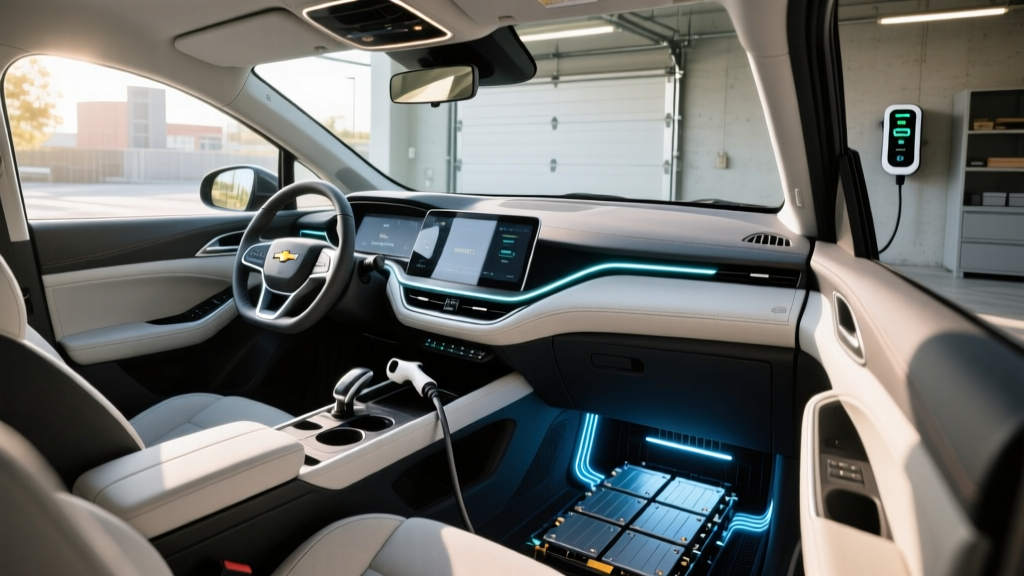
The keyword drawing buyers to this review — Chevrolet Bolt EV interior — deserves thorough treatment because the cabin is where this compact hatchback punches well above its price class. Chevrolet has carried over the roomy proportions of the previous generation while updating the infotainment stack and material quality for 2026.
Front passengers get 42.3 inches of legroom and 40.0 inches of headroom, which rivals midsize sedans. Rear-seat legroom measures 35.7 inches — adequate for adults on shorter trips, though taller riders will notice the sloping roofline cuts into headroom. The seats themselves are upholstered in a durable cloth on the base 1LT trim, with a synthetic leather option (EvoTex) on the 2LT and Premier trims. The seating position is elevated compared to most hatchbacks, giving a commanding view of the road that many buyers prefer.
The dashboard is dominated by an 11.0-inch diagonal touchscreen running Chevrolet's latest Infotainment 4 system with wireless Apple CarPlay and Android Auto. A 10.2-inch digital driver display replaces the old instrument cluster, providing customizable readouts for range, energy flow, and navigation. Physical climate controls remain — a welcome decision over the touch-capacitive sliders plaguing some competitors.
Cargo space measures 22.4 cubic feet behind the rear seats and expands to 57.0 cubic feet with the 60/40 split rear seats folded flat. That is competitive with the Hyundai Kona Electric (25.8/55.5 cu ft) and substantially more than the Nissan LEAF (23.6/53.0 cu ft). A shallow under-floor storage compartment holds the included mobile charging cord, though there is no front trunk (frunk).
Range, Battery, and Real-World Efficiency
The 2026 Bolt EV is powered by a 65 kWh usable lithium iron phosphate (LFP) battery pack. LFP chemistry trades some energy density for longer cycle life, better thermal stability, and lower cost — a smart choice for an affordable commuter EV. Chevrolet and the EPA rate the Bolt EV at 259 miles of combined range.
The LFP battery also allows Chevrolet to recommend regular charging to 100% without the degradation concerns associated with NMC chemistries — a practical advantage for daily drivers who want maximum range every morning without managing state-of-charge limits.
Charging Speeds: DC Fast, Level 2, and Level 1
Charging remains the Bolt EV's most debated specification. The 2026 model sees a modest improvement over its predecessor, but DC fast-charging speeds still lag behind competitors built on 800V architectures.
| Level | Power / Rate | Speed | Notes |
|---|---|---|---|
| Level 1 (120V) | 1.4 kW | ~4 miles/hr | Emergency/trickle only |
| Level 2 (240V, 48A) | 11.5 kW | ~34 miles/hr | Full charge in ~6 hours |
| DC Fast Charge | 85 kW peak | ~150 miles in 30 min | 10–80% in ~35 min |
The 85 kW peak DC fast-charge rate is the Bolt EV's most significant limitation. On a road trip, a 10–80% session takes approximately 35 minutes, compared to 18–22 minutes for competitors like the Hyundai Ioniq 5 (peak 240 kW) or Kia EV6. The charge curve is relatively flat from 10% to about 55%, then tapers to 45–50 kW above 70% state of charge. This means highway road trips are feasible but require more patience and planning.
For home charging, the 11.5 kW onboard charger is a strength. A full overnight charge from empty takes roughly six hours on a 48-amp Level 2 circuit — more than sufficient for daily commuting. The Bolt EV uses the NACS (Tesla-style) connector for the 2026 model year, granting access to Tesla Supercharger stations via Chevrolet's native charge port. CCS adapter compatibility is also available for Electrify America and other networks.
Performance and Drivetrain
The 2026 Bolt EV is powered by a single front-mounted permanent-magnet electric motor producing 200 horsepower and 266 lb-ft of torque. Power is sent exclusively to the front wheels — no all-wheel-drive option is available.
| Spec | Value |
|---|---|
| EPA Range | 259 miles |
| Battery (usable) | 65 kWh, LFP |
| Motor Output | 200 hp / 266 lb-ft |
| 0–60 mph | ~6.5 seconds |
| Drivetrain | FWD, single motor |
| MPGe (combined) | 120 MPGe |
| Max DC Charge | 85 kW peak |
| Level 2 Rate | 11.5 kW (~34 mi/hr) |
| Cargo Volume | 22.4 / 57.0 cu ft |
| Base MSRP (1LT) | $26,900 |
| Battery Warranty | 8 yr / 100,000 mi |
The 0–60 mph time of approximately 6.5 seconds is respectable for a front-drive hatchback and makes merging and passing effortless. Regenerative braking offers multiple modes selectable via steering-wheel paddles, including a one-pedal driving mode that can bring the car to a complete stop without touching the brake pedal. Ride quality is comfortable around town, though the relatively narrow 215/50R17 tires can struggle for traction on wet pavement under hard acceleration — a common trait of torque-heavy FWD EVs.
Pricing, Trims, and Federal Tax Credit
The 2026 Bolt EV is offered in three trims. Pricing starts at a remarkably accessible level, and federal tax credit eligibility further strengthens the value equation.
| Trim | MSRP | Est. After §30D Credit* |
|---|---|---|
| 1LT | $26,900 | ~$19,400 |
| 2LT | $29,400 | ~$21,900 |
| Premier | $32,800 | ~$25,300 |
*Estimated after $7,500 federal tax credit. Actual eligibility depends on IRS §30D requirements including buyer income caps ($150K single / $300K joint AGI), vehicle MSRP caps ($55,000 for cars), and battery critical-mineral and component sourcing rules. The Bolt EV qualifies as a car under the $55,000 MSRP cap across all trims. The credit can be transferred to the dealer at point of sale as an instant rebate under current IRS rules. Always verify eligibility with a tax professional and consult the latest guidance at irs.gov.
- 1LT ($26,900): 11-inch touchscreen, wireless CarPlay/Android Auto, cloth seats, 17-inch wheels, Chevy Safety Assist suite, dual-zone climate.
- 2LT ($29,400): Adds heated front seats, heated steering wheel, EvoTex upholstery, 360-degree camera, adaptive cruise control, Bose premium audio.
- Premier ($32,800): Adds leather-appointed seats, ventilated front seats, power driver seat with memory, 18-inch alloy wheels, wireless phone charging pad, premium interior lighting.
Driver Assistance and Safety Technology
Every 2026 Bolt EV comes standard with Chevy Safety Assist, which includes automatic emergency braking with pedestrian detection, forward collision alert, lane keep assist with lane departure warning, following distance indicator, and IntelliBeam automatic high beams. The available adaptive cruise control (2LT and above) works well in highway traffic but is a SAE Level 2 driver-assistance system — the driver must remain fully engaged with hands on the wheel and eyes on the road at all times. This is not autonomous driving.
The Bolt EV has not yet been crash-tested by the NHTSA or IIHS in its 2026 configuration. The previous-generation Bolt earned an IIHS Top Safety Pick when equipped with specific headlights, and the new platform is expected to perform competitively, but official ratings are pending.
Bolt EV vs. Key Competitors
The Bolt EV competes in the affordable compact EV segment against the Hyundai Kona Electric, Nissan LEAF, and the slightly pricier Mini Cooper SE. Here is how it stacks up where it matters:
| Spec | Chevy Bolt EV | Hyundai Kona Electric | Nissan LEAF |
|---|---|---|---|
| EPA Range | 259 mi | 261 mi | 212 mi (SV+) |
| Battery | 65 kWh LFP | 64.8 kWh NMC | 60 kWh NMC |
| Max DC Charge | 85 kW | 100+ kW | 100 kW |
| Cargo (rear up/down) | 22.4/57.0 cu ft | 25.8/55.5 cu ft | 23.6/53.0 cu ft |
| Base MSRP | $26,900 | $32,975 | $29,135 |
| Connector | NACS (native) | CCS / NACS adapter | CCS1 |
The Bolt EV wins decisively on price — undercutting the Kona Electric by over $6,000 while matching its range. The Kona charges faster on DC and offers slightly more rear cargo space. The LEAF's CHAdeMO/CCS charging and lower range make it harder to recommend unless heavily discounted.
Pros, Cons, and Who Should Buy
Pros
- Lowest starting MSRP in the EV segment at $26,900
- Generous interior and cargo space for a compact hatch
- 259 miles EPA range is excellent for the price
- LFP battery allows daily 100% charging without degradation worry
- Native NACS connector — Supercharger access without adapters
- Strong 11.5 kW Level 2 home charging
- Comprehensive standard safety suite
Cons
- 85 kW DC fast charging is slow vs. 150–240 kW competitors
- FWD only — no AWD option for snow-belt buyers
- No frunk for additional storage
- Traction can be an issue under hard acceleration in wet conditions
- Rear headroom is tight for passengers over 6 feet
- Hard plastics on lower-trim door panels
- Super Cruise not available on this model
Who the Bolt EV Suits Best
Ideal buyer: Urban and suburban commuters with home charging access who prioritize low purchase price, daily range, and interior practicality over road-trip charging speed. The Bolt EV is an outstanding first EV, a practical second car, or a budget-friendly way to go electric without compromise on daily usability.
Look elsewhere if: You regularly drive 200+ miles between charging stops, need AWD for harsh winters, or want the fastest possible DC charging for frequent road trips. Consider the Hyundai Ioniq 5, Tesla Model 3, or Chevrolet Equinox EV instead.
Warranty and Ownership Costs
Chevrolet backs the 2026 Bolt EV's battery and drive unit with an 8-year / 100,000-mile warranty covering defects and capacity loss below a specified threshold (typically 60% retained capacity). The limited vehicle warranty covers 3 years / 36,000 miles bumper-to-bumper and 5 years / 60,000 miles for the powertrain.
LFP chemistry provides additional peace of mind: these cells are rated for 3,000+ full charge cycles before reaching 80% state of health, which translates to well over 500,000 miles in typical use — far exceeding the vehicle's expected lifespan. Insurance costs are moderate for the segment; expect annual premiums in the $1,400–$1,800 range depending on your state and driving record.
Frequently Asked Questions
What is the real-world range of the 2026 Chevrolet Bolt EV?
The EPA rates the Bolt EV at 259 miles combined. Real-world highway driving at 70 mph typically yields 225–240 miles, while cold weather (below freezing) can reduce range to 195–210 miles. City driving with regenerative braking in mild weather can exceed 270 miles.
How fast does the Bolt EV charge at home and on DC fast chargers?
On a 48-amp Level 2 home charger, the Bolt EV charges at 11.5 kW, adding about 34 miles of range per hour and fully recharging in roughly 6 hours. On DC fast chargers, it peaks at 85 kW, achieving a 10–80% charge in approximately 35 minutes.
Does the 2026 Bolt EV qualify for the $7,500 federal tax credit?
The Bolt EV is eligible for up to $7,500 under IRS §30D, subject to buyer income limits ($150K single / $300K joint), the $55,000 MSRP cap for cars (all trims qualify), and battery critical-mineral and component sourcing requirements that are subject to change. The credit can be applied as a point-of-sale rebate at the dealership. Verify current eligibility at irs.gov and with your tax professional.
Is the Bolt EV worth buying over the Hyundai Kona Electric?
If price is your priority, the Bolt EV wins by over $6,000 while matching the Kona's range. If DC fast-charging speed matters for road trips, the Kona charges faster. For pure commuter value with the most interior space per dollar, the Bolt EV is the stronger pick.
Does the Bolt EV have all-wheel drive?
No. The 2026 Bolt EV is front-wheel drive only. If AWD is essential for your climate, consider the Chevrolet Equinox EV, Hyundai Ioniq 5, or Tesla Model Y.
What connector does the 2026 Bolt EV use?
The 2026 Bolt EV uses a native NACS (North American Charging Standard) connector, the same as Tesla vehicles. This provides direct access to Tesla Supercharger stations without an adapter. CCS charging is available via adapter for Electrify America and other networks.