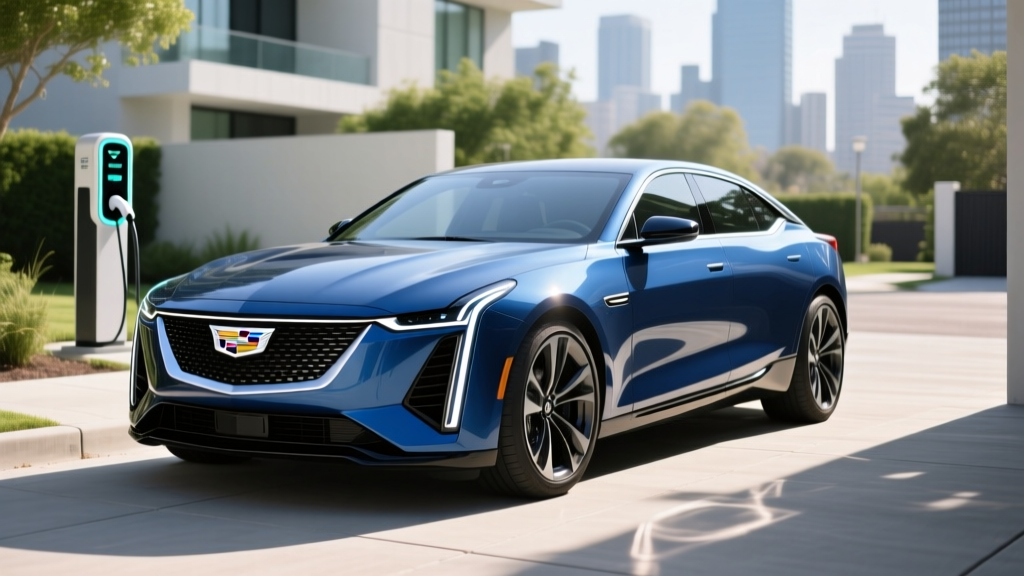
Cadillac's entry-luxury EV push continues with the 2026 Optiq V, a sportier, higher-output variant of the standard Optiq crossover. Built on General Motors' Ultium platform and assembled in the United States, the Optiq V targets buyers who want premium badging, dual-motor all-wheel drive, and a usable 300-plus-mile range without stepping up to the Lyriq's larger footprint or the Celestiq's stratospheric price.
After spending time with the published specs, EPA filings, and GM's engineering data, here's the granular breakdown that matters for a purchase decision — not the brochure highlights, but the numbers you'll actually live with every day.
2026 Cadillac Optiq V: Core Specifications at a Glance
| Spec | Value |
|---|---|
| EPA Range (est.) | 312 miles |
| Battery (usable) | 85 kWh, NMC (Ultium) |
| Drivetrain | Dual-motor AWD |
| Horsepower | 420 hp |
| Torque | 460 lb-ft |
| 0-60 mph | 4.3 seconds |
| Peak DC Fast Charge | 190 kW |
| 10-80% DC Charge Time | ~27 minutes |
| Level 2 Charge Rate | 11.5 kW (~31 mi/hr) |
| MPGe (combined, est.) | 95 MPGe |
| Efficiency | 35 kWh/100 mi |
| Cargo (rear seats up) | 26.0 cu ft |
| Cargo (rear seats folded) | 54.0 cu ft |
| Base MSRP | $58,990 |
| Battery/Powertrain Warranty | 8 years / 100,000 miles |
EPA Range vs. Real-World Expectations
Real-world expectation: plan for approximately 265-285 miles in mixed highway driving at 70-75 mph, and 240-260 miles in cold weather (below 30°F) with cabin heating active. City and stop-and-go driving with regenerative braking can push closer to or slightly above the EPA sticker.
The 85 kWh usable Ultium pack uses NMC (nickel manganese cobalt) chemistry, which offers higher energy density than LFP but is more sensitive to sustained 100% state of charge. GM recommends daily charging to 80-90% for longevity, which effectively gives you a daily usable range of roughly 250-280 miles before factoring in driving conditions.
Highway efficiency in a dual-motor AWD crossover of this mass (roughly 4,900 lbs) is where the range penalty shows up. At sustained 80 mph on flat Interstate, expect consumption to climb to around 38-40 kWh/100 mi, cutting range to roughly 215-225 miles. This is typical for the segment — the Audi Q4 e-tron 55 and BMW iX xDrive50 behave similarly — but it's something to model into any road-trip plan that involves stretches longer than 200 miles between chargers.
Charging Speed: DC Fast and Level 2 Home Charging
| Level | Max Power | Miles Added per Hour | Notes |
|---|---|---|---|
| Level 1 (120V, 12A) | 1.4 kW | ~4 mi/hr | Emergency/trickle only |
| Level 2 (240V, 48A) | 11.5 kW | ~31 mi/hr | Full charge in ~8 hours |
| DC Fast Charge (CCS/NACS) | 190 kW peak | ~190 mi in 30 min (peak) | 10-80% in ~27 min |
The Optiq V peaks at 190 kW on a DC fast charger, but as with every EV, that number is a ceiling, not an average. The charge curve holds near peak output between roughly 10-40% state of charge, then tapers progressively. From 60-80%, expect the rate to drop to around 90-110 kW. This is why the 10-80% time of approximately 27 minutes is the more useful figure than the peak kW spec.
For the 2026 model year, GM vehicles ship with NACS (Tesla-style) charge ports natively, giving access to Tesla Supercharger V3 and V4 stalls without an adapter. CCS1 compatibility is maintained via the included adapter, so Electrify America, EVgo, and other CCS networks remain accessible. On a 350 kW Electrify America stall, the Optiq V will still be capped at its 190 kW onboard limit — the bottleneck is in the vehicle, not the station.
At home on a 48-amp Level 2 wall connector (hardwired, requiring a 60-amp breaker), the 11.5 kW onboard charger replenishes about 31 miles of range per hour. A full 10-100% session takes roughly 8 hours, which fits comfortably into an overnight window. Installation costs for a Level 2 home setup typically run $1,200-$2,500 including the charger unit, electrician labor, and permit — more if your panel needs an upgrade to 200A service.
Performance and Driving Dynamics
The dual-motor AWD powertrain produces 420 horsepower and 460 lb-ft of torque, launching the Optiq V to 60 mph in 4.3 seconds. That's brisk enough to feel genuinely quick in daily driving without crossing into the tire-shredding territory of a BMW iX M60 or Tesla Model X Plaid.
GM's Ultium platform places the battery pack low in the chassis, giving the Optiq V a center of gravity that belies its crossover ride height. The suspension tuning leans toward compliant luxury rather than sport-sedan firmness — you'll feel the weight through tight transitions, but highway ride quality is genuinely impressive and quiet.
Regenerative braking offers two modes: standard coasting and one-pedal driving. The one-pedal mode is strong enough to bring the vehicle to a full stop in most traffic situations, though the friction brakes still engage for emergency stops and final holding. The brake pedal feel is better blended than early Ultium vehicles (the 2022-2023 Lyriq had notably grabby regen), and it ranks among the smoother implementations in the luxury EV segment.
Pricing, Trims, and Federal Tax Credit Eligibility
| Trim | MSRP | After Est. §30D Credit |
|---|---|---|
| Optiq V Luxury (base) | $58,990 | ~$51,490* |
| Optiq V Sport | $63,490 | ~$55,990* |
| Optiq V Sport w/ Platinum Pkg | $67,890 | ~$59,390* |
*Tax credit estimates assume full eligibility. Individual results vary — consult a tax professional.
The 2026 Optiq V qualifies for the federal §30D Clean Vehicle Credit — up to $7,500 — but only if you meet all current IRS requirements. This is not a universal discount; it's a credit with specific eligibility gates:
- MSRP cap: SUVs/crossovers must have an MSRP at or below $80,000. All Optiq V trims clear this threshold.
- Buyer income cap: Adjusted gross income must not exceed $150,000 (single), $225,000 (head of household), or $300,000 (married filing jointly).
- Battery sourcing: The $7,500 credit splits into two $3,750 halves — one for critical-mineral sourcing and one for battery-component manufacturing. GM's Ultium battery production in Ohio and Tennessee meets the component requirement; the critical-mineral half depends on supply-chain compliance that GM has confirmed for 2026 model-year vehicles.
- Point-of-sale transfer: As of 2024, buyers can transfer the credit to the dealer at purchase, reducing the out-of-pocket price immediately rather than waiting to claim it on a tax return. This is available for the Optiq V.
Verify your personal eligibility against the latest IRS guidance before relying on the credit in your purchase math, as sourcing requirements and eligible-model lists can shift.
Interior, Cargo, and Technology
The Optiq V's cabin follows Cadillac's current design language: a 33-inch curved LED display spanning the instrument cluster and infotainment touchscreen, Google Built-In for maps and voice assistant, wireless Apple CarPlay and Android Auto, and a 19-speaker AKG audio system on Sport and Platinum trims.
Passenger space is competitive with the Audi Q4 e-tron and Genesis GV60:
- Front headroom: 39.6 in
- Front legroom: 41.4 in
- Rear headroom: 38.2 in
- Rear legroom: 37.8 in
Cargo volume behind the rear seats is 26.0 cubic feet, expanding to 54.0 cubic feet with the 60/40 split rear seats folded. There is no front trunk (frunk) — the space under the hood is occupied by HVAC and power electronics, which is a missed opportunity for additional sealed storage that competitors like the Ford Mustang Mach-E and Hyundai Ioniq 5 offer.
On the driver-assistance front, the Optiq V comes with Cadillac's Super Cruise on mapped divided highways. Super Cruise is a SAE Level 2 system — it handles steering, acceleration, and braking on compatible roads, but the driver must remain attentive. A camera-based driver-monitoring system tracks eye gaze and will escalate alerts if you look away. This is not autonomous driving; it's a hands-off, eyes-on system. GM's mapped highway coverage now exceeds 750,000 miles in the US and Canada, which is the broadest Level 2 hands-off network available from any automaker.
Super Cruise requires the driver to remain alert and ready to take over at any time. The system will disengage on unmapped roads, in construction zones, or when the driver-monitoring camera detects inattention. It does not handle city streets, traffic lights, or stop signs without driver input.
Ownership Costs, Warranty, and Long-Term Value
GM backs the Optiq V's battery pack and electric powertrain components for 8 years or 100,000 miles, whichever comes first. The battery warranty guarantees replacement or repair if net capacity drops below 60% of original capacity during the warranty period — a threshold that's lower than Hyundai/Kia's 70% guarantee but in line with most domestic and European automakers.
The bumper-to-bumper limited warranty covers 4 years / 50,000 miles, and Cadillac includes 3 years of complimentary scheduled maintenance (which for an EV is minimal — cabin air filter, tire rotation, fluid top-offs).
For a 5-year ownership horizon with 15,000 miles per year, the Optiq V's estimated energy cost is approximately $0.13/kWh national average × 35 kWh/100 mi × 75,000 miles = ~$3,413 in electricity. A comparable gasoline luxury crossover at 24 MPG combined and $3.50/gallon would cost roughly $10,938 in fuel over the same period — a difference of about $7,500 in energy savings alone, which largely offsets the EV's purchase-price premium.
Insurance premiums for the Optiq V run approximately 15-25% higher than an equivalent ICE Cadillac XT5, based on current industry averages for luxury EVs. Factor this into your total cost of ownership calculation.
Pros and Cons
- Super Cruise hands-off driving on 750,000+ miles of mapped highways
- NACS native charge port — no adapter needed for Tesla Superchargers
- Competitive 312-mile EPA range for the luxury compact crossover segment
- Strong 420 hp dual-motor performance with refined ride quality
- Federal §30D tax credit eligible across all trims (MSRP under $80K cap)
- Google Built-In infotainment with strong voice navigation
- 190 kW peak DC charge rate trails Hyundai/Kia's 800V architecture (~240 kW)
- No front trunk (frunk) for additional cargo
- Battery warranty capacity threshold at 60% is below some competitors' 70%
- Real-world highway range drops meaningfully at sustained 80+ mph speeds
- Insurance premiums 15-25% higher than comparable ICE luxury crossovers
- Rear legroom (37.8 in) is slightly tight for the class
Who Should Buy the 2026 Cadillac Optiq V?
The Optiq V is best suited for luxury-oriented commuters and couples who regularly drive on Super Cruise-compatible highways and want a premium badge without the full-size SUV footprint of the Escalade IQ or the six-figure price of the Celestiq.
If your daily commute is 40-80 miles round trip with access to home Level 2 charging, the Optiq V's range and overnight charging will cover your needs with margin to spare. The Super Cruise capability is a genuine differentiator for Interstate-heavy commuters — no other automaker offers hands-off driving on as many miles of road.
If you regularly tow, take frequent 400+ mile road trips through charging-desert regions, or need maximum rear-seat space for taller passengers, look at the larger Lyriq, the Hyundai Ioniq 5 (for faster charging), or the Genesis Electrified GV70 (for more rear-seat room). The Optiq V is a focused luxury commuter, not a do-everything family hauler.
2026 Cadillac Optiq V FAQ
What is the real-world range of the 2026 Cadillac Optiq V?
The EPA estimates 312 miles. In real-world mixed highway driving at 70-75 mph, expect 265-285 miles. In cold weather below 30°F with cabin heat, plan for 240-260 miles. City driving with regenerative braking can match or slightly exceed the EPA number.
How fast does the Optiq V charge at home and on DC fast chargers?
On a DC fast charger, it peaks at 190 kW and charges from 10-80% in approximately 27 minutes. At home on a 48-amp Level 2 charger (11.5 kW), it adds about 31 miles of range per hour, with a full charge taking roughly 8 hours.
Does the 2026 Cadillac Optiq V qualify for the $7,500 federal EV tax credit?
All trims fall under the $80,000 SUV MSRP cap, and GM's US battery production meets component-sourcing requirements. However, buyer income caps ($150K single / $300K joint) and critical-mineral sourcing rules apply. The credit can be transferred at the point of sale. Verify your eligibility on IRS.gov before purchasing.
Is the Optiq V worth buying over the Audi Q4 e-tron or BMW iX?
It depends on priorities. The Optiq V offers Super Cruise (hands-off Level 2 on mapped highways), which neither Audi nor BMW matches in coverage. The BMW iX charges faster and has more rear-seat space but starts above $70,000. The Audi Q4 e-tron is less expensive but offers notably less range and performance. If Super Cruise highway coverage and Cadillac brand loyalty matter, the Optiq V is compelling; if maximum charging speed or interior volume is the priority, cross-shop carefully.
What battery chemistry does the Optiq V use, and how long will it last?
The Optiq V uses NMC (nickel manganese cobalt) chemistry in its 85 kWh Ultium pack. NMC offers higher energy density than LFP, which is why the Optiq V achieves 312 miles in a relatively compact package. GM warrants the battery for 8 years / 100,000 miles against capacity loss below 60%. Industry data suggests NMC packs typically retain 85-90% capacity after 100,000 miles under normal use patterns.
Can the Optiq V use Tesla Superchargers?
Yes. The 2026 Optiq V ships with a native NACS charge port, providing direct access to Tesla's Supercharger network (V3 and V4 stalls) without any adapter. CCS1 charging at Electrify America, EVgo, and other networks is available via the included adapter.