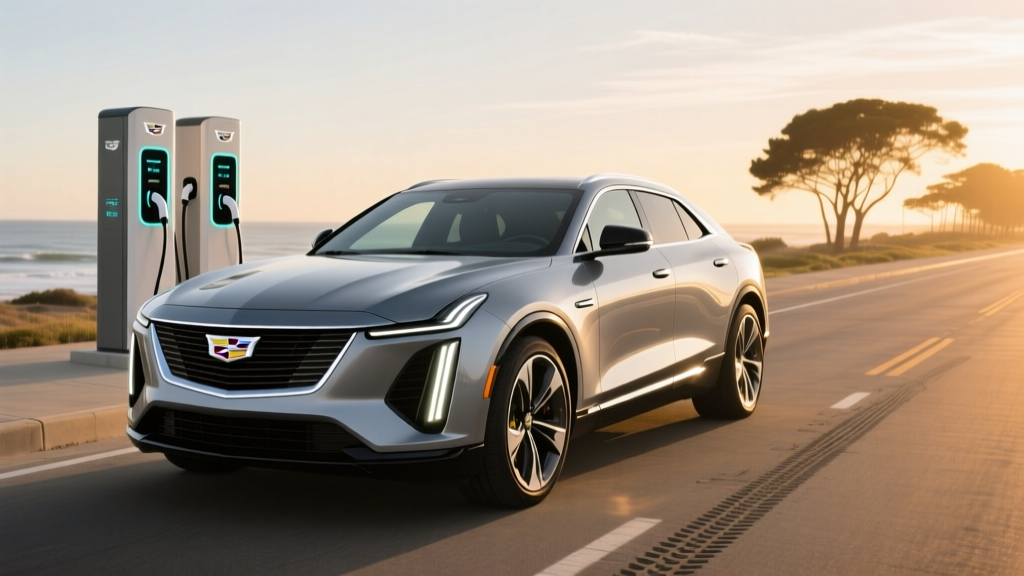
The 2026 Cadillac Lyriq enters its fourth model year as a refined midsize luxury electric SUV built on GM's Ultium platform. With a 102 kWh battery, available all-wheel drive, and a 33-inch LED dashboard display, it targets buyers who want premium comfort without the Tesla aesthetic. But how does it stack up on range, charging speed, and total cost against rivals like the BMW iX, Genesis Electrified GV70, and Tesla Model X? We break down every number that matters.
2026 Lyriq Range and Efficiency
The EPA rates the 2026 Lyriq at 314 miles for the rear-wheel-drive Luxury trim and 307 miles for the all-wheel-drive Sport and Luxury trims. Efficiency lands at 89 MPGe combined (38 kWh/100 mi) for RWD and 87 MPGe combined (39 kWh/100 mi) for AWD, per fueleconomy.gov.
Real-World Range Reality
EPA sticker: 314 mi (RWD) / 307 mi (AWD)
Highway cruising (70-75 mph, 72°F): Expect ~260–280 miles. The Lyriq's boxy SUV profile creates more drag than sleeker sedans, reducing highway efficiency by roughly 10–15%.
Cold weather (below 32°F): Plan for 220–250 miles. The Lyriq uses a resistive PTC heater rather than a heat pump in most trims, which draws significant battery power in freezing conditions. Preconditioning while plugged in is essential.
City/regenerative driving: Range can exceed the EPA estimate in stop-and-go traffic thanks to aggressive one-pedal regen modes.
Battery, Platform, and Powertrain
The 2026 Lyriq rides on GM's BEV3 platform with a 102 kWh usable Ultium battery (12-module, nickel-cobalt-manganese-aluminum or NCMA chemistry). This is an NMC-variant chemistry optimized for energy density and longevity, distinct from the LFP packs GM uses in some lower-cost models.
| Spec | RWD Luxury | AWD Luxury/Sport |
|---|---|---|
| Battery (usable) | 102 kWh NCMA (Ultium) | |
| EPA Range | 314 mi | 307 mi |
| Efficiency | 89 MPGe / 38 kWh/100mi | 87 MPGe / 39 kWh/100mi |
| Horsepower | 340 hp | 500 hp |
| Torque | 325 lb-ft | 450 lb-ft |
| 0–60 mph | 6.0 sec | 4.6 sec |
| Drivetrain | Rear-motor RWD | Dual-motor AWD |
| Towing (max) | 3,500 lbs | |
| Cargo (rear seats up) | 28.0 cu ft | |
| Cargo (rear seats folded) | 60.9 cu ft | |
| Rear legroom | 39.6 in | |
The NCMA chemistry offers a strong balance of energy density and cycle life, though it is more sensitive to sustained 100% SoC storage than LFP. For daily driving, GM recommends setting the charge limit to 80–90% and only charging to full for road trips. Long-term degradation data from 2023–2025 Lyriq owners suggests roughly 5–7% capacity loss over the first 60,000 miles — typical for NMC-family packs with active liquid thermal management.
Charging Speed: DC Fast and Home Level 2
The Lyriq supports a peak DC fast-charge rate of 190 kW via its CCS1 connector (NACS adapter available for Tesla Supercharger access). On a 350 kW Electrify America or EVgo station, the Lyriq can add approximately 76 miles of range in 10 minutes, with a 10–80% charge taking roughly 33 minutes.
| Charging Level | Power | Speed / Time |
|---|---|---|
| Level 1 (120V household) | ~1.4 kW | ~4 mi/hr — ~70 hrs for full charge |
| Level 2 (240V home, 48A) | 11.5 kW | ~31 mi/hr — ~10 hrs for full charge |
| DC Fast Charge (peak) | 190 kW | 10–80% in ~33 min; 76 mi in 10 min |
Charging curve reality: The Lyriq hits peak 190 kW only between roughly 10–30% SoC, then tapers progressively. From 50–80%, expect sustained rates closer to 90–110 kW. This taper is managed by the battery management system to protect cell health, but it means the last 30% of a DC session takes nearly as long as the first 50%. Plan road-trip stops accordingly — charge to 80% and go rather than waiting for a full battery.
For home charging, the Lyriq's onboard charger maxes out at 11.5 kW (48 amps on a 60-amp circuit). A full Level 2 home installation (hardwired wall connector, 60-amp breaker, 240V) typically costs $800–$2,200 depending on panel proximity and local permit fees. This is sufficient for overnight replenishment — most daily commutes of 30–50 miles require only 1.5–2 hours of Level 2 charging.
Interior, Technology, and Driver Assistance
The Lyriq's cabin is anchored by a 33-inch advanced LED display that spans the instrument cluster and infotainment screen in a single curved panel. Google Built-In provides native Google Maps navigation (critical for EV route planning with charging stops), Google Assistant voice control, and Play Store app access. Wireless Apple CarPlay and Android Auto are standard.
Audio options include a 19-speaker AKG Studio system (standard on Luxury) and an available 23-speaker AKG Studio Reference on higher trims. A panoramic fixed glass roof with a power shade is standard across the lineup.
Driver assistance: The Lyriq comes with GM's Super Cruise on mapped divided highways (over 750,000 miles of compatible roads in the US and Canada as of 2026). Super Cruise is a Level 2 SAE system — it handles steering, acceleration, and braking hands-free, but the driver must maintain attention via an infrared eye-tracking camera. It is not autonomous driving. When Super Cruise is unavailable (unmapped roads, construction zones, poor weather), the system defaults to standard adaptive cruise and lane-keep assist.
⚠️ Super Cruise Is Not Self-Driving
Super Cruise operates at SAE Level 2. The driver must remain alert, keep eyes on the road, and be ready to take over instantly. It does not handle city streets, unmapped roads, or complex intersections. Hands-free does not mean attention-free.
Pricing, Trims, and Federal Tax Credit Eligibility
The 2026 Lyriq lineup starts at $58,590 (including destination) for the RWD Luxury trim and tops out near $73,000+ for a fully loaded AWD Sport with the AKG Reference audio and all packages.
| Trim | MSRP | Potential §30D Credit | Effective Price |
|---|---|---|---|
| Luxury RWD | $58,590 | Up to $7,500* | ~$51,090 |
| Luxury AWD | $61,590 | Up to $7,500* | ~$54,090 |
| Sport AWD | $63,590 | Up to $7,500* | ~$56,090 |
| Sport AWD (loaded) | ~$73,000 | Up to $7,500* | ~$65,500 |
Federal tax credit rules (§30D) — critical caveats:
- MSRP cap: SUVs must be under $80,000. All Lyriq trims qualify.
- Buyer income cap: Modified AGI must not exceed $150,000 (single), $225,000 (head of household), or $300,000 (joint filers).
- Battery sourcing: The credit splits into two halves — $3,750 for critical-minerals sourcing and $3,750 for battery-component assembly. As of the 2026 tax year, GM has worked to onshore Ultium cell production (at plants in Ohio and Tennessee), but exact credit amounts depend on current-year IRS battery-sourcing determinations. Confirm your specific eligibility at irs.gov or with a tax professional.
- Point-of-sale transfer: The §30D credit can be transferred to the dealer at purchase, reducing your out-of-pocket price immediately rather than waiting for a tax refund.
- One vehicle per VIN, one credit per taxpayer per year.
Warranty and Long-Term Ownership
Cadillac backs the 2026 Lyriq with a competitive warranty package:
- Battery & powertrain: 8 years / 100,000 miles (whichever comes first), covering capacity loss below 60% of original.
- Bumper-to-bumper: 4 years / 50,000 miles.
- Roadside assistance: 6 years / 70,000 miles.
- Corrosion: 6 years / unlimited miles.
The 60% battery-capacity retention threshold is in line with industry standards but worth noting — a Lyriq would need to lose over 40% of its original range (dropping from 314 to roughly 188 miles) before the warranty kicks in. In practice, most Ultium packs are projected to retain 85–90% capacity at 100,000 miles based on early fleet data.
Insurance: Expect premiums 15–25% higher than a comparable gas-powered Cadillac XT5, reflecting the Lyriq's higher repair costs and MSRP. Average annual premiums run $2,200–$2,800 depending on state, driving record, and coverage level.
Pros, Cons, and Who Should Buy
Pros
- Quiet, well-isolated cabin with premium materials
- Super Cruise hands-free highway driving (750K+ mapped miles)
- Strong 314-mile EPA range (RWD)
- 11.5 kW home charging — faster than many rivals limited to 7.2–9.6 kW
- Google Built-In navigation with EV-aware route planning
- Under $80K MSRP — eligible for the full §30D federal credit (if sourcing/income rules met)
- 3,500-lb towing capacity (useful for small trailers/boats)
Cons
- DC fast-charge peak of 190 kW trails Hyundai Ioniq 5 (240 kW) and Porsche Macan EV (270 kW)
- No heat pump on most trims — cold-weather range loss is significant
- Cargo space (28 cu ft behind rear seats) is tight for the class
- Frunk is very small (~1.5 cu ft) — not a practical storage area
- Infotainment learning curve; some settings buried in submenus
- Rear-seat headroom is limited for tall passengers under the glass roof
Is the 2026 Lyriq Worth It? Choose Based on Your Needs:
Choose the Lyriq if: You want a quiet, comfortable luxury EV SUV with hands-free highway driving, prioritize cabin refinement over sporty handling, have home Level 2 charging, and mostly drive in moderate climates.
Look elsewhere if: You need the fastest DC charging for frequent road trips (consider the Hyundai Ioniq 5 or Kia EV6), live in a cold climate without a garage (the lack of a heat pump hurts), or need maximum cargo space (the BMW iX offers 35.5 cu ft).
2026 Lyriq vs. Key Competitors
| Spec | 2026 Cadillac Lyriq AWD | 2026 BMW iX xDrive50 | 2026 Genesis Electrified GV70 |
|---|---|---|---|
| EPA Range | 307 mi | 324 mi | 236 mi |
| Battery (usable) | 102 kWh NCMA | 105.2 kWh NMC | 77.4 kWh NMC |
| Peak DC Charge | 190 kW | 200 kW | 240 kW |
| 10–80% DC Time | ~33 min | ~31 min | ~18 min |
| Horsepower | 500 hp | 516 hp | 429 hp |
| 0–60 mph | 4.6 sec | 4.4 sec | 4.5 sec |
| Cargo (seats up) | 28.0 cu ft | 35.5 cu ft | 28.7 cu ft |
| Starting MSRP | $61,590 | $87,250 | $66,950 |
| §30D Eligible? | Yes (under $80K) | No (over $80K cap) | Yes (under $80K) |
The Lyriq's strongest competitive advantage is value: it undercuts the BMW iX by over $25,000 while offering comparable range and performance. The Genesis Electrified GV70 charges faster but carries a much smaller battery and 236-mile range that limits road-trip practicality. For luxury EV SUV buyers who want 300+ miles of range and hands-free driving without crossing the $80,000 §30D MSRP cap, the Lyriq occupies a compelling middle ground.
Frequently Asked Questions
What is the real-world range of the 2026 Lyriq?
In mixed driving at moderate temperatures, expect 270–295 miles from the RWD model and 260–285 miles from the AWD. Highway-only driving at 75 mph drops this to roughly 250–270 miles. In sub-freezing weather, plan for 220–250 miles due to cabin heating demands and reduced battery efficiency.
How fast does the 2026 Lyriq charge at home and on the road?
At home on a 240V Level 2 charger (48A/11.5 kW), the Lyriq adds about 31 miles of range per hour — a full overnight charge from empty takes roughly 10 hours. On a DC fast charger, it peaks at 190 kW and can go from 10–80% in approximately 33 minutes, though the charge curve tapers significantly above 50% SoC.
Does the 2026 Lyriq qualify for the $7,500 federal EV tax credit?
All trims fall under the $80,000 MSRP cap for SUVs, so the vehicle qualifies. However, your personal eligibility depends on income limits ($150K single / $300K joint), and the credit amount ($3,750–$7,500) depends on current-year battery critical-mineral and component sourcing rules. Check the latest determinations on fueleconomy.gov and consult a tax professional.
Does the Lyriq have a heat pump?
No. The 2026 Lyriq uses a conventional resistive PTC heater for cabin heating, which draws more energy from the battery in cold weather compared to a heat pump system. This contributes to the 20–30% range reduction observed in sub-freezing temperatures. Preconditioning the cabin and battery while still plugged in at home is the best mitigation strategy.
Can the Lyriq use Tesla Superchargers?
Yes. GM provides a NACS adapter that allows the Lyriq to access the Tesla Supercharger network (V3 and V4 stalls). This significantly expands fast-charging options for road trips, adding roughly 17,000+ Supercharger locations to the Lyriq's charging map.
How does Super Cruise compare to Tesla Autopilot or Ford BlueCruise?
All three are SAE Level 2 hands-free systems limited to mapped or supported highways. Super Cruise covers 750,000+ miles of divided highways and uses an eye-tracking camera for driver monitoring. It is widely regarded as smooth and reliable on compatible roads but does not function on surface streets. Tesla's FSD (Supervised) works on more road types but requires constant hands-on-wheel attention in most jurisdictions. Ford BlueCruise offers similar highway functionality on 130,000+ miles of roads.
What is the Lyriq's towing capacity?
3,500 pounds with the factory towing package. This handles small boat trailers, utility trailers, and lightweight campers. Expect a 25–35% range reduction when towing at highway speeds.