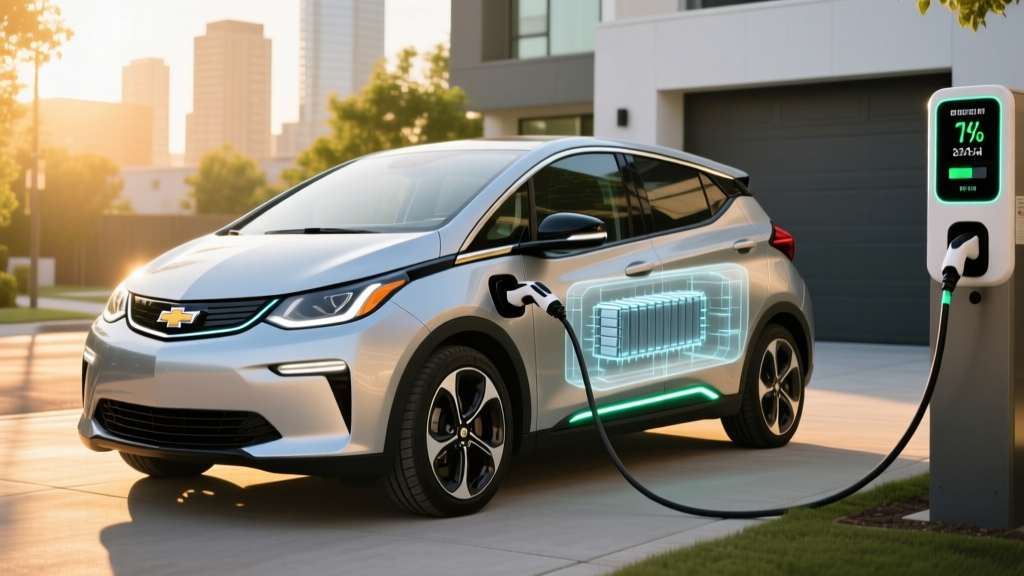
The Chevrolet Bolt EV returns for 2026 with a familiar formula: compact footprint, competitive range, and an entry price that undercuts nearly every battery-electric rival. After the Bolt's brief discontinuation and subsequent revival on GM's Ultium platform, the 2026 model carries forward the refreshed architecture introduced for 2025 — now with incremental software and efficiency tweaks that keep it relevant in an increasingly crowded affordable-EV segment.
This review covers the 2026 Bolt EV in detail: real-world range expectations, DC fast-charging reality, home charging setup, federal tax credit eligibility under IRS §30D, and how it stacks up against the Hyundai Kona Electric, Nissan Leaf, and Tesla Model 3 base trim. If you're shopping for a sub-$30,000 EV commuter, this is the data you need.
2026 Bolt EV Specifications at a Glance
| Spec | Value |
|---|---|
| EPA Range | 255 miles (1LT), 249 miles (2LT) |
| Battery Capacity | 65 kWh usable (Ultium, NMC chemistry) |
| Drivetrain | FWD, single permanent-magnet motor |
| Horsepower / Torque | 200 hp / 236 lb-ft |
| 0–60 mph | ~7.0 seconds |
| DC Fast-Charge Peak | 85 kW (CCS → NACS adapter included) |
| 10–80% DC Charge Time | ~40 minutes |
| Level 2 Home Charge Rate | 11.5 kW (~34 mi/hr) |
| Efficiency | 120 MPGe combined / 28 kWh/100 mi |
| Cargo Volume | 16.3 cu ft (rear seats up), 57.4 cu ft (folded) |
| Rear Legroom | 36.0 inches |
| Base MSRP (1LT) | $27,895 (incl. destination) |
| Battery Warranty | 8 years / 100,000 miles |
Range and Efficiency: EPA Sticker vs. the Real World
The 2026 Bolt EV's EPA-estimated range is 255 miles for the 1LT trim and 249 miles for the heavier, more equipped 2LT. That 65 kWh Ultium battery pack uses nickel-manganese-cobalt (NMC) chemistry, which offers higher energy density than the lithium iron phosphate (LFP) packs found in some competitors — meaning more range in a smaller physical package, though with slightly more sensitivity to long-term high-State-of-Charge storage.
The EPA 255-mile figure assumes a mix of city and highway driving at moderate temperatures. In practice:
• City/suburban commuting (55 mph avg): Expect 260–280 miles — the Bolt's regen braking and low-speed efficiency shine here.
• Highway cruising (70–75 mph): Expect 210–230 miles. The Bolt's upright hatchback shape creates more aero drag than a sleek sedan.
• Cold weather (below 32°F): Expect 170–200 miles. NMC chemistry loses roughly 25–30% range in sustained freezing temps without preconditioning. The Bolt's heat pump (standard on 2LT, optional on 1LT) mitigates cabin energy draw but doesn't fully eliminate cold-weather range loss.
• Combined real-world average: Most owners report 230–250 miles in mixed three-season driving.
Efficiency lands at 120 MPGe combined (28 kWh per 100 miles) per fueleconomy.gov. That's competitive with the Kona Electric (120 MPGe) but trails the Tesla Model 3 RWD (132 MPGe), which benefits from superior aerodynamics and a more aggressive thermal management system. For context, at the US average electricity rate of $0.17/kWh, driving 100 miles in the Bolt costs roughly $4.76 — versus about $12.50 for a 30 MPG gas car at $3.75/gallon.
Charging Speed: DC Fast Charging and Home Level 2
Charging speed remains the Bolt EV's most debated spec. The 2026 model peaks at 85 kW on DC fast charging — a meaningful improvement over the pre-2025 Bolt's 55 kW ceiling, but still well below the 150–250 kW rates offered by rivals on 800V architectures.
| Charging Level | Power (kW) | Miles Added per Hour | Typical Use Case |
|---|---|---|---|
| Level 1 (120V household) | 1.2 kW | ~4 mi/hr | Overnight trickle; emergency top-up |
| Level 2 (240V home/public) | 11.5 kW | ~34 mi/hr | Daily home charging; full charge in ~6 hrs |
| DC Fast Charge (CCS/NACS) | 85 kW peak | ~200 mi/hr (peak) | Road trips; 10–80% in ~40 min |
The 10–80% DC fast-charge time is approximately 40 minutes. The charge curve is relatively flat — the Bolt sustains close to peak rate through ~55% State of Charge, then tapers gradually. That's actually more predictable than some competitors that spike to 200+ kW for three minutes then drop sharply. Still, on a long road trip, you'll spend 10–15 minutes more at each stop than a Hyundai Ioniq 5 or Tesla Model 3 driver.
GM includes a NACS adapter with every 2026 Bolt EV, granting access to Tesla Supercharger stalls — a significant network advantage over CCS-only vehicles. At home on a 48-amp Level 2 circuit (hardwired, 60-amp breaker), the Bolt's 11.5 kW onboard charger replenishes the pack from empty in roughly 6 hours. A standard 32-amp Level 2 unit (common for plug-in models) delivers about 7.7 kW, extending a full charge to ~8.5 hours — still easily overnight.
Home charging installation note: A 48-amp hardwired Level 2 charger typically requires a 60-amp dedicated circuit. Installation costs range from $500–$2,500 depending on panel proximity, conduit run length, and whether your electrical panel needs a 200-amp service upgrade ($1,500–$3,500 additional). Always consult a licensed electrician for a site-specific quote.
Performance and Driving Dynamics
The 2026 Bolt EV sends 200 horsepower and 236 lb-ft of torque to the front wheels through a single-speed reduction gear. The 0–60 mph sprint takes approximately 7.0 seconds — adequate for highway merging and genuinely quick off the line thanks to instant electric torque. The FWD layout means some torque steer under hard acceleration, and the all-season tires prioritize efficiency over grip.
Ride quality is compliant for a subcompact hatchback. The Ultium platform's lower center of gravity (battery pack under the floor) reduces body roll compared to the pre-2025 Bolt, and the steering is light but reasonably precise for city driving. Regenerative braking offers two modes — a mild deceleration setting and a near-one-pedal mode that brings the car to a complete stop without touching the brake pedal. The Bolt does not offer an AWD or dual-motor variant; if you need all-wheel traction, look at the Hyundai Kona Electric AWD or the Subaru Solterra.
Pricing, Trims, and Federal Tax Credit Eligibility
The 2026 Bolt EV is offered in two trims:
| Trim | Base MSRP (incl. destination) | Key Features |
|---|---|---|
| 1LT | $27,895 | 17" wheels, 11" infotainment, wireless CarPlay/Android Auto, heated front seats, Level 2 charge cable |
| 2LT | $31,395 | 18" wheels, adaptive cruise, surround-view camera, Bose audio, heat pump, power liftgate, leatherette |
A well-equipped 2LT with the sole option package (panoramic sunroof + premium paint, ~$1,800) lands around $33,200 before incentives.
The 2026 Bolt EV is expected to qualify for the full $7,500 federal tax credit under IRS §30D, based on GM's Ultium battery sourcing and US final assembly (Orion Township, MI). However, eligibility depends on your situation:
• MSRP cap: Vehicle must be under $55,000 (sedan/hatchback). The Bolt clears this easily.
• Buyer income cap: Modified AGI must not exceed $150,000 (single), $225,000 (head of household), or $300,000 (joint).
• Battery sourcing: Critical minerals and battery components must meet escalating percentage thresholds from US or FTA-partner nations. GM has confirmed Ultium packs meet 2026 thresholds.
• Point-of-sale transfer: You can transfer the credit to the dealer at purchase, reducing your out-of-pocket cost immediately — effectively bringing the 1LT to ~$20,395 if you qualify.
Always verify current eligibility at irs.gov and consult a tax professional. Rules and sourcing certifications can change mid-year.
Interior, Cargo, and Technology
Inside, the 2026 Bolt uses GM's latest 11-inch diagonal infotainment touchscreen running a Google Built-In–based interface with native Google Maps navigation, Google Assistant, and access to the Play Store for streaming apps. Wireless Apple CarPlay and Android Auto are standard on both trims. A digital 8-inch driver display replaces the old analog-digital hybrid cluster.
Cargo space: 16.3 cubic feet behind the rear seats — enough for a week's groceries or two carry-on bags. Fold the 60/40 split rear bench and you get 57.4 cubic feet, competitive with the Kona Electric (45.8 cu ft max) and significantly more than the Tesla Model 3 sedan (23 cu ft trunk, no hatch). The Bolt's hatchback design makes loading bulky items far easier than a traditional trunk.
Passenger space: Front headroom is generous at 39.7 inches; rear legroom at 36.0 inches is adequate for adults on short trips but tight for six-footers on long rides. The flat floor (no transmission tunnel) helps the middle-rear passenger.
Driver assistance (SAE Level 2): Chevy Safety Assist is standard and includes automatic emergency braking, forward collision alert, lane keep assist with lane departure warning, following distance indicator, and IntelliBeam automatic high beams. The 2LT adds adaptive cruise control and a surround-view camera. These are driver-assist features — you must remain engaged and hands-on at all times. The Bolt does not offer GM's hands-free Super Cruise system; that remains reserved for higher-tier GM EVs.
Warranty and Long-Term Battery Outlook
Chevrolet covers the 2026 Bolt EV's battery and powertrain with an 8-year/100,000-mile warranty, with a capacity retention threshold of 60% — meaning GM will repair or replace the pack if usable capacity drops below 60% of original within the warranty period. The limited vehicle warranty is 3 years/36,000 miles.
NMC Ultium packs in GM's current fleet are showing early degradation data consistent with industry norms: approximately 5–8% capacity loss over the first 50,000 miles, then a flatter degradation curve. For a commuter driving 12,000 miles annually, the pack should retain roughly 85–90% capacity at the 8-year mark. Real-world longevity depends heavily on charging habits — frequent DC fast charging above 90% SoC accelerates degradation, while keeping daily charges between 20–80% maximizes cycle life.
Out-of-warranty battery replacement for a 65 kWh Ultium pack currently runs $8,000–$12,000 including labor, based on GM dealer estimates. That figure is expected to decline as Ultium cell production scales.
How the 2026 Bolt EV Compares
| Spec | Chevy Bolt EV | Hyundai Kona Electric | Tesla Model 3 RWD |
|---|---|---|---|
| EPA Range | 255 mi | 261 mi | 272 mi |
| Battery | 65 kWh (NMC) | 64.8 kWh (NMC) | 60 kWh (LFP) |
| DC Fast Charge Peak | 85 kW | 100 kW | 170 kW |
| 10–80% Time | ~40 min | ~43 min | ~25 min |
| 0–60 mph | 7.0 sec | 7.2 sec | 5.8 sec |
| Base MSRP | $27,895 | $32,975 | $38,990 |
| Cargo (max) | 57.4 cu ft | 45.8 cu ft | 23 cu ft |
| Federal Credit | $7,500 (expected) | $7,500 | $7,500 |
The Bolt's price advantage is stark: even against the Kona Electric, it's roughly $5,000 cheaper before credits. The trade-off is DC charging speed — the Bolt's 85 kW peak means longer road-trip stops. If you drive primarily in-town and charge at home, that trade-off is nearly irrelevant. If you take monthly 300+ mile highway trips, the Model 3's 170 kW charging and Supercharger network become more compelling despite the higher entry price.
- Lowest base MSRP in the 250+ mile EV segment
- Hatchback cargo versatility (57.4 cu ft)
- NACS adapter included — Supercharger access
- Strong city efficiency and regen braking
- Qualifies for full $7,500 federal credit
- Google Built-In infotainment with native Maps
- 85 kW DC fast charging lags competitors
- FWD only — no AWD option
- Rear legroom tight for tall adults
- Super Cruise not available on Bolt
- Heat pump optional on 1LT, not standard
- No front trunk (frunk)
Who Should Buy the 2026 Bolt EV?
- You commute under 80 miles round-trip and charge at home nightly
- You want the most affordable 250+ mile EV on the market
- Hatchback cargo space matters (strollers, gear, IKEA runs)
- You rarely take road trips over 250 miles between stops
- Your household income qualifies for the §30D credit
- You need AWD for snow-belt winters (consider Kona AWD or Solterra)
- Fast DC charging is critical for your road-trip habits (Model 3 or Ioniq 5)
- You regularly carry four adults (rear space is limited)
- You want hands-free highway driving (Super Cruise on Equinox EV or Blazer EV)
Frequently Asked Questions
What is the real-world range of the 2026 Bolt EV?
Expect 230–250 miles in mixed three-season driving, 210–230 miles on sustained highway trips at 70+ mph, and 170–200 miles in sustained freezing temperatures. The EPA sticker reads 255 miles, but real-world results depend heavily on speed, temperature, and terrain.
How fast does the 2026 Bolt EV charge?
On DC fast charging, it peaks at 85 kW, achieving a 10–80% charge in approximately 40 minutes. On a 48-amp Level 2 home charger (11.5 kW), a full charge takes about 6 hours, adding roughly 34 miles of range per hour. Level 1 (120V) trickle charging adds about 4 miles per hour — useful only for overnight top-ups.
How much does the 2026 Bolt EV cost after the federal tax credit?
The 1LT starts at $27,895. If you meet all §30D requirements (income caps, MSRP cap, battery sourcing), the $7,500 credit via point-of-sale transfer brings the effective price to approximately $20,395 before state incentives, taxes, and dealer fees. The 2LT drops from $31,395 to roughly $23,895.
Does the 2026 Bolt EV qualify for the full federal tax credit?
Based on GM's Ultium battery sourcing and US assembly, the 2026 Bolt EV is expected to qualify for the full $7,500 credit. However, your personal eligibility depends on modified adjusted gross income limits ($150K single / $300K joint), and sourcing certifications can change. Verify at irs.gov before purchase.
Is the 2026 Bolt EV worth buying over the Tesla Model 3 or Kona Electric?
If budget is your primary driver and you charge at home, the Bolt EV at ~$20,400 after the credit is the best value in the segment. If you road-trip frequently and need fast charging, the Model 3's 170 kW peak and Supercharger network justify the ~$11,000 price premium. The Kona Electric splits the difference with slightly more range and faster charging than the Bolt, but at a higher MSRP.
Does the Bolt EV have a frunk?
No. The 2026 Bolt EV does not include a front trunk. All cargo space is in the rear hatch area (16.3 cu ft / 57.4 cu ft folded).