If you're researching the BMW iX, you've probably noticed something unusual in the luxury EV SUV segment: BMW's pricing strategy has made this flagship electric crossover one of the most value-competitive options against rivals like the Mercedes-Benz EQE SUV and Audi Q8 e-tron. The 2026 BMW iX MSRP starts at a point that, after incentives, makes it a serious contender for buyers who want German engineering, 300+ mile range, and ultra-fast charging without crossing the six-figure line.
This review breaks down every trim, the real-world range you can expect beyond the EPA sticker, charging speeds that rival anything on the road, and the specific IRS §30D tax credit rules that determine whether you'll save thousands at the point of sale.
2026 BMW iX MSRP by Trim Level
The 2026 BMW iX is offered in three primary configurations. Pricing below reflects the base MSRP before destination charges, options, or any applicable incentives.
| Trim | Drivetrain | HP | Base MSRP | Federal Credit Eligible? |
|---|---|---|---|---|
| xDrive45 | Dual-Motor AWD | 396 hp | $75,150 | Check §30D rules |
| xDrive50 | Dual-Motor AWD | 516 hp | $87,250 | Check §30D rules |
| M60 | Dual-Motor AWD | 610 hp | $111,500 | Over MSRP cap |
Destination & Options Reality: Add $995 for destination to every trim. The xDrive50 — the volume seller — typically lands between $92,000 and $98,000 once buyers add the Premium Package, Driving Assistance Professional, and 22-inch wheels. The xDrive45, introduced for 2025, gives buyers a lower entry point with the same body and nearly identical range.
Federal Tax Credit: The §30D Eligibility Check
The BMW iX's tax credit situation requires careful attention. Under current IRS §30D rules, several conditions must be met:
- MSRP Cap: SUVs must have a base MSRP at or below $80,000. This means the xDrive45 qualifies on price; the xDrive50 and M60 exceed the cap and are not eligible for the new-vehicle credit.
- Income Limits: Modified AGI must not exceed $300,000 (joint), $225,000 (head of household), or $150,000 (single).
- Battery Sourcing: Critical minerals and battery component requirements phase in annually. BMW sources battery cells from CATL and Samsung SDI — buyers should verify current-year sourcing compliance on the IRS qualified vehicles list before purchase.
- Point-of-Sale Transfer: If eligible, the credit can be applied at purchase, reducing your out-of-pocket cost immediately rather than waiting for tax filing.
Bottom line: The xDrive45 is the trim to target if the federal credit matters to your purchase decision. Always confirm eligibility with your dealer and a tax professional at the time of purchase — rules and qualified vehicle lists update throughout the year.
Range, Battery, and Real-World Efficiency
The 2026 BMW iX uses a fifth-generation BMW eDrive system with a large lithium-ion battery pack. BMW has not published the exact usable kWh for the 2026 model year at the time of writing, but the pack is an NMC (nickel manganese cobalt) chemistry — chosen for its high energy density, which enables the iX's strong range figures in a package that still fits beneath the floor without compromising cabin space.
EPA Range vs. Reality
| Trim | EPA Est. Range | Real-World Highway | Cold Weather (20°F) |
|---|---|---|---|
| xDrive45 | 324 miles | ~270–290 miles | ~225–250 miles |
| xDrive50 | 324 miles | ~270–290 miles | ~225–250 miles |
| M60 | 296 miles | ~245–265 miles | ~200–225 miles |
Real-world figures based on mixed highway/city driving at 70–75 mph. Cold-weather estimates assume 20°F with cabin heating active and no preconditioning. Highway efficiency drops to approximately 2.2–2.4 kWh/mile in the xDrive50.
Efficiency Numbers
The xDrive50 achieves an EPA-rated 86 MPGe combined, which translates to roughly 39 kWh per 100 miles in mixed driving. The xDrive45 posts slightly better efficiency at approximately 89 MPGe combined due to its lower power output. The M60 drops to around 78 MPGe — the cost of 610 horsepower.
For context, the Mercedes EQE 350+ SUV returns 85 MPGe, and the Audi Q8 e-tron achieves 81 MPGe. The iX sits near the top of its class for efficiency-to-size ratio, largely thanks to BMW's aerodynamic optimization (Cd of 0.25) and standard heat pump, which significantly reduces cabin-heating energy draw in cold weather.
Charging Speed: DC Fast and Level 2
The BMW iX supports some of the fastest charging in the luxury SUV segment, provided you use a compatible high-power station.
| Charging Level | Max Power | Speed / Time | Connector |
|---|---|---|---|
| Level 1 (120V) | 1.4 kW | ~4 miles/hr | J1772 adapter |
| Level 2 (240V, 48A) | 11.5 kW | ~35 miles/hr, full charge in ~11 hrs | J1772 / NACS* |
| DC Fast Charge | 195 kW peak | 10–80% in ~31 minutes | CCS1 / NACS* |
*BMW has committed to NACS (Tesla-style) port adoption. For the 2026 model year, verify whether your vehicle ships with NACS native or CCS1 with a NACS adapter — this varies by build date.
The Charging Curve Reality
The 195 kW peak figure is impressive, but as with all EVs, peak rate is sustained only briefly — typically between 10% and 30% State of Charge. Beyond 50% SoC, the rate tapers progressively. In real-world DC fast-charging on a 350 kW Electrify America or Ionity station, expect an average rate of roughly 130–150 kW across the full 10–80% session, which is still excellent for this battery size.
For road trips, the 31-minute 10–80% window means a typical stop adds approximately 210 miles of range — enough to cover 2.5 hours of highway driving before the next charge. The iX's navigation system will precondition the battery when a DC fast charger is set as the destination, warming the pack to optimal temperature for maximum charge acceptance. Skipping preconditioning in cold weather can add 10–15 minutes to your charge time.
Home Charging Setup
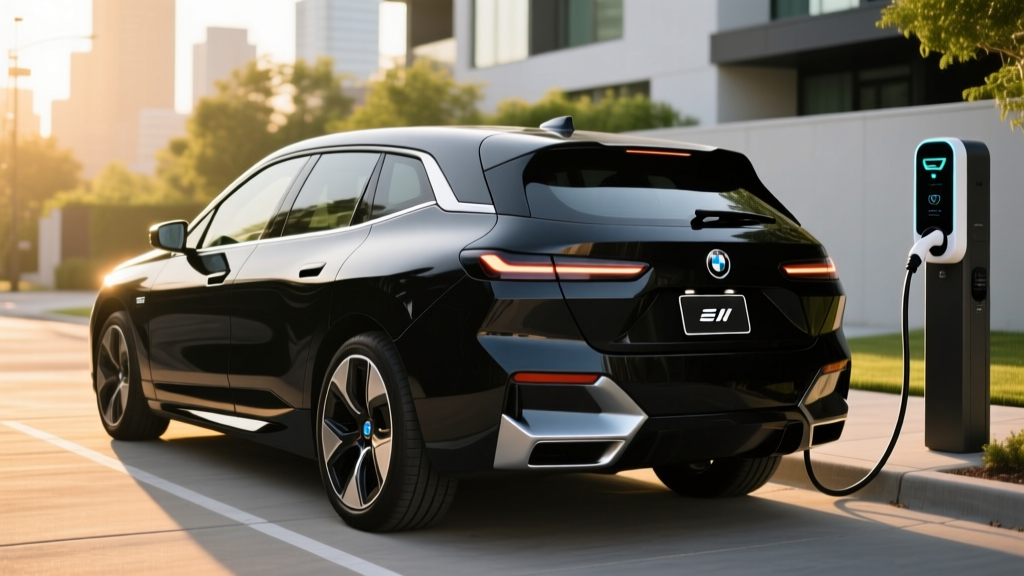
The iX's 11.5 kW onboard charger is a strong point — it's faster than the 9.6 kW chargers in some competitors. On a dedicated 48-amp Level 2 circuit (requiring a 60-amp breaker), you'll recover a full battery overnight. Most owners driving 40–60 miles daily will need only 2–3 hours of Level 2 charging each night.
Home installation for a Level 2 charger typically runs $800–$2,500 total (charger hardware plus electrician labor and permit), depending on whether your electrical panel needs an upgrade. A 200-amp panel is generally sufficient; older homes with 100-amp service may need a panel upgrade adding $1,500–$3,000.
Performance and Driving Dynamics
| Spec | xDrive45 | xDrive50 | M60 |
|---|---|---|---|
| Horsepower | 396 hp | 516 hp | 610 hp |
| Torque | 516 lb-ft | 564 lb-ft | 811 lb-ft |
| 0–60 mph | 5.0 sec | 4.4 sec | 3.6 sec |
| Drivetrain | Dual-Motor AWD | Dual-Motor AWD | Dual-Motor AWD |
| Top Speed | 130 mph | 130 mph | 155 mph |
Every iX comes with dual-motor all-wheel drive as standard — no RWD option. The xDrive50 hits the sweet spot: 4.4 seconds to 60 mph is genuinely quick for a 5,600-pound SUV, and the instant electric torque makes highway merging effortless. The M60's 3.6-second run puts it in sports-car territory, though you sacrifice roughly 30 miles of range and pay a $24,000 premium.
Ride quality is a standout. The optional air suspension (standard on M60, available on xDrive50) delivers a compliant, near-silent ride that absorbs rough pavement with composure. The iX's steering is precise if slightly light — typical of BMW's electric tuning — and the one-pedal driving mode offers strong regenerative braking, though not quite enough for a full stop in all conditions.
Interior Space, Tech, and Notable Drawbacks
The iX interior is where BMW's "technology flagship" positioning becomes obvious. The cabin uses sustainable materials (recycled plastics, FSC-certified wood, olive-leaf-tanned leather) and features the BMW Curved Display — a 14.9-inch infotainment screen merged with a 12.3-inch instrument cluster running iDrive 8.5.
Cargo and Passenger Dimensions
| Measurement | Specification |
|---|---|
| Cargo (rear seats up) | 35.5 cu ft |
| Cargo (rear seats folded) | 77.9 cu ft |
| Front Legroom | 40.2 in |
| Rear Legroom | 38.9 in |
| Front Headroom | 40.8 in |
| Frunk | None (no front trunk) |
The absence of a frunk is a missed opportunity — competitors like the Rivian R1S and Ford Mustang Mach-E offer front storage. Rear seat space is generous for adults, and the flat floor (no transmission tunnel) makes the middle seat usable, though the cushion is firmer than the outboard positions.
Driver Assistance: SAE Level 2
SAE Automation Level: 2 (Driver Assist)
The BMW iX offers Driving Assistant Professional, which includes highway lane-keeping, adaptive cruise with stop-and-go, and lane-change assistance. This is not self-driving. The driver must remain fully engaged, with hands on or near the wheel and eyes on the road at all times. BMW does not currently offer a hands-free highway system comparable to GM's Super Cruise or Ford's BlueCruise.
The Highway Assistant feature (available on equipped models) does allow hands-off driving at speeds up to 85 mph on divided highways, but only with active driver monitoring via an interior camera. It's a strong system that reduces fatigue on long trips, but it is categorically a Level 2 feature requiring supervision.
Drawbacks Worth Knowing
- No frunk: All cargo goes in the rear; no front storage for cables or groceries.
- iDrive learning curve: The Curved Display is visually impressive but menus can be deep; some climate controls are buried in touchscreens rather than physical buttons.
- No hands-free driving: BMW lags behind GM and Ford in hands-free highway assist availability.
- Charging port location: The port is on the driver-side rear quarter — awkward in some tight parking situations.
- Towing limited: Maximum towing capacity is 3,500 lbs — adequate for a small trailer, but less than the Rivian R1S (7,700 lbs).
Pros, Cons, and Who Should Buy the BMW iX
Pros
- 324-mile EPA range (xDrive45/xDrive50) is class-leading
- 195 kW DC fast charging; 10–80% in ~31 min
- 11.5 kW Level 2 onboard charger — faster than many rivals
- Standard heat pump for cold-weather efficiency
- Spacious, premium interior with sustainable materials
- xDrive45 MSRP falls under the $80K federal credit cap
- Refined ride quality, especially with air suspension
Cons
- No front trunk (frunk)
- xDrive50 and M60 exceed $80K MSRP credit cap
- No hands-free highway driving (unlike Super Cruise/BlueCruise)
- iDrive infotainment can feel menu-heavy
- 3,500-lb towing limit trails some competitors
- Charging port placement is inconvenient in some spots
Who the BMW iX Suits Best
Buy the iX if you are: A luxury buyer who prioritizes range and charging speed over badge cachet, commutes 40–80 miles daily with home charging, takes road trips 3–5 times per year, and values a quiet, tech-forward cabin. The xDrive45 is the value pick for credit-eligible buyers; the xDrive50 is the performance-and-range sweet spot if the credit doesn't apply.
Look elsewhere if you: Need a frunk, want hands-free highway driving (consider Cadillac Lyriq with Super Cruise or Ford Mustang Mach-E with BlueCruise), tow more than 3,500 lbs (Rivian R1S), or need three-row seating (Kia EV9).
BMW iX vs. Key Competitors
| Spec | BMW iX xDrive50 | Mercedes EQE 350+ SUV | Audi Q8 e-tron | Cadillac Lyriq AWD |
|---|---|---|---|---|
| EPA Range | 324 mi | 305 mi | 285 mi | 307 mi |
| Battery | ~105 kWh (NMC) | 90.6 kWh (NMC) | 114 kWh (NMC) | 102 kWh (NMC) |
| DC Fast Charge | 195 kW | 170 kW | 170 kW | 190 kW |
| 0–60 mph | 4.4 sec | 6.4 sec | 5.5 sec | 4.6 sec |
| Base MSRP | $87,250 | $78,050 | $75,595 | $64,195 |
| Hands-Free Highway | No | No | No | Yes (Super Cruise) |
The iX leads on range and charging speed. The Lyriq undercuts on price and offers Super Cruise. The EQE and Q8 e-tron are competitive but trail on efficiency and DC charging rate. According to EPA data on fueleconomy.gov, the iX's combined MPGe rating places it ahead of the Q8 e-tron and near parity with the EQE.
Warranty and Ownership Costs
BMW backs the iX with the following warranty coverage:
| Coverage | Term |
|---|---|
| Limited Vehicle Warranty | 4 years / 50,000 miles |
| Battery Pack Warranty | 8 years / 100,000 miles (retains ≥70% capacity) |
| Powertrain (eDrive) | 8 years / 100,000 miles |
| Corrosion Perforation | 12 years / unlimited miles |
| Roadside Assistance | 4 years / unlimited miles |
The 8-year/100,000-mile battery warranty with a 70% capacity retention threshold is industry-standard. In practice, BMW's fifth-generation eDrive system has shown strong degradation performance in European-market iX fleets — typically retaining 93–95% capacity after 30,000 miles based on owner-reported data. NMC chemistry with BMW's thermal management system (liquid cooling and heating) is designed for longevity, though long-term 100,000+ mile data specific to the US market is still accumulating.
For a deeper understanding of how battery chemistry affects long-term ownership, see our LFP vs NMC degradation guide.
Frequently Asked Questions
What is the real-world range of the 2026 BMW iX?
The EPA rates the xDrive45 and xDrive50 at 324 miles, and the M60 at 296 miles. In real-world highway driving at 70–75 mph, expect approximately 270–290 miles from the xDrive50. In cold weather (around 20°F) with cabin heating, that drops to roughly 225–250 miles. Preconditioning the battery and using seat heaters instead of cabin heat can recover 10–15 miles.
How fast does the BMW iX charge at home and on the road?
On a DC fast charger, the iX peaks at 195 kW and charges from 10–80% in approximately 31 minutes, adding about 210 miles of range. At home on a 48-amp Level 2 charger (11.5 kW), it recovers roughly 35 miles per hour, meaning a full charge takes about 11 hours. Level 1 (standard 120V outlet) adds about 4 miles per hour — useful for emergencies but not practical for daily use.
Does the BMW iX qualify for the federal EV tax credit?
It depends on the trim. Under IRS §30D rules, the SUV MSRP cap is $80,000. The xDrive45 (MSRP $75,150) falls under this cap and may qualify, subject to buyer income limits, battery sourcing requirements, and point-of-sale transfer availability. The xDrive50 ($87,250) and M60 ($111,500) exceed the cap and are not eligible for the new-vehicle credit. Always verify current eligibility on the IRS qualified vehicles list before purchasing.
How much does the BMW iX cost after incentives?
If you purchase the xDrive45 at $75,150 and qualify for the full $7,500 federal credit via point-of-sale transfer, your effective price drops to approximately $67,650 before state incentives. Some states offer additional credits (e.g., California's CVRP, Colorado's state credit) that can further reduce cost. Check your state's energy office for current programs, as these vary by jurisdiction and change frequently.
Is the BMW iX worth buying vs. the Mercedes EQE SUV or Audi Q8 e-tron?
The iX wins on EPA range (324 vs. 305 vs. 285 miles), DC fast-charge speed (195 kW vs. 170 kW for both), and 0–60 performance (4.4 sec for the xDrive50). The Audi Q8 e-tron and Mercedes EQE 350+ SUV start at lower MSRPs but deliver less range and slower charging. If hands-free highway driving matters, the Cadillac Lyriq with Super Cruise is the stronger pick. For the best combination of range, charge speed, and driving refinement in a two-row luxury EV SUV, the iX xDrive50 is the segment benchmark — provided the MSRP cap doesn't disqualify your credit eligibility.
Does the BMW iX have a frunk?
No. The iX does not have a front trunk. All cargo must go in the rear cargo area (35.5 cu ft with seats up, 77.9 cu ft folded). This is a notable omission compared to the Rivian R1S and Ford Mustang Mach-E.
Can the BMW iX tow?
Yes, with a maximum towing capacity of 3,500 pounds when properly equipped. This is sufficient for a small utility trailer or a pair of jet skis, but falls well short of the Rivian R1S (7,700 lbs). Expect a 30–40% range reduction when towing at highway speeds.
Sources: EPA range and efficiency data via fueleconomy.gov; BMW USA official specifications; IRS §30D clean vehicle credit rules via irs.gov. Pricing and specs reflect the 2026 model year as available. Verify all tax credit eligibility with a qualified tax professional and the IRS qualified vehicles list at time of purchase.