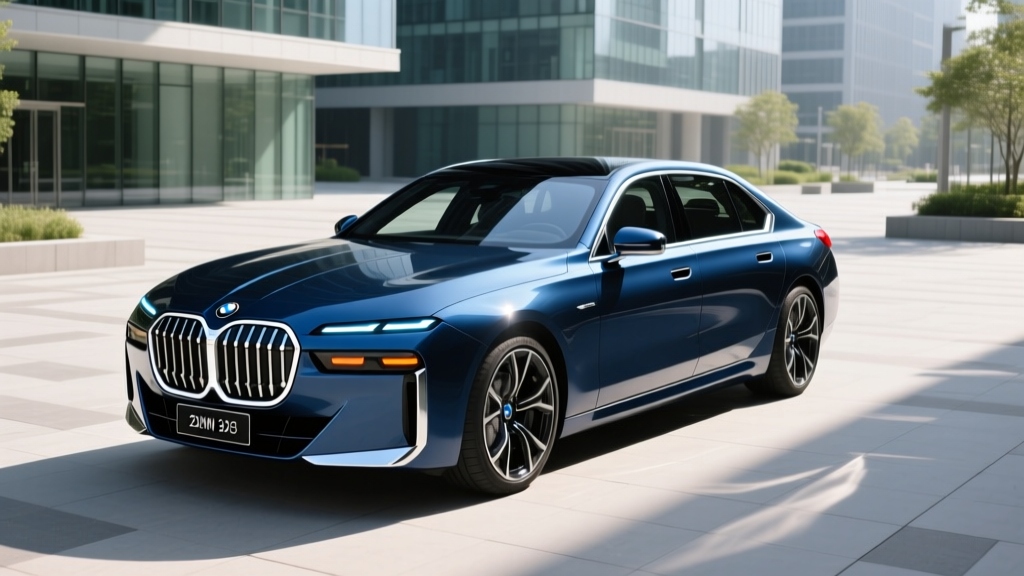
The BMW i7 is the automaker's flagship electric luxury sedan — a 7 Series that trades its inline-six for dual motors and a 101.7 kWh battery pack. For buyers researching the BMW i7 MSRP, the sticker price is only the beginning: federal tax credit eligibility, trim-level premiums, and real-world efficiency all reshape the final cost of ownership. This review dissects every number that matters, from the xDrive60's base price to the M70's performance premium, and pairs them with the charging and range data you need before signing a purchase agreement.
2026 BMW i7 MSRP by Trim Level
BMW offers the i7 in three trims for the 2026 model year. Pricing below reflects base MSRP before destination charges ($995), options, or any applicable incentives.
| Trim | Drivetrain | Horsepower | 0-60 mph | EPA Range | Base MSRP |
|---|---|---|---|---|---|
| i7 eDrive50 | RWD (single motor) | 449 hp | 5.5 sec | 321 mi | $106,695 |
| i7 xDrive60 | AWD (dual motor) | 536 hp | 4.5 sec | 318 mi | $125,195 |
| i7 M70 xDrive | AWD (dual motor) | 650 hp | 3.5 sec | 295 mi | $169,795 |
The eDrive50 was added for the 2024 model year as a more accessible entry point, dropping the front motor to save weight and extend range slightly. The xDrive60 remains the volume seller, balancing dual-motor traction with over 300 miles of EPA-rated range. The M70 is BMW's M Performance variant — a 650-hp luxury missile that sacrifices roughly 25 miles of range for a 3.5-second 0-60 time.
Estimated Out-the-Door Pricing (Before Options)
| Trim | Base MSRP | Destination | Federal §30D Credit | Effective Price |
|---|---|---|---|---|
| eDrive50 | $106,695 | $995 | $0 (MSRP cap exceeded) | ~$107,690 |
| xDrive60 | $125,195 | $995 | $0 (MSRP cap exceeded) | ~$126,190 |
| M70 xDrive | $169,795 | $995 | $0 (MSRP cap exceeded) | ~$170,790 |
Tax credit reality check: Under current IRS §30D rules, the federal EV tax credit caps eligible sedans at an MSRP of $55,000. Every i7 trim exceeds that threshold by a wide margin, meaning no i7 variant qualifies for the $7,500 federal credit. This is a structural limitation of the law, not a battery-sourcing issue. Buyers should investigate state-level incentives — some states (California, Colorado, Massachusetts) offer rebates with higher MSRP caps or no cap at all — but these vary by jurisdiction and income. Consult your tax professional before factoring any incentive into your budget.
Range, Efficiency, and Real-World Expectations
The i7's battery pack stores 101.7 kWh of total capacity (approximately 94.8 kWh usable, with the remainder reserved as a top/bottom buffer to protect cell longevity). BMW uses NMC (nickel manganese cobalt) chemistry, which offers higher energy density than LFP — important in a large sedan where packaging space for cells is at a premium.
EPA Range vs. Real-World Driving
EPA estimates (per fueleconomy.gov):
- eDrive50: 321 miles EPA / 87 MPGe combined
- xDrive60: 318 miles EPA / 86 MPGe combined (with 20" wheels; 19" wheels may yield slightly higher)
- M70 xDrive: 295 miles EPA / 78 MPGe combined
Real-world expectations:
- Highway driving (70-80 mph): Expect 250–275 miles in the xDrive60. Aerodynamic drag scales with the square of speed, and the i7's large frontal area compounds this at highway velocities.
- Cold weather (below 32°F): Range drops 15–30% depending on severity. The i7's heat pump (standard on all trims) mitigates cabin-heating energy draw, but battery chemistry itself slows in cold, increasing internal resistance. Plan for ~220–250 miles in the xDrive60 during a Midwest winter.
- City/commuter driving: You may match or slightly exceed the EPA number thanks to regenerative braking recapturing energy in stop-and-go traffic.
Efficiency translates to roughly 32–35 kWh per 100 miles in the xDrive60 under mixed driving. That's competitive with the Mercedes EQS 450+ (which achieves slightly better efficiency due to its lower drag coefficient of 0.20 vs. the i7's 0.24) but trails the Tesla Model S Long Range, which benefits from a lighter curb weight and more aggressive thermal management.
Charging Speed: DC Fast, Level 2, and the Charge Curve
The i7 supports DC fast charging at up to 195 kW via its CCS1 connector (or NACS on 2025+ models equipped with BMW's native NACS port, which began phasing in for the 2025 model year). Level 2 AC charging maxes out at 11 kW (48 amps on a 240V circuit).
| Charging Level | Power (kW) | Connector | Speed / Time |
|---|---|---|---|
| Level 1 (120V household) | ~1.4 kW | J1772 / NACS | ~3–4 mi/hr (emergency use only) |
| Level 2 (240V home/work) | 11 kW | J1772 / NACS | ~30 mi/hr; 0–100% in ~9.5 hrs |
| DC Fast Charge | Up to 195 kW (peak) | CCS1 / NACS | 10–80% in ~34 min |
Charging curve reality: The 195 kW figure is a peak, not a sustained rate. In real-world DC fast charging, the i7 typically hits peak power between 10–30% State of Charge (SoC), then tapers progressively. From 50–80%, expect average rates closer to 100–120 kW. This taper is normal for NMC cells — the battery management system reduces current to prevent lithium plating and thermal stress at higher SoC. On a road trip, this means a 10–80% session takes roughly 34 minutes at a 200+ kW Electrify America or Tesla Supercharger stall, but an 80–100% top-off adds another 25–30 minutes. For highway travel, plan to charge to 80% and move on.
For home charging, an 11 kW Level 2 wallbox (such as the BMW Wallbox or a ChargePoint Home Flex configured for 48A) replenishes roughly 30 miles of range per hour. A full overnight charge from 20% to 100% takes about 8–9 hours. Most i7 owners will plug in nightly and wake to a full battery, making public fast charging a road-trip-only affair.
Performance, Drivetrain, and Driving Dynamics
The i7 shares BMW's CLAR platform with the 7 Series, adapted for electric propulsion. All trims use BMW's fifth-generation eDrive technology, with the motor, power electronics, and single-speed transmission integrated into a single housing.
- eDrive50: A single rear motor produces 449 hp and 479 lb-ft of torque. The 0–60 mph sprint takes 5.5 seconds — quick for a 5,800-lb sedan and more than adequate for merging and passing.
- xDrive60: Dual motors deliver 536 hp and 549 lb-ft, with torque distributed between axles for all-weather traction. The 4.5-second 0–60 time puts it in sports-sedan territory despite its mass.
- M70 xDrive: The M-tuned dual-motor setup generates 650 hp (in Sport mode with launch control) and 749 lb-ft. BMW claims 3.5 seconds to 60 mph, and independent testing has verified figures in the 3.4–3.7 range depending on surface and conditions.
All trims feature adaptive air suspension, rear-axle steering (Integral Active Steering), and BMW's xDrive or RWD torque management. The M70 adds stiffer spring rates, M-specific damper tuning, and larger brakes. Ride quality in the eDrive50 and xDrive60 is genuinely exceptional — the air suspension isolates occupants from road imperfections with the composure expected of a six-figure BMW.
Interior Space, Technology, and Notable Drawbacks
The i7 is a full-size luxury sedan, and its cabin reflects that. Key dimensions:
- Front headroom: 39.8 inches
- Rear headroom: 38.6 inches
- Rear legroom: 42.8 inches (class-leading; rivals like the EQS offer ~40 inches)
- Trunk volume: 17.7 cu ft (competitive with the segment; no frunk due to the forward HVAC and electronics packaging)
The rear seat is the i7's party piece. Available Executive Lounge seating includes reclining rear outboard seats with massage, ventilation, and footrests. The optional 31.3-inch BMW Theater Screen (an 8K display that deploys from the headliner) transforms the rear cabin into a mobile cinema — impressive for chauffeured use or family road trips with children.
Infotainment: BMW's iDrive 8.5 runs on a curved display (12.3" instrument cluster + 14.9" central touchscreen). The system is responsive, supports wireless Apple CarPlay and Android Auto, and includes a capable voice assistant. Physical shortcut buttons remain for climate and volume — a welcome decision.
Driver assistance: The i7 comes standard with BMW Driving Assistant Professional, which includes adaptive cruise control with stop-and-go, lane-keeping assist, and automatic lane-change on highways (when the driver confirms via turn signal). This is an SAE Level 2 system — the driver must remain fully engaged and hands must be detected on the wheel. It is not autonomous driving.
ADAS Limitation Notice
BMW Driving Assistant Professional and Highway Assistant are SAE Level 2 driver-assistance systems. They do not make the i7 self-driving. The driver must continuously monitor the road, maintain steering input, and be prepared to take over instantly. Hands-off driving is not supported in the US market.
Notable drawbacks:
- No front trunk (frunk): The space is occupied by power electronics and HVAC components. For a car at this price, the lack of any secondary cargo area is a miss.
- Weight: At roughly 5,800–6,200 lbs depending on trim, the i7 is heavy. You feel it during aggressive cornering, and tire wear may be higher than lighter competitors.
- Charging speed vs. rivals: At 195 kW peak, the i7 charges slower than the Lucid Air (300+ kW), the Porsche Taycan (270 kW on 800V architecture), and the Hyundai Ioniq 6 (240 kW). For a luxury flagship, 34 minutes 10–80% is acceptable but not class-leading.
- Styling: The i7's polarizing split-headlight design and large kidney grille remain subjective dealbreakers for some buyers. There is no accounting for taste, but it's worth a thorough in-person viewing before committing.
Pros, Cons, and Who Should Buy
Pros
- Class-leading rear-seat legroom (42.8") and available Executive Lounge seating
- Exceptional ride quality via adaptive air suspension
- 300+ mile EPA range in eDrive50 and xDrive60 trims
- Whisper-quiet cabin with excellent NVH isolation
- Strong standard driver-assist suite (Level 2)
- BMW's 8-year/100,000-mile battery warranty
Cons
- No federal §30D tax credit (MSRP far exceeds $55K sedan cap)
- 195 kW peak DC charging is below rival benchmarks
- No frunk for additional cargo
- Heavy curb weight affects tire wear and handling limits
- Polarizing exterior styling
- M70 range drops to 295 miles EPA
Who this EV suits best:
- Executive commuters who prioritize rear-seat comfort and a serene ride over sporty handling. The i7 is a chauffeur's car that also works as a daily driver.
- Luxury sedan loyalists transitioning from the 7 Series, S-Class, or A8 who want electric powertrain without sacrificing interior quality or tech.
- Families needing space: The rear legroom and available Theater Screen make the i7 surprisingly practical for long family trips — provided you don't need SUV-level cargo volume.
Who should look elsewhere:
- Budget-conscious EV buyers: The i7 starts above $106K and does not qualify for the federal credit. Consider the BMW i5 or Hyundai Ioniq 6 for luxury-adjacent electric sedans under $70K.
- Road-trip enthusiasts who prioritize charging speed: The Lucid Air (300+ kW charging) or Porsche Taycan (270 kW, 800V) add range faster on long drives.
- Performance-first buyers: The Tesla Model S Plaid and Lucid Air Sapphire deliver supercar acceleration at lower prices, though neither matches the i7's interior refinement.
Warranty, Ownership Costs, and Long-Term Outlook
BMW backs the i7 with the following coverage:
- Limited vehicle warranty: 4 years / 50,000 miles
- Battery and electric drivetrain warranty: 8 years / 100,000 miles (covers defects and capacity loss below 70% of original capacity)
- Complimentary maintenance: 3 years / 36,000 miles (covers brake fluid, cabin microfilter, and vehicle check — EVs have fewer routine maintenance items than ICE vehicles)
The 70% battery capacity retention threshold is standard for the luxury EV segment (matching Mercedes and Audi). Real-world NMC degradation data from BMW's earlier iX and i4 models suggests owners typically see 5–8% capacity loss over the first 100,000 miles when following recommended charging practices (avoiding sustained 100% SoC, limiting DC fast charging to road trips, and using preconditioning).
Insurance premiums for the i7 are elevated — expect $3,000–$4,500 annually depending on your profile, location, and coverage level. This reflects the vehicle's repair costs (aluminum and carbon-fiber-reinforced plastic body panels, high-voltage system servicing) rather than any specific safety concern. The i7 earned top marks from IIHS in crashworthiness testing for the prior model year; 2026 ratings should be confirmed as they are published.
Competitor Comparison: i7 vs. EQS vs. Lucid Air
| Spec | BMW i7 xDrive60 | Mercedes EQS 450+ | Lucid Air Pure |
|---|---|---|---|
| Base MSRP | $125,195 | $105,550 | $69,900 |
| EPA Range | 318 mi | 390 mi | 419 mi |
| Battery (usable) | ~94.8 kWh (NMC) | ~108.4 kWh (NMC) | ~88 kWh (NMC) |
| Peak DC Charge | 195 kW | 200 kW | 250+ kW |
| 10–80% Time | ~34 min | ~31 min | ~25 min |
| 0–60 mph | 4.5 sec | 5.9 sec | 5.0 sec |
| Rear Legroom | 42.8" | 40.3" | 41.3" |
| Federal §30D Credit | Not eligible | Not eligible | Not eligible (sedan cap) |
The EQS wins on range and efficiency, the Lucid Air wins on range, charging speed, and price, and the i7 wins on rear-seat space and traditional luxury build quality. None of these sedans qualify for the federal tax credit. Your choice comes down to whether you value maximum range (EQS/Lucid), maximum rear-seat luxury (i7), or maximum value (Lucid Air Pure).
Frequently Asked Questions
What is the real-world range of the BMW i7?
The EPA rates the xDrive60 at 318 miles. In real-world highway driving at 70–80 mph, expect 250–275 miles. In freezing temperatures, plan for 220–250 miles. City driving with regenerative braking may match or slightly exceed the EPA sticker.
How fast does the BMW i7 charge?
On a DC fast charger, the i7 peaks at 195 kW and charges from 10–80% in approximately 34 minutes. On a Level 2 home charger (11 kW / 48A), it adds about 30 miles of range per hour, fully replenishing overnight in ~9.5 hours.
Does the BMW i7 qualify for the federal EV tax credit?
No. Under IRS §30D rules, the federal credit caps eligible sedans at $55,000 MSRP. Every i7 trim starts well above that threshold, making none eligible regardless of battery sourcing. Check your state's incentive programs for potential rebates with higher or no MSRP caps.
How much does the BMW i7 cost after incentives?
With no federal credit available, the effective price equals MSRP plus destination ($995) minus any state or utility incentives you may qualify for. The eDrive50 starts at approximately $107,690 before options; the xDrive60 at ~$126,190. Options packages (Executive, M Sport, Bowers & Wilkins audio) can add $10,000–$25,000+.
Is the BMW i7 worth buying vs. the Mercedes EQS or Lucid Air?
If rear-seat luxury, ride quality, and BMW's build reputation are your priorities, the i7 justifies its premium. If range and charging speed matter more, the EQS and Lucid Air outperform it on both metrics — and the Lucid does so at a significantly lower price. Test-drive all three; the i7's cabin experience is difficult to convey on a spec sheet.
What battery chemistry does the BMW i7 use?
The i7 uses NMC (nickel manganese cobalt) lithium-ion cells. NMC offers higher energy density than LFP, which is necessary to achieve 300+ miles of range in a sedan-sized battery pack. BMW's battery management system includes a ~7% top/bottom buffer to reduce degradation over time.
Does the i7 have a frunk?
No. The i7 does not have a front trunk. The space beneath the hood houses power electronics, the onboard charger, and HVAC components. Total cargo space is limited to the 17.7 cu ft rear trunk.