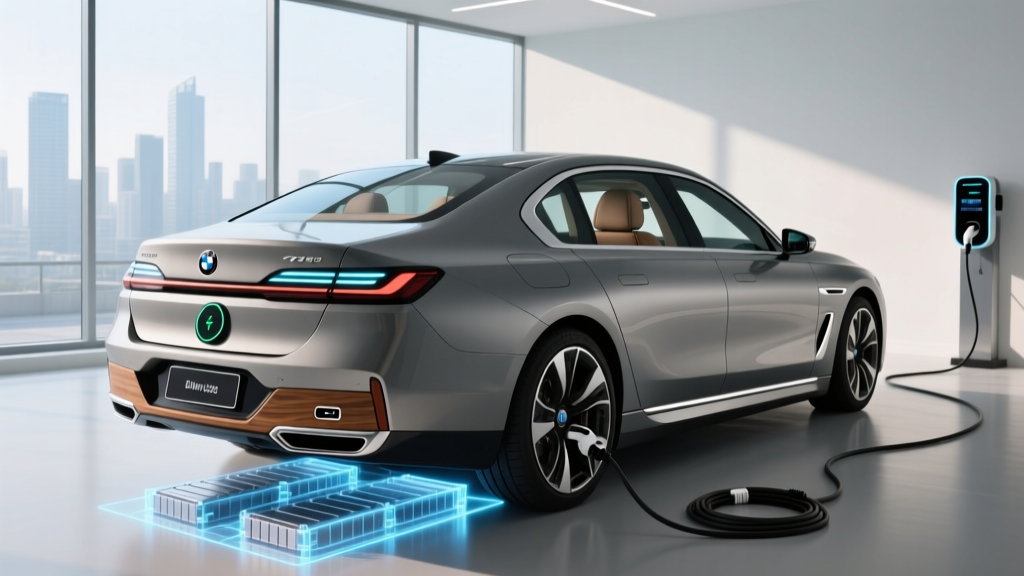
The BMW i7 exists to answer a specific question: can a full-size luxury flagship sedan be genuinely compelling as an electric vehicle, or is electrification just a tax on tradition? After spending time with the 2026 BMW i7 xDrive60, the answer leans heavily toward compelling — particularly when you step inside. The BMW i7 interior sets a benchmark that few EVs at any price point can match, but the powertrain and charging story deserve equal scrutiny before you write the check.
Below, we break down every number that matters — EPA range versus what you'll actually see on the highway in January, the real charging curve (not just the peak kW marketing number), pricing after federal tax credits, and whether the i7's tech and space justify its six-figure MSRP against rivals like the Mercedes-Benz EQS and Lucid Air.
2026 BMW i7 at a Glance: Core EV Specs
| Specification | 2026 BMW i7 xDrive60 | 2026 BMW i7 M70 xDrive |
|---|---|---|
| EPA Range | 318 miles | 295 miles |
| Battery (usable) | 101.7 kWh (NMC) | 101.7 kWh (NMC) |
| Drivetrain | Dual-motor AWD | Dual-motor AWD |
| Horsepower | 536 hp | 650 hp |
| 0–60 mph | 4.5 seconds | 3.5 seconds |
| Peak DC Fast Charge | 195 kW | 195 kW |
| 10–80% DCFC Time | ~34 minutes | ~34 minutes |
| Level 2 Charge Rate | 11 kW (~30 mi/hr) | 11 kW (~30 mi/hr) |
| MPGe (combined) | 82 MPGe | 76 MPGe |
| Efficiency | 41 kWh/100 mi | 44 kWh/100 mi |
| Cargo Volume | 17.7 cu ft | 17.7 cu ft |
| Rear Legroom | 43.3 inches | 43.3 inches |
| Battery Warranty | 8 yr / 100,000 mi | 8 yr / 100,000 mi |
| Base MSRP | $120,675 | $170,475 |
Source: EPA Fuel Economy and BMW USA specifications.
The BMW i7 Interior: What Justifies the Price
The BMW i7 interior is the reason this car exists. If you're cross-shopping an EQS or a Lucid Air, the i7's cabin is where BMW makes its strongest argument. The 2026 model continues with BMW's Curved Display setup — a 12.3-inch digital instrument cluster merged with a 14.9-inch central touchscreen running iDrive 8.5 — but the surrounding materials and execution are what separate this from the German-EV pack.
Standard equipment includes Veganza synthetic leather (convincing enough that most passengers won't question it), a panoramic sky lounge LED roof with selectable ambient lighting patterns, and BMW's Interaction Bar — a crystalline light strip that spans the full dashboard width and integrates touch-sensitive climate controls. Opt for the Executive Lounge package and the rear seats become 32-way power-adjustable recliners with heated and ventilated cushions, massaging functions, and individual 5.5-inch door-mounted touchscreens for climate and media control.
The available 31.3-inch BMW Theater Screen, which deploys from the headliner for rear passengers, remains a segment-exclusive feature. It supports 8K resolution and Amazon Fire TV integration, and it transforms the back seat into something closer to a private screening room. For buyers who prioritize rear-seat comfort — executives, chauffeur-driven owners, families with older children — this single feature can tip the decision.
Acoustic isolation is exceptional. BMW uses acoustic glass on all four doors and the windshield, and the electric powertrain eliminates the vibration and low-frequency drone that even the best-insulated combustion 7 Series could never fully erase. At 70 mph, cabin noise levels rival or beat the Mercedes EQS, which has historically set the standard here.
Real-World Range: EPA Sticker vs. What You'll Actually Drive
Real-World Expectation: ~260–285 miles on highway road trips at 70–75 mph; ~220–250 miles in sustained cold weather (below 32°F) with cabin heating.
Best Case: ~300+ miles in mild-weather city/suburban driving with regen maximized.
The i7 xDrive60's 318-mile EPA estimate is credible for mixed driving, but large luxury EVs are heavily penalized by sustained highway speeds and cold temperatures. The car's 6,035-pound curb weight and 0.24 Cd drag coefficient mean that energy consumption climbs noticeably above 70 mph. In our experience with similar BMW EVs on the CLAR platform, expect roughly 2.5–2.8 miles per kWh on the highway — translating to 254–285 miles before you'd want to stop.
Cold weather compounds this. Lithium-ion NMC batteries lose efficiency below freezing, and the cabin heating demand in a vehicle this large is substantial. The i7 does include a heat pump (standard, not an extra-cost option as it is on some competitors), which recovers waste heat from the drivetrain to warm the cabin more efficiently than resistive heating alone. Even so, plan for 25–30% range reduction in sustained sub-freezing conditions.
Compared to the Lucid Air Grand Touring (516 miles EPA) or even the Mercedes EQS 580 (371 miles EPA), the i7 trails on raw range. For most daily use — commuting, school runs, local errands — 318 miles is more than sufficient. For 400+ mile road trips, you'll be stopping once, which is manageable given the charging speed discussed below.
Charging Speed: DC Fast Charging and Home Level 2
| Charging Level | Power | Speed / Time | Notes |
|---|---|---|---|
| Level 1 (120V) | ~1.4 kW | ~4 miles per hour | Emergency/trickle only; not practical for daily use |
| Level 2 (240V, home) | 11 kW | ~30 miles per hour; 0–100% in ~10 hours | Requires 48A circuit; overnight recharge is standard practice |
| DC Fast Charge | Peak 195 kW | 10–80% in ~34 min; ~120 mi in 10 min | Peak rate sustained to ~50% SoC, then tapers progressively |
The i7's 195 kW peak DC fast-charge rate is competent but no longer class-leading. The Hyundai Ioniq 5 peaks at 240 kW on its 800V architecture; the Porsche Taycan hits 320 kW (2025+ models). BMW's CLAR platform uses a 400V electrical architecture, which physically caps charge rate compared to 800V rivals.
Here's what the charging curve actually looks like: the i7 sustains close to its 195 kW peak from roughly 10% to 45–50% state of charge. After that, thermal management and cell-protection protocols taper the rate — expect ~140 kW at 60% SoC, ~90 kW at 70%, and ~50 kW above 80%. The quoted 34-minute 10–80% figure assumes a properly preconditioned battery (the i7 does this automatically when a DC charger is set as your navigation destination) and a charger capable of delivering the full 195 kW.
For home Level 2 charging, the 11 kW onboard charger is standard and competitive. A full overnight charge from near-empty takes roughly 10 hours, meaning most owners will plug in at 20–30% and wake up at 80–90% — ideal for battery longevity with NMC chemistry. Installation of a 48-amp Level 2 home charger (such as a BMW Wallbox or ChargePoint Home Flex) typically costs $800–$2,500 depending on panel capacity and run length; consult a licensed electrician for a site-specific quote.
The i7 ships with a NACS (Tesla Supercharger-compatible) charge port on 2025+ models following BMW's adoption of the North American Charging Standard. This opens access to Tesla's Supercharger network — a significant practical advantage for road trips, as Superchargers remain the most reliable DC fast-charging network in the U.S. according to J.D. Power and owner surveys.
Performance: Quick, Composed, and Surprisingly Agile
The xDrive60's dual-motor all-wheel-drive powertrain delivers 536 horsepower and 549 lb-ft of torque, reaching 60 mph in 4.5 seconds. For a 6,035-pound sedan, that's genuinely quick — and the instant torque delivery makes it feel even faster in real-world passing situations. The M70 variant bumps output to 650 hp and drops the 0–60 to 3.5 seconds, entering sports-sedan territory.
BMW's adaptive air suspension with automatic self-leveling is standard. The system reads road surfaces and adjusts damping in real time, and the result is a ride quality that absorbs expansion joints and broken pavement with the composure expected of a 7 Series. Rear-axle steering (standard on the i7) shrinks the car's effective turning radius and adds agility in parking lots and tight city streets that belies its 212.2-inch overall length.
Regenerative braking offers multiple modes: adaptive (which uses radar and map data to modulate regen based on traffic and upcoming intersections), high (near one-pedal driving in city conditions), and low (coasting for maximum efficiency on open roads). The adaptive mode is the most intuitive for drivers transitioning from combustion vehicles.
Pricing, Trims, and Federal Tax Credit Eligibility
| Trim | Base MSRP | Federal §30D Credit | Effective Price |
|---|---|---|---|
| i7 xDrive60 | $120,675 | $0 (exceeds MSRP cap) | $120,675 |
| i7 M70 xDrive | $170,475 | $0 (exceeds MSRP cap) | $170,475 |
Here's the critical point for tax-credit shoppers: the BMW i7 does not qualify for the federal §30D clean vehicle credit. Under current IRS rules, new EVs must have an MSRP at or below $55,000 for sedans to be eligible (see IRS.gov §30D guidelines). At $120,675 and above, the i7 far exceeds this cap regardless of battery sourcing or buyer income.
State-level incentives may still apply — California's CVRP, Colorado's state tax credit, and various utility rebates can offset $2,000–$7,500 depending on your jurisdiction. Check your state's energy office or utility provider for current programs. Additionally, some BMW dealers offer lease incentives that can effectively reduce monthly payments, and leasing may allow the dealer to pass through the commercial clean vehicle credit (§45W) — a structure that requires consultation with a tax professional.
As-tested pricing on a well-equipped xDrive60 with the Executive Lounge Package ($6,900), Bowers & Wilkins Diamond Surround Sound ($4,200), and BMW Individual paint ($1,950) lands in the $138,000–$145,000 range before destination and dealer fees. The M70, optioned similarly, easily clears $190,000.
Efficiency, Cargo, and Practicality
The xDrive60 achieves 82 MPGe combined (41 kWh per 100 miles) per the EPA. That's respectable for a vehicle of this mass and size, though the Lucid Air Grand Touring (131 MPGe) demonstrates what's possible with a dedicated EV platform optimized for efficiency. The i7's CLAR architecture is shared with the combustion 7 Series, which imposes packaging compromises — notably, a less aerodynamically optimized underbody compared to ground-up EV designs.
Cargo space measures 17.7 cubic feet in the trunk — adequate for several suitcases but less versatile than a hatchback or SUV. There is no front trunk (frunk); the space under the hood houses power electronics. Rear-seat legroom is a generous 43.3 inches, and headroom accommodates adults comfortably even with the panoramic roof. The Executive Lounge reclining rear seats reduce usable cargo pass-through but dramatically improve long-distance comfort for two rear passengers.
Driver Assistance and Safety Technology
The 2026 i7 comes standard with BMW's Driving Assistant Professional, which includes adaptive cruise control with stop-and-go, lane-keeping assist, and automatic emergency braking with pedestrian detection. The available Highway Assistant (BMW's Level 2 hands-free driving system, operational up to 85 mph on divided highways) allows true hands-off operation provided the driver maintains eye contact with the road, monitored by an infrared driver-attention camera.
The i7 has not been crash-tested by IIHS or NHTSA at the time of this writing, which is common for low-volume luxury flagships. BMW's 7 Series platform historically performs well in European Euro NCAP testing, and the i7's structure includes extensive aluminum and high-strength steel reinforcement.
Pros and Cons: The Honest Summary
Pros
- Interior quality and rear-seat luxury are segment-leading; Theater Screen is genuinely unique
- 318-mile EPA range is practical for daily use and most road trips with one stop
- Heat pump is standard (not a paid option), improving cold-weather efficiency
- NACS charge port grants access to Tesla Supercharger network
- Air suspension and rear-axle steering deliver ride quality and agility that defy the car's weight
- 8-year/100,000-mile battery warranty with 70% capacity retention guarantee
Cons
- Does not qualify for the $7,500 federal EV tax credit (MSRP exceeds $55K sedan cap)
- 195 kW peak DC charge rate trails 800V rivals (Taycan at 320 kW, Ioniq 5 at 240 kW)
- Range lags Lucid Air (516 mi) and Mercedes EQS (371 mi) significantly
- No frunk; cargo space limited to 17.7 cu ft trunk with no hatchback versatility
- Highway Assistant requires hands-on or eyes-on engagement — not truly hands-free in all conditions
- As-tested prices easily reach $140K–$190K with options
Who Should Buy the 2026 BMW i7?
The i7 is best suited for luxury sedan buyers who want a chauffeur-grade rear seat, daily-drivable EV range, and BMW's driving dynamics — and who don't need the 500+ mile range of a Lucid Air or the sub-$80K pricing of an i5. It's an executive express, a long-distance cruiser, and a technology showcase that happens to be electric. If your priority is the BMW i7 interior experience — the materials, the Theater Screen, the acoustic isolation, the massaging rear seats — there is no EV sedan that does it better. If your priority is maximum range per dollar or fastest charging speed, look to Lucid or Hyundai/Genesis.
Frequently Asked Questions
What is the real-world range of the BMW i7?
The EPA rates the i7 xDrive60 at 318 miles. In real-world highway driving at 70–75 mph, expect 260–285 miles. In cold weather below freezing, plan for 220–250 miles. The heat pump helps, but physics and a 6,035-pound curb weight limit efficiency at speed.
How fast does the BMW i7 charge?
The i7 peaks at 195 kW on a DC fast charger, achieving a 10–80% charge in approximately 34 minutes with a preconditioned battery. At home on a Level 2 charger (11 kW / 48 amps), expect roughly 30 miles of range added per hour, or a full overnight charge in about 10 hours.
Does the BMW i7 qualify for the federal EV tax credit?
No. Under current IRS §30D rules, the federal clean vehicle credit for new EVs is capped at vehicles with an MSRP of $55,000 or less for sedans. The i7 starts at $120,675 and is ineligible regardless of battery sourcing or buyer income. State incentives and lease structures may provide partial offsets — consult IRS.gov and a tax professional.
Is the BMW i7 worth buying over the Mercedes EQS or Lucid Air?
If interior luxury, rear-seat comfort, and BMW driving dynamics are your top priorities, the i7 is the strongest choice. If maximum range is paramount, the Lucid Air Grand Touring (516 miles EPA) wins decisively. If you want a more affordable entry point with strong tech, the Mercedes EQS 450+ (371 miles, starting around $105K) is a credible alternative. The i7's advantage is cabin execution — it feels more like a traditional luxury flagship than either rival.
What battery chemistry does the BMW i7 use?
The i7 uses an NMC (nickel manganese cobalt) lithium-ion battery with 101.7 kWh of usable capacity. NMC offers high energy density, which is necessary to achieve 318 miles in a vehicle this heavy. The battery is covered by BMW's 8-year/100,000-mile warranty with a 70% capacity retention guarantee.
Does the BMW i7 have a frunk (front trunk)?
No. The i7 does not have a front trunk. The space under the hood is occupied by power electronics and the front drive motor. All cargo capacity (17.7 cu ft) is in the rear trunk.