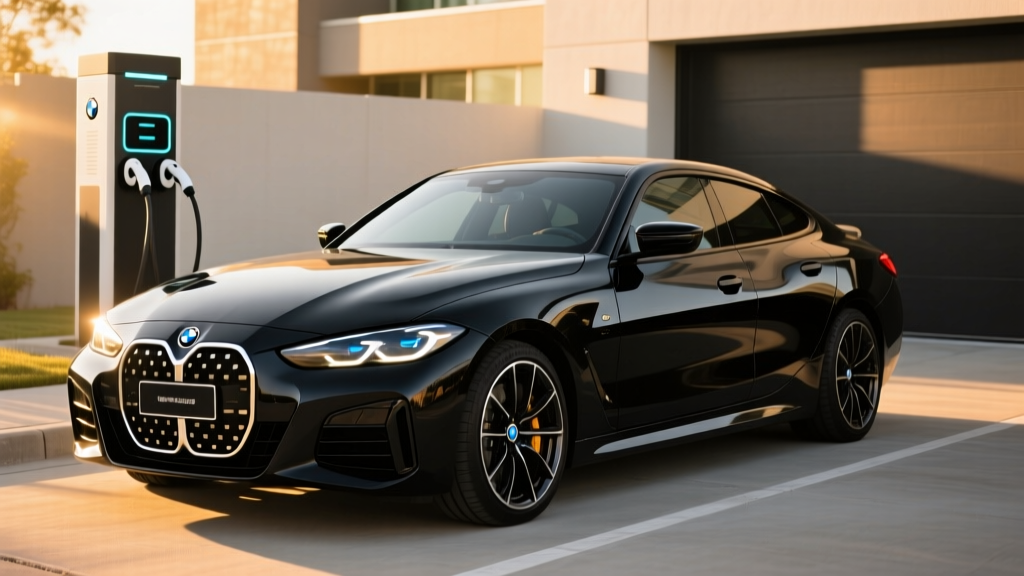
The BMW i4 M60 has always occupied a specific niche: the electric sports sedan that doesn't look, feel, or drive like an appliance. For 2026, BMW has refreshed the i4 lineup with updated aerodynamics, a revised battery management system, and the latest iDrive 8.5 software. The M60 remains the performance flagship, packing dual motors, 536 horsepower, and a price that undercuts its closest rivals from Mercedes-AMG and Porsche. But with a $69,900 starting MSRP that puts it squarely outside the federal EV tax credit's price cap, the i4 M60 asks buyers to pay full freight for electrified M performance. Is the driving experience worth the premium?
EPA Estimated: 283 miles (19-inch wheels) | 258 miles (20-inch M wheels)
Real-World Expectation: ~240–260 miles highway (70+ mph); ~210–230 miles in freezing weather with cabin heat. The i4 M60's 81.5 kWh usable battery and dual-motor AWD drivetrain trade some efficiency for performance. Plan conservatively on road trips.
Core Specs at a Glance
| Specification | 2026 BMW i4 M60 |
|---|---|
| Base MSRP | $69,900 |
| EPA Range (19" wheels) | 283 miles |
| EPA Range (20" M wheels) | 258 miles |
| Battery (Usable) | 81.5 kWh, NMC chemistry |
| Drivetrain | Dual-motor AWD (xDrive) |
| Horsepower | 536 hp (Sport Boost mode) |
| Torque | 586 lb-ft |
| 0–60 mph | 3.7 seconds |
| Max DC Fast Charge | 205 kW (CCS1) |
| 10–80% DC Charge Time | ~31 minutes |
| Level 2 Home Charge | 11 kW (~30 mi/hr) |
| Efficiency (EPA Combined) | 87 MPGe / 38 kWh/100mi |
| Cargo Volume | 10.0 cu ft (rear seats up) / 36.0 cu ft (folded) |
| Rear Legroom | 33.0 inches |
| Battery Warranty | 8 years / 100,000 miles (70% capacity retention) |
| Federal Tax Credit (§30D) | Not eligible — MSRP exceeds $55,000 sedan cap |
Range and Efficiency: What the Numbers Really Mean
The i4 M60 shares its Gen5 eDrive platform with the more efficiency-oriented i4 eDrive40, but the dual-motor setup and sportier tuning cost it roughly 20–30 miles of range compared to the single-motor variant. The 81.5 kWh usable battery (out of a ~83.9 kWh gross capacity) uses NMC (nickel manganese cobalt) chemistry, which BMW favors for its energy density — important in a performance sedan where weight distribution matters.
EPA efficiency comes in at 87 MPGe combined, or roughly 38 kWh per 100 miles. That's middling for the segment. The Tesla Model 3 Performance, for comparison, extracts about 25% more range per kWh thanks to lighter weight and a more efficient motor design. On a 250-mile highway road trip at 75 mph in 40°F weather, expect the i4 M60's range to contract to roughly 210–220 miles — meaning one DC fast-charge stop is mandatory.
One positive: the i4 M60 includes a standard heat pump, which mitigates cold-weather range loss compared to resistance-heated EVs. BMW's thermal management system also preconditions the battery when a DC fast charger is set as the navigation destination, which is critical for achieving peak charge rates.
Charging Speed and Infrastructure
| Charge Level | Power | Speed | Notes |
|---|---|---|---|
| Level 1 (120V) | ~1.4 kW | ~4 mi/hr | Emergency/trickle only |
| Level 2 (240V, 48A) | 11 kW | ~30 mi/hr | Full charge in ~9 hours |
| DC Fast Charge | Peak 205 kW | 10–80% in ~31 min | CCS1 connector; tapers above 80% |
The 205 kW peak DC charge rate is competitive but not class-leading. The Hyundai Ioniq 6 SE peaks at 240 kW and hits 10–80% in roughly 18 minutes on a 350 kW charger. BMW's charge curve holds near peak from about 10% to 50% state of charge, then progressively tapers — a typical NMC pattern designed to protect long-term battery health.
For home charging, the i4 M60's 11 kW onboard charger is a strong point. On a 48-amp Level 2 circuit (the most common residential installation), you'll recover roughly 30 miles of range per hour. An overnight charge from 20% to full takes about 8–9 hours, which is perfectly practical for daily commuting. Note that you'll need a NEMA 14-50 outlet or hardwired Level 2 station — BMW includes a flexible charger cable but does not bundle a wall unit.
The i4 M60 uses a CCS1 connector for DC fast charging. BMW has not yet adopted the NACS (Tesla) port natively on the 2026 i4, so Supercharger access requires BMW's included CCS-to-NACS adapter or a third-party equivalent. Check BMW's official i4 page for the latest adapter details.
Performance and Driving Dynamics
This is where the M60 earns its badge. The dual-motor xDrive system delivers 536 hp and 586 lb-ft of torque in Sport Boost mode (activated via the M Sport button on the steering wheel; standard Drive mode produces 469 hp). The 0–60 mph sprint takes 3.7 seconds — quick enough to gap most traffic and within a half-second of the old M3 Competition.
But straight-line speed is only part of the story. The i4 M60 uses BMW's CLAR platform with a low center of gravity (battery pack mounted under the floor), adaptive M suspension, and a rear-biased torque distribution that makes it feel more agile than its 4,763-pound curb weight suggests. Steering is precise, body roll is well-controlled, and the regenerative braking system offers adjustable levels including a true one-pedal driving mode.
The trade-off is ride firmness. On 20-inch M wheels with performance tires, the M60 transmits more road imperfections than a comfort-oriented sedan buyer might expect. Switching to the 19-inch wheel/tire package softens things slightly but costs nothing in the EPA range column — and gains 25 miles of rated range.
Tax Credit, Pricing, and Total Cost
| Item | Amount |
|---|---|
| Base MSRP (i4 M60) | $69,900 |
| As-Tested (with M Sport Package, 20" wheels, Premium Package) | ~$77,500 |
| Federal §30D Tax Credit | $0 — MSRP exceeds $55,000 sedan cap |
| Destination Charge | $995 |
| Estimated Out-the-Door (before state incentives) | ~$70,895+ |
The 2026 BMW i4 M60 does not qualify for the federal §30D new clean vehicle credit. IRS rules cap eligible sedans at an MSRP of $55,000, and the M60 starts at $69,900 — well above the threshold. Buyers should also be aware of income caps ($150,000 single / $300,000 joint MAGI) and critical-mineral/battery-sourcing requirements that apply to all §30D-eligible vehicles. See the IRS §30D page for current rules.
Some state-level incentives may partially offset the cost. California's CVRP, for example, has offered rebates up to $7,000 for income-eligible buyers on vehicles under $60,000 MSRP — but the M60 exceeds that cap too. Check your state energy office for local programs. On the leasing side, BMW Financial sometimes offers lease cash that effectively discounts the M60 by $3,000–$5,000, which is worth investigating if you're open to leasing.
Five-year ownership costs will be driven by electricity (roughly $0.13/kWh national average = ~$600/year for 12,000 miles), insurance (expect $2,400–$3,200/year depending on profile), and BMW's included 3-year/36,000-mile maintenance plan. Depreciation on the i4 M60 has historically been steeper than on the Tesla Model 3 — plan for roughly 45–50% value retention at 5 years based on current market trends.
Interior, Tech, and Daily Livability
The i4 M60's cabin is a strong suit. BMW's Curved Display pairs a 12.3-inch digital instrument cluster with a 14.9-inch touchscreen running iDrive 8.5. Wireless Apple CarPlay and Android Auto are standard, as is a head-up display with M-specific readouts (G-meter, boost gauge, lap timer). The Harman Kardon 17-speaker audio system delivers excellent sound quality.
On the driver-assistance front, the i4 M60 comes equipped with BMW's Driving Assistant Professional, which includes adaptive cruise control with stop-and-go, lane-keeping assist, and automatic lane-change on highways (when the driver confirms with the turn signal). This is an SAE Level 2 system — the driver must remain attentive and keep hands near the wheel at all times. It is not self-driving.
Practicality is the i4's relative weakness. The Gran Coupe liftback design provides a 10.0 cu ft trunk (36.0 cu ft with the 40/20/40 rear seats folded), which is adequate but smaller than a Tesla Model 3's 23 cu ft trunk. Rear legroom at 33.0 inches is tight for taller adults on long trips. There is no front trunk (frunk) — the space is occupied by drive electronics. If you regularly carry four adults or need maximum cargo flexibility, the i4 M60 will feel cramped compared to a Model Y or Hyundai Ioniq 5.
How It Stacks Up Against Rivals
The i4 M60 competes in a narrow band of electric sport sedans priced between $60,000 and $85,000. Here's how it compares to the three most relevant alternatives:
- Tesla Model 3 Performance ($54,990): Faster (0–60 in 2.9s), more efficient (132 MPGe combined), more range (330 mi EPA), and eligible for the $7,500 federal credit. But the interior materials, ride quality, and service infrastructure are a step down from BMW.
- Mercedes-AMG EQB 350 4MATIC (~$64,000): An SUV rather than a sedan, but similarly priced with 282 hp and 230 miles of range. The i4 M60 is significantly quicker and more engaging to drive.
- Porsche Taycan 4S ($92,500): The handling benchmark, but $22,000+ more expensive with less range (246 mi EPA) and slower DC charging in practice despite its 270 kW peak. The i4 M60 delivers about 85% of the Taycan experience at 75% of the price.
- Hyundai Ioniq 6 SE AWD (~$52,000): Best-in-class charging speed (240 kW, 10–80% in 18 min) and 316 miles of range. But it lacks the M60's performance, premium materials, and brand cachet.
Look elsewhere if: You need 300+ miles of real-world range, want the $7,500 federal credit, regularly carry four adults, or prioritize charge speed above all else.
Warranty and Long-Term Battery Outlook
BMW covers the i4 M60's high-voltage battery for 8 years or 100,000 miles, whichever comes first, against defects and capacity loss below 70% of original capacity. The standard limited warranty is 4 years / 50,000 miles, with a complimentary maintenance plan covering 3 years / 36,000 miles.
NMC batteries in BMW's Gen5 eDrive platform have shown moderate degradation in real-world use. Based on data from 2022–2024 i4 models tracked by owner communities, typical capacity loss is approximately 5–8% over the first 60,000 miles — well within the warranty threshold. BMW's conservative 81.5 kWh usable buffer (out of ~83.9 kWh gross) helps protect the pack from the deep-cycle stress that accelerates degradation.
For a full breakdown of NMC vs LFP battery chemistry trade-offs and long-term cost projections, see the DOE's EV technology resources at fueleconomy.gov.
Pros and Cons
- 536 hp dual-motor AWD with genuine M-car driving dynamics
- Premium interior with iDrive 8.5 Curved Display
- 11 kW Level 2 home charging — faster than many rivals
- Heat pump standard (improves cold-weather efficiency)
- Strong build quality and dealer service network
- No federal tax credit eligibility (MSRP above $55K cap)
- 283-mile EPA range drops to ~258 on 20" wheels
- Rear seat and cargo space tighter than competitors
- 205 kW DC charging slower than Hyundai/Kia/Tesla rivals
- CCS1 port requires adapter for Tesla Supercharger access
Frequently Asked Questions
What is the real-world range of the 2026 BMW i4 M60?
Expect 240–260 miles on the highway at 70+ mph in mild weather, and 210–230 miles in freezing temperatures with cabin heating. The EPA sticker says 283 miles (19-inch wheels), but real-world driving — especially at highway speeds where EVs are least efficient — will consistently fall short. Plan road trips around 200-mile segments to maintain a safety buffer.
How fast does the i4 M60 charge at home and on the road?
At home on a 48-amp Level 2 charger (240V), the i4 M60 charges at 11 kW, adding roughly 30 miles of range per hour. A full charge from 20% takes about 8–9 hours. On DC fast chargers, it peaks at 205 kW and reaches 10–80% in approximately 31 minutes — adequate but not best-in-class. Always precondition the battery by entering the charger as your navigation destination.
Does the 2026 BMW i4 M60 qualify for the $7,500 federal EV tax credit?
No. Under IRS §30D rules, new sedans must have an MSRP at or below $55,000 to be eligible. The i4 M60 starts at $69,900, disqualifying it regardless of battery sourcing or buyer income. The lower-trim i4 eDrive40 (starting ~$58,000) also exceeds the cap. State incentives may apply — check your local energy authority.
Is the i4 M60 worth buying over a Tesla Model 3 Performance?
It depends on your priorities. The Model 3 Performance is faster, more efficient, longer-range, and eligible for the federal credit — making it the clear value pick. The i4 M60 wins on interior quality, ride refinement, brand prestige, and dealer-based service. If you want a premium sport sedan experience and don't need the tax credit, the M60 is compelling. If you want maximum performance-per-dollar, the Tesla is hard to beat.
What's the biggest drawback of the i4 M60?
Range and charging speed relative to the price. At $69,900, buyers in this segment increasingly expect 300+ miles of range and sub-20-minute DC charging. The i4 M60 delivers neither. The tight rear seat and lack of a frunk also limit practicality for families. It's a driver's car first and a daily commuter second.
Can I charge the i4 M60 at Tesla Superchargers?
Yes, but with an adapter. The 2026 i4 M60 uses a CCS1 port natively. BMW provides a CCS-to-NACS adapter that enables access to Tesla's V3 and V4 Supercharger network. Charge speeds on Superchargers (which max out at 250 kW) will be limited by the i4's 205 kW peak, so expect roughly 10–80% in 31–33 minutes on a V3 stall.