Quick Verdict: The Driver's Electric Gran Coupe
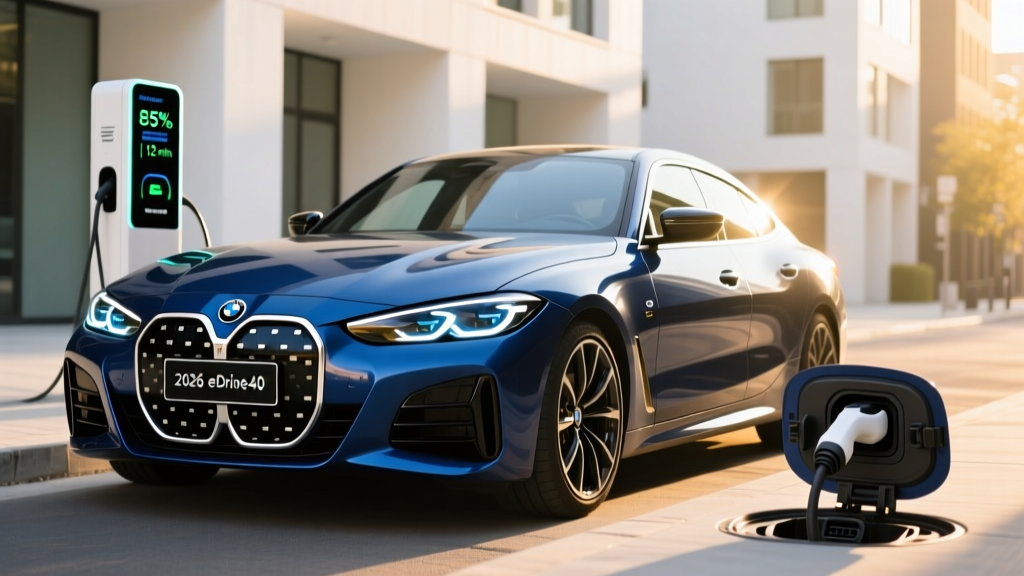
The 2026 BMW i4 eDrive40 occupies a specific niche in the EV market: it's the electric sedan for people who actually enjoy driving. Built on BMW's CLAR platform (shared with the 4 Series Gran Coupe), it sacrifices nothing in chassis dynamics to accommodate its battery. The single-motor rear-wheel-drive layout delivers 335 horsepower, a 307-mile EPA range, and a driving experience that most purpose-built EV platforms still can't match. The trade-off is a rear seat and cargo area that reflect its combustion-platform origins rather than a skateboard-EV packaging advantage.
If you're cross-shopping against the Tesla Model 3 Long Range, Hyundai Ioniq 6, or Polestar 2, the i4 eDrive40 wins on build quality and driving engagement but loses on interior space efficiency and price-to-range ratio. Here's the full data breakdown.
Range, Efficiency, and Real-World Expectations
Real-World Expectation: 260–285 miles highway (70-75 mph); 230–250 miles in freezing temperatures with climate control active. City/regenerative driving can match or slightly exceed the EPA sticker.
The i4 eDrive40 carries an 81.5 kWh usable battery pack (83.9 kWh gross) using NMC (nickel manganese cobalt) chemistry. BMW's fifth-generation eDrive powertrain integrates the motor, power electronics, and single-speed transmission into a single rear-axle housing, which contributes to the car's 97 MPGe combined rating (34 kWh/100 mi) per fueleconomy.gov.
Opting for the 19" or 20" wheel packages reduces EPA range to approximately 282–290 miles due to increased rolling resistance and weight. The aerodynamic drag coefficient of 0.24 helps highway efficiency, but the i4's Gran Coupe profile doesn't match the teardrop efficiency of the Hyundai Ioniq 6 (Cd 0.21).
Cold-weather note: NMC chemistry in the i4 loses roughly 20–28% range in sustained sub-30°F driving. BMW's heat pump (standard on 2026 models) mitigates cabin-heating energy draw, but battery thermal management still consumes from the pack. Preconditioning the battery while plugged in is essential for preserving both range and charge speed in winter.
Charging Speed: DC Fast, Level 2, and the Charge Curve
Charging capability is where the i4 eDrive40 shows its engineering maturity. The 400-volt architecture supports DC fast charging up to 205 kW peak — not class-leading, but sustained well through the mid-state-of-charge window.
| Charging Level | Power / Rate | Speed / Time |
|---|---|---|
| Level 1 (120V household) | ~1.4 kW | ~4 miles per hour |
| Level 2 (240V home/workplace) | 11 kW (48A) | ~32 miles per hour; 0–100% in ~8.5 hours |
| DC Fast Charge (peak) | 205 kW | 10–80% in ~31 minutes |
| DC Fast Charge (sustained avg.) | ~140 kW avg (10-80%) | ~180 miles added in 20 minutes |
Understanding the charge curve: The 205 kW peak hits between roughly 10–35% state of charge, then tapers progressively. From 60–80%, expect rates closer to 80–100 kW. This is typical of 400V NMC architectures. For road-trip planning, plan DC stops from 10% to 80% rather than topping to 100% — the final 20% can take as long as the first 70%.
The i4 uses the CCS1 connector standard. BMW has confirmed NACS (Tesla Supercharger) adapter compatibility for 2026 models, and future production will transition to native NACS ports. As of early 2026, i4 owners can access Tesla's Supercharger network using BMW's provided adapter.
Performance and Driving Dynamics
| Specification | 2026 BMW i4 eDrive40 |
|---|---|
| Powertrain | Single motor, rear-wheel drive |
| Horsepower | 335 HP |
| Torque | 317 lb-ft |
| 0–60 mph | 5.5 seconds |
| Top Speed | 118 mph (electronically limited) |
| Curb Weight | ~4,682 lbs |
| Battery (usable / gross) | 81.5 kWh / 83.9 kWh (NMC) |
| EPA Range | 307 miles (18" wheels) |
| Efficiency | 97 MPGe combined / 34 kWh/100mi |
| Max DC Fast Charge | 205 kW |
| Level 2 Charge Rate | 11 kW (48A) |
| Cargo Volume | 16.6 cu ft (rear hatch); 45.6 cu ft seats folded |
| Rear Legroom | 34.7 inches |
| Base MSRP | $57,900 (incl. destination) |
The eDrive40's rear-axle motor placement gives the i4 a near 50/50 weight distribution that BMW engineers clearly prioritized. The steering is communicative by EV standards, and the adaptive M suspension (optional on eDrive40, standard on M50) keeps body motions controlled through corners. Regenerative braking offers both an adaptive mode (which uses radar and navigation data to modulate regen based on traffic and upcoming intersections) and a max-regen setting for one-pedal-style driving, though it doesn't come to a complete hold without brake application.
The 5.5-second 0–60 time is brisk but not thrilling by 2026 EV standards — the dual-motor i4 M50 hits 3.9 seconds, and a Tesla Model 3 Performance manages 2.9 seconds. The eDrive40's advantage is delivery smoothness and chassis composure, not straight-line shock value.
Pricing, Trims, and Federal Tax Credit Eligibility
| Trim | Base MSRP | Est. §30D Credit | Effective Price |
|---|---|---|---|
| eDrive40 | $57,900 | Up to $7,500* | ~$50,400* |
| eDrive40 w/ Premium + Driving Asst. Pkg | ~$64,500 | Up to $7,500* | ~$57,000* |
| M50 (AWD dual-motor) | $69,700 | Up to $7,500* | ~$62,200* |
*Federal tax credit eligibility under IRS §30D depends on multiple requirements that change frequently:
- MSRP Cap: Sedans must be under $55,000 MSRP. The i4 eDrive40 at $57,900 exceeds this cap — meaning it does NOT qualify for the new-vehicle §30D credit as of current rules. Verify current thresholds with a tax professional.
- Buyer Income Cap: AGI must not exceed $150,000 (single) / $300,000 (joint) / $225,000 (head of household).
- Battery Sourcing: Critical minerals and battery components must meet escalating domestic-content and FEOC (foreign entity of concern) thresholds — BMW's supply chain compliance varies by model year.
- Point-of-Sale Transfer: Eligible buyers can transfer the credit to the dealer at purchase for an immediate price reduction rather than waiting for tax filing.
Interior, Tech, and Daily Usability
The i4's cabin uses BMW's Curved Display setup: a 12.3" instrument cluster and 14.9" central touchscreen running iDrive 8.5 (2026 update). The system is one of the better luxury-EV interfaces — responsive, logically menued, and retaining physical knobs for climate and volume, a practical advantage over touch-only competitors.
Standout tech features:
- BMW Digital Key Plus (UWB-based phone-as-key, works without removing phone from pocket)
- Augmented-reality navigation overlay on the instrument cluster
- Wireless Apple CarPlay / Android Auto with wireless charging pad
- Driving Assistant Professional (Level 2): adaptive cruise with stop-and-go, lane-keeping, automatic lane-change on highway — not self-driving; driver must remain engaged per SAE Level 2 requirements
- Parking Assistant Plus with surround-view and remote parking maneuver assist
Space and cargo: The Gran Coupe hatchback design gives the i4 a 16.6 cu ft rear cargo area (45.6 cu ft with 40/20/40 seats folded), which is generous for the segment and more practical than a traditional sedan trunk. However, rear legroom at 34.7 inches is tight for taller passengers on longer trips — a consequence of the platform's combustion-engine firewall positioning that a skateboard-EV architecture avoids. Headroom under the sloping roofline also limits comfort for passengers over 6 feet.
No front trunk (frunk): The CLAR platform's forward structure houses auxiliary systems rather than offering storage, unlike the Tesla Model 3 or Hyundai Ioniq 5.
Warranty and Long-Term Battery Outlook
BMW covers the i4 eDrive40 with:
- Limited Vehicle Warranty: 4 years / 50,000 miles
- High-Voltage Battery Warranty: 8 years / 100,000 miles (guarantees ≥70% capacity retention)
- Complimentary Maintenance: 3 years / 36,000 miles
- Roadside Assistance: 4 years / unlimited miles
The 70% capacity retention threshold is standard across most manufacturers. NMC chemistry in BMW's Gen5 eDrive system has shown moderate degradation in real-world fleet data — roughly 5–8% loss over the first 50,000 miles, stabilizing afterward. Thermal management via the liquid-cooled battery pack is robust, and BMW's preconditioning routines help minimize calendar aging.
Out-of-warranty battery replacement for the i4 is estimated at $12,000–$18,000 based on current BMW parts pricing, though this figure is expected to decline as the supply chain matures. Individual module replacement (rather than full pack) is supported by BMW's service architecture, potentially reducing costs for localized cell failures.
How It Compares: i4 eDrive40 vs. Key Rivals
| Attribute | 2026 BMW i4 eDrive40 | 2026 Tesla Model 3 LR | 2026 Hyundai Ioniq 6 SEL |
|---|---|---|---|
| EPA Range | 307 mi | 341 mi | 305 mi (361 LR) |
| Base MSRP | $57,900 | $47,990 | $42,950 |
| 0–60 mph | 5.5 sec | 4.2 sec (AWD) | 5.1 sec (RWD) |
| Max DC Charge | 205 kW | 250 kW | 240 kW |
| 10–80% DC Time | ~31 min | ~25 min | ~18 min |
| Rear Legroom | 34.7 in | 35.3 in | 39.5 in |
| Cargo (rear) | 16.6 cu ft | 23.0 cu ft | 11.2 cu ft (trunk) |
| Drivetrain | RWD | AWD | RWD |
- Build quality, materials, and cabin quietness are top priorities
- You value driving dynamics and steering feel over straight-line speed
- You prefer a luxury-brand dealer experience and service network
- The hatchback cargo opening matters more than maximum rear-seat space
- Maximum range per dollar is the priority (341 mi at ~$10K less)
- You need Supercharger network access without an adapter
- Over-the-air updates and software-forward features are important
- Fastest DC charging speed matters (18 min 10–80%)
- Rear-seat passenger space is a daily need (39.5" legroom)
- Budget is a primary constraint ($15K less than the i4)
Pros and Cons
Pros
- Best-in-class driving dynamics and steering feedback for an EV sedan
- Premium interior materials and excellent cabin isolation
- iDrive 8.5 with physical climate controls — intuitive daily use
- Hatchback cargo versatility (16.6 cu ft, 45.6 cu ft folded)
- Adaptive regen that reads traffic and navigation data ahead
- Strong 205 kW sustained charge capability for road trips
Cons
- Exceeds §30D MSRP cap — likely ineligible for $7,500 federal credit
- Rear legroom (34.7") is tight for the price point
- No frunk; less total storage than skateboard-platform rivals
- Higher starting price than equally capable or longer-range competitors
- 400V architecture limits peak charge speed vs 800V rivals (Ioniq 6, Taycan)
Frequently Asked Questions
What is the real-world range of the 2026 BMW i4 eDrive40?
The EPA rates the eDrive40 at 307 miles with 18" wheels. In real-world highway driving at 70–75 mph, expect 260–285 miles. In freezing weather with cabin heat active, plan for 230–250 miles. City driving with regenerative braking can match or slightly exceed the EPA figure.
How fast does the i4 eDrive40 charge at home and on the road?
At home on a 240V Level 2 charger (48A / 11 kW), the i4 adds about 32 miles of range per hour, reaching a full charge from empty in roughly 8.5 hours. On DC fast chargers, it peaks at 205 kW and charges from 10–80% in approximately 31 minutes, adding roughly 180 miles in a 20-minute stop.
Does the 2026 BMW i4 eDrive40 qualify for the federal EV tax credit?
Likely not under the standard §30D new-vehicle credit. The i4 eDrive40's $57,900 MSRP exceeds the $55,000 sedan cap set by the Inflation Reduction Act. However, leasing the i4 may allow the leasing company to claim the commercial clean vehicle credit (§45W), which some lessors pass through as a capitalized-cost reduction. Always verify with a tax professional and your BMW dealer before relying on credit eligibility.
Is the BMW i4 eDrive40 worth buying over the Tesla Model 3 or Ioniq 6?
If driving engagement, interior quality, and luxury-brand ownership experience are your top three criteria, yes — the i4 delivers on all three. If range-per-dollar, charging speed, or rear-seat space rank higher, the Model 3 Long Range and Ioniq 6 are objectively better values. The i4 is a driver's car that happens to be electric; its rivals are electric cars that happen to be practical.
What's the biggest drawback of the i4 eDrive40?
The price-to-range ratio. At $57,900 for 307 miles of range, you're paying a significant premium over the Tesla Model 3 LR ($47,990 / 341 mi) and Hyundai Ioniq 6 ($42,950 / 305 mi). That premium buys build quality, driving dynamics, and brand cachet — but not measurable efficiency or space advantages.
Can I charge the BMW i4 at Tesla Superchargers?
Yes. For 2026, BMW provides a NACS adapter that enables i4 owners to use Tesla's Supercharger network. BMW is transitioning to native NACS ports in future production, but current CCS-equipped i4 vehicles work with the adapter at all NACS-equipped stations.
How does the i4 handle in winter and cold weather?
The standard heat pump reduces cabin-heating energy draw significantly compared to resistive heaters. Expect 20–28% range loss in sustained sub-30°F conditions. Battery preconditioning (activated automatically when navigation is set to a DC charger) warms the pack for optimal charging speed. BMW's xDrive AWD is available on the M50 trim but not the eDrive40, which remains RWD — winter tire investment is recommended for snow-belt owners.