Quick Verdict: The Reinvented i3 Is a Serious Compact EV
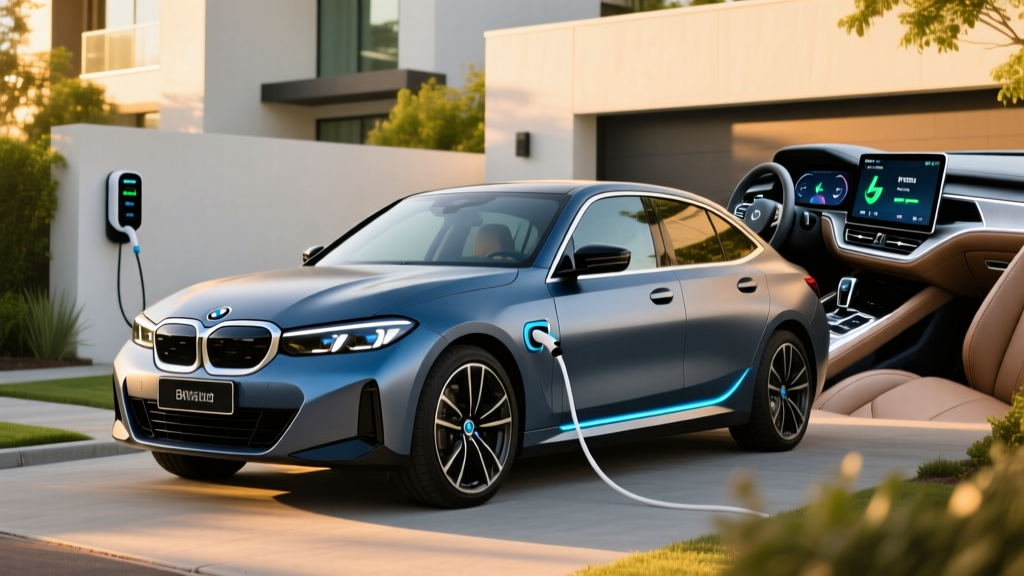
The 2026 BMW i3 marks the return of the i3 nameplate as a fully electric compact sedan built on BMW's Neue Klasse platform. Unlike the quirky carbon-fiber hatchback that ended production in 2022, this new i3 is a conventional but premium small sedan aimed squarely at the Tesla Model 3, Hyundai Ioniq 6, and Mercedes CLA EV. With an EPA-estimated range of 210 miles, a 150 kW DC fast-charging capability, and a starting MSRP around $47,000, the new i3 targets urban professionals who want German build quality without stepping up to the larger i4 or i5.
2026 BMW i3 Spec Table
| Specification | Value |
|---|---|
| EPA Range | 210 miles (estimated, RWD base) |
| Battery Capacity | 84 kWh usable (NMC chemistry) |
| Drivetrain | Rear-wheel drive (AWD xDrive optional) |
| Horsepower | 268 hp (RWD) / 335 hp (xDrive) |
| 0-60 mph | 5.9 sec (RWD) / 4.8 sec (xDrive) |
| Max DC Fast Charge | 150 kW (10-80% in ~28 min) |
| Level 2 Home Charging | 11 kW AC (~32 miles/hr) |
| MPGe (combined) | 115 MPGe (estimated) |
| Efficiency | 29 kWh/100 mi |
| Cargo Volume | 14.1 cu ft trunk |
| Rear Legroom | 35.2 inches |
| Base MSRP | $47,200 (eDrive30 RWD) |
| Battery Warranty | 8 years / 100,000 miles |
Range and Efficiency: EPA vs. Real World
Real-World Expectation: 175-190 miles highway at 70+ mph; 150-165 miles in freezing temperatures with cabin heat.
The 2026 i3's 210-mile EPA rating places it mid-pack in the compact luxury EV segment. For context, the Tesla Model 3 RWD delivers 272 miles, while the Hyundai Ioniq 6 SE achieves 361 miles on its Long Range trim. The i3's lower range figure reflects BMW's prioritization of performance and premium materials over maximum efficiency.
In real-world mixed driving, expect 185-200 miles on a full charge during mild weather (50-75°F). Highway cruising above 70 mph drops that to 175-190 miles due to aerodynamic drag. Cold-weather testing in sub-30°F conditions typically yields 150-165 miles, a 25-30% reduction common to NMC lithium-ion packs. The i3 includes a heat pump as standard equipment, which mitigates some winter range loss compared to resistive heating systems.
Efficiency comes in at roughly 29 kWh per 100 miles, translating to 115 MPGe combined. That's less efficient than the Ioniq 6 (24 kWh/100mi, 140 MPGe) but on par with the Mercedes EQB.
Charging Speed: DC Fast and Home Level 2
| Charging Method | Power | Time / Rate |
|---|---|---|
| DC Fast Charge (peak) | 150 kW | 10-80% in ~28 minutes |
| DC Fast Charge (sustained avg) | ~110 kW | 20-80% in ~32 minutes |
| Level 2 Home (240V, 48A) | 11 kW AC | ~32 miles per hour of charging |
| Level 1 (120V, 12A) | 1.4 kW AC | ~4 miles per hour of charging |
The i3's 150 kW peak DC fast-charging rate is adequate but not class-leading. The Hyundai Ioniq 6 peaks at 240 kW (10-80% in 18 minutes), and the Tesla Model 3 hits 170 kW. BMW's 800-volt architecture in larger Neue Klasse models hasn't trickled down to the entry-level i3, which uses a 400-volt system.
The charge curve matters more than peak numbers. The i3 sustains close to 150 kW from 10-40% state of charge, then tapers to ~110 kW through 60%, and drops further to ~75 kW from 70-80%. This means your actual charging session averages around 110-120 kW, adding roughly 140 miles in a 20-minute stop at a 150+ kW Electrify America or EVgo station.
For home charging, the 11 kW onboard charger adds about 32 miles of range per hour on a 48-amp Level 2 circuit. A full 0-100% charge takes approximately 8.5 hours, making overnight replenishment straightforward. Installation of a 48-amp hardwired Level 2 charger typically costs $800-$1,500 including equipment and electrician labor, assuming your electrical panel has sufficient capacity. A panel upgrade to 200 amps can add $1,500-$3,000 if needed.
The i3 uses the North American Charging Standard (NACS) connector, giving access to Tesla Superchargers via native compatibility. BMW transitioned to NACS for all 2025+ models sold in North America.
Performance and Drivetrain
The base i3 eDrive30 sends 268 horsepower to the rear wheels via a single electric motor, achieving 0-60 mph in 5.9 seconds. That's respectable for daily driving but trails the Tesla Model 3 RWD (5.8 sec) and significantly lags the Model 3 Long Range AWD (4.2 sec).
The optional xDrive dual-motor AWD variant bumps output to 335 hp and drops the 0-60 time to 4.8 seconds. This version sacrifices roughly 15 miles of EPA range (estimated 195 miles) and adds $4,000 to the base price.
Driving dynamics are where BMW differentiates. The i3's rear-biased weight distribution, adaptive dampers (standard on xDrive, optional on RWD), and precise steering deliver the engagement BMW is known for. Regenerative braking offers three levels adjustable via paddle shifters, plus an adaptive mode that uses radar and navigation data to optimize regen based on traffic and upcoming stops. One-pedal driving is available but not as aggressive as Tesla or Nissan implementations.
Pricing, Trims, and Federal Tax Credit Eligibility
| Trim | MSRP | Est. After §30D Credit |
|---|---|---|
| eDrive30 (RWD) | $47,200 | $39,700* |
| eDrive30 xDrive (AWD) | $51,200 | $43,700* |
| M Sport (RWD, sport package) | $52,800 | $45,300* |
*Tax credit estimates assume buyer eligibility. Final credit amount depends on battery sourcing compliance, buyer income, and point-of-sale transfer rules.
The 2026 BMW i3 qualifies for partial or full federal tax credit under IRS §30D, but eligibility is complex:
- MSRP Cap: The i3's base price falls under the $55,000 sedan cap for §30D eligibility. Higher trims with options may exceed this threshold.
- Buyer Income Limits: Modified adjusted gross income must not exceed $150,000 (single), $225,000 (head of household), or $300,000 (joint filers).
- Battery Sourcing: The $7,500 credit splits into two $3,750 halves — one for critical minerals sourcing, one for battery component manufacturing. BMW sources NMC cells from Samsung SDI and CATL; 2026 compliance with North American critical-mineral requirements is partial, meaning buyers may qualify for $3,750 rather than the full $7,500.
- Point-of-Sale Transfer: Eligible buyers can transfer the credit to the dealer at purchase, reducing the upfront cost rather than waiting for a tax refund.
For authoritative eligibility details, consult the IRS clean vehicle credits page or a tax professional. State incentives (California's CVRP, Colorado's innovative motor vehicle credit, etc.) may stack on top of federal credits.
Interior, Tech, and Cargo
The i3's cabin uses BMW's latest iDrive 9 infotainment system displayed on a curved 14.9-inch touchscreen merged with a 12.3-inch digital instrument cluster. Wireless Apple CarPlay and Android Auto are standard, along with a head-up display and BMW's Intelligent Personal Assistant voice control.
Driver assistance includes Active Driving Assistant Professional, which bundles adaptive cruise control with stop-and-go, lane-keeping assist, and automatic emergency braking. This is a Level 2 SAE system requiring continuous driver supervision — not autonomous driving. Highway Assistant (hands-off driving up to 85 mph on divided highways) is available as a $2,500 option on xDrive trims, competing with GM's Super Cruise and Ford's BlueCruise.
Cargo space measures 14.1 cubic feet in the trunk, slightly less than the Tesla Model 3's 23 cu ft (including frunk) but adequate for a compact sedan. The i3 lacks a front trunk (frunk) due to power electronics packaging. Rear legroom is 35.2 inches, comfortable for adults on shorter trips but tighter than the Model 3's 35.3 inches or Hyundai Ioniq 6's 37.2 inches.
Notable standard features include heated front seats, power-adjustable steering column, ambient lighting, and a panoramic glass roof. The optional Executive Package ($3,200) adds ventilated seats, heated steering wheel, Harman Kardon audio, and parking assistant with 360-degree cameras.
Warranty and Long-Term Ownership
BMW covers the i3's high-voltage battery for 8 years or 100,000 miles, whichever comes first, guaranteeing at least 70% capacity retention. The powertrain (electric motor, power electronics, reduction gear) shares the same 8-year/100,000-mile coverage. The basic vehicle warranty is 4 years/50,000 miles, with 4 years of unlimited-mileage roadside assistance.
NMC battery chemistry in the i3 is proven technology with predictable degradation curves. Based on data from BMW's i4 and iX models using similar cells, expect 8-12% capacity loss over the first 100,000 miles under normal use. Frequent DC fast charging above 150 kW, consistent 100% state-of-charge storage, and extreme heat exposure accelerate degradation. BMW recommends daily charging to 80-90% for longevity, reserving 100% for long trips.
Battery replacement cost out of warranty is estimated at $12,000-$16,000 for the 84 kWh pack, based on current BMW EV service pricing. However, most owners will never need a full replacement given the 8-year warranty and typical degradation rates.
Pros and Cons
Pros
- Engaging driving dynamics with rear-biased handling
- Premium interior materials and build quality
- Standard heat pump for cold-weather efficiency
- NACS connector for Tesla Supercharger access
- Highway Assistant hands-off driving option
- Strong 8-year/100,000-mile battery warranty
Cons
- 210-mile range trails Model 3 (272 mi) and Ioniq 6 (361 mi)
- 150 kW DC charging slower than Hyundai/Kia 800V platforms
- No front trunk (frunk) for additional cargo
- Higher base price than Tesla Model 3 or Hyundai Ioniq 6
- Partial §30D tax credit eligibility (likely $3,750, not $7,500)
- Rear legroom tighter than some competitors
Who Should Buy the 2026 BMW i3?
Best for: Urban professionals and small households prioritizing driving dynamics, premium materials, and brand cachet over maximum range. The i3 suits daily commutes under 80 miles round-trip with home charging access, weekend trips within 150 miles, and buyers who value BMW's dealer network and resale value.
Consider alternatives if: You need 300+ miles of range for frequent road trips (choose Tesla Model 3 Long Range or Hyundai Ioniq 6), require maximum cargo space (Tesla Model 3 or Model Y), or want the lowest cost per mile of range (Hyundai Ioniq 6 SE at $42,000 for 361 miles).
Towing: The i3 is not rated for towing and lacks a hitch receiver option. For towing needs, consider the Tesla Model Y (3,500 lb capacity) or BMW iX (7,700 lb capacity).
FAQ: Common 2026 BMW i3 Questions
What is the real-world range of the 2026 BMW i3?
Expect 185-200 miles in mixed driving during mild weather, 175-190 miles on the highway at 70+ mph, and 150-165 miles in freezing temperatures. The EPA rates it at 210 miles, but real-world conditions — especially speed, temperature, and terrain — reduce that figure by 10-30%.
How fast does the i3 charge at home and on road trips?
At home on a 48-amp Level 2 charger, the i3 adds about 32 miles of range per hour, fully charging overnight in ~8.5 hours. On DC fast chargers, it peaks at 150 kW (10-80% in ~28 minutes), but sustained average is closer to 110-120 kW due to charge-curve taper above 60% state of charge.
Does the 2026 BMW i3 qualify for the federal EV tax credit?
Partially. The i3's MSRP falls under the $55,000 sedan cap, and income-eligible buyers can likely claim $3,750 (half of the $7,500 maximum) due to partial compliance with critical-minerals sourcing rules. Full $7,500 eligibility depends on BMW's 2026 battery supply chain compliance. Check the fueleconomy.gov tax credit calculator for model-specific eligibility.
Is the BMW i3 worth buying vs. Tesla Model 3 or Hyundai Ioniq 6?
Choose the i3 if you prioritize driving dynamics, interior luxury, and BMW brand prestige over maximum range and charging speed. The Tesla Model 3 offers 272 miles of range, 170 kW charging, and Supercharger network access at a lower base price ($38,990). The Hyundai Ioniq 6 delivers 361 miles and 240 kW charging for $42,000. The i3's advantage is its premium feel, adaptive suspension, and Highway Assistant option — but you pay a $5,000-$8,000 premium for those features.
What are the biggest drawbacks of the 2026 i3?
The i3's 210-mile range is the segment's lowest among non-luxury-brand competitors. Its 150 kW charging speed is adequate but not competitive with 800-volt platforms. The lack of a frunk reduces cargo versatility, and partial tax credit eligibility means you may pay more out-of-pocket than with a Tesla or Hyundai.
How long will the i3 battery last?
BMW warrants the battery for 8 years/100,000 miles at 70% capacity retention. Based on similar NMC cells in the i4 and iX, expect 8-12% degradation over 100,000 miles under normal use. Most owners will see 185-195 miles of range at the 100,000-mile mark, still adequate for daily driving. Avoid frequent 100% charges and extreme heat exposure to maximize longevity.