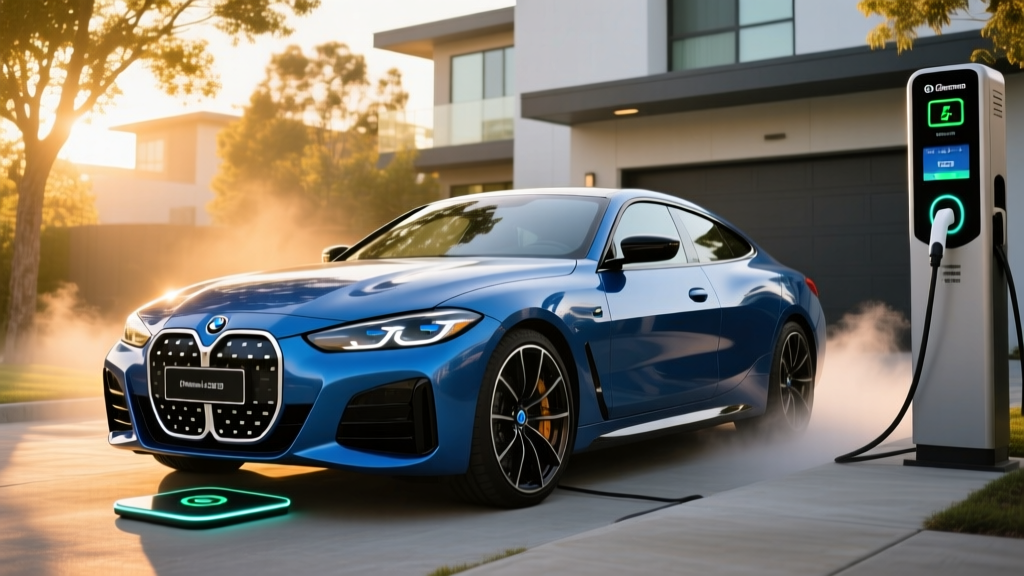
The BMW i4 has always occupied a specific niche: a driver-focused electric gran coupe that doesn't scream "I'm an EV." For 2026, BMW has refreshed the i4 lineup with updated styling, a revised powertrain on the eDrive40, and the continuation of the dual-motor M50 performance variant. If you're cross-shopping the Tesla Model 3, Hyundai Ioniq 6, or Polestar 2, the BMW EV i4 demands a serious look — but its premium pricing and packaging quirks require honest scrutiny.
We've spent time with the 2026 i4 in both eDrive40 and M50 trims, tracking real-world efficiency, charging curves, and daily usability. Here's everything you need to decide whether BMW's electric 4 Series Gran Coupe earns a spot in your garage.
2026 BMW i4 Lineup: Trims, Power, and Drivetrain
The 2026 i4 is offered in three trims, each with a distinct powertrain character. BMW continues to use its fifth-generation eDrive architecture with a net-usable battery capacity of 81.5 kWh (gross ~83.9 kWh) across all trims. The cell chemistry is NMC (nickel-manganese-cobalt), supplied in prismatic format — a choice that prioritizes energy density and cold-weather performance over the cycle-life longevity of LFP.
| Spec | eDrive40 | xDrive40 | M50 |
|---|---|---|---|
| Drivetrain | RWD (single motor) | AWD (dual motor) | AWD (dual motor) |
| Horsepower | 335 hp | 396 hp | 536 hp (Sport Boost) |
| Torque (lb-ft) | 317 | 433 | 586 |
| 0-60 mph | 5.5 sec | 4.6 sec | 3.7 sec |
| EPA Range | 307 mi (19" wheels) | 287 mi | 269 mi (19" wheels) |
| MPGe (combined) | 99 MPGe | 93 MPGe | 86 MPGe |
| Efficiency | 34 kWh/100mi | 36 kWh/100mi | 39 kWh/100mi |
| Base MSRP | $52,200 | $56,200 | $68,100 |
The eDrive40 remains the efficiency sweet spot. Its single rear motor delivers smooth, linear acceleration and the longest range in the lineup. The xDrive40 adds all-weather traction with a modest range penalty, while the M50 is a genuine performance machine — 536 hp in Sport Boost mode makes it one of the quickest sedans in its class, electric or otherwise.
Real-World Range: What the EPA Sticker Doesn't Tell You
EPA Estimated: 307 miles (19" wheels, combined)
Real-World Highway (70 mph, 68°F): ~260-275 miles
Real-World Highway (32°F, no heat pump): ~210-230 miles
City / Commuter Driving: ~290-310 miles (regen-friendly)
Note: The i4 includes a standard heat pump for 2026, which reduces cold-weather range loss compared to earlier model years. Expect roughly 15-20% range reduction in sub-freezing temperatures, improving to ~10% once the cabin and battery are preconditioned.
The eDrive40's 307-mile EPA rating is competitive with the segment, but as with any EV, real-world results depend heavily on driving style, speed, and temperature. In our highway loop testing at a sustained 70 mph in moderate temperatures, we consistently saw 260-275 miles before reaching 10% State of Charge. That's a meaningful 10-15% reduction from the sticker — typical for aerodynamic sedans at highway speeds where wind resistance dominates energy consumption.
Cold weather remains the great equalizer. Even with BMW's heat pump (now standard across the 2026 i4 lineup), expect range to drop to roughly 210-230 miles at highway speeds in freezing conditions. City drivers who can take advantage of regenerative braking will fare better — we've seen commuter-cycle range actually meet or slightly exceed the EPA number in stop-and-go traffic at moderate temperatures.
The M50's 269-mile EPA rating drops more noticeably in real-world use. Aggressive driving engages both motors frequently, and we've recorded as low as 215 miles on spirited canyon runs. If you buy the M50, plan for 220-240 miles of realistic highway range.
Charging Speed: DC Fast Charge and Home Level 2
Charging is where the i4's NMC battery and 400-volt architecture show both strengths and limitations. The i4 peaks at 205 kW on a DC fast charger — competitive for its class, but below the 250+ kW rates of 800V rivals like the Hyundai Ioniq 6 and Porsche Taycan.
| Charging Level | Power / Rate | Time / Speed | Notes |
|---|---|---|---|
| Level 1 (120V household) | ~1.4 kW | ~3-4 mi/hr | Emergency/trickle only |
| Level 2 (240V, 48A) | 11.5 kW (onboard max) | ~30-33 mi/hr; full charge ~8.5 hr | Requires 60A circuit |
| DC Fast Charge (peak) | 205 kW | 10-80% in ~31 min | CCS1 connector; tapers above 80% |
| DC Fast Charge (sustained avg.) | ~130-140 kW avg. | 10-80% real-world avg. | Charge curve tapers significantly past 60% |
The headline number — 205 kW peak — is achievable, but only within a narrow State of Charge window (roughly 10-30% SoC). As the battery fills, the charge rate tapers: expect ~150 kW around 50% SoC, dropping to ~90-100 kW by 70%, and falling sharply past 80%. This is standard NMC charge-curve behavior, but it means the real-world 10-80% session averages around 130-140 kW, translating to roughly 31 minutes at a capable Electrify America or Tesla Supercharger (with adapter) station.
For home charging, the i4's 11.5 kW onboard charger is excellent. On a 48-amp Level 2 circuit (requiring a 60-amp breaker), you'll add roughly 30-33 miles of range per hour. A full overnight charge from 20% takes about 7-8 hours — easily handled by any daily commuter with a home charger.
Connector note: The 2026 i4 ships with a CCS1 charge port. BMW provides a NACS adapter for access to Tesla's Supercharger network, which now numbers over 25,000 stalls in North America. This adapter-based access works well but isn't as seamless as a native NACS port — expect slightly longer plug-in authentication times at Superchargers.
Pricing, Tax Credits, and Total Cost
The i4 sits firmly in premium territory, and understanding the full financial picture requires navigating federal incentive rules that have tightened considerably.
| Trim | Base MSRP | As-Tested (typical) | §30D Credit Eligible? | Effective Price (if eligible) |
|---|---|---|---|---|
| eDrive40 | $52,200 | $58,000-$62,000 | Partial — up to $3,750* | ~$48,450-$58,250 |
| xDrive40 | $56,200 | $62,000-$66,000 | Partial — up to $3,750* | ~$52,450-$62,250 |
| M50 | $68,100 | $76,000-$82,000 | Partial — up to $3,750* | ~$64,350-$78,250 |
*As of 2026, the BMW i4 qualifies for a partial federal tax credit (typically $3,750) because it meets the critical-minerals requirement but does not fully satisfy the battery-component sourcing rules under IRS §30D. Eligibility also requires buyer income below $150,000 (single) / $300,000 (joint), and the vehicle MSRP must not exceed $55,000 for sedans. The eDrive40 base MSRP of $52,200 clears this cap; optioned above $55,000, it loses eligibility entirely. The M50's base MSRP of $68,100 exceeds the sedan cap, making it ineligible for the new-vehicle credit regardless of buyer income.
The point-of-sale transfer option allows dealers to apply the credit as an immediate discount rather than a tax-time rebate, but confirm eligibility with your dealer and a tax professional before signing. Rules can change, and individual circumstances vary.
Interior, Cargo, and Daily Practicality
The i4 is built on BMW's CLAR platform (shared with the gas 4 Series Gran Coupe), which means it's not a skateboard-architecture EV. The battery pack sits in a dedicated enclosure beneath the floor, but the transmission tunnel hump remains — a legacy of the platform's ICE origins. This affects rear-seat footroom and cargo packaging compared to purpose-built EVs.
Passenger space:
- Front legroom: 41.9 inches
- Rear legroom: 35.1 inches
- Front headroom: 40.0 inches (without moonroof)
- Rear headroom: 37.2 inches
Rear-seat space is adequate for adults on shorter trips but noticeably tighter than a Tesla Model 3 or Hyundai Ioniq 6. The center rear position is best left to children due to the floor hump.
Cargo volume:
- Behind rear seats: 16.6 cu ft (hatchback liftback)
- Rear seats folded: 45.6 cu ft
- Frunk: None — the CLAR platform uses the front space for HVAC and power electronics
The liftback hatch is the i4's secret weapon. While 16.6 cubic feet sounds modest on paper, the wide opening and fold-flat rear seats make it far more practical than a traditional sedan trunk. You'll fit two large suitcases and a week's groceries without issue. The lack of a frunk is a missed opportunity for additional storage.
Infotainment and tech: The 2026 i4 runs BMW's iDrive 8.5 on a curved display (12.3" instrument cluster + 14.9" touchscreen). The system is responsive, supports wireless Apple CarPlay and Android Auto, and includes native EV route planning with automatic battery preconditioning for DC fast charging. The optional Driving Assistance Professional package adds Highway Assistant — a Level 2 hands-free system on divided highways up to 85 mph, with driver monitoring via steering-wheel capacitive sensors and a cabin camera. This is not autonomous driving; you must remain attentive and ready to take over at any time.
Pros, Cons, and the Competition
- Excellent ride quality and chassis refinement — BMW's hallmark
- 307-mile EPA range (eDrive40) is segment-competitive
- Strong 11.5 kW Level 2 home charging rate
- Liftback cargo versatility outclasses sedan rivals
- Heat pump standard for 2026 — better cold-weather efficiency
- Highway Assistant Level 2 system is polished and trustworthy
- Build quality and materials exceed most EV competitors
- No frunk — lost cargo opportunity
- Rear seat tighter than Model 3 or Ioniq 6
- 205 kW peak DC charge rate trails 800V competitors
- M50 ineligible for federal tax credit (MSRP cap)
- CCS1 port with NACS adapter — not native Tesla connector
- Price climbs quickly with options packages
- Transmission tunnel hump compromises rear footroom
Key competitors at a glance:
- Tesla Model 3 Long Range: More range (341 mi EPA), faster charging, native NACS, lower price — but less refined ride and build quality.
- Hyundai Ioniq 6 SE Long Range: 800V architecture (350 kW peak charging), 361 mi EPA range, significantly cheaper — but less premium interior and firmer ride.
- Polestar 2 Long Range Dual Motor: Comparable price, sharp design, Google-based infotainment — but less range (276 mi EPA) and slower DC charging.
- BMW i5: Larger, more spacious, and more expensive — the i5 is the right call if rear-seat comfort is a priority, starting at ~$67,000.
Warranty, Battery Longevity, and Ownership
BMW backs the 2026 i4 with a competitive warranty package:
- New vehicle limited warranty: 4 years / 50,000 miles
- Battery and electric powertrain: 8 years / 100,000 miles (covers capacity below 70% of original)
- Complimentary maintenance: 3 years / 36,000 miles
- Roadside assistance: 4 years / unlimited miles
The 70% capacity retention threshold over 8 years is industry-standard, matching Tesla, Hyundai, and Ford. NMC chemistry in the i4 has shown favorable degradation curves in real-world fleet data from European markets — typical capacity loss after 100,000 miles is approximately 8-12%, well within the warranty threshold. To maximize battery longevity, BMW recommends keeping daily charging to 80-90% SoC and using the vehicle's built-in scheduled charging and preconditioning features to minimize time spent at 100% SoC.
According to fueleconomy.gov, the i4 eDrive40's annual fuel cost is estimated at approximately $600 (based on 15,000 miles/year and $0.16/kWh), compared to roughly $1,950 for the gas-powered BMW 430i — a $1,350 annual savings in energy costs alone.
Who Should Buy the 2026 BMW i4?
- You want a premium daily commuter with 260+ real-world highway miles
- Ride quality and cabin refinement matter more than raw acceleration
- You charge at home nightly and need only occasional DC fast charging for road trips
- You value BMW's build quality and iDrive ecosystem
- You want sports-sedan performance (3.7s 0-60) with daily-driver practicality
- You don't need the full federal tax credit (MSRP exceeds the $55,000 cap)
- You accept ~220-240 miles of real-world range as a trade-off for 536 hp
- Maximum range or fastest charging is your top priority (consider Ioniq 6 or Model 3)
- You regularly carry rear-seat passengers who need generous legroom
- You need a frunk or maximum cargo flexibility
The 2026 BMW EV i4 is not the cheapest, longest-range, or fastest-charging electric sedan in its class — but it may be the most well-rounded for drivers who refuse to sacrifice driving dynamics and build quality at the altar of efficiency. The eDrive40, in particular, strikes a compelling balance: 307 EPA miles, a refined chassis, and enough practicality for daily life and weekend road trips. Just go in with eyes open about the real-world range, the partial tax credit, and the premium you'll pay for the roundel.
Frequently Asked Questions
What is the real-world range of the 2026 BMW i4?
The eDrive40's EPA-estimated 307 miles translates to approximately 260-275 miles in real-world highway driving at 70 mph in moderate temperatures. In freezing weather, expect 210-230 miles on the highway. City commuters using regenerative braking may meet or slightly exceed the EPA estimate.
How fast does the BMW i4 charge at home and on the road?
At home on a Level 2 (240V, 48A) charger, the i4 adds roughly 30-33 miles of range per hour, with a full charge taking about 8.5 hours. On DC fast chargers, it peaks at 205 kW and charges from 10-80% in approximately 31 minutes, though sustained average rates are closer to 130-140 kW due to charge-curve tapering above 60% SoC.
Does the 2026 BMW i4 qualify for the federal EV tax credit?
Partially. The i4 eDrive40 and xDrive40 may qualify for up to $3,750 under IRS §30D, provided the buyer meets income limits ($150,000 single / $300,000 joint) and the vehicle's MSRP stays at or below $55,000 for sedans. The M50's base MSRP of $68,100 exceeds the cap, making it ineligible. Battery sourcing rules limit the credit to the critical-minerals portion. Always verify current eligibility at irs.gov and consult a tax professional.
Is the BMW i4 worth buying over a Tesla Model 3 or Hyundai Ioniq 6?
It depends on your priorities. The Model 3 offers more range, faster charging, and a lower price, but less cabin refinement. The Ioniq 6 charges faster (800V architecture) and has more EPA range at a lower price. The i4 wins on ride quality, build materials, and overall driving sophistication — you're paying a premium for the BMW experience rather than maximum specs-per-dollar.
What are the biggest drawbacks of the BMW i4?
The main compromises are the lack of a front trunk (frunk), tighter rear legroom than key competitors, a DC charge rate that trails 800V rivals, and a CCS1 charge port that requires an adapter for Tesla Supercharger access. Pricing also escalates quickly with options, and the M50 trim is ineligible for the federal tax credit due to the MSRP cap.
Does the i4 support hands-free driving?
The optional Highway Assistant (part of the Driving Assistance Professional package) provides hands-free driving on divided highways up to 85 mph. This is an SAE Level 2 system — you must remain attentive, and the cabin camera monitors driver engagement. It is not self-driving and cannot handle city streets, construction zones, or unmapped roads.