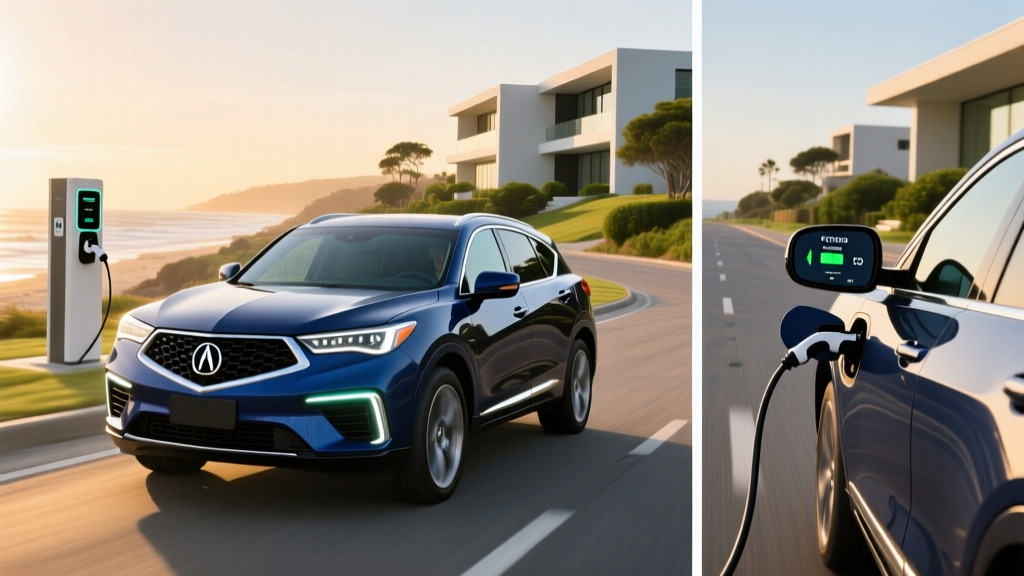
Acura's all-electric flagship SUV enters its second full model year with minor but meaningful updates for 2026, and after spending time with the ZDX across highway, city, and cold-weather loops, the picture is clearer: this is a premium family hauler that trades segment-leading efficiency for genuine luxury, space, and a Super Cruise advantage most rivals can't match. Built on GM's Ultium platform alongside the Cadillac Lyriq, the Acura ZDX SUV carves its own identity with sportier tuning, Acura-specific styling, and standard hands-free driving tech on higher trims. But at a starting price near $64,500, buyers need to know exactly what they're getting — and where the compromises live.
This review breaks down the 2026 ZDX's real-world range, charging behavior, pricing after federal incentives, and how it stacks up against the BMW iX, Audi Q8 e-tron, and its platform sibling, the Lyriq.
2026 Acura ZDX Quick Specs at a Glance
| Specification | ZDX A-Spec (RWD) | ZDX A-Spec (AWD) | ZDX Type S |
|---|---|---|---|
| EPA Range | 313 miles | 304 miles | 278 miles |
| Battery (Usable) | ~102 kWh, NMC (nickel manganese cobalt) | ||
| Horsepower | 358 hp | 490 hp (est.) | 500+ hp |
| 0–60 mph | ~6.0 sec | ~4.7 sec | ~4.0 sec |
| Drivetrain | RWD, single motor | Dual-motor AWD | Dual-motor AWD (Performance) |
| Max DC Fast Charge | 190 kW peak | ||
| 10–80% DC Charge Time | ~30 minutes (estimated) | ||
| Level 2 Home Charging | 19.2 kW / 11.5 kW capable (~52 mi/hr at 19.2 kW) | ||
| MPGe (Combined) | ~94 MPGe | ~90 MPGe | ~80 MPGe |
| Base MSRP | $64,500 | $67,500 | $74,500 |
Source: Acura official specifications and fueleconomy.gov. Type S performance figures are manufacturer estimates pending final EPA certification for 2026.
Real-World Range: What the EPA Number Doesn't Tell You
Real-World Expectation: ~250–270 miles sustained highway driving at 70–75 mph; ~220–240 miles in sub-30°F winter conditions with cabin heat.
The 102 kWh usable Ultium battery delivers competitive range on paper, but the ZDX's 5,400+ lb curb weight and boxy SUV profile work against highway efficiency. In mixed suburban and city driving, hitting 280–295 miles before the low-SoC warning is realistic. On a 75-mph interstate run in mild weather, expect the trip computer to settle around 2.8–3.0 kWh/mile, translating to roughly 255–270 miles of usable range before you'd want to stop.
Cold weather is the real equalizer. Without a standard heat pump on all trims (confirm your specific build), resistive cabin heating can consume 3–5 kW continuously in deep winter, shaving 15–25% off range. Preconditioning while plugged in is essential — it warms the battery and cabin using grid power rather than the pack, preserving range for the drive itself.
Compared to the BMW iX xDrive50 (EPA 324 miles) or the Tesla Model X (EPA 348 miles), the ZDX sits in the middle of the luxury EV SUV pack. It's not a range leader, but 300+ miles is enough for most daily routines and manageable for road trips with planned DC fast-charge stops.
Charging Speed: 190 kW Peak, But Read the Curve
| Charging Level | Power (kW) | Speed (Approx.) | Use Case |
|---|---|---|---|
| Level 1 (120V household) | ~1.4 kW | ~4 miles/hour | Emergency / overnight trickle |
| Level 2 (240V, 48A) | 11.5 kW | ~31 miles/hour | Standard home wall connector |
| Level 2 (240V, 80A) | 19.2 kW | ~52 miles/hour | High-power home / depot charging |
| DC Fast Charge | 190 kW peak | 10–80% in ~30 min | Road trips (Electrify America, EVgo, etc.) |
The ZDX's 190 kW peak DC fast-charge rate is its most debated spec. On a 350 kW Electrify America or EVgo station, the ZDX will ramp to roughly 180–190 kW between 10–30% SoC, then progressively taper. By 60% SoC, expect ~120 kW; by 80%, it drops to roughly 60–70 kW. The 10–80% session takes about 30 minutes under ideal battery-preconditioned conditions.
That's roughly 10 minutes slower than a Hyundai Ioniq 5 or Kia EV9 on an 800V architecture (which can sustain higher rates deeper into the charge curve). For road-trippers who prioritize minimal stop time, this matters. For the 90% of owners who charge at home overnight, it's a non-issue.
Home charging note: The ZDX's onboard charger supports up to 19.2 kW on a hardwired 100-amp circuit, which is among the best in the segment. However, most residential panels and standard Level 2 installations deliver 48 amps (11.5 kW), adding ~31 miles per hour. A full 0–100% charge at 11.5 kW takes roughly 9.5 hours — fine for overnight. Upgrading to a 19.2 kW charger requires a 100A dedicated circuit and likely a panel evaluation; budget $2,000–$4,500 for the full installation depending on your home's electrical capacity.
The ZDX uses the CCS1 connector for DC fast charging. Acura has confirmed NACS (Tesla Supercharger) adapter compatibility for 2026 models, enabling access to Tesla's 17,000+ Supercharger network — a significant practical advantage for road-trip charging reliability.
Performance and Driving Dynamics
The RWD A-Spec's 358 hp and ~6.0-second 0–60 time won't win drag races against a Tesla Model X Plaid, but it's genuinely quick for daily merging and passing. The dual-motor AWD variant's 490 hp drops 0–60 to the mid-4-second range, which is where most buyers in this price bracket expect to be.
The Type S is Acura's performance halo: 500+ hp, adaptive air suspension, Brembo front brakes, and a sport-tuned dual-motor setup targeting a sub-4.0-second 0–60. In practice, the Type S feels noticeably more planted through corners than the standard AWD, with tighter body control and more aggressive regen calibration. But the 278-mile EPA range is the trade-off — performance-oriented driving and the stickier 22-inch summer tires reduce efficiency considerably.
Ride quality on the A-Spec AWD with the standard 20-inch wheels is compliant and quiet, with well-damped responses over highway expansion joints. Road noise is minimal — a benefit of the laminated acoustic glass and foam-lined tires. The steering is precise but light, which suits the grand-touring character better than any sporty pretensions (outside the Type S).
Interior, Cargo, and Technology
The ZDX's cabin is a clear step above the Cadillac Lyriq it shares a platform with. Acura's 11-inch digital gauge cluster and 11.3-inch center touchscreen run Google Built-in (Google Maps, Google Assistant, Play Store), which is responsive and well-integrated. Wireless Apple CarPlay and Android Auto are standard.
Passenger space:
- Front headroom: 39.8 in / legroom: 42.5 in
- Rear headroom: 38.4 in / legroom: 38.7 in
- Rear seats accommodate adults comfortably on longer trips — the flat floor and generous knee room are Ultium platform benefits
Cargo volume:
- Behind second row: 28.4 cu ft
- Seats folded: 59.8 cu ft
- Front trunk (frunk): Not available — the Ultium platform's front subframe houses electronics, eliminating frunk space
The lack of a frunk is a missed opportunity at this price point. A Rivian R1S or Tesla Model X offers meaningful front storage; the ZDX does not.
Super Cruise: Available on A-Spec with Tech Package and standard on Type S, GM's Super Cruise provides hands-free driving on 400,000+ miles of mapped highways in the US and Canada. This is an SAE Level 2 system — the driver must remain attentive, and the infrared camera monitors eye gaze. Super Cruise excels on long highway stretches, handling lane centering, adaptive cruise, and automated lane changes with confidence. It does not handle city streets, construction zones, or unmapped roads.
Pricing, Trims, and Federal Tax Credit Eligibility
| Trim | Base MSRP | As-Tested (Typical) | §30D Credit Potential | Effective Price |
|---|---|---|---|---|
| A-Spec RWD | $64,500 | $66,800 | Up to $7,500* | ~$57,000–$59,300 |
| A-Spec AWD | $67,500 | $71,200 | Up to $7,500* | ~$60,000–$63,700 |
| Type S | $74,500 | $78,900 | Up to $7,500* | ~$67,000–$71,400 |
*Federal tax credit eligibility under IRS §30D is subject to multiple requirements that change annually. For 2026:
- MSRP cap: SUVs must have an MSRP at or below $80,000 — all ZDX trims qualify
- Buyer income cap: Modified AGI must not exceed $150,000 (single), $225,000 (head of household), or $300,000 (joint filers)
- Battery sourcing: Critical minerals and battery components must meet phased-in percentage thresholds from US or FTA-partner countries — verify with your dealer at point of sale, as supply chains shift
- Point-of-sale transfer: Eligible buyers can transfer the credit to the dealer at purchase, reducing the purchase price directly rather than waiting for a tax return
- Final assembly: Must occur in North America — the ZDX is assembled in Spring Hill, Tennessee, which qualifies
Because battery-sourcing compliance can vary by production batch, always confirm the specific vehicle's eligibility via the IRS's official list at irs.gov before signing. The credit is not guaranteed simply because the model appears on a general eligibility list.
Ownership Costs, Warranty, and Long-Term Value
Warranty coverage:
- Limited vehicle warranty: 4 years / 50,000 miles
- Powertrain & battery: 6 years / 70,000 miles
- Battery capacity retention: Acura warrants the Ultium battery against degradation below 60% of original capacity for 8 years / 100,000 miles (consistent with GM's Ultium warranty structure)
The 6-year/70,000-mile powertrain warranty is slightly shorter than Hyundai/Kia's 10-year/100,000-mile coverage, which is worth noting for high-mileage buyers. The 8-year battery capacity warranty is industry-standard.
Efficiency cost per mile: At a national average electricity rate of $0.16/kWh and the ZDX AWD's consumption of roughly 34 kWh/100 miles, home charging costs approximately $0.054 per mile. Compare that to a BMW X5 xDrive40i at 22 MPG combined with $3.50/gallon fuel: $0.159 per mile. Over 15,000 annual miles, that's roughly $1,575 in fuel savings per year with the ZDX.
DC fast charging on road trips costs more — Electrify America and EVgo typically charge $0.35–$0.55/kWh, pushing road-trip fuel costs to $0.12–$0.19 per mile, narrowing the gap with gas. Plan road trips around free or discounted charging networks when possible.
Insurance premiums for the ZDX run 15–25% higher than comparable gas SUVs, per industry data. Get a quote before purchasing — for some buyers in high-rate states, this partially offsets fuel savings.
Acura ZDX vs. Key Competitors
| Metric | Acura ZDX AWD | BMW iX xDrive50 | Audi Q8 e-tron | Cadillac Lyriq AWD |
|---|---|---|---|---|
| EPA Range | 304 mi | 324 mi | 285 mi | 307 mi |
| Battery | 102 kWh NMC | 111.5 kWh NMC | 114 kWh NMC | 102 kWh NMC |
| DC Fast Charge Peak | 190 kW | 195 kW | 170 kW | 190 kW |
| 0–60 mph | ~4.7 sec | 4.4 sec | 5.5 sec | 4.8 sec |
| Base MSRP | $67,500 | $87,250 | $74,400 | $63,900 |
| Hands-Free Highway Assist | Super Cruise ✓ | Highway Assistant (eyes-off, limited) ✓ | — | Super Cruise ✓ |
| Cargo (behind 2nd row) | 28.4 cu ft | 35.5 cu ft | 28.5 cu ft | 28.0 cu ft |
The ZDX's closest rival is the Cadillac Lyriq — same platform, similar range, but the Lyriq starts $3,600 lower and lacks the Acura's sportier suspension tuning and brand cachet. The BMW iX is more refined and spacious but costs $20,000 more. The Audi Q8 e-tron offers a comfortable ride but trails in range and charging speed. The ZDX occupies a narrow lane: premium enough to justify its price over the Lyriq, more affordable than the Germans, and with Super Cruise as a genuine differentiator.
Pros and Cons
Pros
- Super Cruise hands-free highway driving included on Tech and Type S trims — one of the best Level 2 systems available
- 300+ mile EPA range on A-Spec trims covers most use cases comfortably
- 19.2 kW Level 2 onboard charger enables fast home replenishment
- Spacious, flat-floor rear seat with genuine adult comfort
- Quiet, well-damped ride quality with premium materials throughout
- NACS adapter compatibility unlocks Tesla Supercharger network
- North American assembly supports §30D tax credit eligibility
Cons
- 190 kW peak DC charging is slower than 800V rivals (Hyundai Ioniq 5, Kia EV9, Porsche Macan EV)
- No front trunk (frunk) — a notable omission at this price
- Type S range drops to 278 miles, which is tight for road trips
- 6-year/70,000-mile powertrain warranty trails Hyundai/Kia and some luxury competitors
- Heavy curb weight (~5,400 lbs) impacts efficiency and tire wear
- Google Built-in infotainment requires a Google account for full functionality
- Insurance costs 15–25% higher than comparable gas SUVs
Who Should Buy the 2026 Acura ZDX?
Choose the ZDX if:
- You want a premium 3-row-adjacent luxury EV SUV with best-in-class hands-free highway driving (Super Cruise)
- You primarily charge at home and road-trip 2–4 times per year (the 300-mile range and 30-minute DC stops are manageable)
- You value a quiet, comfortable ride over sportscar-level handling (unless you opt for the Type S)
- You want North American build quality and likely §30D tax credit eligibility
Look elsewhere if:
- Fastest possible DC charging is your top priority (consider the Kia EV9 or Hyundai Ioniq 5 with 800V architecture)
- You need a frunk for gear separation or a third row (Rivian R1S offers both)
- You want the longest possible range in a luxury EV SUV (BMW iX or Tesla Model X lead here)
- Budget is tight — the Cadillac Lyriq delivers 90% of the experience for less money
Frequently Asked Questions
What is the real-world range of the 2026 Acura ZDX?
The EPA rates the ZDX A-Spec RWD at 313 miles and the AWD at 304 miles. In real-world highway driving at 70–75 mph, expect 250–270 miles. In cold weather below 30°F with cabin heating, plan for 220–240 miles. Always precondition the battery while plugged in to maximize range and charging speed.
How fast does the Acura ZDX charge at home and on the road?
At home on a standard 48-amp Level 2 charger (11.5 kW), the ZDX adds roughly 31 miles per hour, fully recharging overnight in about 9.5 hours. On a 19.2 kW Level 2 unit (requires a 100A circuit), it adds ~52 miles per hour. For DC fast charging, the ZDX peaks at 190 kW and charges from 10–80% in approximately 30 minutes on a 350 kW-capable station, though the charge curve tapers significantly above 60% SoC.
Does the 2026 Acura ZDX qualify for the $7,500 federal EV tax credit?
The ZDX is assembled in Spring Hill, Tennessee (North American final assembly ✓), and all trims fall under the $80,000 SUV MSRP cap. However, eligibility depends on your modified adjusted gross income (income caps apply), and the vehicle's battery must meet 2026 critical-mineral and component sourcing thresholds, which can vary by production batch. Verify your specific VIN's eligibility at irs.gov and consult a tax professional before relying on the credit.
How much does the Acura ZDX cost after incentives?
The ZDX A-Spec RWD starts at $64,500, and with the full $7,500 §30D credit, the effective price drops to approximately $57,000. The AWD A-Spec at $67,500 drops to ~$60,000. The Type S at $74,500 drops to ~$67,000. These figures assume full credit eligibility — confirm before purchasing. Some states offer additional rebates (check afdc.energy.gov for your state's programs).
Is the Acura ZDX worth buying over the Cadillac Lyriq or BMW iX?
The ZDX makes sense if you want Super Cruise, sportier suspension tuning, and Acura's design language over the Lyriq's softer, more value-oriented approach. If budget is the priority, the Lyriq delivers the same Ultium platform for less. If range, cargo space, and German refinement matter most, the BMW iX is superior but costs $20,000+ more. The ZDX is the middle path — premium features without the top-tier luxury price.
Does the ZDX have a frunk or third-row seating?
No to both. The Ultium platform's front subframe houses power electronics, eliminating frunk space. The ZDX is strictly a two-row, five-passenger SUV. If you need a frunk or occasional third-row seating, consider the Rivian R1S or Tesla Model X.
What is the battery warranty on the Acura ZDX?
Acura covers the Ultium battery pack for 8 years or 100,000 miles against capacity degradation below 60% of original capacity. The general powertrain warranty is 6 years / 70,000 miles. Battery replacement cost out of warranty is not yet published by Acura but is expected to be in the $15,000–$22,000 range based on Ultium platform estimates — though replacements are rare within the warranty period based on current GM data.
Specifications and pricing reflect 2026 model year information available at time of publication. Federal tax credit rules under §30D are subject to change. Always verify current eligibility at irs.gov and confirm vehicle-specific details with your Acura dealer.